
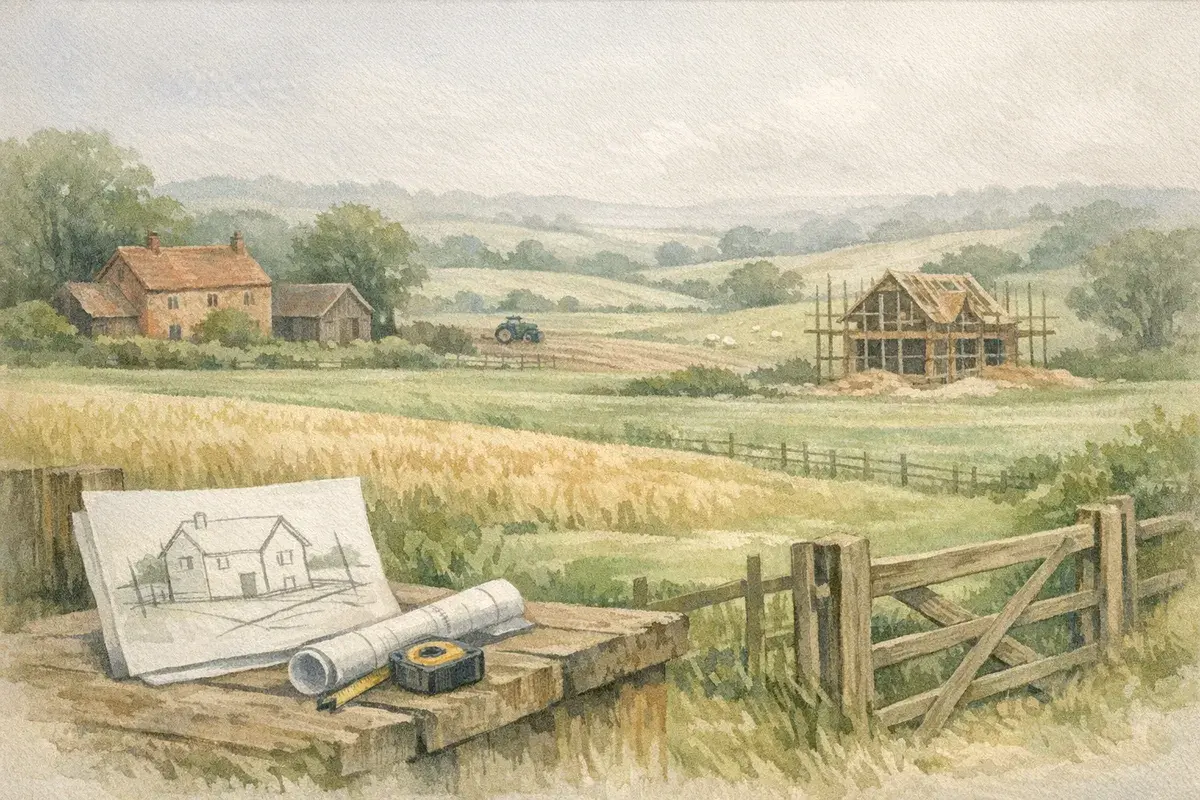
Can you build a house on agricultural land uk? Sometimes, yes, but only with the right planning route, evidence, and a fair wind from the local planning authority. For most buyers, the answer depends on whether the site can prove an agricultural need, meet local policy, or qualify under a rare exception.
The short version is this: agricultural land does not stop development, but it does make it much harder. If youre hoping to turn a field into a family home, youll need to understand planning permission, local plan policy, access, drainage, utilities, and often a strong case that the dwelling is necessary for farming or another rural use.
That matters because the difference between a workable site and a dead end can be huge, especially in counties where land values, planning appetite, and infrastructure vary sharply. Wed argue that the smartest approach is to treat the land as a planning project first and a property purchase second.
What Agricultural Land Means For House Building
Agricultural land is land used mainly for farming, including arable crops, pasture, orchards, and horticulture. It is not a planning class that automatically bans homes, but it usually sits outside settlement boundaries and is controlled by strict rural policy.
That distinction is crucial. A field with a grass ley in Somerset or a block of arable land in Lincolnshire may look developable, but local policy will usually expect new housing to be directed to towns, villages, or previously developed land first.
Why Planning Status Matters More Than Land Use
The legal question is not simply whether the land is agricultural. It is whether a dwelling is acceptable under the local development plan, the National Planning Policy Framework, and any site-specific constraints such as flood risk or listed-building setting.
In plain English, you can own a perfectly ordinary productive field and still be refused a house because the council views it as open countryside. Thats why agricultural land buyers in counties like Devon, Northumberland, Wiltshire, and Herefordshire should always check policy before getting carried away by a postcard view.
- Agricultural land: Land used for farming or related rural production.
- Planning permission: Formal consent from the local authority to build.
- Rural exception: A policy route that can allow limited housing in the countryside.
Best And Worst-Case Scenarios
At the best end, the land sits adjacent to a village, has services nearby, and can support a modest rural dwelling through a robust planning case. At the worst end, it is isolated countryside with no access, no services, and no policy support, which is where many hopeful schemes fall apart.
For estate agents, that gap in outcomes is why agricultural land marketing needs care. Two parcels of the same acreage can have wildly different prospects depending on access, slope, ecology, and whether the site sits near an existing settlement edge.
When You Can Get Permission For A House
So, can you build a house on agricultural land uk in practice? Yes, but usually only where one of a handful of routes applies. The most common is a genuine agricultural or rural need, though some sites may also support a rural worker dwelling, replacement dwelling, infill plot, or exception housing scheme.
These routes are not loopholes. Councils test them hard, and they will expect clear evidence. A vague plan to 'live near the land' will not get far (and rightly so).
Agricultural Worker Dwellings
This is the classic route for farmers. If a new house is needed to support a full-time agricultural enterprise, the applicant must usually prove functional need, financial viability, and that no suitable alternative dwelling is available nearby.
In counties with strong livestock or specialist horticulture sectors, such as Cornwall, Cumbria, Norfolk, and Shropshire, this can be relevant where stock welfare, crop security, or seasonal labour demands justify a presence on site. Councils will still scrutinise whether the business is established and sustainable.
Rural Exception And Local Plan Policies
Some councils allow limited affordable housing on rural exception sites where there is clear local need and the scheme is tied to affordability in perpetuity. That does not mean a market-value house for open sale, but it can make a modest rural scheme workable.
Other sites may be accepted through local plan policies if they are adjacent to a settlement and otherwise meet design and sustainability tests. In parts of East Anglia and the South West, proximity to services and transport links can make a bigger difference than the land use label alone.
Replacement And Conversion Routes
If there is already a lawful dwelling, or a building capable of conversion, the planning position may be easier. Replacement dwellings and barn conversions on agricultural land can succeed where the existing structure is robust and the design keeps to rural character.
That said, councils often resist over-sized rebuilds or speculative conversions that look more like new-builds in disguise. If the roof, walls, and structural form are too limited, the case weakens quickly.
The Planning Tests Councils Apply
Local planning authorities do not decide these applications on instinct. They apply policy tests, site evidence, and professional reports, then weigh the benefits against countryside harm. That process can feel slow, but there is a logic to it.
Understanding those tests helps buyers avoid expensive mistakes. It also helps agents set expectations early, which is especially important where a sale includes hope value rather than consented development value.
| Date Reference | Typical Test | What Council Looks For | Practical Impact |
|---|---|---|---|
| As of June/2026 | Need | Proof that a house is necessary for farming operations | Critical for agricultural worker dwellings |
| As of June/2026 | Location | Proximity to settlement, services, and access roads | Stronger in edge-of-village sites |
| As of June/2026 | Landscape impact | Visibility, character, and countryside harm | Can sink isolated sites |
| As of June/2026 | Technical feasibility | Drainage, highways, ecology, and utilities | Often the hidden deal-breaker |
Functional Need And Financial Viability
For a farm dwelling, councils typically want evidence that someone needs to live on site to manage stock, respond to emergencies, or run a specialist operation efficiently. They also want to see that the farm business can support the dwelling without relying on unrealistic future profits.
That means business accounts, stocking records, cropping plans, and independent agricultural appraisal can matter. A modest dairy unit in Cheshire or a poultry enterprise in Kent may have a stronger case than a hobby holding with a few ponies and a dream.
Highways, Flood Risk, And Utilities
Even where principle looks promising, practical constraints still bite. A poor access onto a fast county road, a site in flood zone 3, or a lack of foul drainage and water supply can stop a scheme or force costly mitigation.
In low-lying marshland areas of Somerset, Lincolnshire, and parts of Lancashire, flood risk can be decisive. In more remote upland areas, the issue may be whether the lane can take construction traffic and emergency vehicles without major upgrade works.
Costs, Values, And What Changes The Equation
Buying agricultural land with a view to building a house is rarely cheap once planning, surveys, and infrastructure are added. The land itself may look affordable compared with residential plots, but the real cost is often the route to consent.
As of June/2026, credible UK farmland values still vary sharply by region and land quality. Good arable land in eastern counties often commands a premium, while marginal grazing land in hillier areas may trade for less, yet planning hope value can distort pricing where a dwelling prospect is perceived.
Typical Cost Drivers
The biggest hidden costs are usually planning consultants, ecology surveys, drainage testing, access design, and legal work on title and rights of way. Where a new access is needed, highways drawings and visibility splays can add materially to the budget.
Then there is abnormal ground. A former field in Sussex may need archaeological work, while a site in Gloucestershire might need biodiversity mitigation, tree protection, or a package treatment plant because mains drainage is absent.
- Planning reports: Professional evidence supporting the application.
- Abnormal costs: Site-specific expenses beyond normal build costs.
- Hope value: Extra value due to possible future development.
Regional Price And Risk Differences
County context matters. In Surrey, Oxfordshire, and parts of Berkshire, the bar is often high because development pressure is intense and councils protect countryside setting closely. In more rural parts of Wales, Northumberland, or Devon, the policy test may still be strict, but the type of rural need accepted can differ.
Wed suggest focusing on the local plan rather than headlines. A site that looks viable in one district can be a non-starter in the next parish, even when the fields are only a few miles apart.
How Buyers Should Assess A Site Before They Commit
If you are asking can you build a house on agricultural land uk, due diligence is the difference between informed risk and blind hope. Before exchange, you need to know what the land can legally and practically support.
The best buyers treat this as a staged exercise. First the planning likelyhood, then the technical feasibility, then the price. Do that in the wrong order and you can end up overpaying for a field that will never carry a house.
Key Checks Before Purchase
Start with the local planning history, policy map, and any refused or approved nearby applications. Then check title, access rights, restrictive covenants, public rights of way, services proximity, drainage, and ecology constraints.
If the land is intended for a farmers house, a farm business appraisal is essential. If it is a speculative plot, a pre-application enquiry can be useful, but it is not a guarantee, so caution remains wise.
- Title restrictions: Legal limits that may prevent development.
- Planning history: Past applications that hint at council stance.
- Pre-application advice: Early planning feedback, not a formal consent.
When To Walk Away
Some sites simply do not stack up. Deeply isolated pasture with no settlement relationship, poor access, poor drainage, and no functional need is probably a non-starter, however attractive the view or however persuasive the seller.
That is not pessimism. It is discipline. In rural property, the best deal is often the one you do not force.
Conclusion
So, can you build a house on agricultural land uk? Yes, but only where planning policy, evidence of need, and site constraints all line up. For most agricultural land, a house is possible only through a carefully justified route, not by default.
If you are buying, the winning move is to assess planning first, land quality second, and price third. That approach protects farmers, landowners, and investors alike, and it keeps expectations firmly grounded in what the council is likely to approve.
Disclaimer: AgLand.co.uk is a UK agricultural land and rural property matching service, where buyers register what they are looking for and owners advertise directly to the buyers who match, and a rural resource hub. Nothing in this text is intended as legal, financial, or investment advice. You should carry out your own due diligence and seek guidance from appropriately qualified professionals (for example, solicitors, land agents, surveyors, and financial advisors) for your specific circumstances.