
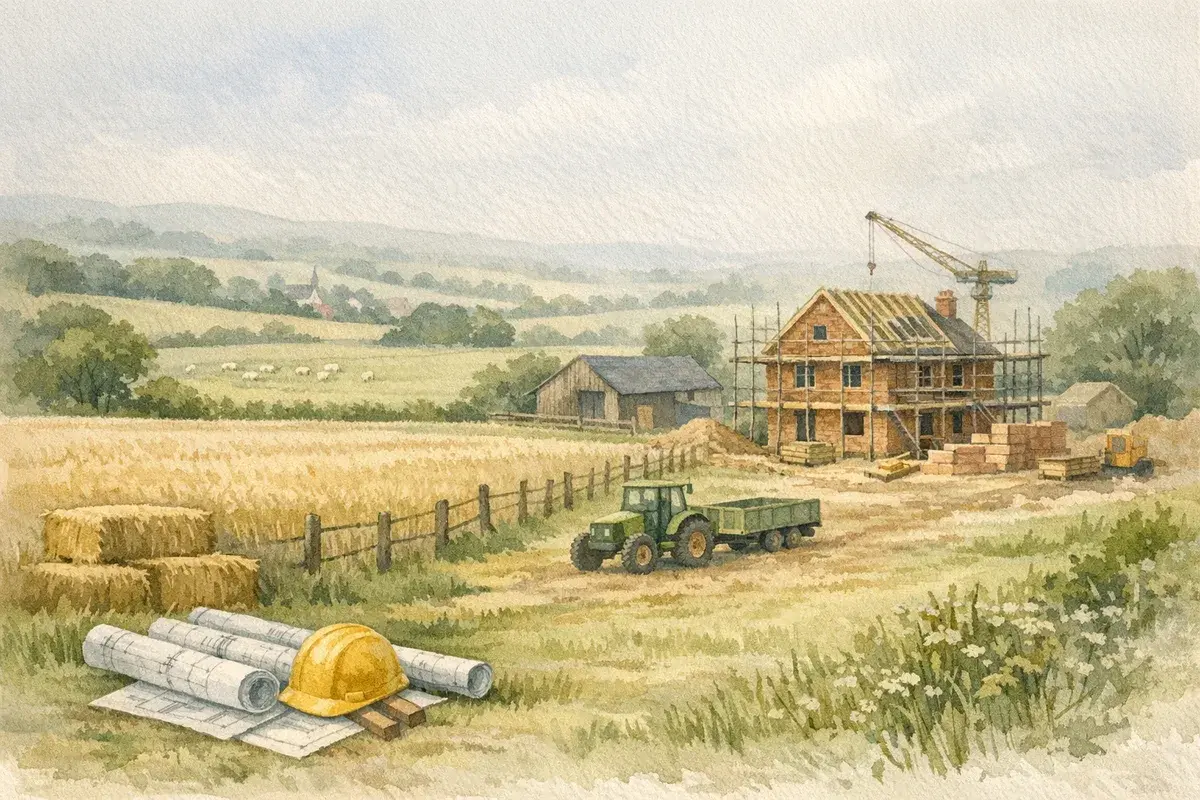
Can i build a house on agricultural land uk? In short, sometimes, but only with the right planning route, a strong case, and a realistic view of costs and risk. The answer depends on whether the site can justify a new dwelling under local and national planning policy, not simply on whether the land is currently farmed.
Most buyers assume agricultural land automatically means no housing potential. That's too blunt. In practice, some plots can support a farmhouse, a rural worker's dwelling, a replacement house, a conversion, or very occasionally a new-build through a special planning argument, but the bar is high and the evidence burden is real.
If you're a farmer, a landowner, or an investor, the key question isn't just can I build, but can I prove a need, satisfy countryside policy, and make the numbers stack up? We'd argue that's where most schemes succeed or fail.
When Agricultural Land Can Support A House
Planning policy in England, Scotland, Wales, and Northern Ireland all protects the countryside in different ways, but the core principle is similar: new isolated homes in open farmland are usually resisted unless there is a strong functional reason. That means the best prospects are rarely speculative self-builds on bare fields. They are more often tied to agricultural need, replacement of an existing dwelling, or limited infill in a settlement pattern that already exists.
In England, the National Planning Policy Framework expects new homes in the countryside to be justified carefully. Local plans and parish-level policies then decide the detail. In Cornwall, Northumberland, Devon, and other areas with high landscape sensitivity, councils often take a tighter view than in parts of the Midlands or Lancashire where settlement patterns can be more varied. Still, every case turns on site-specific evidence.
Agricultural Occupation Dwelling
An agricultural occupancy dwelling is a house restricted to someone working in agriculture, forestry, or a closely related rural role. It is often the most recognisable route for a new home on agricultural land, but it is not easy. The applicant normally has to show a functional need for a person to live on site, full-time, and that the need cannot be met elsewhere nearby.
That usually means livestock farms, dairy units, poultry farms, or intensive horticulture where constant supervision matters. A large arable unit in Lincolnshire might struggle unless there is a genuinely continuous labour or security need. A sheep farm in Cumbria with lambing issues, on the other hand, may have a stronger case if the evidence is well prepared.
Replacement Dwelling Or Rebuild
If there is already a lawful house on the land, replacing it can be much simpler than seeking a brand-new dwelling. Councils often accept rebuilds where the original structure is beyond repair, subject to design, access, and countryside impact. The catch is that the existing building must be lawful, not merely shown on an old map.
Replacement schemes can also arise after fire, structural failure, or long-term dereliction. In some counties, especially where rural housing policy is rigid, officers will still scrutinise whether the rebuild is genuinely a replacement and not a disguised new build. Size can matter too. If the proposal is much larger than the original, expect questions.
Conversion Of Rural Buildings
Old barns, stables, milking parlours, and threshing barns can sometimes become homes, provided the structure is suitable and policy allows it. This is often the most practical route because it uses an existing building rather than taking fresh land out of agricultural production. Of course, structural surveys and heritage constraints can quickly change the economics.
Converted agricultural buildings are common in parts of Shropshire, Herefordshire, Somerset, and Yorkshire, where the stock of traditional farm buildings is strong. Steel portal sheds are harder to convert and often trigger more expensive structural interventions, so the cheaper-looking option can become the most expensive one very quickly.
- Functional need: a genuine on-site farming requirement for daily supervision or security.
- Replacement: a lawful existing home being rebuilt or substantially renewed.
- Conversion: a building with enough structure left to justify residential reuse.
- Local plan support: a policy route that fits the site's countryside context.
Planning Permission And The Evidence You'll Need
Planning permission is the central hurdle. Agricultural use does not override planning control, and permitted development rights are limited for full houses. If you are asking can i build a house on agricultural land uk, the honest answer is that you need to think like a planning officer before you spend like a buyer.
The strongest applications are built on evidence, not optimism. Councils want to see business appraisals, functional evidence, land ownership details, accommodation need, access arrangements, drainage strategy, landscape impact, and often an ecological appraisal. If the site is near a village or farmstead cluster, you may have a better chance than on a truly isolated parcel.
Functional Need Tests
Functional need is the phrase that comes up again and again. It means showing that somebody needs to live on or very close to the site to carry out essential work that cannot be done from elsewhere. That might be animal welfare checks, security of valuable equipment, lambing, calving, irrigation monitoring, or biosecurity matters in poultry and pig units.
Councils do not accept vague convenience. They want detail, records, and a business case that shows why off-site housing would fail or create unacceptable risk. If the housing need is temporary or seasonal, the argument is usually weaker unless there is a clear and recurring operational demand.
Permitted Development And Prior Approval
Some farm buildings can change use under permitted development rights, but these are tightly controlled and not a shortcut for most new houses. Prior approval often focuses on transport, contamination, flooding, noise, and the effect on the listed or protected setting if relevant. It is handy, yes, but it is not a magic wand.
In reality, buyers should check the planning status of every building on the land before assuming a route exists. A building that looks like a barn may have no lawful residential conversion potential. A building that was once in agricultural use may also be subject to occupancy conditions, making resale more complicated later on.
| Route | Typical Strength | Common Risk | As Of April/2026 Observation |
|---|---|---|---|
| Agricultural occupancy dwelling | Strong where on-site need is proven | Functional need evidence can be rejected | Councils remain cautious, especially for speculative schemes |
| Replacement dwelling | Moderate to strong if lawful house exists | Over-sized designs attract refusal | Often the cleanest route where a dwelling already stands |
| Building conversion | Moderate if structure is suitable | Structural inadequacy or policy conflict | Popular in rural counties with traditional barns |
What Changes The Answer By County And Region
Regional context matters more than many buyers expect. The same scheme can be welcomed in one district and resisted in the next, even if the land use is identical. That is because local plans, landscape designations, flood risk, and settlement patterns vary widely across the UK.
In the South East, including Kent, Surrey, and parts of Essex, housing pressure can increase market value, but it can also bring stronger policy sensitivity around green belt, AONB land, and gap policies. In the West Country, especially Devon, Dorset, and Somerset, strong landscape protection can weigh heavily against fresh development on open agricultural land. In contrast, some parts of the East Midlands and the East of England may offer slightly more flexibility where a site sits beside an existing farmstead or ribbon settlement.
England, Scotland, Wales, And Northern Ireland
England is generally the most familiar market for agricultural land promotion and rural housing arguments, but Scotland and Wales have their own national planning frameworks and a strong emphasis on landscape and community needs. In rural Aberdeenshire, Perthshire, Powys, and Ceredigion, isolated house proposals are still closely controlled and usually need a compelling operational or local need case.
Northern Ireland also applies strict countryside policy, especially for sporadic development in open rural areas. If you are assessing a borderland holding or a cross-jurisdiction business, do not assume one regime will tell you much about the other. They can feel similar on the ground, but the planning tests are not identical.
Land Classification And Settlement Pattern
Land classification matters too. Grade 1 and Grade 2 agricultural land is the best quality and often harder to release for housing because councils dislike permanent loss of prime production potential. Lower-grade land does not guarantee permission, but it may slightly improve the planning balance if the site is already weak for farming purposes.
Settlement pattern is another major factor. A parcel tucked beside a village edge near a farm cluster in Cheshire is different from an isolated field in the Fens. Councils like development that feels connected to existing form. They dislike houses that create scattered, ribbon, or piecemeal sprawl.
- Landscape policy: AONB, National Park, green belt, and open countryside designations tighten control.
- Flood risk: many river valley sites in Yorkshire, Lincolnshire, and Somerset face added constraints.
- Access: rural lanes, visibility splays, and highway safety can sink a scheme.
- Services: drainage, water, and power can be costly in remote parts of Wales and Scotland.
Costs, Value, And Market Reality
Even when the planning route exists, the financial picture can be messy. Land with housing potential is usually priced very differently from pure agricultural land, but an uplift in hope value is not the same as a certainty. The market discounts risk heavily, which is why two apparently similar fields can have wildly different sale prices.
As of April/2026, typical bare agricultural land values in England still vary sharply by quality and location. Prime arable land in the eastern counties can command a substantial premium, while weaker grazing land in upland areas may trade at a much lower level. Once planning is in play, valuations often move into a separate category entirely, but only if the route is credible and the risk profile is manageable.
The table below gives a broad guide for market positioning. These are market-level observations, not a valuation, and they should be treated as directional rather than definitive.
| Land Type | Indicative Market Position | Main Housing Potential | As Of April/2026 Note |
|---|---|---|---|
| Prime arable land | Highest agricultural value | Usually low unless as part of a farmstead | Often protected from non-agricultural loss |
| Improved pasture | Mid to strong value | Possible if adjacent to existing settlement | Commonly assessed with access and drainage in mind |
| Marginal upland land | Lower agricultural value | Sometimes better for replacement or cluster schemes | Still faces landscape and policy hurdles |
| Converted farm building | Value depends on structure and permission | Can be strong if lawful conversion is secured | Often priced for occupation potential, not farming yield |
Costs can surprise first-time applicants. Planning consultants, architects, ecology reports, drainage design, highways input, and surveys can run into many thousands before a decision is made. If a scheme fails, those costs are sunk. If it succeeds, the uplift can be large, but only after a long lead time and with no guarantee of resale liquidity.
For estate agents, this is the point to stress with vendors. A field with no realistic prospect of permission should not be marketed as a housing opportunity. Buyers are sharper now, and lenders are too.
Common Pitfalls And How To Avoid Them
The biggest mistake is assuming agricultural status itself creates residential potential. It doesn't. Another is buying the cheapest parcel first and asking planning questions later, which is a quick route to disappointment. If you are serious, get the planning position checked before exchange, not after.
Another trap is underestimating access. Rural access can look fine on a drone shot and fail at the first highways review because visibility is poor or the lane cannot take additional traffic safely. Drainage is just as important. In parts of Suffolk, Norfolk, Yorkshire, and Dorset, soakaway or foul drainage solutions can be a real constraint.
Title, Rights, And Hidden Burdens
Legal title matters far more than many buyers realise. There may be rights of way, overage clauses, restrictive covenants, tenancies, sporting rights, easements, or ransom strips that affect development. A land parcel can look perfect and still be blighted by a neighbour's access right or a historic covenant preventing residential use.
If the land is tenanted, the agricultural tenancy terms may also complicate a sale or application. In some cases, tenant rights and landlord rights need untangling before any planning move is sensible. On family farms, that can be awkward, but it is better than discovering the problem after a costly design process.
Practical Checks Before You Spend Money
A sensible route is to test the site against planning, legal, and physical criteria in that order. First, confirm whether the council is likely to support any dwelling at all. Second, check title, access, and services. Third, test build costs against likely end value, because even a successful permission can be a poor investment if construction is expensive or resale is thin.
That is especially true in remote Welsh uplands, the Scottish Borders, and parts of rural Cumbria, where materials, labour, and access can inflate build costs quickly. The romance of a country house fades fast when you are pricing road upgrades, power connections, and foundations on awkward ground.
- Pre-application advice: often worth paying for because it can reveal policy objections early.
- Land agent input: useful for assessing agricultural need and market value.
- Planning consultant: helpful where the site needs a structured policy case.
- Surveyor's report: vital for conversions, access, drainage, and condition issues.
Conclusion
So, can i build a house on agricultural land uk? Sometimes, yes, but only where the planning case is strong, the evidence is solid, and the site fits local policy. The most realistic routes are an agricultural occupancy dwelling, a replacement dwelling, or a genuine building conversion, not an optimistic speculative plot in open fields.
If you're buying or advising on rural land, treat every site as a planning question first and a property question second. That is the safest way to judge value, risk, and long-term usefulness in the countryside market.
Disclaimer: AgLand.co.uk is a UK agricultural land and rural property matching service, where buyers register what they are looking for and owners advertise directly to the buyers who match, and a rural resource hub. Nothing in this text is intended as legal, financial, or investment advice. You should carry out your own due diligence and seek guidance from appropriately qualified professionals (for example, solicitors, land agents, surveyors, and financial advisors) for your specific circumstances.