
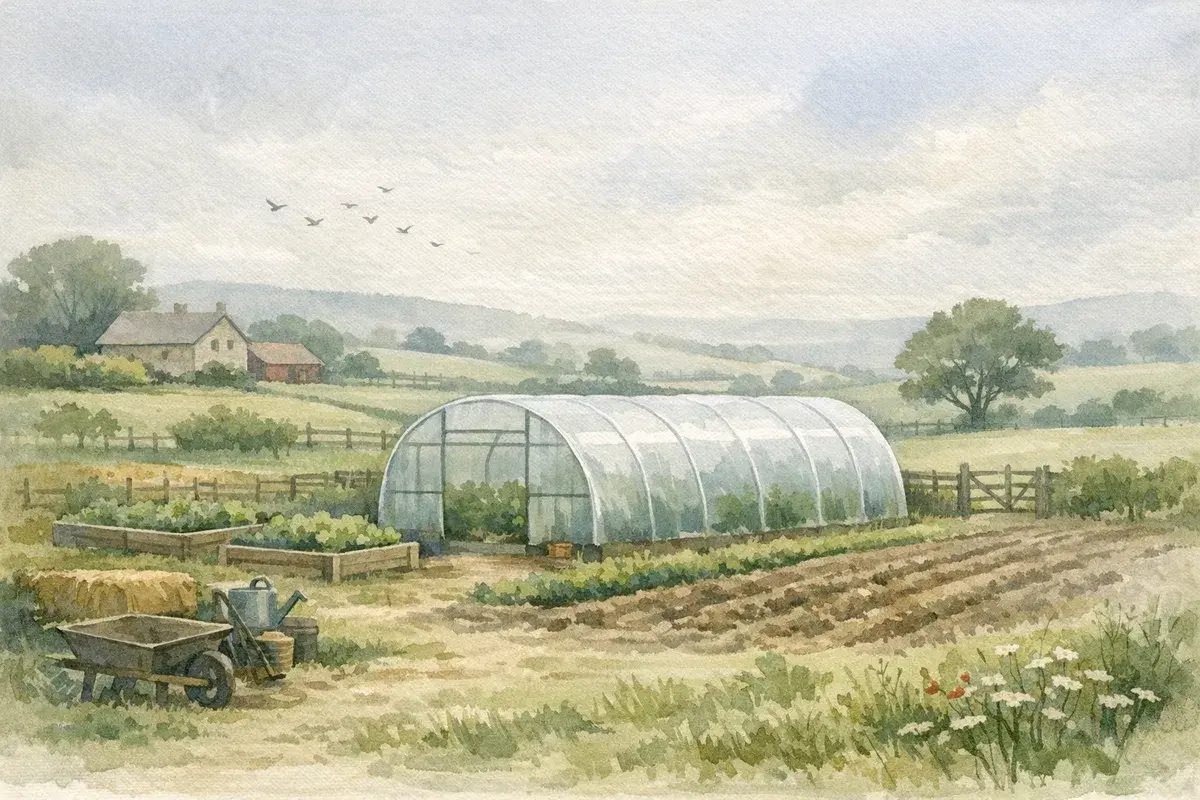
Can you put a polytunnel on agricultural land? Yes, often you can, but the answer depends on planning status, the size and permanence of the structure, the land use, and local council interpretation.
If you are growing vegetables, soft fruit, salad crops, or protected horticulture under cover, a polytunnel can be a practical and relatively low-cost solution. Yet what looks simple on the ground can still raise questions about planning permission, agricultural permitted development, drainage, access, and even whether the land is genuinely in agricultural use.
The short version is this: many farm polytunnels are acceptable without full planning permission, especially when they are temporary, moveable, and tied to farming activity. But once a tunnel becomes large, fixed, commercial in scale, or part of a change to non-agricultural use, the rules tighten quickly. We'd argue that it is always worth checking before you buy materials or dig anchors.
When A Polytunnel Is Likely To Be Allowed
In England, agricultural land can usually support polytunnels where the activity is part of horticulture or wider agricultural production. That means the tunnel is used for growing produce, propagating plants, or protecting crops from weather and pests, rather than for retail, storage unrelated to farming, or leisure use. The same broad logic applies in Wales and Scotland, although local planning practice can differ.
A key point is whether the tunnel is treated as development that needs permission. A lightweight, temporary structure used in active farming may fall within permitted development in some cases, especially on larger holdings where the land is clearly agricultural. But if the structure is substantial, bolted into concrete, or intended to stay in place for years, a council may view it as operational development requiring approval.
Typical Situations Where Approval Risk Is Lower
In practice, risk is often lower where the tunnel sits within an established farm business and supports crop production on land already in agricultural use. Dorset soft fruit growers, Herefordshire top-fruit producers, and Lincolnshire salad growers often use polytunnels as part of normal operations, provided siting and scale are sensible.
Smaller tunnels used for market gardening, plant raising, or season extension are usually easier to justify than a large commercial block beside a road or right next to a village edge. Local amenity matters. So does visibility. A tunnel in a hidden field can attract less scrutiny than one visible from a public footpath or from neighbouring houses.
- Agricultural use: growing crops or plants for sale or farm production.
- Temporary structure: a tunnel that can be removed without major ground works.
- Operational development: building work or installation linked to the running of a farm.
- Local context: nearby homes, roads, and landscape sensitivity can influence decisions.
Planning Permission, Permitted Development, And Local Rules
The planning question is usually the make-or-break issue. In some cases, polytunnels are treated as part of agricultural development, but there is no blanket rule that says every tunnel is exempt. The decisive factors are often permanence, purpose, size, and whether the structure changes the character of the land.
For farmers and landowners, the safest assumption is that informal advice is not enough. Councils in Somerset, Kent, and Monmouthshire, for example, may look closely at landscape impact where fruit and salad production is expanding rapidly. Even a benign-looking tunnel can become contentious if it sits in an Area of Outstanding Natural Beauty, on open downland, or in a sensitive river valley. In those places, the visual effect matters almost as much as the use itself.
What Councils Usually Look At
Local planning officers tend to ask similar questions. Is the land in agricultural use now? Is the tunnel genuinely needed for farming? Can it be removed? Does it affect drainage, access, or biodiversity? If the answer to any of those is awkward, the project may need a better paper trail or a formal application.
It also helps to remember that farm diversification is not the same thing as agriculture. A tunnel used for a pick-your-own enterprise, a farm shop display area, or non-farm events may trigger different rules. That is where many owners get caught out. The structure may look identical, but the use is not.
- Permitted development: rights that can allow certain farm buildings without a full planning application.
- Change of use: when land stops being used purely for agriculture.
- Lawful development certificate: formal proof that a use or structure is lawful in planning terms.
- Listed or sensitive land: conservation designations often mean stricter scrutiny.
Regional Differences That Matter
Regional variation is real. Kent and East Sussex growers may face closer scrutiny on landscape and flood risk than a tunnel on a more enclosed farmyard site in Shropshire. In parts of Perthshire and Aberdeenshire, wind exposure and siting stability can matter as much as planning policy. Meanwhile, in Gloucestershire or Devon, the visual impact on rolling countryside can be the main sticking point.
If your holding crosses county boundaries or you are renting land, check who actually controls planning responsibility. Tenants, landlords, and contract growers do not always have the same rights. That detail sounds boring, but it can save a lot of grief later.
| Scenario | Planning Risk | Typical Issue | As Of August/2025 |
|---|---|---|---|
| Small tunnel on working vegetable unit | Lower | Usually easier to justify as agricultural use | Often acceptable subject to local conditions |
| Large fixed tunnel block near dwellings | Medium to high | Visual impact and permanence | May need formal consent |
| Tunnel for non-farm retail or events | High | Likely change of use | Full planning usually required |
| Mountain or landscape-sensitive site | Medium to high | Ecology, amenity, and siting concerns | Case-by-case assessment |
Building Standards, Drainage, And Site Practicalities
Even when planning looks manageable, the site still has to work. A polytunnel on agricultural land can fail in practice if drainage is poor, the ground is too exposed, or access for machinery is awkward. Good siting is not glamorous, but it is what keeps crops alive and repair bills down.
Drainage deserves more attention than it usually gets. A tunnel on heavy clay in Somerset or Staffordshire can become a mud bath in winter if water runs off surrounding slopes. In wetter parts of the UK, this can also create runoff into ditches or adjacent fields, which may raise environmental concerns. A simple soakaway or land shaping exercise can make a big difference.
Access, Orientation, And Soil Conditions
Think about vehicle access first. Can a tractor, sprayer, or small lorry get close enough without rutting the whole field? Can you load compost, rolls of crop, or plant trays efficiently? If not, the tunnel may cost more to run than it saves in protected cropping.
Orientation matters too. Many growers place tunnels to maximise light and reduce wind stress, but the best position depends on the crop, the slope, and the prevailing weather. On exposed land in Northumberland or the Welsh borders, a tunnel may need extra anchoring, windbreaks, or a less ambitious footprint.
- Wind loading: the force wind puts on the cover and frame.
- Ground anchors: fixings that hold the tunnel in place.
- Drainage run-off: water moving off the tunnel and surrounding land.
- Access track: farm track or hard standing that supports vehicles.
Environmental And Neighbour Considerations
Neighbours can object if a tunnel changes views, increases lorry movements, or creates reflective glare. That is especially relevant in counties with strong tourism economies, such as Cornwall, Devon, and parts of the Cotswolds. A thoughtful layout, screening, and sensible operating hours can reduce friction.
There are ecological points too. If the land supports hedgerows, nesting birds, rare grassland, or watercourses, you may need survey input before installation. We'd argue this is one of the few areas where spending a little on advice usually pays back later. A cheap mistake can become an expensive redesign.
Costs, Value, And Commercial Considerations For Farmers
For many businesses, the question is not only whether you can put a polytunnel on agricultural land, but whether it adds real value. On that front, tunnels are often compelling because they extend the season, improve quality, and protect high-value crops from weather damage. That matters more now than it did ten years ago, with tighter margins and more volatile weather patterns.
Costs vary widely by scale and specification. A small market-garden tunnel can be relatively affordable, while a commercial block with ventilation, irrigation, and professional anchoring quickly becomes a serious capital project. Labour and ground preparation are often underestimated. So are replacement covers, which eventually wear out.
| Typical Cost Item | Indicative Range | Notes | As Of August/2025 |
|---|---|---|---|
| Small hobby or starter tunnel | Low four figures to mid four figures | Basic frame and covering | Depends on width and length |
| Commercial farm tunnel | Mid four figures to low five figures | Anchoring, ventilation, and installation add cost | Scale changes pricing fast |
| Site preparation | Several hundred to several thousand pounds | Ground levelling, drainage, tracks | Often overlooked |
| Replacement cover | Hundreds to low thousands | Lifetime depends on material and exposure | Plan for renewal |
From a land value perspective, a tunnel can make a holding more attractive to an operator if it supports profitable horticulture. That said, it does not automatically add capital value in the same way as permanent buildings. Agents in Cambridgeshire, Kent, and West Sussex will usually look at the income potential, existing infrastructure, and whether the tunnel can be reused or removed.
For landlords, there is also a rental angle. A tenant growing salad crops or strawberries may accept a higher rent if the tunnel boosts output, but the agreement needs to spell out repair, reinstatement, and ownership of fixtures. This is where good farm tenancy drafting earns its keep.
How To Check Before You Install A Polytunnel
If you are still asking can you put a polytunnel on agricultural land, the best answer is to check the facts against the site. Start with land use, then look at planning status, then review practical constraints. That sequence sounds dull, but it stops you from assuming the wrong thing.
Begin by confirming whether the land is unequivocally agricultural and whether the tunnel will support bona fide farming use. Next, speak to the local planning authority or a qualified land agent about whether the structure may fall within permitted development or require permission. If the site is rented, get the landlord's written consent before you spend a penny.
Documents Worth Having Ready
Keep a simple file ready. Drawings, dimensions, crop plans, photos of the site, and notes on access and drainage can all help if a council asks questions. If there is any chance of later sale, finance, or tenancy scrutiny, a tidy paper trail is worth far more than it costs.
In many situations, the decision turns on evidence. A clear business case for protected cropping in Norfolk, Worcestershire, or Fife carries more weight than a vague idea of putting up a farm tunnel because the land is available. The more specific you are about crop type, seasonal use, and removability, the stronger your position.
- Site plan: shows where the tunnel sits and how large it is.
- Land status: confirms whether the site is agricultural, mixed use, or otherwise.
- Landlord consent: essential on let land.
- Planning advice: protects against avoidable breaches.
Conclusion
So, can you put a polytunnel on agricultural land? In many cases, yes, but only when the use, scale, siting, and planning position all stack up properly. A farm tunnel can be an excellent tool for crop quality and season extension, yet the wrong location or a poorly judged setup can create avoidable headaches.
If you treat the question as both a planning issue and a farm business decision, you'll usually make the right call. Check the local rules, document the agricultural use, and think carefully about drainage, access, and neighbours before you build. That is the sensible path for most holdings in England, Scotland, and Wales.
Disclaimer: AgLand.co.uk is a UK agricultural land and rural property matching service, where buyers register what they are looking for and owners advertise directly to the buyers who match, and a rural resource hub. Nothing in this text is intended as legal, financial, or investment advice. You should carry out your own due diligence and seek guidance from appropriately qualified professionals (for example, solicitors, land agents, surveyors, and financial advisors) for your specific circumstances.