
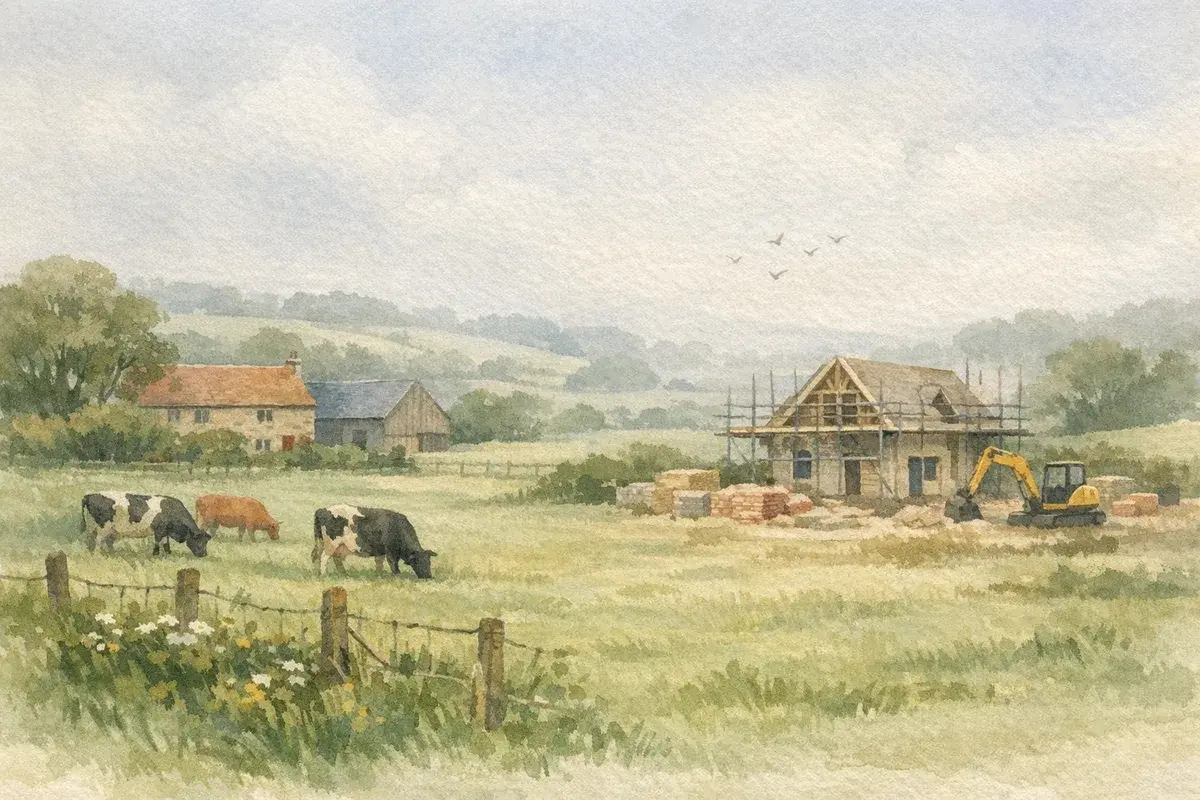
Can you build on permanent pasture land? Sometimes, yes, but only if the planning case is strong and the land can support a lawful change of use. For most buyers, the harder question is not whether you can build, but whether you can justify building in the first place.
Permanent pasture usually means grassland that has been used for grazing or forage for at least five years and is often protected by environmental rules, tenancy terms, or local planning policy. That makes blanket assumptions dangerous. One county can be far more permissive than the next, and a site in rural Cheshire may face a very different outcome from one in the Cotswolds or North Yorkshire.
The short answer is this: if you want a barn, house, equestrian unit, agricultural building, or a modest rural enterprise structure, the route will depend on planning class, land designation, and whether the proposal is genuinely linked to agriculture or another accepted rural use. We'd argue that getting the first conversation right with a land agent or planning consultant usually saves more money than any later appeal.
What Permanent Pasture Means For Planning
Permanent pasture is not just 'grass land'. In planning and land management terms, it often signals long-established sward, limited cultivation history, and, in some cases, environmental sensitivity. That matters because development on such land can trigger more scrutiny from the local planning authority, especially where the proposal would remove productive agricultural land or affect wildlife habitats.
There is also a practical point. If the land is classed as permanent pasture for subsidy, stewardship, or habitat reasons, changing the use can have knock-on effects beyond planning. A landowner in Somerset or Devon may find that one field is valuable for grazing cattle, but not necessarily suitable for a dwelling simply because it sits close to a lane. Proximity helps, but it does not override policy.
Why The Land Status Matters
Permanent pasture can be treated differently from land that has been recently reseeded or arable-rotated. If the site has been grass for many years, any proposal to remove or disturb it may raise questions about soil health, drainage, biodiversity, and whether the best and most versatile agricultural land is being lost.
- Planning policy: local plans often restrict development on open countryside and agricultural land.
- Environmental value: older grassland may support insects, birds, and soil structure worth protecting.
- Land use history: long-term grazing can make a change of use harder to justify.
- Subsidy or stewardship: existing agreements may limit what you can do next.
When You Might Build On Permanent Pasture Land
You can sometimes build on permanent pasture land if the proposal meets a recognised planning route. The most straightforward is where the development is genuinely agricultural, such as a livestock shed, machinery store, manure clamp, or field shelter. Even then, many authorities want evidence that the building is needed for a viable farming business, not merely convenient.
There are also cases where non-agricultural development may be accepted, but the bar is higher. In parts of rural Gloucestershire, Herefordshire, and parts of the South West, small-scale diversification projects, tourism uses, or replacement dwellings can get consent if they fit the site and policy framework. In contrast, sites close to York, Bath, or protected landscapes often face a tighter test.
Agricultural Buildings And Permitted Development
Some agricultural buildings may fall under permitted development rights in the General Permitted Development Order 2015, but that is not a free-for-all. Prior approval may still be required, and the rules depend on the building size, siting, and whether the land is truly in agricultural use. A farmer expanding a beef unit in Lincolnshire may have a stronger case than an investor hoping to add a speculative structure on a small block of grassland.
Important distinctions include the following:
- Agricultural use: the building must usually support farming activity.
- Prior approval: the council may assess access, siting, flood risk, and design.
- Curtilage limits: domestic-style extensions to an existing dwelling follow different rules.
- Ancillary use: a building serving a non-agricultural business may not qualify.
Change Of Use And Rural Diversification
If the land is no longer needed purely for farming, a change of use application may be possible. Rural workshops, equestrian facilities, food production units, or storage uses can sometimes work well on pasture, especially if the site has existing access and can be screened. Still, the planning authority will ask whether the scheme is sustainable and whether it harms the character of the countryside.
In market towns across Kent, Warwickshire, and Cheshire, mixed-use rural sites tend to attract attention because they can support local enterprise without sprawling into open countryside. But the more land you take out of grazing, the more you need to show a clear economic and practical benefit.
The Planning Tests And Constraints That Matter Most
The planning decision usually comes down to a handful of core tests. Is the site in the open countryside? Is it within an Area of Outstanding Natural Beauty, National Landscape, green belt, or flood zone? Does the proposal preserve the farming character of the holding, or does it amount to unnecessary sprawl? These questions can make or break an application.
On larger holdings, the context matters just as much as the plot itself. A 12-hectare grassland block in rural Shropshire may be treated more sympathetically if it forms part of a working farmyard, while a lone pasture parcel near a village edge in Surrey may face stronger resistance because it could look like ribbon development.
| Typical Planning Context | Practical Effect | Likelihood of Approval |
|---|---|---|
| Open countryside in a local plan area | Strong policy presumption against unnecessary development | Low to moderate |
| Established farmstead with operational need | Better case for agricultural buildings or conversion | Moderate to strong |
| Green belt or protected landscape | Extra tests on openness, character, and harm | Low unless exceptional |
| Flood-sensitive lowland pasture | Drainage and resilience issues become central | Variable but cautious |
As of June/2026, local planning teams remain particularly wary of speculative housing on agricultural land because housing need can usually be met elsewhere first. That is why proposals on permanent pasture often succeed only when they are tightly tied to farming, land management, or proven rural necessity. A decent access track is helpful; a weak justification is not.
Green Belt, Protected Landscapes, And Best Land
If the pasture sits in the green belt, the issue is not just whether you can build. It is whether the development counts as appropriate under the National Planning Policy Framework, if it preserves openness, and whether any very special circumstances exist. In protected landscapes such as the Yorkshire Dales, Peak District, or Norfolk Coast, visual impact and landscape character become central, and even modest structures can face resistance.
There is another point that buyers sometimes overlook. Where the pasture is good-quality agricultural land, councils may expect very strong justification before accepting built development. That is especially true where the land is productive, irrigated, or part of a wider commercial farming unit.
How To Assess A Site Before You Apply
Before spending money on plans, check the site properly. Get the title documents, look at the local plan, review mapping for flood risk and designations, and establish whether the land is under any environmental agreement. If you are buying in Scotland, Wales, or different English counties, the policy context still changes enough to affect your odds.
A land agent will usually look at access, visibility, utilities, neighbouring uses, and how the site reads in the landscape. A planning consultant will ask a different question: what is the lawful route to consent, and what evidence will the authority expect? Those are complementary, not competing, checks.
Useful Checks Before You Commit
- Planning status: confirm whether the land is in the countryside, green belt, or a protected area.
- Tenure: check if there is a tenancy, underpinning rights, or restrictive covenant.
- Water and drainage: pasture can sit in damp ground, which complicates foundations and access.
- Access: verify whether the site has lawful highway access and enough visibility splays.
- Existing use: document the farm activity, grazing history, and any buildings nearby.
For estate agents, this due diligence is important commercially too. A pasture parcel with nearby services and a believable planning route can command a premium over a similar field with no prospect of development. But overstate the potential, and you may create a sale that falls apart after searches come back.
Market Reality, Costs, And Regional Differences
The market for permanent pasture land is shaped by agricultural value first and development hope second. As of June/2026, typical pasture values still vary sharply by region, quality, access, and whether there is any realistic planning angle. In practical terms, land in the West Country, South East, and parts of the East Midlands can command far more than marginal grassland in upland areas, but only exceptional sites should be priced as if planning is certain.
For buyers, this means one thing: do not pay housing-site money for a field unless consent is already in hand or highly likely. For sellers, it means being honest about what the land can and cannot do. A Somerset pasture block with farmyard adjacency and services is a different proposition from a remote grazed field in Cumbria.
| Region | Indicative Pasture Value | Planning Outlook |
|---|---|---|
| South East | As of June/2026: often higher where access and settlement edge potential exist | Tight, especially near villages and green belt land |
| South West | As of June/2026: strong demand for good grazing blocks | Mixed, but landscape constraints are common |
| East Midlands | As of June/2026: steady interest from livestock and mixed farms | Moderate, with local policy heavily site-specific |
| Northern Counties | As of June/2026: often lower for remote grassland, stronger near farm hubs | Variable, often dependent on access and settlement pattern |
There is also a taxation angle, though it depends on the wider estate. Pasture retained in agricultural use may fit common farm business models, but once development becomes the intention, valuation and tax treatment can shift quickly. That is why a realistic appraisal from a professional is worth more than optimistic gossip from the parish pub.
What Buyers And Agents Should Watch
County-level patterns matter. In Cheshire and parts of the Midlands, pressure from commuter demand can sharpen interest in edge-of-village land. In Northumberland, Cumbria, and much of Wales, landscape constraints and lower residential land values may keep the focus on livestock viability instead. In Cornwall, the mix of high land demand and planning caution can produce very competitive but often frustrating outcomes.
We'd argue that a sensible pricing strategy should separate three things: agricultural value, amenity value, and any realistic development potential. Blend them too casually, and you risk confusion. Separate them clearly, and both buyers and agents can see where the genuine opportunity lies.
Conclusion
So, can you build on permanent pasture land? Yes, in some cases, but only when the planning route, site context, and land use history stack up properly. For most people, the answer is less about the grass itself and more about policy, access, landscape impact, and whether the proposal serves a real agricultural or rural need.
If you are buying, selling, or promoting pasture land, treat planning potential with caution and evidence. The best outcomes usually come from honest land appraisal, early professional advice, and a clear understanding of county-level planning attitudes. In short, the land may be grass, but the decision is rarely simple.
Disclaimer: AgLand.co.uk is a UK agricultural land and rural property matching service, where buyers register what they are looking for and owners advertise directly to the buyers who match, and a rural resource hub. Nothing in this text is intended as legal, financial, or investment advice. You should carry out your own due diligence and seek guidance from appropriately qualified professionals (for example, solicitors, land agents, surveyors, and financial advisors) for your specific circumstances.