
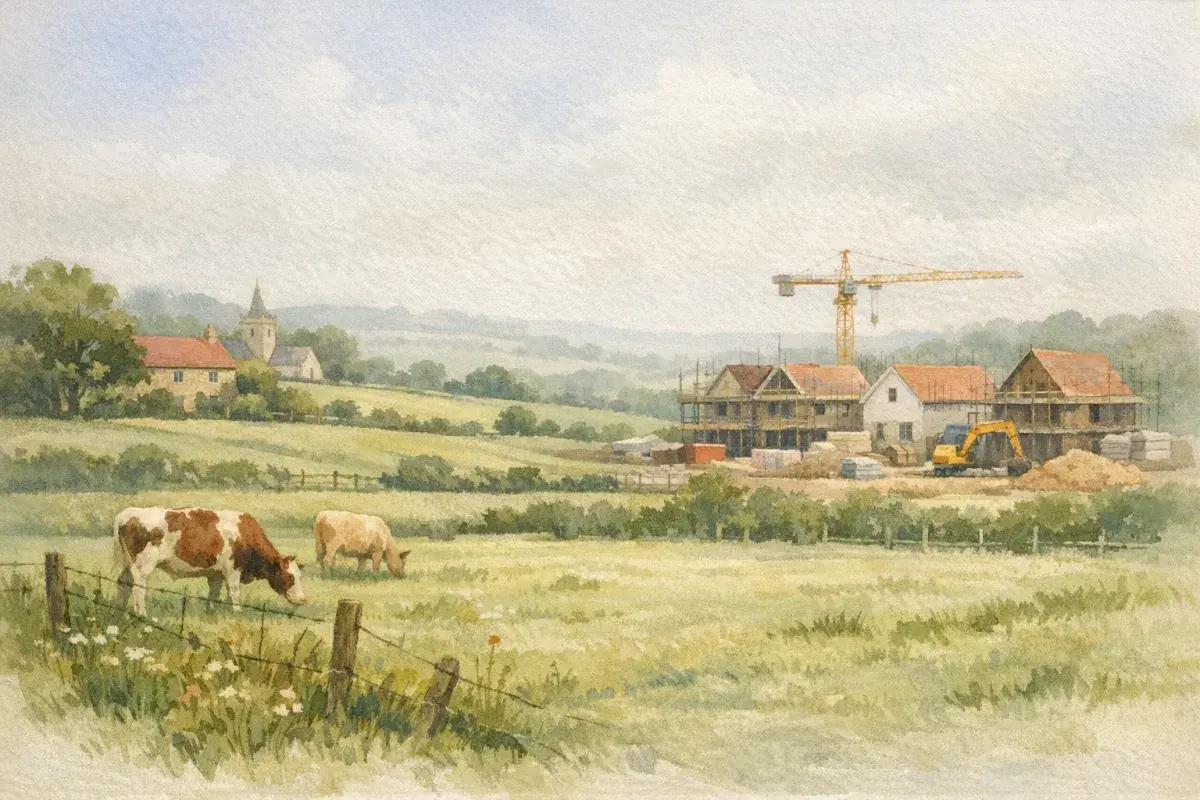
Can you build on grazing land? Sometimes, yes, but it's rarely straightforward and planning permission is the real hurdle. This guide explains what grazing land is, what can actually be built, and how the rules vary across the UK.
If you're looking at a field and wondering whether it could become a house plot, a farm building site, or something more ambitious, the first answer is this: land use matters far more than many buyers expect. Grazing land is usually protected by planning policy, local landscape designations, and agricultural need, so the key question is not just can you build, but what sort of development might be acceptable and under what evidence.
That said, grazing land is not automatically a dead end. We'd argue that the best outcomes usually come where the proposal supports agriculture, replaces an existing rural structure, or sits on the edge of settlements with better infrastructure nearby. The devil is in the detail, and in counties like Cornwall, Somerset, Cheshire, North Yorkshire, and the Scottish Borders, local planning practice can shape the result as much as national policy.
What Grazing Land Means In Planning Terms
Grazing land is land used for livestock feed, typically pasture or meadow grassland. In planning terms, it is generally classed as agricultural land, even if it is not intensively cropped, and that matters because agriculture enjoys some permitted development rights while housing usually does not.
Most grazing land sits in the countryside, where planning policy aims to limit sporadic development. So if you are asking can you build on grazing land, the first thing to establish is whether the land already has a lawful planning use, whether there are any existing buildings, and whether the site falls within a designated area such as a green belt, national park, Area of Outstanding Natural Beauty, now often called an National Landscape, or conservation area.
Why Agricultural Use Matters
A field used for grazing cattle or sheep is usually treated differently from domestic garden land or brownfield land. That distinction affects everything from valuation to the likelihood of getting permission for a dwelling, although agricultural buildings, field shelters, and some operational structures may still be possible without full planning consent.
- Agricultural land: land used for farming activity, including pasture and grazing.
- Planning use class: the lawful category of land use recognised by the local authority.
- Permitted development: certain works that may proceed without a full planning application, as set out in the General Permitted Development Order 2015.
The practical effect is simple. A farmer may be able to erect fencing, tracks, or a modest agricultural building, but a non-agricultural building or dwelling almost always needs a much stronger case. That is why a grazed field in Devon or Powys is not the same as a serviced plot on the edge of a market town in Kent or East Lothian.
Can You Build On Grazing Land Without Planning Permission
In most cases, you cannot build a house on grazing land without planning permission. Full stop. There are exceptions for certain agricultural works, but a new dwelling, holiday let, or commercial unit usually requires an application and supporting evidence.
What can sometimes go ahead is a limited agricultural structure. Think livestock shelters, feed stores, machinery sheds, hardstanding, tracks, fencing, or drainage works. Even then, location, size, design, and visual impact all matter, especially in open countryside or sensitive landscapes.
Works That May Be Easier To Justify
If the land is actively grazed, the local authority will ask whether the structure is genuinely needed for agriculture. If the answer is yes, and the design is proportionate, the proposal can be easier to defend than a residential scheme.
- Field shelters: small structures for stock, usually easiest where livestock welfare is clear.
- Livestock handling facilities: pens, races, and small yards linked to farming operations.
- Agricultural storage: hay, feed, straw, or machinery storage where the farm need is proven.
- Boundary works: fencing, gates, and livestock-proofing that support grazing management.
By contrast, a glamping pod, equestrian livery yard, or a house site on prime pasture will face a much tougher test. In places like Surrey, Oxfordshire, or the Cotswolds, policy pressure is often especially strong because of landscape and settlement protection.
When Residential Development Might Be Possible
A dwelling on grazing land is not impossible, but it needs a clear planning route. The most common routes are an infill plot within a settlement boundary, replacement of an existing lawful dwelling, conversion of a genuinely redundant rural building, or a proven agricultural worker's dwelling supported by an operational need.
Local authorities will usually check access, drainage, ecology, landscape impact, and whether services can be provided without harm to the rural character of the area. In parts of Cornwall, for example, the policy focus may be tightly bound to landscape and housing need, while in Lancashire or Staffordshire the viability of a farm business can become central to the evidence.
Agricultural Worker's Dwelling Tests
Where a farmer needs to live on site to run a livestock enterprise, the case can sometimes be made for a new dwelling. The authority will normally want to know whether the enterprise is financially sound, whether the need is functional, and why an existing house nearby will not do the job.
That means the proposal has to stack up on paper, not just in principle. If the grazing enterprise is small, seasonal, or easily managed remotely, the argument weakens. If the farm covers a substantial acreage and has calving, lambing, or night-time stock checks, the case may look stronger.
| Planning Scenario | Typical Outcome | Key Test | As Of Date |
|---|---|---|---|
| Field shelter for sheep | Often possible | Agricultural need | June 2026 |
| New family house | Usually resisted | Very special or proven need | June 2026 |
| Conversion of barn | Sometimes possible | Structural integrity and lawful use | June 2026 |
| Farm shop or diversification unit | Case by case | Highway safety and rural policy | June 2026 |
That table is only a guide, of course. A site in the Cheshire Green Belt may face a different response from a similar parcel in rural Lincolnshire or the Scottish Lowlands, because policy weight and landscape sensitivity vary so much.
How Local Planning Policy Shapes The Answer
Planning policy is where many grazing land proposals succeed or fail. Even where the principle looks promising, the local development plan may restrict new homes outside settlement boundaries, protect good quality agricultural land, or limit visual intrusion in open countryside.
In England, the National Planning Policy Framework tends to favour sustainable development, but it still gives strong weight to countryside protection and the maintenance of the best and most versatile agricultural land. In Wales, the emphasis on sustainable placemaking and landscape character can be equally influential. In Scotland, rural development policy often turns on development plan support, countryside location tests, and whether the proposal helps the wider rural economy.
County-Level Differences That Matter
Local practice matters more than many first-time buyers realise. A planning officer in Herefordshire may look differently at a modest farm building than an officer in Hertfordshire, where development pressure is higher and the countryside edge is more sensitive to settlement creep.
Likewise, a grazing field in Cumbria near a village may be viewed differently from a remote moorland parcel in Northumberland or a lowland pasture holding in Shropshire. The application context, road access, flood risk, and ecological setting all feed into the decision.
- Green Belt: very restrictive, especially for new dwellings.
- National Landscape: landscape protection is a major factor.
- Flood plain: drainage and flood risk can block development.
- Best and Most Versatile Land: higher-grade farmland, graded by Natural England, gets added policy protection.
For estate agents and sellers, this means marketing grazing land as potential development land without evidence can be risky. For buyers, it means due diligence should start before an offer is made, not after solicitors are instructed.
What Grazing Land Is Worth If Development Is Possible
Valuation can change dramatically if there is a realistic prospect of planning permission. A straightforward grazing paddock might trade as agricultural land, while a plot with residential hope value can command a materially higher price, although hope value is speculative and should not be confused with consented value.
As of June 2026, typical grassland values in England and Wales can vary widely depending on grade, location, access, and amenity. Better quality pasture in areas with strong owner-occupier demand tends to achieve more than poorer grazing in remote locations, while any genuine development prospect can lift value sharply if the planning risk is credible rather than fanciful.
| Land Type | Typical Market Position | Valuation Driver | As Of Date |
|---|---|---|---|
| Productive grazing pasture | Moderate agricultural value | Grass quality and access | June 2026 |
| Marginal pasture | Lower agricultural value | Yield and management cost | June 2026 |
| Plot with credible housing prospect | Substantially higher hope value | Planning likelihood | June 2026 |
| Consented building plot | Highest value category | Approved use and infrastructure | June 2026 |
But here's the catch. If permission is uncertain, overpaying for hope value can be a costly mistake. We'd argue that the best deals are usually the ones where the land still stacks up as a farm asset, even if the planning upside never materialises.
Evidence Buyers And Sellers Should Review
Before selling or buying grazing land with development ambitions, it helps to look at title documents, historic aerial imagery, previous applications, access rights, utility proximity, and any agricultural occupancy conditions. A small error there can change the whole financial picture.
If the land has been in long-term grazing use in Gloucestershire, Norfolk, or the Scottish Borders, that history may support its agricultural status but weaken a residential narrative. If there is an old barn, former hardstanding, or a disused yard, the story may be more nuanced, and therefore more valuable.
Practical Steps Before You Build Or Apply
The best approach is usually to test the planning case before spending on design or surveys. Start with the lawful use of the land, then assess whether your proposed development is agricultural, diversified, or residential in nature. That order matters.
Next, check whether there are constraints such as rights of way, protected species, listed structures, drainage easements, or highway limits. An attractive field in rural Somerset or Monmouthshire can still fail if the access is too narrow or the ecology survey shows protected habitats.
The Core Due Diligence Checks
Well-advised buyers should carry out a hard look at the site and the paperwork. It sounds obvious, but many problems only surface once money has already been spent.
- Title and access: confirm legal rights, wayleaves, and vehicle access.
- Planning history: review previous refusals, approvals, and conditions.
- Land classification: check whether higher grade agricultural land applies.
- Site constraints: assess drainage, ecology, highways, and landscape impact.
If the aim is a dwelling, a planning consultant or land agent will often want a clear strategy: new-build, conversion, replacement, or agricultural worker route. If the aim is a shed or livestock structure, the case may be simpler, but design, scale, and need still need to be evidenced.
For many grazing land purchases, the smartest question is not can you build on grazing land at all, but can you build something lawful, proportionate, and defensible for this specific site? If you can answer that honestly, you're already ahead of a lot of buyers.
Conclusion
So, can you build on grazing land? Yes, but often only with planning permission and a proposal that fits the land's lawful use, local policy, and site constraints. Agricultural structures are usually the easiest route, while homes face a much higher bar, especially in protected countryside or on strong farmland.
If you're assessing a purchase or preparing an application, focus on planning status, access, policy context, and evidence. Get those right, and you'll know whether the grazing land is a working field, a viable farm asset, or a site with a realistic development case.
Disclaimer: AgLand.co.uk is a UK agricultural land and rural property matching service, where buyers register what they are looking for and owners advertise directly to the buyers who match, and a rural resource hub. Nothing in this text is intended as legal, financial, or investment advice. You should carry out your own due diligence and seek guidance from appropriately qualified professionals (for example, solicitors, land agents, surveyors, and financial advisors) for your specific circumstances.