
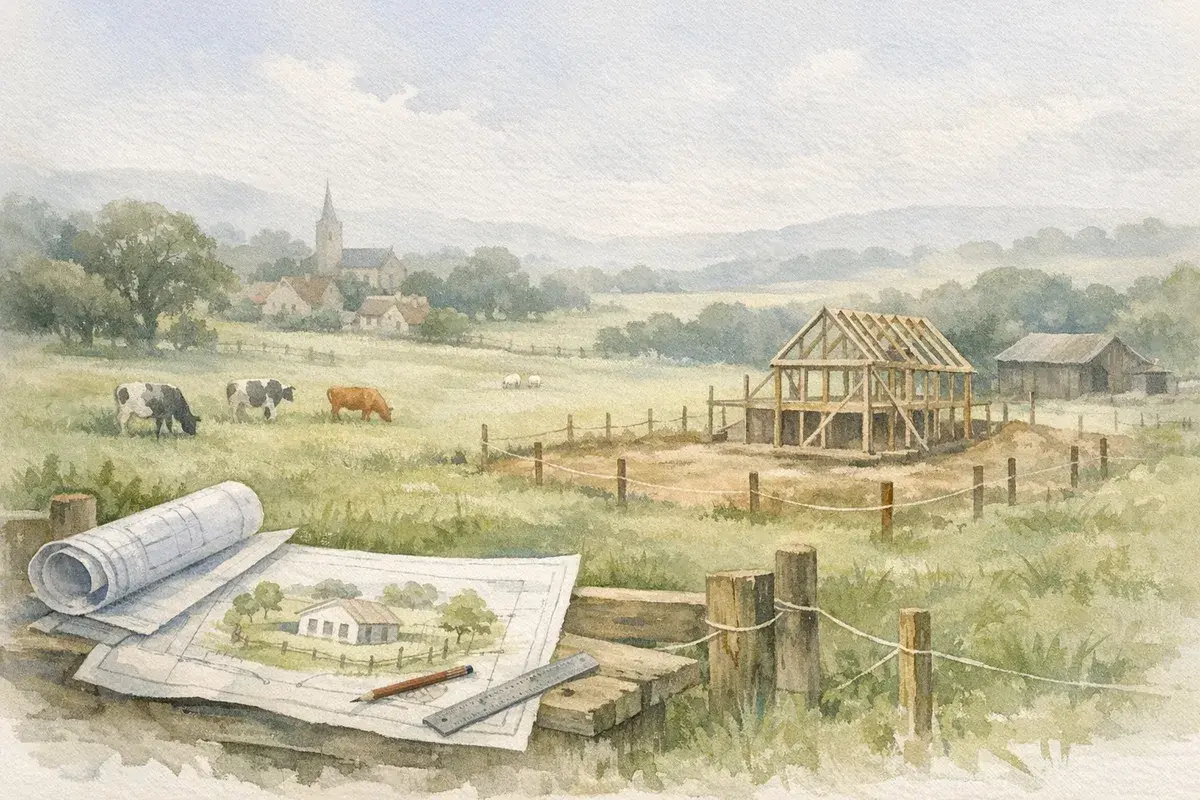
Can you build on pasture land? Sometimes, yes, but only if planning policy, site constraints, and the specific use all stack up. Most pasture land in the UK remains protected from arbitrary development, so the answer is rarely as simple as a yes or no.
If you're a farmer, landowner, or rural buyer, the real question is whether the land is likely to support a dwelling, agricultural building, equestrian unit, or some other lawful use. If you're an agent, the practical issue is how to assess planning risk, value, and saleability before anyone spends serious money.
We'd argue that this is where many people get caught out. Pasture sounds open and straightforward, but agricultural land is often the most policy-sensitive of all rural assets, especially where green belt, national landscapes, flood risk, or an area of outstanding natural beauty comes into play. The site may look ideal. Planning may think otherwise.
What Pasture Land Usually Means In Planning Terms
Pasture land is generally land used for grazing livestock or producing forage, typically permanent grassland rather than arable cropping. In planning terms, that distinction matters because the existing lawful use, the soil quality, and the local policy designation all influence what might be acceptable later. Grass that has been down for five years or more is usually treated as permanent pasture, and it can carry stewardship agreements and local plan protection that ordinary grass does not - how that history changes the planning tests is worth reading before you commit.
Most pasture land sits within the wider category of agricultural land, but agricultural use does not give free rein to build whatever you fancy. A new barn, track, hardcore yard, field shelter, or slurry store may be something very different from a house, holiday let, or commercial unit. That is the key divide.
Agricultural Use Versus Development Potential
The fact that land is pasture does not mean it is automatically developable, and it does not mean it is protected forever either. The law looks at the proposed use, local plan policy, countryside designations, sustainability, highways access, drainage, and visual impact.
In practice, a well-located field on the edge of a village in South Oxfordshire will be judged very differently from rough grazing in upland Cumbria or a flood-prone meadow in Somerset. Same phrase, different planning outcome.
- Permitted development: some agricultural buildings and operations may proceed without a full planning application, subject to conditions and prior approval.
- Full planning permission: usually needed for dwellings, non-agricultural uses, and material changes of use.
- Lawful use evidence: records of grazing, cropping, and maintenance can help prove the current agricultural status.
- Local policy context: green belt, national parks, and national landscapes can sharply limit new buildings.
Why The Existing Use Matters So Much
The existing use affects both planning prospects and valuation. A clean pasture block with good access, mains water nearby, and no designation may attract interest for agricultural or lifestyle purposes, but it still needs a credible planning route before anyone assumes residential value.
Agents should be careful here. Sellers often talk about 'future potential', but unless there's an identified route through the local plan or a strong planning case, buyers should price the land as pasture first and opportunity land second.
When You May Be Able To Build On Pasture Land
There are several situations where building on pasture land can be possible, but each comes with different rules and evidence requirements. The broad principle is that the more the proposal supports an existing rural enterprise, the stronger the case tends to be.
In England, a new agricultural building may be easier to justify than a house. In Wales and Scotland, the same logic applies, though the policy wording differs and local authority practice can be noticeably more cautious in sensitive landscapes. County context matters too, because authorities in places such as Devon, North Yorkshire, Herefordshire, or Cornwall often deal with high volumes of countryside-based applications and know the arguments inside out.
Agricultural Buildings And Field Shelters
New barns, livestock sheds, and field shelters can sometimes be erected on pasture land under agricultural permitted development rights or through a straightforward planning application. The catch is that the building must genuinely serve agriculture, and the scale must be appropriate to the holding.
If the land is only a few acres of horse grazing in Kent, a large cattle shed will raise eyebrows. If it is a working dairy unit in Cheshire, a functional shed may look entirely reasonable. Context is everything. Stocking records, cropping plans and machinery lists are what usually carry the argument, and we cover the evidence councils expect in our guide to putting a barn on agricultural land.
Farm Dwellings And Rural Workers' Housing
Building a house on pasture land is much harder. New agricultural dwellings usually require strong evidence that a full-time worker needs to live at the site, that the enterprise is established, and that no existing dwelling can reasonably meet the need.
Planning officers will look closely at business accounts, labour requirements, enterprise scale, and whether the need is essential rather than convenient. A speculative 'one day house plot' on grazing land is rarely a strong starting point.
Conversions Are Often Easier Than New Builds
If there is already a barn or other rural structure on, or adjacent to, pasture land, conversion can sometimes be more achievable than a new build. That said, the building must usually be structurally capable of conversion, and the use must fit planning policy.
This is why old threshing barns, brick byres, and redundant outbuildings across counties like Shropshire, Lancashire, and Gloucestershire remain so attractive. The shell is already there, which can reduce planning friction. It does not remove it entirely, though.
Planning Permission, Permitted Development, And Key Constraints
Planning permission is the central issue in most pasture land build questions. Even where an application looks modest, local authorities will test the proposal against landscape character, highway safety, drainage, biodiversity, and the local plan.
Some proposals fall within permitted development rights, which means a full application may not be needed, but this is not the same as having a free pass. Many agricultural developments still require prior approval, and those rights can be removed or restricted by previous conditions and designation.
Common Constraints That Stop Schemes Cold
A site may have planning potential in theory and still fail in practice. Access across a narrow lane near a Suffolk village, for instance, may be perfectly acceptable for tractors but poor for year-round residential traffic. Likewise, a field in a flood zone in Lincolnshire may be fine for grazing but unsuitable for a house platform.
Designations matter too. Green belt policy is generally hostile to new build unless very special circumstances exist. National parks and national landscapes also guard against development that harms scenic value, which can be a high bar for pasture sites.
- Highways access: safe and lawful access is often a deal-breaker.
- Flood risk: low-lying pasture can be constrained by surface water or river flooding.
- Biodiversity: habitats, hedgerows, and protected species may limit works.
- Facilities: no mains drainage or water can raise cost and viability issues.
How Local Policy Shapes The Answer
Local plans set the framework, but enforcement practice varies. A county council or district authority in rural Norfolk may take a different view from one in the West Midlands fringe, simply because settlement patterns and development pressure are different.
If the pasture land adjoins an established village in Warwickshire, a modest infill proposal might be considered. If it is isolated open countryside in Powys, the same idea may be dead on arrival. That's why site-specific advice matters so much.
How To Assess Whether Pasture Land Has Build Potential
Before paying development money for pastoral acreage, you need a structured review. Start with the title, then the policy position, then the physical site, and only then the likely end value. In that order. Not the other way round.
From a sales perspective, this is where marketing language can overheat. A field described as 'ideal for development' might simply be a clean parcel with access and a decent road frontage. That does not make it consentable.
| Assessment Point | Why It Matters | Typical Risk Level | Date Reference |
|---|---|---|---|
| Local Plan Designation | Sets the main policy test for new development | High if green belt or protected landscape | As of June 2026 |
| Access And Visibility | Affects highways approval and construction feasibility | Medium to high on narrow rural lanes | As of June 2026 |
| Flood And Drainage | Can rule out dwellings or add costly mitigation | High on low-lying pasture | As of June 2026 |
| Existing Agricultural Use | Supports lawful use and some permitted development routes | Low if well documented | As of June 2026 |
The table above is a useful shorthand, but it is not a substitute for professional advice. If the site has a known history of grazing, fencing, muck spreading, or hay cuts, keep the evidence. A planning officer may ask for it later, and it can be surprisingly helpful.
Buyers should also check whether the site has ever had temporary permissions, enforcement history, covenants, overage clauses, or restrictive easements. A pasture field in Northamptonshire or Sussex can look attractive on paper yet still be tied up by legal restrictions that kill the deal.
Land Value And Development Hope Value
Pasture land values vary hugely depending on quality, location, size, and whether any development angle exists. Pure grazing land often trades on agricultural fundamentals, but land with credible residential or commercial prospects can attract a hope value premium.
As of June 2026, modest grazing land in parts of northern England and Wales can still trade at relatively accessible levels, while peri-urban pasture near commuter settlements in Surrey, Hertfordshire, or Cheshire can command much stronger prices because of long-term potential. The premium is not guaranteed, of course. It has to be earned by policy and planning reality.
Regional Differences Across The UK
The answer to can you build on pasture land varies significantly by region. The same acreage can be treated as ordinary farm ground in one county and as highly sensitive countryside in another. That is why local market knowledge matters so much for both purchasers and agents.
In the South East, especially Surrey, Hampshire, and parts of Kent, pressure from housing demand can increase interest in edge-of-settlement pasture, but designations and highway constraints often tighten the screws. In contrast, upland pasture in Cumbria, Derbyshire, or rural Powys may face stronger landscape protection yet less speculative pressure from buyers chasing development upside.
England, Wales, And Scotland In Practice
England generally relies on the National Planning Policy Framework and local plans, with agricultural permitted development rights playing a major role. Wales tends to be more tightly controlled in many rural contexts, particularly where landscape quality is a defining feature.
Scotland has its own planning regime and land-use culture, which can make occasional development on pasture easier in some edge-of-settlement locations but still far from straightforward. The point is not that one nation is simply easier. It depends on the site, the authority, and the use.
County-Level Patterns Buyers Should Know
Some counties see repeated demand for rural lifestyle plots, small holdings, and conversion opportunities. Think Gloucestershire, Oxfordshire, Somerset, and parts of Cornwall, where pasture land can be marketed with a stronger narrative around amenity and mixed-use rural living.
By contrast, in counties with tougher county-wide constraints or heavily protected landscapes, such as Northumberland, Pembrokeshire, or areas within the Lake District and Dartmoor-related influence zones, even modest proposals can face intense scrutiny. That does not mean no development. It means stronger evidence is needed.
- South East: stronger demand, but often tighter policy and higher prices.
- South West: high landscape sensitivity and variable settlement patterns.
- Midlands: useful edge-of-village opportunities, especially near growing towns.
- North and Uplands: more landscape constraints, often lower baseline land values.
Conclusion
So, can you build on pasture land? Sometimes, but only where the proposal fits planning policy, the site constraints stack up, and the use is genuinely justified. For many pasture fields, the answer will be no for a dwelling and maybe for a farm-related structure, which is why careful assessment matters from day one.
The safest approach is to treat pasture land as agricultural first and potential development land second. If there is a credible route through local policy, design, access, and drainage, then the opportunity becomes real. If not, it's just optimism with a field boundary.
Disclaimer: AgLand.co.uk is a UK agricultural land and rural property matching service, where buyers register what they are looking for and owners advertise directly to the buyers who match, and a rural resource hub. Nothing in this text is intended as legal, financial, or investment advice. You should carry out your own due diligence and seek guidance from appropriately qualified professionals (for example, solicitors, land agents, surveyors, and financial advisors) for your specific circumstances.