
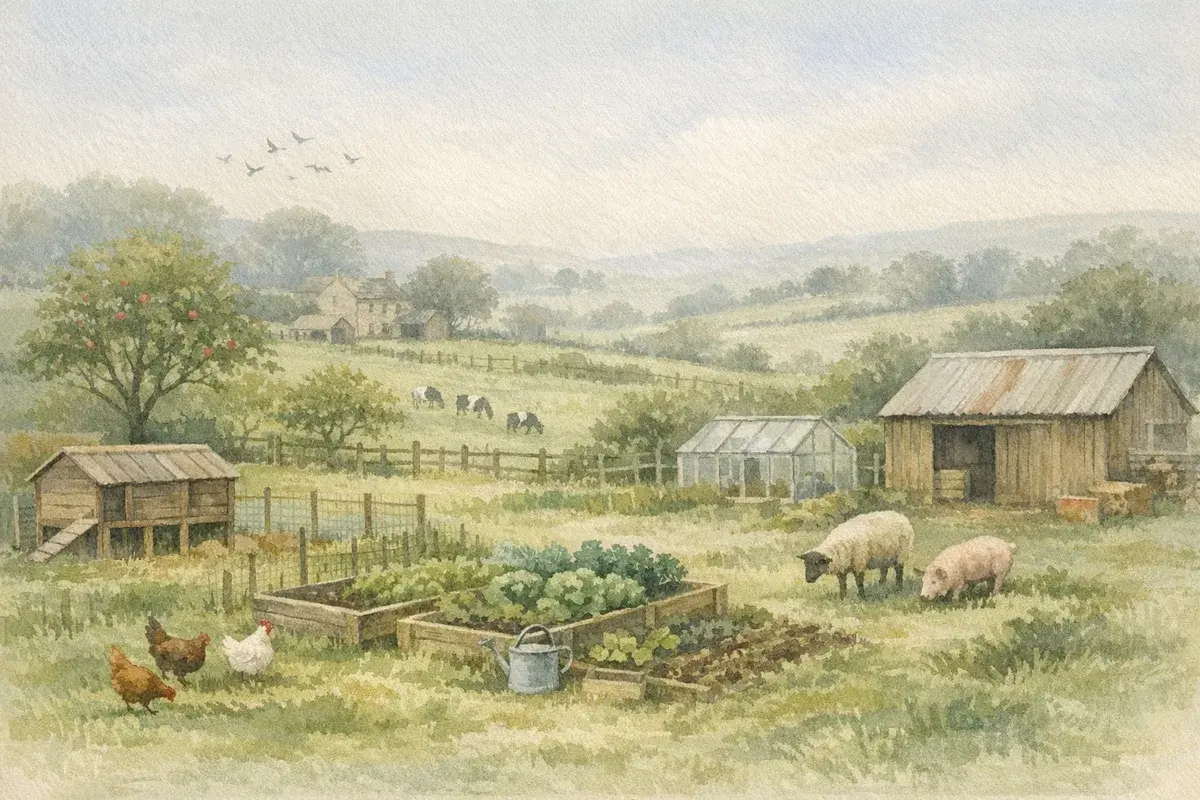
Can you live on a smallholding? In many cases, yes, but it depends on planning use, the land and buildings you buy, and whether the property already has lawful residential accommodation. This guide explains the rules, costs, income options, and the practical realities of making a smallholding work.
The short answer is that you can often live on a smallholding if there is an existing dwelling, a lawful annexe, or planning permission for residential use. If the land is agricultural only, though, things get trickier fast, because sleeping in a caravan, barn or converted outbuilding is not the same as having a lawful home.
That distinction matters. A smallholding is usually a small rural holding, often anywhere from a few acres up to around 20 acres or more, used for livestock, growing produce, or keeping horses alongside domestic life. The attraction is obvious: a bit of land, some independence, maybe a few sheep or poultry (and perhaps a side income), but the reality is usually more demanding and more regulated than buyers expect.
If you're asking the question because you want to move to the countryside and live more self-sufficiently, you're not alone. We'd argue that the real question is not just whether you can live on a smallholding, but whether you can do so lawfully, affordably, and sustainably over the long term.
What Living on a Smallholding Really Means
Living on a smallholding usually means your home and your land are closely linked. You may keep livestock, grow vegetables, manage orchards, or produce hay, and the holding may generate some income, though often not enough to support a household on its own. In practice, many smallholders combine full-time work with part-time enterprises on the land.
For estate agents and buyers alike, the detail matters. Is it a farmhouse with land, a bungalow with paddocks, a barn conversion with grazing, or a bare parcel of land with no lawful dwelling? Those categories affect value, finance, and whether you can simply move in and get on with it.
Smallholding, Small Farm, Or Lifestyle Plot
These terms get mixed up all the time, but they're not interchangeable. A small farm usually implies an active agricultural business, while a lifestyle plot may simply be a rural home with a little acreage attached.
A smallholding sits somewhere between the two. It may be productive and business-like, but it can also be partly domestic and partly rural leisure, which is why planning and access to services matter so much.
- Smallholding: A holding with land used for mixed rural, domestic, or agricultural purposes.
- Small farm: A commercial agricultural unit, usually with clearer production and income aims.
- Lifestyle plot: A rural property bought mainly for home life, not primary farming output.
If you're viewing in Devon, Sussex, or Shropshire, you'll often see this blurred in marketing language. The brochure may say smallholding, but the legal status of the dwelling and land use is what really counts.
Planning Permission And Residential Use
This is the crux. You can live on a smallholding if there is a lawful residential dwelling, or if planning permission has been granted for one. Without that, you may be looking at a holding that's suitable for agricultural use but not for permanent residence.
Planning law in England, Scotland, and Wales can be strict, and local policy varies by county and district. In parts of Cornwall, Somerset, Herefordshire, and Powys, for example, planning authorities are often cautious about new homes in the open countryside unless there is a strong agricultural or rural exceptions case.
Agricultural Dwelling Requirements
Some homes are tied to agricultural occupancy, meaning the property was approved because a worker in agriculture needed to live there. These are sometimes called agricultural tie properties, and the tie can restrict who may occupy the home. A buyer should always check the title, planning history, and any occupancy conditions carefully.
If there's a barn, shed, or redundant agricultural building on site, you cannot assume it can simply be converted into a house. Permitted development rights may help in some cases, but many barn conversions still need a full application, and local designations can limit what is possible.
- Lawful dwelling: A building with clear residential permission or established lawful use.
- Agricultural tie: A condition limiting occupation to farming or rural workers.
- Change of use: Planning consent to convert a non-residential building to housing.
As of June 2026, planning authorities remain under pressure to protect the countryside from speculative development, so buyers should expect scrutiny. That's especially true where access, drainage, biodiversity, or landscape character could be affected.
Can You Afford To Live On A Smallholding?
Affordability is where romantic ideas often meet hard numbers. A smallholding can be cheaper than a larger estate, but it still carries costs that suburban homeowners may never encounter, from fencing and water supplies to machinery repair and animal health.
Property prices vary hugely by region, condition, and whether there is a house included, but as of June 2026 a modest residential smallholding in parts of the Midlands or northern England may start from around £350,000 to £700,000, while well-located holdings in the South West or Surrey can be far higher. Land values also move sharply: grazing land in some areas may sit around £8,000 to £12,000 per acre, while productive arable land can exceed that, depending on quality and demand.
| Factor | Typical Cost Range as of June 2026 | What It Means |
|---|---|---|
| Residential smallholding with house | £350,000 to £1.5m+ | Depends on acreage, dwelling quality, and region |
| Bare grazing land | £8,000 to £12,000 per acre | Lower value if no residential use |
| Basic setup costs | £10,000 to £50,000+ | Fencing, water, sheds, access, groundwork |
| Annual holding costs | Varies widely | Feed, vet bills, insurance, fuel, maintenance |
The holding may look affordable on paper, but can become expensive very quickly once you add drainage issues, septic tanks, track repairs, and machinery. If you're buying in counties such as Dorset, Kent, or North Yorkshire, transport links and labour availability can also push running costs up.
Income Streams That Help The Numbers Work
Many owners don't rely on one source of income. Instead, they combine several smaller streams to make the holding viable, which is often the most practical approach anyway.
Common options include egg sales, meat boxes, vegetable boxes, let grazing, woodland products, rural tourism, or renting stables and storage. The key is to be realistic: a few hens and a veg patch are lovely, but they rarely pay the mortgage on their own.
- Livestock sales: Sheep, pigs, poultry, or beef direct to local buyers.
- Produce sales: Vegetables, fruit, flowers, eggs, or preserves.
- Land let: Seasonal grazing or hay rights to another farmer.
Practical Constraints On A Working Smallholding
Even if you can live there legally, daily life on a smallholding is not a passive experience. Water supply, field access, biosecurity, outbuildings, and waste disposal all shape how easy the place is to run.
For example, if the property depends on a private borehole, private drainage, or an old septic tank, maintenance becomes your problem. In wet counties such as Cumbria, Lancashire, or parts of Wales, field poaching and muddy access tracks can create real wear and tear, especially in winter.
Infrastructure You Should Check
Buyers often focus on the house and overlook the working bits. That's a mistake, because the land itself may be the thing that makes the living arrangement viable.
Look closely at mains water, electricity capacity, broadband, boundary fencing, handling areas, and whether there is usable shelter for animals. If you want to keep livestock, make sure the site has safe separation between domestic areas and working areas, because animal welfare and household safety both matter.
- Access: Can a trailer, feed lorry, or vet vehicle get in safely?
- Water: Is it mains, borehole, spring, or shared supply?
- Waste: Is drainage lawful, functional, and well maintained?
- Boundaries: Are fences, hedges, and gates stock-proof?
- Buildings: Are sheds, barns, and stores structurally sound?
This is where a good land agent or surveyor earns their keep. A holding in Gloucestershire may seem idyllic in midsummer, but if the access lane floods every November and the fences are failing, the dream becomes a management job.
Buying The Right Type Of Smallholding For Your Goals
The right smallholding depends on what you want from it. If your priority is family life with a few animals, look for a lawful dwelling, manageable acreage, and low maintenance. If you want a commercial sideline, you'll need better land, stronger buildings, and a proper business plan.
Local character also matters. In parts of Gloucestershire and Worcestershire, mixed holdings with pasture and orchards can suit a diversified setup. In Lincolnshire or East Anglia, flatter land may suit growing or grazing but can require more attention to drainage and shelter.
We'd argue that the best smallholding purchases are the ones that match your actual time, skills, and cash flow, not your weekend fantasies. Ask yourself whether you want a home with land, or a land business with a home attached, because those are very different commitments.
Can you live on a smallholding? Yes, if the legal status works and the economics stack up. The smartest buyers treat it as both a home and an enterprise, checking planning, infrastructure, and income potential before they fall in love with the view.
Disclaimer: AgLand.co.uk is a UK agricultural land and rural property matching service, where buyers register what they are looking for and owners advertise directly to the buyers who match, and a rural resource hub. Nothing in this text is intended as legal, financial, or investment advice. You should carry out your own due diligence and seek guidance from appropriately qualified professionals (for example, solicitors, land agents, surveyors, and financial advisors) for your specific circumstances.