
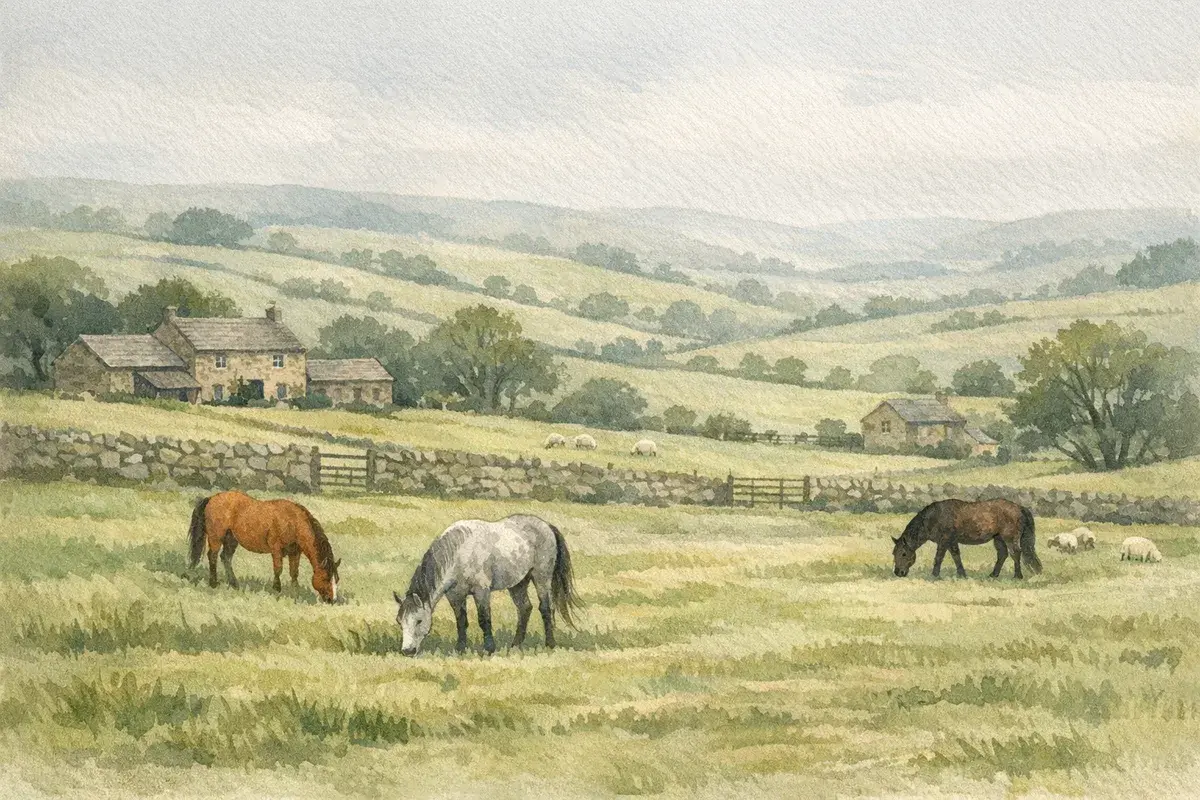
If you've ever walked a "perfect-looking" paddock in July and then seen it churned into a knee‑deep mess by January, you already know the truth about grazing land for horses: the real test is British weather, British soils, and British horse-keeping habits.
Whether you're a farmer considering letting a block for equine grazing, a landowner weighing up a rental arrangement, or you're trying to secure turnout for your own horses, the stakes are higher than most people expect. Get it right and you'll have healthier horses, fewer vet bills, easier winters, and land that holds its value. Get it wrong and you're looking at poaching, weeds, neighbour disputes, planning headaches, and a field that never quite recovers.
This guide cuts through the wishful thinking. You'll learn what genuinely makes good horse grazing in UK conditions, how much land you realistically need, the checks to make before you buy or rent, and the management habits that keep both horses and ground in good shape for the long run.
What Makes Good Horse Grazing Land (And What Does Not)
A lot of people judge horse grazing land by how green it looks from the gate. In the UK, that's a trap.
Good grazing for horses is productive enough to recover, tough enough to take traffic, and safe enough to trust when you can't inspect every square metre daily. Bad grazing is often "nice" in summer, then becomes thin, weedy, and wet exactly when you need it most.
Grass Species, Sward Density, And Seasonal Growth Patterns
For horses, you're aiming for a dense, resilient sward rather than a lush, dairy-style carpet. In practical UK terms:
- Perennial ryegrass drives growth and recovery, but on richer ground it can be too good for native types and good-doers.
- Timothy, meadow fescue and cocksfoot can add structure and drought tolerance.
- Creeping grasses and a tight base help resist poaching and keep weeds out.
The biggest "horse paddock" mistake we see is land that's overgrazed down to the roots. Horses graze very selectively and will repeatedly hammer their favourite patches. Over time you end up with:
- "Lawns" around gateways and water points
- Rank, rejected tussocks elsewhere
- Bare soil where weeds establish
A field that's genuinely suitable for horses has enough acreage (and a grazing plan) to maintain cover through peak pressure periods: spring flush, late summer dry spells, and the long wet squeeze of autumn into winter.
Drainage, Soil Type, And Poaching Risk In Winter
UK winters are the make-or-break. Even a well-managed paddock can be destroyed if the land's wrong for the job.
Key points to assess on foot:
- Soil type: clay holds water and poaches easily: light land can drain well but may burn off in summer.
- Slope and aspect: a slight slope can help shed water: a flat bottom can become a persistent wet patch.
- Compaction: years of horses standing at gates can create a pan that stops infiltration.
If you're viewing land, don't just look at the grass. Look for hoof prints, rushes, standing water, and muddy "desire lines". Ask bluntly: Where does the water go in February?
Pragmatically, many UK set-ups need a sacrifice area (more on that later) because "keeping horses off wet ground" is easier said than done when your only turnout is the same paddock 365 days a year.
Pasture Hazards: Ragwort, Toxic Plants, And Hidden Debris
Horse grazing carries specific risk that a cattle or sheep keeper may underestimate.
- Ragwort: The headline hazard. It's a legal and welfare issue, especially where land is accessible to horses. It's also more dangerous when dried in hay.
- Other toxic plants: yew clippings (often from neighbouring gardens), acorns (oak), sycamore seeds/seedlings (associated with atypical myopathy), foxglove, hemlock, and more.
- Hidden debris: old wire, baler twine, broken gates, dumped rubbish, and fly-tipped garden waste.
Your baseline expectation should be: you can't "set and forget" horse grazing land. If you're a landowner letting grazing, clear responsibilities for inspection and weed control are essential, because when problems crop up, they crop up fast.
How Much Land Do You Need Per Horse In UK Conditions?
This is where horse grazing land gets emotional. Everyone wants the tidy answer, "X acres per horse", but UK reality is a moving target: rainfall, soil, grass growth, turnout hours, and whether you're feeding hay in the field all change the equation.
If you want the deeper numbers and scenarios, it's worth reading our guide on working out how much land you need per horse, but here's the practical thinking you can apply immediately.
Rule-Of-Thumb Stocking Rates Versus Reality (Workload, Weather, And Soil)
A rule-of-thumb can help you sanity-check, but it's not a plan.
In broad UK terms, the "safe" end of horse stocking is often more land than people expect, because:
- Horses don't graze evenly like sheep.
- You'll have high-traffic zones (gateways, water, shelters).
- Wet winters can force you into restricted turnout or concentrated areas.
Ask yourself three questions:
- Are you aiming to graze (mostly) off the field, or are you happy feeding hay for long periods?
- Can you rest paddocks properly, or is every acre in constant use?
- What happens in a bad winter? (Not an average winter. A bad one.)
If you're a landowner, this is also where tenant/keeper expectations need managing. A paddock that "holds" two horses in summer might not be capable of doing it through a wet winter without damage.
Managing Weight And Laminitis Risk On Rich Pasture
From a horse health perspective, "good grazing" isn't always good news.
On productive UK pasture (especially improved, fertilised leys), good-doers can gain weight quickly. Then you're into:
- Laminitis risk (particularly in spring and autumn)
- Overgrazing when you restrict turnout too tightly
- Behaviour issues when horses aren't moving and foraging naturally
Practical tools that actually work:
- Track systems (encourages movement while controlling intake)
- Strip grazing with back fencing (protects regrowth)
- Mixed swards and less "rocket fuel" grass where appropriate
If you're buying or renting grazing land for horses, try to match the land to the type of horse you keep. Native ponies on dairy-quality pasture is a familiar UK mismatch.
When You Need More Than "Grazing": Hay Ground, Sacrifice Areas, And Turnout Systems
In many UK set-ups, the winning move is admitting early that you'll need more than just "a field".
Consider:
- Hay ground / forage supply: If you can take a hay cut (or have reliable supply nearby), you're less exposed when grass growth stalls.
- Sacrifice area / all-weather turnout: A surfaced or well-drained area protects your main grazing during wet periods. It's often the difference between a field that improves each year and a field that declines.
- Handling and routines: If you can't catch, lead, load, or safely bring in when the weather turns, your "grazing land" becomes a liability.
If your plan involves buying rather than renting, our explainer on buying land for horses in the UK goes into the bigger decision: when land is enough, and when you're really looking for an equestrian set-up.
Key Checks Before You Buy Or Rent Grazing Land
Grazing land for horses sits at the awkward crossroads of agriculture, equestrian use, and local planning control. Before you commit, whether it's a purchase, a seasonal licence, or a longer arrangement, do these checks with your eyes open.
Access, Boundaries, And Rights Of Way You Cannot Ignore
Access sounds basic until you try to get a vet down a lane in January or you're reversing a trailer with traffic building behind you.
Check:
- Legal access (not just "we've always gone that way"). If it's a private track, who maintains it?
- Width and turning for horseboxes, hay deliveries, and contractors.
- Boundary responsibility: who owns which fence/hedge line, and what condition it's in.
- Public rights of way: footpaths and bridleways can run straight through grazing. That's workable, but you'll need safe fencing lines and clear signage. It can also affect privacy and the practicalities of moving horses.
If you're buying, pay attention to what your solicitor is actually checking versus what you assume is included (e.g., strips of land, gateways, verges). Small boundary surprises become big disputes.
Water Supply, Field Shelter, And Practical Handling Areas
A paddock can look ideal and still fail on basics.
- Water: Mains water is straightforward but not always available. Troughs need reliable supply and frost protection. Natural watercourses add management and safety issues.
- Shelter: Natural shelter (hedges, banks, woodland edge) is valuable, but watch for toxic trees (yew) and fallen branches.
- Handling: You'll want somewhere to catch, tie up, farrier, and treat minor injuries safely. Even if you keep it simple, plan for the day things go wrong.
Many of the "horse-keeping headaches" we hear about aren't glamorous, they're daily friction: carrying water, dragging hay through mud, fencing that won't hold, nowhere level to stand.
Planning And Permitted Development Basics For Stables, Shelters, And Hardstanding
This is where people get caught out.
If your "grazing land" plan includes stables, field shelters, hardstanding, lighting, ménages, or even frequent use for schooling, you need to think about planning early. The rules depend on specifics: location, designation (e.g., AONB), past planning history, and whether the use is classed as agriculture, equestrian, or a mix.
A few pragmatic truths:
- Permitted development rights are not a universal safety net.
- A "moveable" shelter isn't automatically exempt if it's effectively permanent in the eyes of the council.
- Hardstanding and access tracks can trigger planning and drainage considerations.
If planning is central to your purchase (or you want land that's already set up), read our guide to finding equestrian land with the right planning position. And if you're stepping up from grazing into a full yard, our overview of how to assess an equestrian property properly will save you from expensive assumptions.
Renting Grazing: Licences, Grazing Agreements, And Common Pitfalls
Renting grazing can be brilliant: flexible, lower capital outlay, and a way to test a location before you buy. But it's also where misunderstandings multiply, especially when the paperwork is vague and expectations are "handshake-based".
Grazing Licence Versus Farm Business Tenancy: Why The Distinction Matters
In the UK, the structure of the agreement matters. A genuine grazing licence is typically a short-term permission to graze, without granting exclusive possession of the land. A tenancy (including a Farm Business Tenancy) is a different beast with different rights and responsibilities.
Why you should care:
- Control: Landowners often want to retain control (e.g., to top, fertilise, spray, cut hay, or re-let).
- Security and duration: Keepers may need enough certainty to invest in fencing or water.
- Risk: If the arrangement looks and behaves like a tenancy, it can create legal complexity later.
This is an area where you should take proper professional advice before signing anything, especially if you're the landowner and the land is part of a wider farming business.
Typical Terms: Repairs, Fencing, Water, Manure, And Weed Control
Most disputes come from "obvious" things nobody wrote down.
A sensible grazing agreement usually clarifies:
- Who supplies and maintains fencing, gates, and posts
- Who pays for and maintains water supply and troughs
- Who controls ragwort and weeds (and what standard is expected)
- Whether topping is allowed/required, and who does it
- What happens with manure (removal, muck heaps, spreading rules)
- Whether you can bring in contractors (harrowing, rolling, spraying)
If you're letting land, be realistic: horse grazing often causes more concentrated wear than livestock grazing. If you're taking land, don't underestimate the cost of getting it "horse-ready" (safe fencing alone can be a meaningful annual expense).
Insurance, Liability, And HSE Considerations For Landowners And Keepers
Even a quiet paddock creates risk.
- Public liability: If there's a public footpath, nearby road, or shared access, you need robust cover.
- Employer's liability: If anyone works for you (even casually), you may have obligations.
- Health and safety: Yard-style activities (loading, handling, machinery use) can raise the risk profile beyond simple grazing.
Landowners should consider their duty of care about obvious hazards (derelict structures, old pits, unsafe boundaries). Keepers should assume responsibility for day-to-day horse safety, and document condition on entry with photos. It's boring admin until it saves you.
Day-To-Day Pasture Management For Healthy Horses And Healthy Ground
If you want grazing land for horses to stay productive, your goal isn't "short grass". It's living cover, strong roots, and a system that survives winter.
The good news? You don't need a degree in agronomy. You do need consistency and a willingness to protect grass when it's vulnerable.
Rotational Grazing, Rest Periods, And Reseeding Strategy
Rotational grazing for horses isn't about being fancy, it's about giving grass time to recover.
A workable UK approach:
- Split into multiple paddocks (even temporary electric fencing helps)
- Graze hard enough to use grass, but avoid scalping to bare soil
- Rest long enough for regrowth (rest periods vary hugely by season)
If you're trying to lift carrying capacity, it helps to measure what you've got: where the ground stays wet, where horses congregate, where weeds establish.
For a step-by-step UK framework, covers, soil pH, compaction, and practical rotation, use our pasture management guide for better grass and healthier soils.
Reseeding is sometimes necessary, but it's not a magic reset if the underlying problem is traffic or drainage. On heavy land, improving infrastructure and turnout strategy can deliver more than throwing seed at mud.
Fertiliser, Spraying, And Manure Management Without Causing Problems
Horse paddocks often get managed "lightly" compared with commercial grassland, yet they can still benefit from basic, sensible inputs.
- Soil testing: Start here. Correcting pH (often with lime) can make existing nutrients more available.
- Fertiliser: Use cautiously if you've got good-doers: faster growth can increase intake and laminitis risk.
- Spraying / weed control: Ragwort and docks need timely action. Always follow label instructions and withdrawal periods, and consider how you'll keep horses off treated areas.
Manure is its own ecosystem. Left unmanaged, it:
- Concentrates worm eggs and larvae
- Smothers grass
- Encourages weeds
If you can't remove it regularly, at least create a plan for collection areas and disposal that doesn't annoy neighbours or breach environmental rules.
Worm Control, Droppings Removal, And Co-Grazing Options
Modern worm control is moving away from blanket dosing. In the UK, many vets now encourage:
- Faecal egg counts to target treatment
- Strategic dosing for specific risks (e.g., encysted small redworm, tapeworm) based on veterinary guidance
Daily or near-daily poo picking is labour, yes, but it's also one of the most effective pasture management tools you've got.
Co-grazing can help break parasite cycles and tidy up rejected patches, but it's not a casual decision. Sheep or cattle bring different fencing needs, handling, and biosecurity considerations. If you're a farmer integrating horses into a wider rotation, it can work very well, just do it with a plan, and keep responsibilities clear.
Where To Find Horse Grazing Land In The UK (And How To Search Efficiently)
Finding grazing land for horses is rarely about luck, it's about being systematic and moving quickly when the right block appears.
In many areas, the best opportunities never make it to social media. They move through land agents' call lists, local networks, and specialist platforms where the audience is already rural-property-focused.
Using Specialist Agricultural Portals And Agent Networks To Avoid "Post-And-Hope" Listings
General classifieds can be a time sink: vague locations, unclear tenure, no maps, and "ideal for horses" slapped on anything green.
A better approach is to search where agricultural land is marketed properly, by acreage, boundaries, access, and location, with filters that reflect how rural property is actually assessed.
On AgLand, you register what you're after - type of land, acreage, budget and area - and you're alerted the moment a matching block is advertised, so equine-suitable land comes to you instead of you hunting for it.
What To Ask Land Agents Up Front To Save Wasted Viewings
Before you drive an hour for a viewing, ask a tight set of questions. You're trying to rule out the "no chance" sites fast.
Ask:
- What's the water situation (mains, troughs, rights to connect)?
- Any public rights of way through the land?
- What's it like in a wet winter, does it hold up?
- What are the boundaries and who maintains them?
- Are there any known issues with ragwort or other weeds?
- Is it offered on a licence or tenancy, and what's the term?
If you're buying, ask what's included: gateways, tracks, hardstanding, and whether any facilities have planning history.
Due Diligence Checklist Before You Commit
When you're close to saying yes, slow down and check the unglamorous stuff:
- Walk the boundaries, look for gaps, broken posts, old wire
- Check drainage clues: rushes, ruts, ponding, compacted gateways
- Identify hazards: poisonous trees, fly tipping, derelict structures
- Confirm access rights and practical access for vehicles
- Get clarity (in writing) on responsibilities: weeds, fencing, water, manure
- Budget for immediate basics: safe fencing, water, a handling area
And if your plan is to buy rather than rent, be honest about what you're really building: a simple grazing arrangement, or an equestrian operation. The costs, permissions, and neighbour dynamics are not the same.
Conclusion
Grazing land for horses in the UK isn't just about acreage, it's about resilience. The best paddocks are the ones that still function when it's been raining for three weeks, the gateway's under pressure, and you need turnout anyway.
If you take one mindset into your search and management, make it this: protect the land and it will look after the horses. That means doing the checks early (access, water, rights of way, planning), getting the agreement structure right if you're renting, and running a simple pasture system that allows rest and recovery.
When you're ready to act, be decisive, but not rushed. The right block of grazing is an asset: the wrong one becomes a winter-long problem.
Disclaimer: AgLand.co.uk is a UK agricultural land and rural property matching service, where buyers register what they are looking for and owners advertise directly to the buyers who match, and a rural resource hub. Nothing in this text is intended as legal, financial, tax, or investment advice. You should carry out your own due diligence and seek advice from appropriately qualified professionals (e.g., solicitors, surveyors, land agents, planning consultants, accountants, and veterinarians) before buying, renting, or managing land for horses.