
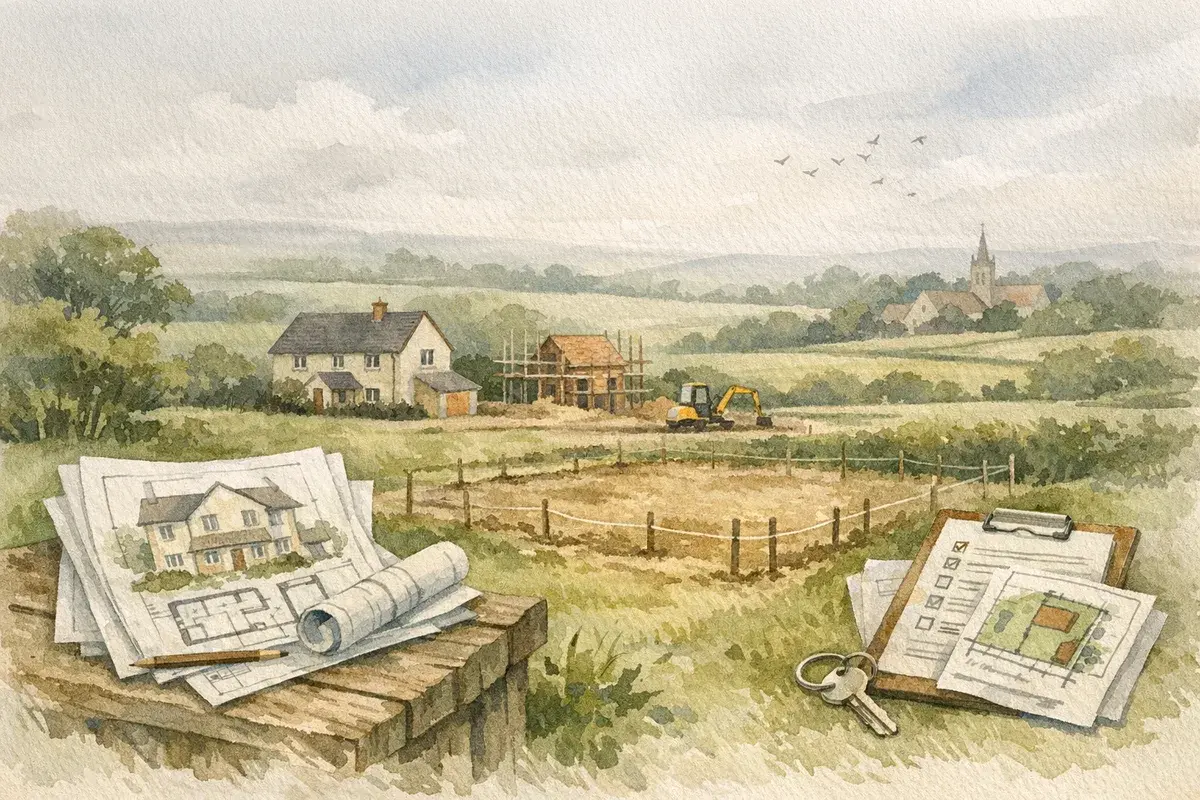
If you want to buy land with planning permission uk, you're usually paying for certainty as much as acres. That can mean a development plot, a barn conversion site, or farmland with consent for a dwelling, but the real value depends on what the permission actually allows.
The trick is not just spotting an approved site. It's understanding whether the consent is implementable, bankable, and still valid, because planning paperwork can look attractive while the hidden conditions quietly kill the deal.
We'd argue this is where many buyers overpay. A site with permission in Surrey won't behave like one in Lincolnshire, and a plot with outline consent in Devon is a very different beast from one with full reserved matters approved in Cheshire.
What Buying Land With Planning Permission Actually Means
Land with planning permission is land that has approval from the local planning authority for a specific use or development. That might be a single rural bungalow, a pair of houses, an agricultural building conversion, or a wider residential scheme on the edge of a village.
For buyers, the attraction is obvious. You are not starting from scratch, and you may avoid years of uncertainty, design work, and appeal risk. But the permission is not a free pass. It comes with conditions, time limits, and often financial obligations such as Section 106 agreements or the Community Infrastructure Levy, usually called CIL.
Outline Consent Versus Full Permission
Outline permission establishes that development is acceptable in principle, but some matters are left for later approval. Full permission, by contrast, usually settles the design and layout in more detail, which is why it often carries greater certainty for a buyer.
If you're buying for a self-build, a family dwelling, or a small rural development, full permission is generally easier to finance and less exposed to interpretation. Outline consent can still be valuable, though, especially where the site is strategic or the design work is straightforward.
- Outline consent: principle agreed, details still to follow.
- Full permission: details approved, subject to conditions.
- Reserved matters: the later approval stage for outline schemes.
- Condition precedent: a condition that must be satisfied before starting.
The key point is simple. You are buying the rights attached to the permission, not just the soil beneath your boots.
How Much Land With Planning Permission Costs In The UK
Prices vary massively, because consent changes the value of raw land into potential development land. As of June 2026, a small rural plot with permission for a single dwelling in parts of the North East or Wales may trade at a very different level from a comparable site in the South East, where housing demand is stronger and planning gain is often much greater.
That said, there is no single national yardstick. Agricultural value, access, services, build costs, sales risk, and planning certainty all affect the price. A site with road access, mains drainage, and a clean title will usually command more than a cheaper-looking parcel that needs infrastructure, easements, or a ransom strip sorted out.
| Site Type | Typical Price Driver | Risk Level | Market Note as of June 2026 |
|---|---|---|---|
| Single dwelling plot | Local house values and permission quality | Medium | Often strongest in commuter counties and coastal villages |
| Barn conversion site | Conversion costs and heritage constraints | Medium to High | Popular in Somerset, Herefordshire, and Wiltshire |
| Residential development land | Plot count, affordable housing, and obligations | High | More complex where policy pressure is strong |
| Former agricultural land with consent | Access, services, and abnormal costs | Medium | Can be compelling if utility connections are close |
As of June 2026, buyers are also being more selective on sites with costly abnormal works. If a plot needs new drainage, retaining walls, or a long private access track, the apparent discount can disappear fast. The headline price matters, but the all-in cost decides whether the site is actually worth buying.
Why Price Per Acre Can Mislead
Land values are often quoted per acre, but that can be dangerously simplistic when planning permission is involved. Two fields of the same size can have wildly different value depending on whether one has a live consent, while the other has only a hopeful local assumption.
We'd say the smarter approach is to price the residual value. In plain English, that means estimating the finished scheme's value, then stripping out build costs, professional fees, policy contributions, finance, and profit margin before deciding what the land is worth.
What To Check Before You Buy
This is the part that saves money. A planning permission can look robust and still be fragile if the details are wrong, incomplete, or about to expire.
Start with the decision notice, approved plans, and all related reports. Then check the condition wording carefully. Some conditions are routine, but others are so restrictive they delay the build or force expensive redesigns.
Legal And Planning Due Diligence
You need to know who owns the land, what rights come with it, and whether there are any restrictions on use or sale. It's also worth checking whether the permission has been lawfully implemented, because that can preserve the consent even if later stages change.
On rural sites, access rights and third-party easements matter just as much as the planning stamp. If the only route to the site crosses neighbouring land, or if services run through someone else's title, the deal can become messy very quickly.
- Decision notice: confirms the exact approved development.
- Conditions: may require drainage, landscaping, ecology, or materials approval.
- Section 106: legal agreement that can affect cost and timing.
- CIL liability: a levy that may apply to new development.
- Title restrictions: can limit use, transfer, or mortgageability.
Technical Checks That Matter On Rural Land
Drainage is a big one, especially on former pasture or clay ground in counties like Norfolk, Shropshire, and Gloucestershire. Flood risk, soil conditions, protected species, and archaeology can all affect whether the planning gain is real or merely theoretical.
If there is a barn conversion, check whether the building is structurally suitable and whether any prior approval or heritage consent was granted. If it is an edge-of-settlement plot, ask whether the local authority will treat it as a natural infill site or as a contentious extension into open countryside. That distinction can be worth a fortune.
Regional Differences In England, Scotland, Wales, And Northern Ireland
Buying land with planning permission is a very local game. National headlines are useful, but county-level policy and market demand usually decide the outcome.
In England, the South East, parts of the East of England, and strong commuter counties such as Kent, Surrey, and Hertfordshire often show the highest competition for consented plots. In the Midlands and the North West, values may be lower, but build costs and local demand still shape the economics.
How The Nations Differ
Scotland has its own planning system, built on the Town and Country Planning (Scotland) Act 1997, so buyers need to understand local policy, rural housing exceptions, and the different approach to development rights. In Wales, countryside policy can be tighter in some areas, while opportunities still exist around settlements, farmsteads, and conversion schemes.
Northern Ireland also follows a separate planning framework, and rural sites can come with distinct sensitivities around access, design, and neighbourhood impact. The practical message is the same everywhere: the only permission that matters is the one attached to your exact site, not the one that worked next door.
County Examples Buyers Often Miss
In Cornwall, landscape constraints and coastal policy can make permissions more precious, but also more fragile. In Cambridgeshire, pressure from housing growth and infrastructure can create opportunities, though not always at bargain prices.
Meanwhile, in counties with strong agricultural inheritance like Staffordshire or North Yorkshire, barns, yard parcels, and farm edge plots can be attractive if access, services, and policy fit together. The best sites are rarely obvious from the fence line alone.
Financing, Taxes, And Exit Strategy
Finance is where many promising purchases run into reality. Lenders will usually want clarity on title, planning status, access, and exit strategy, and they may be cautious where the site is speculative or the permission is conditional.
For smaller plots, especially self-build or one-off dwelling sites, bridging finance or specialist development funding may be used. For larger sites, lenders often want experienced borrowers, realistic sales appraisals, and a decent contingency. That is sensible, because a planning permission does not remove market risk, it simply changes its shape.
Tax Points To Think About
Different tax issues can apply depending on whether you are buying as an individual, company, trust, or trading business. Land transaction tax, stamp duty land tax, VAT on certain elements, and capital gains implications can all matter, particularly if the land was previously agricultural or is being bought from a business seller.
If a farm is selling a parcel with consent, the seller may be balancing tax efficiency against land value. Buyers should watch for over-engineered deal structures, retainers, or overage agreements, which can all affect future cost and resale. Overage, sometimes called a clawback, means the seller gets a share of later uplift if the site is improved further.
That is not always bad. It just needs to be priced properly, because the cheapest site on paper can prove the most expensive in practice.
Conclusion
If you want to buy land with planning permission uk, focus on certainty, not just the headline consent. Check the detail, test the infrastructure, understand the local market, and make sure the numbers still stack up once conditions, obligations, and build costs are included.
The best purchases combine a clean title, a workable permission, and a realistic exit. Miss one of those, and the land can stop being an opportunity and start becoming a burden.
Disclaimer: AgLand.co.uk is a UK agricultural land and rural property matching service, where buyers register what they are looking for and owners advertise directly to the buyers who match, and a rural resource hub. Nothing in this text is intended as legal, financial, or investment advice. You should carry out your own due diligence and seek guidance from appropriately qualified professionals (for example, solicitors, land agents, surveyors, and financial advisors) for your specific circumstances.