
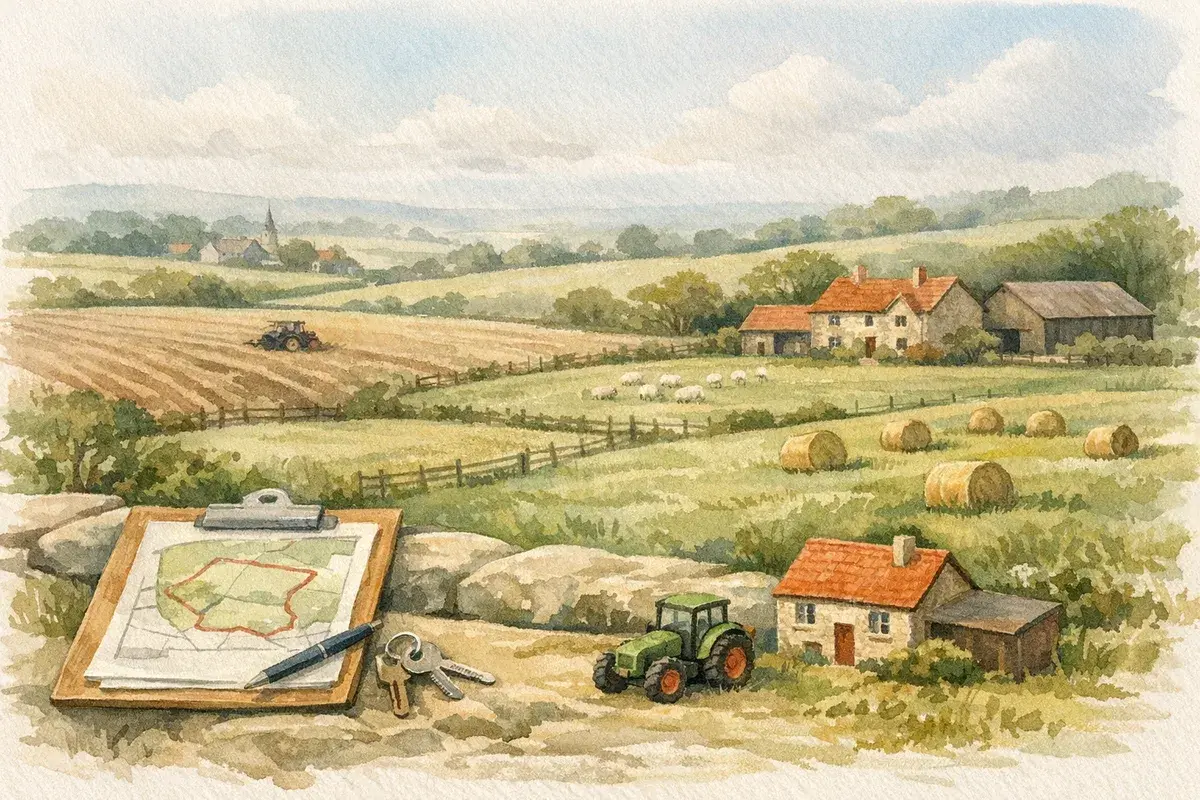
The sale of agricultural land is rarely straightforward. Price, tax, access, development hope value and buyer type all shape the outcome, so it pays to understand the process before you place land on the market.
Whether you are selling a small paddock in Kent, a block of arable land in Lincolnshire, or mixed grassland in Devon, the right approach can make a material difference to both price and certainty. We'd argue that in most cases, the best sales are the ones prepared well before a buyer is found.
That means thinking beyond headline acres and looking at what the land can genuinely do. Is it productive Grade 2 arable ground, poorer grazing, or land with longer term development angles? The answer changes everything. It affects valuation, marketing, buyer appetite and, crucially, the legal terms you should insist on.
What Drives The Sale Price Of Agricultural Land
There is no single market rate for farmland. In sale of agricultural land cases, price is driven by a mix of agricultural productivity, location, access, size, and any non-agricultural potential. A compact block with good road frontage in East Anglia will often attract more interest than a fragmented parcel in a remote part of Northumberland, even if both are the same acreage.
Productive capacity matters. Better soils, reliable drainage and sensible field shapes usually support stronger bids because they reduce operating costs for farmers and contractors. Land close to grain stores, livestock units or abattoirs can also be more attractive, especially where transport costs are biting.
Then there is hope value. That is the market's assessment of what the land might be worth if planning permission or a future use change becomes possible. It can be significant in parts of the South East, around expanding market towns, and along lower-risk edges of settlements in counties such as Essex, Hertfordshire and Oxfordshire. But hope value is not guaranteed value, and that distinction matters.
How Acreage And Shape Affect Demand
Small parcels can sell quickly if they suit local farmers, equestrian buyers or lifestyle purchasers. Larger blocks often appeal to commercial operators because they improve scale and efficiency, but only if boundaries, access and drainage make sense.
Irregular shapes, awkward access and split ownership arrangements can all suppress competition. Buyers do not like complications, and they price them in.
Why Soil And Drainage Still Count
Soil type is one of the quiet drivers of value. Loams and deep silts usually command stronger agricultural demand than wet heavy clays, especially where cropping margins are tight. Drainage, flooding history and seasonal accessibility can make the difference between land that is easy to farm and land that is expensive to keep productive.
- Grade 1 and 2 land: Usually strongest on agricultural productivity.
- Grade 3 land: Often versatile, but value depends on local context.
- Grade 4 and 5 land: Typically lower output, though amenity or environmental interest can matter.
- Road frontage: Improves access, visibility and possible development interest.
- Drainage and water supply: Directly affect usability and buyer confidence.
Preparing Agricultural Land For Sale
Preparation is not just about tidying the hedges and mowing the gateway tracks. A well-prepared sale of agricultural land starts with paperwork, tenancy review, title review and a hard look at what you are actually offering. If the legal pack is messy, buyers will slow down or chip away at the price.
First, check the title plan and deeds against the land on the ground. It sounds obvious, but boundaries, rights of way, drainage easements, grazing rights and access strips are common sources of delay. In counties with older field patterns, such as Somerset, Shropshire and Yorkshire, historic arrangements can run deep and create complications that surface only when a buyer's solicitor asks the awkward questions.
If the land is tenanted, you need to understand the tenancy type. A fixed term Farm Business Tenancy (FBT) is usually more saleable than a longer protected arrangement because buyers can see when possession will arise. But each case turns on the agreement itself, and on whether the buyer wants vacant possession or a continuing income stream.
Documents Buyers Expect To See
Serious buyers expect usable information, not a box of random PDFs. The more complete your pack, the less likely you are to face last-minute haggling.
- Title documents: confirm ownership and boundaries.
- Tenancy agreements: show occupation terms and expiry dates.
- Soil and drainage details: help buyers assess productive capacity.
- Environmental scheme information: reveals ongoing obligations or income.
- Access and rights documentation: proves practical entry to the land.
It also helps to clear out practical issues. Overgrown gateways, broken fencing, littered margins and unclear access points do not just look untidy. They can cause buyers to assume the land has been neglected, which weakens confidence.
Should You Consider Planning Or Overage First?
Sometimes yes, sometimes no. If your land lies on a village edge in Surrey, Cheshire or South Devon, a planning appraisal may be worthwhile before sale because even a modest uplift in development potential can transform value. On the other hand, if the ground is plainly agricultural and remote from settlement, spending heavily on planning speculation may not pay back.
Overage, also called a clawback, is a clause that lets the seller receive additional money if a future event, usually planning permission, increases value. It sounds attractive, but buyers will scrutinise it carefully, and too much overage can deter bids altogether.
Pricing, Valuation And Market Conditions
Pricing agricultural land is part art, part evidence. A land agent will usually look at comparable sales, soil quality, local demand, access, size and any development prospects, then build a view of where the land should sit in the market. That is especially important in a softening or uneven market, because overpricing can leave land stale.
As of June 2026, UK farmland values remain highly location-dependent. As a broad guide, good arable land in strong county markets such as Cambridgeshire, Lincolnshire and Norfolk tends to attract the sharpest prices, while poorer grassland in upland areas usually sits lower. We are deliberately cautious here, because deals vary widely and no two blocks are identical.
The table below gives a practical feel for how market positioning can differ by land type rather than stating a single national figure that would be misleading.
| Land Type | Typical Buyer Interest | Price Driver | Market Note As Of June 2026 |
|---|---|---|---|
| Prime arable land | Commercial farmers and investors | Yield, soil quality, scale | Often strongest where blocks are large and well connected |
| Improved grassland | Livestock farmers and mixed units | Grazing quality, drainage, fencing | Solid demand in dairy and beef regions |
| Marginal or rough grazing | Local farmers, amenity buyers | Usability, access, environmental schemes | Pricing can be sensitive to location and waterlogging |
| Edge-of-settlement land | Developers and land promoters | Planning prospect, access, policy context | High variance, especially near expanding towns |
Market timing matters too. Spring and early summer often bring strong interest because buyers can inspect land in better condition, but that does not mean you should force a sale to suit the calendar. If you have a standout block, the right price and the right pack will usually weigh more than the month of launch.
Regional Variations Buyers Watch
In the South East, development-adjacent land and small parcels can command exceptional attention. In the East of England, scale and arable quality often drive the contest. In Wales, the South West and parts of the North, livestock utility, environmental payments and amenity use may matter more than pure cropping logic.
Estate agents selling agricultural land should also remember local buyer pools. In some counties there are plenty of commercial operators nearby; in others, interest may come from hobby farmers, equestrian buyers, or neighbouring estates looking to rationalise holdings.
Taxes, Legal Issues And Deal Structure
The legal and tax structure can be as important as the headline price. A strong offer can still turn into a weak outcome if you ignore capital gains tax, inheritance planning, VAT, or occupation rights. That is why the sale of agricultural land should be considered early, not after a buyer appears.
If the land qualifies as part of a farming business, Agricultural Property Relief and Business Property Relief may be relevant elsewhere in the succession picture, but a sale itself can still trigger tax consequences. Capital gains treatment depends on the vendor's circumstances, historic acquisition cost, and whether private residence or trading reliefs are in play. There is no one-size-fits-all answer.
VAT is another issue buyers dislike discovering late. Some farmland sales are outside the scope of VAT, while others are opted to tax or linked to taxable supplies. If a buyer is not expecting VAT on top of the price, the deal can quickly unravel. Likewise, overage, ransom strips, easements and reserved rights all need clean drafting.
Vacant Possession Versus Subject To Tenancy
Vacant possession usually broadens the market because it gives buyers flexibility. That said, a secure tenancy can still appeal if the income is attractive and the buyer wants an income-producing asset rather than immediate occupation.
In practice, the best route depends on who you are targeting. A sale to a nearby farmer in Cheshire may work on a subject-to-tenancy basis if they want long-term scale, whereas a developer or land investor will usually want clean control of title and access.
Planning Terms That Matter Long After Completion
Do not treat completion as the end of the story. If you agree overage, ransom rights or restrictive covenants, those terms can live with the land for years. Slightly tougher drafting now can protect value later, but it can also reduce bidder appetite if pushed too far.
- Overage period: sets how long future value sharing lasts.
- Trigger events: define what activates additional payment.
- Access rights: prevent disputes after completion.
- Reserved rights: keep essential seller rights intact where needed.
Marketing Agricultural Land To The Right Buyer
The strongest marketing is specific. A broad claim that land is 'suitable for all uses' usually helps no one. Instead, define the likely buyer: local farmers seeking block adjunction, investors looking for land-backed diversification, or developers interested in edge-of-settlement potential.
Good particulars should show field boundaries clearly, note soil and drainage where known, and explain access without ambiguity. If the land sits in Devon with sea views and stony pasture, say so. If it is a neat 80-acre arable block in Lincolnshire with direct roadside access, say that too. Buyers need enough detail to picture the operational reality.
Photography matters more than many sellers think. Images taken in poor weather or after harvest may undersell the land, while well-timed pictures can make an ordinary parcel look orderly and usable. That does not mean dressing it up dishonestly. It means showing it at its best.
Discreet off-market approaches can work for sensitive disposals, but open marketing usually creates a wider field of bidders. For many blocks, especially those suitable for commercial farming, competition is what moves value. Without it, a buyer can sense weakness from a mile off.
Who Usually Buys Agricultural Land?
The buyer pool is broader than pure farmers. In many counties, the field includes neighbours, agricultural investors, lifestyle purchasers, equestrian operators and, where planning potential exists, specialist land buyers.
Understanding which buyer matters most helps you decide whether to prioritise scale, access, amenity, income or future potential in your marketing. Get that wrong, and even a good parcel can sit too long.
Conclusion
The sale of agricultural land works best when value, legal structure and buyer strategy are aligned from the start. A realistic price, tidy title, clear access and a sales pack that answers the obvious questions will usually outperform a rushed launch with plenty of guesswork.
If you are selling farmland in England, Scotland or Wales, remember that regional demand varies sharply by county and land type. The right approach is to treat the land as a business asset first, then market it in a way that matches the most likely buyer.
Disclaimer: AgLand.co.uk is a UK agricultural land and rural property matching service, where buyers register what they are looking for and owners advertise directly to the buyers who match, and a rural resource hub. Nothing in this text is intended as legal, financial, or investment advice. You should carry out your own due diligence and seek guidance from appropriately qualified professionals (for example, solicitors, land agents, surveyors, and financial advisors) for your specific circumstances.