
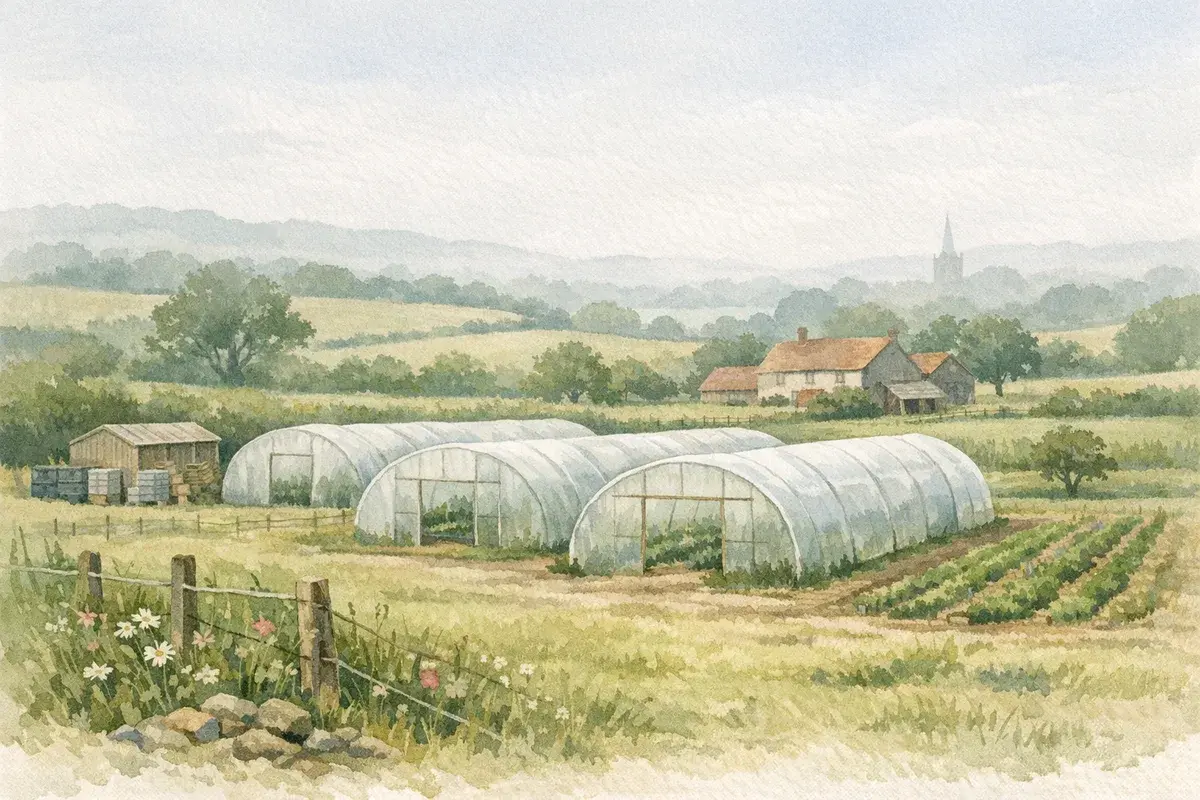
If you're asking do i need planning permission for a polytunnel on agricultural land, the short answer is: sometimes, but not always. It depends on what the polytunnel is for, how it's fixed to the ground, and whether your site falls within permitted development rights.
For many farms, a polytunnel is treated as an agricultural structure and can go ahead without a full planning application. But that's only true when it supports genuine farming use, stays within local planning limits, and doesn't behave like a permanent building (which is where trouble starts).
The practical test is simple enough. If the tunnel is supporting crop production, is relatively temporary, and the land remains in agricultural use, you're often on safer ground. If it's used for retail sales, leisure, storage unrelated to farming, or sits on a sensitive site, the planning picture changes fast.
When A Polytunnel Is Likely To Be Permitted Development
Most farmers first look to permitted development rights, which allow certain agricultural buildings and operations without a full planning permission. A polytunnel can fall within these rights if it is genuinely for agriculture, such as soft fruit, salad crops, nursery plants, or protected cropping for market gardening.
The key distinction is between a farm structure and a development that changes the character of the land. A lightweight tunnel with plastic sheeting and simple hoops is much more likely to be accepted than a heavily anchored, semi-permanent frame with hardstanding and associated services. We'd argue that planning officers often focus less on the label and more on how the thing is actually used.
Agricultural Use Matters Most
Planning policy looks closely at the principal use of the land. If the tunnel supports crop production as part of an existing agricultural holding, that helps demonstrate an agricultural purpose. If the land is already in farming use, and the tunnel forms part of the business rather than a separate commercial venture, the argument is stronger.
- Crop production: soft fruit, vegetables, herbs, propagation, and nursery stock are typical farm uses.
- Temporary structure: tunnels that can be removed without major ground works are usually easier to justify.
- Ongoing agriculture: the wider holding should still be used for farming, not just parked as a speculative site.
What Planning Officers Usually Look For
Local authorities tend to ask a familiar set of questions. Does the tunnel support an agricultural enterprise? Is it visually intrusive? Has the site already got permission history? And does the proposal involve drainage, concrete pads, lighting, roads, or visitor access that turn a simple farm structure into something more substantial?
County context can matter too. In intensive horticultural areas of Kent and Herefordshire, tunnelling is commonplace and generally understood. In more sensitive landscapes, such as parts of the Cotswolds, North Yorkshire, Devon, or the Norfolk countryside, visual impact and landscape character can trigger more scrutiny.
When Planning Permission Is More Likely To Be Needed
There is no single national rule that says every polytunnel on agricultural land is exempt. Full planning permission becomes more likely if the tunnel is large, permanent in appearance, or linked to a non-agricultural use. Size matters, but so does purpose.
A common mistake is assuming that because a structure is made of plastic and metal, it is automatically temporary. Not so. If it is fixed to the ground for the long term, has substantial anchoring systems, or is accompanied by yards, fencing, access tracks, or utilities, a council may treat it more like development requiring consent.
Examples That Raise Red Flags
Several fact patterns frequently push a project towards planning control. These include tunnels used for retail plant sales, wedding or event overflow, equine storage, or packing operations detached from crop production. The more the site looks like a business park with crops rather than a farm with a tunnel, the more attention it attracts.
Another issue is change of use. If the land is no longer clearly agricultural, even a modest polytunnel may need permission because the underlying use has shifted. That can happen on amenity smallholdings, lifestyle holdings, or former pasture where the farming activity is limited or token.
- Non-agricultural sales: direct retail use can trigger planning control.
- Permanent groundwork: concrete, surfacing, or service trenches make exemption harder to claim.
- Change of use: if the site is not truly farmed, the tunnel may not benefit from agricultural rights.
- Sensitive designation: green belt, AONB, National Park, listed setting, or conservation constraints can change the answer.
Listed Land, Protected Landscapes, And Green Belt
If your holding sits in the Green Belt, an Area of Outstanding Natural Beauty, or a National Park, extra caution is sensible. The same applies near listed buildings, scheduled monuments, flood zones, and sites with ecological designations. A polytunnel might still be possible, but the assessment becomes more detailed and the margin for error shrinks.
In parts of Surrey, Oxfordshire, Somerset, and the Lake District fringe, local policy often places heavy weight on openness and landscape impact. Even if a tunnel is technically agricultural, it may still need prior dialogue with planning officers before installation. Doing that early is cheaper than arguing later.
How Size, Location, And Fixing Affect The Planning Answer
The phrase agricultural land sounds straightforward, but planning law is fussier than that. Councils look at physical characteristics, not just the title plan. A small tunnel tucked beside existing sheds on an active market garden is very different from a long row of tunnels on an open hillside.
Fixing method is especially important. Ground anchors and removable pegs are one thing. Substantial foundations, concrete strips, or engineering works are another. The more permanent the base, the more the tunnel begins to resemble a building rather than a temporary farm aid.
| Factor | Lower Risk | Higher Risk |
|---|---|---|
| Use | Crop production on an active farm | Retail, storage, leisure, or mixed non-farm use |
| Fixing | Light anchors, removable frame | Concrete bases, hardstanding, services |
| Site Context | Existing farmyard or sheltered field edge | Open landscape, protected designation, prominent roadside location |
| Date Reference | As of June 2026, local planning interpretation still varies by council | Always confirm with the relevant local planning authority |
That table is useful because it reflects what actually drives decisions. Local planning authorities still vary, and a scheme that passes quietly in Lincolnshire may prompt much more questioning in Sussex or the Scottish Borders, depending on visibility, landscape sensitivity, and the farm's planning history.
Temporary Versus Permanent Structures
Temporary structures are easier to defend if they can be removed without major works and are clearly part of seasonal or rotational production. Permanent-looking tunnels, especially those intended to stay in place year-round for many years, may be treated less favourably. The line is not always crisp, which is mildly annoying, but that is the reality.
If your business model relies on year-round protected cropping, use that fact carefully when discussing planning. It may support agricultural purpose, yet the physical scale and durability could still bring the scheme into planning territory.
What To Tell Your Local Planning Authority
When in doubt, a short pre-application discussion can save a lot of grief. You do not need to arrive with a grand legal argument. You need a clear description of the holding, the tunnel, the crop, the location, and how the structure will be installed and used.
Local authorities respond better to facts than to assumptions. Say what the farm produces, how many hectares are in production, whether the tunnel is needed for soil protection or season extension, and whether any groundworks or ancillary equipment are proposed. That is the sort of practical detail planning officers can work with.
Useful Information To Prepare
A concise pack makes life easier on both sides. We'd suggest including a site plan, photographs, evidence of farming activity, and a brief note about the intended crop cycle. If the land is tenanted, include the tenancy context too, because rights and responsibilities can affect how the proposal is presented.
- Site plan: show boundaries, access, existing buildings, and the tunnel position.
- Farm evidence: cropping records, holding number, or other proof of agricultural use.
- Specification: dimensions, materials, anchoring method, and whether it is movable.
- Landscape notes: explain visibility, screening, and any hedges or trees.
If you are in a county with strong horticultural demand, such as Kent, Worcestershire, or Cornwall, councils may be familiar with tunnel proposals. If you're in a less common locality, you may need to explain more clearly why the tunnel is integral to the farm business rather than a bolt-on commercial idea.
Why Records Matter On Family Farms And Let Land
Evidence is especially important on diversified or let holdings, where the planning story can get muddy. A tenant may think the land is agricultural, while the freeholder sees a development concern. That mismatch can cause delays if no one has kept proper records of use, cropping, or consent history.
For land agents, this is a familiar issue on sales and lettings. A holding with a clean planning file is easier to market, easier to finance, and usually worth more to the right buyer. A messy planning position, even for simple polytunnels, can create avoidable friction during due diligence.
Practical Scenarios Farmers And Agents See Most Often
It helps to think in real-world terms. A soft fruit grower in Kent installing a few lightweight tunnels on an established fruit farm will usually have a much simpler route than a lifestyle smallholder in Cheshire adding a tunnel for plant retail and weekend visitors. Same structure, very different planning risk.
On an upland sheep unit in Cumbria, a tunnel used for lambing support or fodder plant production may still be agricultural, but visual impact and siting may become more sensitive. In East Anglia, a larger market-garden operation on former arable land may be entirely reasonable, yet access, run-off, and drainage can still matter.
- Low-risk case: existing horticultural holding, removable tunnel, crop production only.
- Medium-risk case: mixed farm with several tunnels and some ancillary hardstanding.
- Higher-risk case: non-farm sales, prominent site, permanent works, or protected landscape.
A sensible rule of thumb is this: the more the tunnel behaves like a piece of farming kit, the easier it is to defend. The more it behaves like a semi-permanent building or a commercial venue, the more likely planning permission becomes necessary. Not glamorous, but true.
Conclusion
If you are asking do i need planning permission for a polytunnel on agricultural land, the answer depends on use, scale, fixing method, and site context. Many farming tunnels can proceed under permitted development rights, but sensitive locations, non-agricultural uses, and more permanent installations often need planning consent.
The safest approach is to assess the holding properly, keep good records, and check the local authority's stance before work begins. That way, you protect the farm business, avoid enforcement headaches, and keep the project aligned with both agricultural need and planning reality.
Disclaimer: AgLand.co.uk is a UK agricultural land and rural property matching service, where buyers register what they are looking for and owners advertise directly to the buyers who match, and a rural resource hub. Nothing in this text is intended as legal, financial, or investment advice. You should carry out your own due diligence and seek guidance from appropriately qualified professionals (for example, solicitors, land agents, surveyors, and financial advisors) for your specific circumstances.