
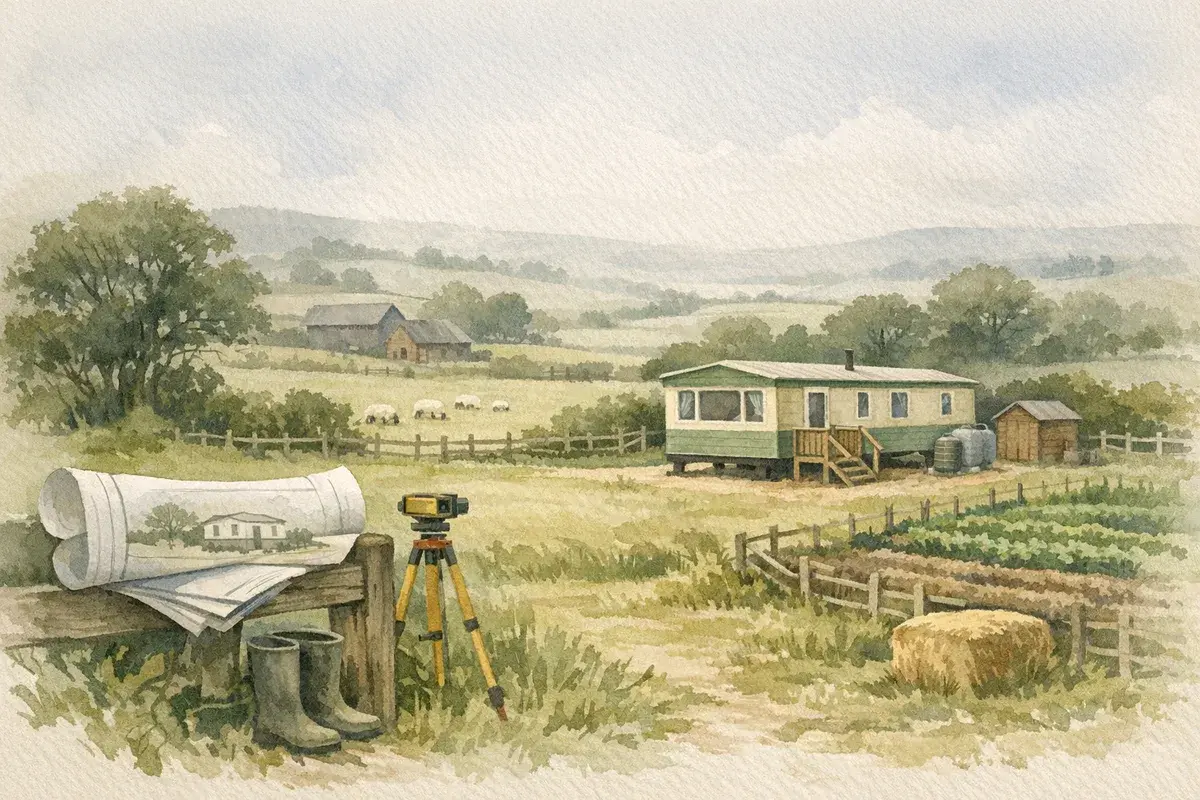
If you're considering mobile home planning permission on agricultural land, the short answer is this: it can be possible, but only where the use is properly justified and the siting is carefully documented. The planning route depends on whether the mobile home supports a genuine agricultural need, a rural business, or a separate residential use.
That distinction matters a lot. A temporary-looking caravan or park home is not automatically exempt from planning control, and councils will still look at access, landscape impact, utility connections, and whether the land can support a lawful rural enterprise.
Most refusals happen because applicants assume being on farmland is enough. It's not. Planning officers will ask what the unit is for, who will occupy it, how long it's needed, and whether less intrusive alternatives have been explored. We'd argue that a clear paper trail is often the difference between approval and a costly refusal.
This guide explains how the rules work in England and Wales, where county-level practice can differ in tone and emphasis, and what farmers, landowners, and agents should check before spending money on drawings, surveys, or site works.
When Mobile Home Planning Permission Is Needed
In planning terms, a mobile home can mean a touring caravan, static caravan, park home, or lodge-style unit, but the label alone won't decide the outcome. If it is used for residential occupation, or sits on agricultural land for more than a genuinely temporary period, planning permission is usually required.
The first thing councils test is whether the proposed use is part of agriculture. Agricultural land can support a worker's dwelling where there is an essential need for someone to live on site full-time, often due to stock, biosecurity, or crop management. That is a high bar, and it isn't met by convenience alone.
There is also a difference between temporary accommodation and permanent development. A mobile unit used during lambing, harvest, or an emergency may be easier to justify than a long-term home for a family. But even temporary use can need time-limited permission, especially if services are being installed or the unit is on hardstanding.
Common Planning Triggers
These are the most common situations that bring agricultural land into planning control:
- Permanent residential use: a mobile home used as a main home on farmland.
- Agricultural worker's dwelling: accommodation linked to a proven full-time farm need.
- Temporary operational accommodation: short-term living space for seasonal or emergency use.
- Change of use concerns: when land starts to function like a residential plot rather than farmland.
County attitudes can vary. In parts of Devon, Somerset, and Herefordshire, for example, planners often focus heavily on landscape sensitivity and isolated siting. In Norfolk, Lincolnshire, and East Yorkshire, the discussion may centre more on farming justification and whether an older farmstead could absorb the need instead.
If the mobile home is only being used incidentally, such as welfare accommodation for staff during a critical period, you may still need to demonstrate that it is ancillary to the agricultural enterprise. If it starts to look settled, connected, fenced, serviced, and lived in year-round, the council will likely treat it as development.
The Main Planning Routes For Agricultural Land
There is no single route to permission. The right approach depends on purpose, duration, and the relationship between the unit and the land. For many applicants, the key question is whether they are seeking temporary consent, a temporary agricultural dwelling, or a permanent residential permission.
For a farm worker's unit, councils usually expect a robust agricultural appraisal. That means evidence of labour needs, stock numbers, cropping, working patterns, and why a nearby house won't do. A standing need is more persuasive than a speculative future need, and the business must often be established, profitable, and likely to remain so.
Where a mobile home is intended as short-term accommodation, temporary permission can be more realistic. Councils may grant it for a fixed period while a business is proved, a permanent dwelling is built, or another on-farm housing solution is assessed. Temporary permission is still permission, though, and conditions can be strict.
Temporary Use Versus Permanent Occupation
Temporary consent is often the practical option where the unit supports a farming enterprise but the long-term proposal is not yet fully evidenced. It can also suit succession plans, where an older farmer needs nearby accommodation before estate restructuring or a farm sale.
Permanent occupation is much harder. Councils want to know why the need cannot be met in an existing stone farmhouse, a redundant steadings conversion, or a nearby village property. If the answer is simply that living on site would be convenient, approval is unlikely.
| Permission Route | Best Fit | Typical Issues | As Of |
|---|---|---|---|
| Temporary agricultural consent | Short-term farm need or trial period | Time limit, siting, removal condition | June/2026 |
| Permanent agricultural dwelling | Proven essential full-time need | Business viability, fallback housing, design | June/2026 |
| Ancillary worker accommodation | Staff welfare or seasonal operations | Duration, occupation control, service access | June/2026 |
| Retrospective application | Existing unauthorised siting | Enforcement risk, poor evidence, delay | June/2026 |
Retrospective applications are risky. If the unit is already in place without consent, the council can still refuse and take enforcement action. That said, if the actual land use is defensible and the evidence is strong, it can sometimes regularise an honest mistake. Sometimes. Not always.
What Councils Look For In Supporting Evidence
Planning officers do not just inspect the unit. They assess the whole case. The application needs to show why the mobile home is genuinely required, how it will be occupied, and why that form of accommodation is the least harmful option.
Strong evidence, judged against the National Planning Policy Framework and local policy, often includes business accounts, herd or flock data, cropping plans, staff rotas, and a clear explanation of why existing buildings are unsuitable. A farm on sandy soils in Cambridgeshire faces different operational pressures from a hill unit in Cumbria, so the evidence should reflect local farming conditions rather than rely on generic templates.
Location matters too. A site tucked beside existing barns will usually be easier to defend than one placed in open countryside with no visual relationship to the farmyard. Access via an established track, discreet service runs, and minimal new hardstanding all help. So does a sensible landscape statement, especially in designated areas.
Essential Documents And Surveys
You'll usually be asked for some combination of the following:
- Planning statement: sets out the proposal and policy context.
- Agricultural appraisal: explains labour need and farm viability.
- Site plan: shows exact position, access, and services.
- Design and access note: covers appearance and movement.
- Ecology or drainage input: needed where habitat or runoff issues arise.
Utility connections can also be a sticking point. A mobile home that needs sewage treatment, water, and an electricity supply may trigger more scrutiny than a genuinely temporary unit with limited services. If a new septic tank or package treatment plant, or an overhead line, is proposed, those works may need separate approvals or technical checks.
For estate agents, this is where local insight matters. A well-run arable unit in Lincolnshire may justify modest worker accommodation, while an upland Dales farm might require a more persuasive case because access, visibility, and winter resilience all come under closer examination. The principle is the same, but the planning conversation isn't.
How To Improve The Chances Of Approval
The best applications are specific, modest, and firmly tied to necessity. Councils are far more receptive to a small, well-sited unit that supports a clear agricultural function than to a grander scheme that looks like an unspoken residential plot.
Start by matching the proposal to the business need. If the requirement is seasonal, say so. If it is tied to livestock welfare, explain the calendar, the staffing pattern, and why rapid response is critical. If the need is transitional, such as while a farm succession is completed, provide dates and milestones rather than vague intentions.
It also helps to think like a planner. Ask whether the unit can be screened by hedges or existing buildings, whether it can be removed easily later, and whether the occupation can be limited by condition. The more reversible the scheme, the easier it can be to defend.
Practical Steps Before Submitting
These checks can strengthen the application and reduce avoidable objections:
- Confirm the land use class: check whether the site is purely agricultural or mixed-use.
- Map the exact siting: place the unit near existing farm infrastructure where possible.
- Gather operational evidence: show why the unit is needed now, not later.
- Review local designations: consider AONB, National Park, Green Belt, or flood risk.
Local policy tone can be decisive. For example, a scheme in North Yorkshire may be tested against landscape and tourism impacts as much as farming need, while a proposal in parts of Cheshire might face questions about openness and cumulative development near settlements. Even where policy is similar, officers' expectations can differ quite a bit between districts.
Do not ignore access and safety. If the mobile home relies on a track that also serves livestock movements, county highways officers may want visibility splays, passing points, or a maintenance agreement. And if the proposal touches overhead power, drainage ditches, or public footpaths, those technical constraints should be dealt with early rather than left for planning comments to uncover.
Costs, Timescales, And Market Reality
By June 2026, the cost of a modest planning application for this type of rural proposal often sits in a broad band, because consultant input and site complexity matter as much as the council fee. A simple temporary application might cost far less than a contested permanent dwelling case requiring agricultural, highways, ecology, and drainage support.
As a practical guide, many applicants should budget for professional fees first, not last. A planning statement, site plan, and basic agricultural appraisal may be enough for a straightforward case, but more challenging land parcels can need multiple reports, especially in sensitive counties such as Cornwall, the Cotswolds, or the Lake District fringe.
Market conditions also shape how councils respond. When land values are under strain, some owners are tempted to see a mobile home as a quick route to extra value. Planners can usually spot that angle. If the proposal looks like an attempt to create a residential holding rather than support agriculture, the odds of consent fall sharply.
| Cost Item | Typical Range | What Drives It | As Of |
|---|---|---|---|
| Application fee | Low hundreds | Type of application and authority | June/2026 |
| Planning consultant | 1,000 to 5,000+ | Complexity and evidence required | June/2026 |
| Agricultural appraisal | 1,500 to 4,000+ | Business size and labour case | June/2026 |
| Technical reports | 500 to 3,000+ | Drainage, ecology, highways, utilities | June/2026 |
Timescales vary too. A straightforward rural decision might land in a few months, but contested cases can drag on much longer if plans are amended, neighbours object, or the local authority asks for more information. In parts of Somerset, Gloucestershire, and Pembrokeshire, for instance, consultation rounds can be especially protracted where landscape sensitivity is high.
Conclusion
mobile home planning permission on agricultural land is possible, but only when the proposal is tied to a real, evidenced need and presented in a way that respects local planning policy. The strongest cases are modest, site-aware, and backed by proper agricultural business evidence, while the weakest are vague, oversized, or clearly just trying to create an unofficial residential plot. Get the need right, the siting right, and the paper trail right, and you'll save time, money, and a great deal of frustration.
Disclaimer: AgLand.co.uk is a UK agricultural land and rural property matching service, where buyers register what they are looking for and owners advertise directly to the buyers who match, and a rural resource hub. Nothing in this text is intended as legal, financial, or investment advice. You should carry out your own due diligence and seek guidance from appropriately qualified professionals (for example, solicitors, land agents, surveyors, and financial advisors) for your specific circumstances.