
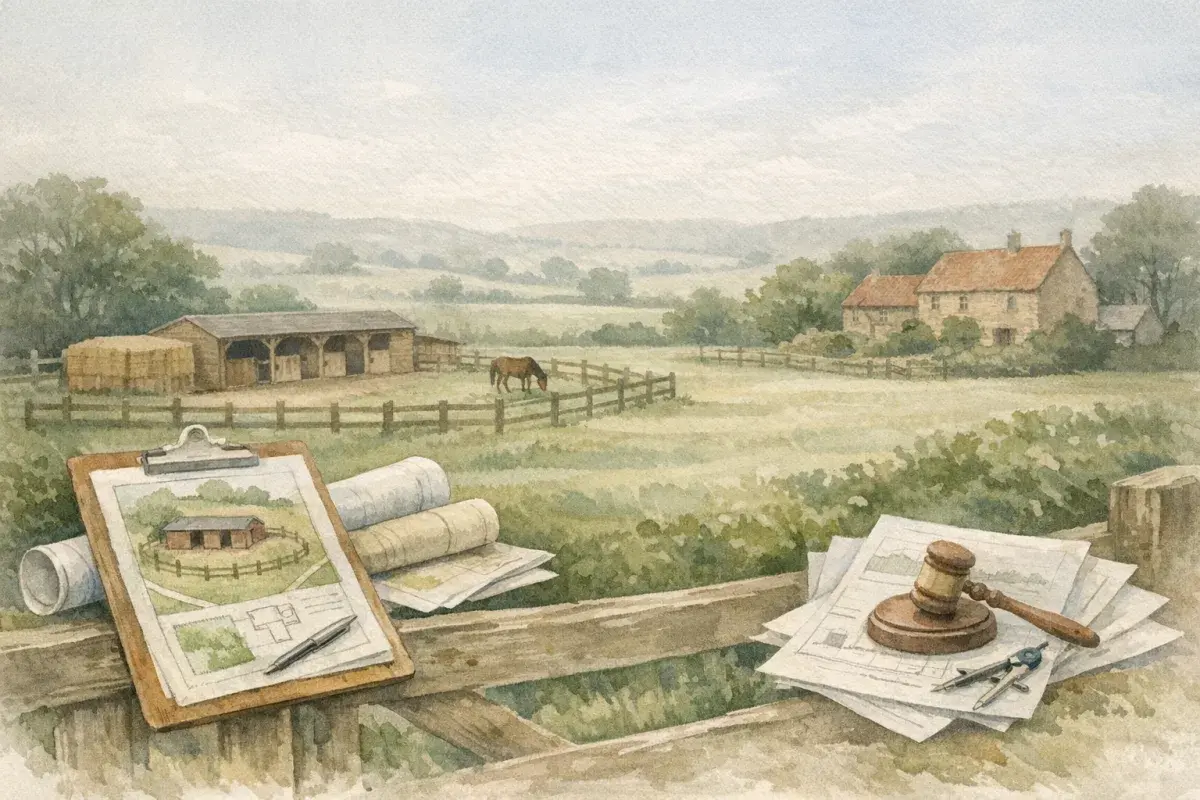
If you're looking at planning permission for stables on agricultural land, the short answer is that it depends on what you want to build, how the land is used, and where it sits in the planning system. Some stables are straightforward; others need a full application, especially if the land's use is changing from pure farming to equestrian.
The tricky bit is that stables can fall between agriculture and equestrian use, which means the rules aren't always as simple as farmers expect. A well-placed field shelter may be fine in one parish and dead in the water in another, particularly in Green Belt, National Landscapes, or areas with listed buildings nearby.
For landowners, farmers, and estate agents, the key question is not just 'can I build stables?', but 'what consent do I need, what evidence will the council expect, and how will the decision affect land value?' Get that right and you avoid costly delays, refusal, or a building that has to come down later.
When Stables Need Planning Permission
Stables on agricultural land do not automatically require planning permission, but don't assume they're exempt either. The planning position turns on use, size, location, and whether the works count as development under the Town and Country Planning Act framework.
In simple terms, if the building is genuinely part of an agricultural holding and supports a farming business, it may sometimes qualify under agricultural permitted development rights. But once horses are kept mainly for leisure, livery, riding school use, or private equestrian enjoyment, the council will usually treat the proposal as a non-agricultural equestrian development.
Agricultural Use Versus Equestrian Use
This distinction matters more than many applicants realise. Horses can be kept on farmland without the land automatically becoming equestrian in planning terms, but the council will look at the actual activity on the ground, not just the label on the form.
If the stable block is for working horses used in agriculture, that may help the case. If it's for private horses, a DIY livery setup, or a riding business, the development is more likely to need express permission.
- Agricultural use: Buildings supporting farming operations, such as livestock, crops, or rural enterprises tied to the holding.
- Equestrian use: Horses kept for leisure, competition, livery, riding instruction, or breeding outside a clear agricultural purpose.
- Change of use: Where land moves from agricultural occupation to horse-related use, planning scrutiny usually increases.
- Green Belt impact: Even modest stables can be harder to justify within protected landscapes or constrained sites.
Signs Permission Is Likely To Be Needed
There are a few common triggers. A concrete stable block, hardstanding, new access track, floodlighting, manege, or associated parking can all push the proposal into full planning territory. Add muck heaps, horse movements, and commercial activity, and local authority interest intensifies quickly.
We'd argue that if there's any doubt, assume consent will be needed until proved otherwise. That mindset saves time, and it also makes conversations with planners much easier.
Permitted Development Rights For Agricultural Buildings
Some agricultural buildings can be erected under permitted development rights, which are rights allowing certain works without a full planning application. For stables, the key question is whether the structure is truly agricultural, or whether it is really an equestrian building wearing an agricultural coat.
The right type of building, on the right type of holding, may be possible under the prior approval route rather than a full planning application. The council can still assess matters such as siting, design, transport, and flood risk, so it's not a free pass. It's just less burdensome than a standard application.
What Councils Look For
Planning officers usually focus on the holding's existing agricultural use, the functional need for the building, and whether the proposal is proportionate. They'll also look at whether the stable block is tied to a genuine farming business rather than a lifestyle change in disguise.
That means a livestock farm in Devon, a mixed arable unit in Lincolnshire, or a beef and sheep holding in Northumberland may each face a different evidential test. The local authority will expect details, not assumptions, and the burden sits with the applicant.
- Functional need: Why the building is necessary for the farm operation.
- Siting: Whether the location is sensible, discreet, and close to the existing yard.
- Design: Whether the structure looks agricultural and fits the landscape.
- Access: Whether tractors, horseboxes, or utility vehicles can reach it safely.
When Prior Approval Is Not Enough
Prior approval often falls short where the site is sensitive or the proposed use strays into equestrian territory. If the stables are to be used for private horses, combined with a tack room, ménage, floodlights, or a substantial yard, the council may decide the scheme needs a full planning submission.
In practice, many applicants find that a well-drafted planning statement is worth the extra effort. It clarifies the use, explains the holding, and tackles the issues the council is likely to raise before they raise them.
How The Planning Application Usually Works
Where permission is needed, the process is pretty standard, but the quality of the submission makes a huge difference. A weak application often fails on evidence, while a well-prepared one can progress smoothly even on a tricky site.
The application should explain the land use, the need for stables, the number of horses, the proposed welfare arrangements, drainage, waste storage, access, and landscape impact. If the building is on agricultural land close to a village, footpath, bridleway, or heritage asset, add those details too.
Documents That Strengthen The Case
Planning officers like clarity. They want drawings, site plans, ownership details, and a sensible explanation of why the stables belong where they are proposed, rather than in a less sensitive corner of the holding.
For agents and sellers, this is also where land value starts to shift. A consented stable block can support a stronger asking price, especially where it opens up a smallholding, livery, or diversified rural business opportunity.
- Site location plan: Shows the boundary, access, and relationship to nearby features.
- Floor plans and elevations: Help the council assess scale and appearance.
- Planning statement: Sets out the case for approval in plain English.
- Supporting evidence: Grazing numbers, horse-related business plans, or agricultural justification where relevant.
Typical Timelines And Fees
As of June/2026, most full planning applications in England are determined within 8 weeks for householder-type proposals or 13 weeks for more complex cases, although extension agreements are common. Fees vary with the type of application, and consultants' costs can exceed the official fee if the site is sensitive or contested.
In rural counties like Dorset, Somerset, Gloucestershire, Surrey, and parts of Kent, officer workloads and neighbour interest can slow matters down. In more straightforward arable counties, decisions may be quicker if the proposal is modest and well justified.
| Application Route | Typical Decision Time | Indicative Position As Of June/2026 | Best For |
|---|---|---|---|
| Prior Approval | About 56 days | Lower-cost route where agricultural rights apply | Genuine farm buildings with limited impacts |
| Full Planning | 8 to 13 weeks, often longer | Used where equestrian use or sensitive siting is involved | Private stables, livery, or complex sites |
| Lawful Development Certificate | Varies | Useful where you need certainty on existing use | Proving a stable use is lawful |
Fees and professional costs change over time, so it's sensible to budget for surveys, plans, and planning advice as part of the project. For an estate agent, that budget can be the difference between a saleable development story and a speculative hope.
Common Obstacles And How To Avoid Them
Most refusals don't happen because stables are inherently unacceptable. They happen because the proposal is poorly framed, badly sited, or impossible to separate from heavier development such as domestic use or commercial equestrian activity.
One frequent sticking point is overdevelopment. A modest two-bay stable might sit comfortably in a paddock, but a large block with associated hardstanding, jumps store, sheds, and parking can look more like a business park for horses than a rural building.
Protected Landscapes And Local Policy
National Landscapes, formerly Areas of Outstanding Natural Beauty, are especially sensitive. Planning officers in places such as the Cotswolds, Northumberland, the High Weald, and the Surrey Hills will usually expect proposals to be discreet, low in visual impact, and closely related to an existing farmstead.
Green Belt land is another hurdle. There, the issue is often not just appearance, but whether the building counts as inappropriate development in the first place. That can make even a modest stable block a policy challenge unless a strong justification exists.
Drainage, Manure, And Welfare Matters
Good applications address the practical side, not just the building shell. Drainage matters because standing water around stables creates mud, welfare issues, and objections from neighbours or environmental officers.
Manure management also matters. A tidy, enclosed, and realistic muck handling arrangement looks far better than a vague promise to sort it out later (which, in planning terms, usually means trouble).
- Drainage: Surface water control and prevention of run-off into ditches or watercourses.
- Manure storage: A clear method for collection, containment, and removal.
- Noise and lighting: Especially important near homes, footpaths, or village edges.
- Traffic: Horseboxes, feed deliveries, and service access can all be material issues.
Regional Differences Across The UK
Although the broad planning principles are similar, local policy and rural character vary sharply by county. A proposal that works in Suffolk may struggle in Hampshire, while a scheme that looks perfectly ordinary in Shropshire might be too prominent in Herefordshire's rolling landscape.
In Wales, stricter countryside policies and the presence of National Park authorities can make stables harder to justify. In Scotland and Northern Ireland, the planning systems differ in detail, so applicants need local advice rather than assumptions based on English precedent.
The table below gives a useful snapshot of regional pressure points as of June/2026.
| Region | Typical Planning Sensitivity | Common Issue | Practical Takeaway |
|---|---|---|---|
| South East | High | Landscape, Green Belt, and neighbour impact | Expect detailed scrutiny |
| South West | Medium to High | Rural beauty, tourism, and access | Design and siting matter greatly |
| East of England | Medium | Large holdings and active agricultural use | Strong agricultural justification can help |
| North East and Midlands | Varies | Mix of open countryside and settlements | Local policy context drives outcomes |
If you're acting for a buyer or seller, this regional variation is commercially important. Consent in one county can add disproportionate value, while a refusal in a tightly controlled area can make the same land far less attractive.
Conclusion
Getting planning permission for stables on agricultural land right means understanding the difference between agricultural and equestrian use, checking whether permitted development rights apply, and presenting a clear, practical case if a full application is needed. The best proposals are the ones that look like a sensible part of the holding, not an afterthought.
For farmers, landowners, and agents, the big lesson is simple: the planning answer turns on use, siting, and policy context, especially in sensitive counties and protected landscapes. Get those fundamentals straight, and you're far more likely to secure consent, protect value, and avoid nasty surprises later.
Disclaimer: AgLand.co.uk is a UK agricultural land and rural property matching service, where buyers register what they are looking for and owners advertise directly to the buyers who match, and a rural resource hub. Nothing in this text is intended as legal, financial, or investment advice. You should carry out your own due diligence and seek guidance from appropriately qualified professionals (for example, solicitors, land agents, surveyors, and financial advisors) for your specific circumstances.