
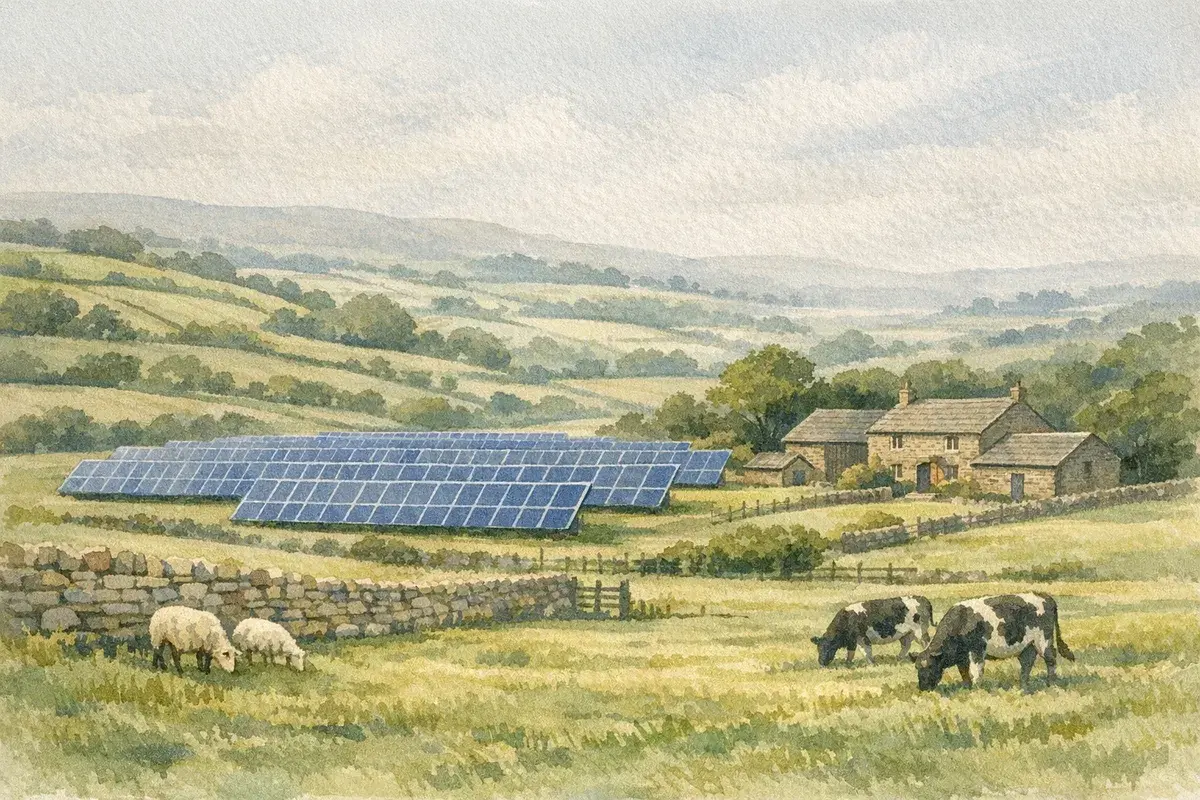
A decade ago, a solar farm on a working holding could feel like a novelty, something you'd glimpse from the motorway and mutter about over the mart café. Now it's a mainstream land use discussion in farm offices across the UK. Not because farmers have suddenly become energy developers, but because the fundamentals have shifted: volatile power prices, tighter margins, and a planning system that (in the right places) will support well‑designed renewables.
If you're weighing up solar panels on agricultural land, whether that means a few hundred kilowatts on shed roofs or a multi‑megawatt ground‑mount scheme, your real job is risk management. You're balancing grid constraints, planning policy, tenancy and title complexity, tax knock‑ons, and the long-term value of the holding. Get it right and solar can underpin income resilience for decades. Get it wrong and you can end up with an unbankable agreement, a planning refusal, or a future sale that becomes far harder than it should be.
This guide cuts through the practical UK realities: what planners and grid operators actually care about, how deals are structured, and the due diligence that protects you and your land.
Why Solar On Farms Has Become A Mainstream Land Use
Solar on farms didn't become "normal" because it's trendy. It became normal because, for a growing number of holdings, it's one of the few land uses that can offer long-duration, index‑linked income without demanding more labour.
Core Drivers: Power Prices, Grid Decarbonisation, And Farm Income Resilience
There are three forces you've probably felt first-hand:
- Power price volatility: If you run cold stores, grain drying, poultry units, dairy, irrigation, or workshops, electricity isn't a background cost anymore, it's a board‑level risk. Rooftop solar and storage can be a straight-line hedge.
- Grid decarbonisation and policy direction: UK policy is firmly set on expanding renewable generation. That doesn't mean every site gets consent, but it does mean planners and inspectors are used to balancing renewables against landscape and best-and-most-versatile land concerns.
- Farm income resilience: A well‑structured solar lease can turn a lumpy farm cashflow into something more predictable. That predictability is exactly why lenders and succession plans often like it, provided the paperwork stacks up.
One nuance worth saying out loud: solar is rarely "set and forget". Even leases marketed that way usually come with obligations, access protocols, drainage responsibilities, habitat management, and compliance with planning conditions.
What "Agricultural Land" Means In Planning Terms (Not Just Soil And Acres)
When you say "agricultural land", you might mean "my field". Planning officers tend to hear something more specific: land quality, current use, policy designations, and whether the development is temporary/reversible.
Two concepts come up again and again:
- Agricultural Land Classification (ALC) and the "best and most versatile" (BMV) categories. If you're unsure what you're dealing with, it's worth grounding yourself in how land quality bands are assessed before you let a developer frame the conversation.
- The planning unit: a scheme can affect how the wider holding is perceived, access routes, farmstead operations, and landscape character. It's not just "take 40 acres and fence it".
And remember: the UK is not one planning system. The broad principles overlap, but practical interpretation differs between England, Scotland, and Wales, and even between neighbouring local authorities. If your holding spans borders or you buy land in a different nation to where you farm now, that matters.
Choosing The Right Solar Route: Rooftop, Ground-Mount, Or Agrivoltaics
Before you get into rents and megawatts, decide which type of solar actually fits your land and business. The "best" option is usually the one that matches your risk appetite and operational reality, not the one with the biggest headline number.
Rooftop Solar On Farm Buildings: When It's The Lowest-Risk Option
Rooftop solar often wins on simplicity:
- Lower planning friction (often, but not always, designations and listed buildings change the picture)
- Less land take and fewer neighbour objections
- Direct on-site use: if you can use what you generate, you're less exposed to export constraints
Where rooftop can quietly go wrong is structural and legal detail:
- Roof condition, asbestos, load capacity, and warranties
- Ownership/leasehold quirks on yards and buildings
- Insurance and fire strategy (especially with batteries)
If you're a buyer looking at a yard with panels already installed, treat the documents like you would any major asset: consents, grid paperwork, MCS/commissioning records, and who actually owns the kit.
Ground-Mounted Solar: Typical Footprints, Fencing, Access, And Visibility
Ground-mount is where the big lease deals happen, and where the biggest misunderstandings start.
In practical terms, most schemes require:
- Secure fencing and gates, plus internal tracks (meaning real changes to the feel and use of a field)
- A construction compound and temporary laydown areas
- Drainage considerations: you don't want a scheme that creates runoff issues into ditches, neighbours, or your own yard
- Visibility management: hedgerow reinforcement, setbacks, and landscape mitigation become central
A common landowner surprise is how much "edge land" is affected. It's not just the panel rows: it's access, easements, turning heads, and the space needed to operate and maintain the site.
Also, the land market context matters. If you're benchmarking a solar proposal against what the field is "worth", make sure you're using realistic local evidence on agricultural land prices in the UK rather than hearsay. That helps you sanity‑check whether the lease really compensates for the opportunity cost and the long tie‑up.
Agrivoltaics: Grazing, Cropping, And Biodiversity Under Panels
Agrivoltaics is essentially "dual use": generating electricity while keeping a meaningful agricultural activity underneath or between panel arrays.
In the UK, the most common practical routes are:
- Sheep grazing under and between panels (usually the easiest to evidence)
- Biodiversity-led management: species-rich grassland, pollinator mixes, and measurable habitat improvements
- Limited cropping in certain designs (more niche, more sensitive to machinery and spacing)
If you're pitching agrivoltaics as part of a planning case, it needs to be more than a slogan. Planners will look for management plans, stocking rates (if grazing), how you'll handle biosecurity, and whether the agricultural use is credible over the whole lifecycle of the scheme.
From a farm operations angle, ask yourself a blunt question: who is actually doing the farming bit? If it's you, price in your time and the constraints. If it's a grazier, get the access and responsibilities crystal clear.
Planning Permission And Consents In The UK
Planning is where optimism meets paperwork. Most solar projects don't fail because solar "doesn't work" on the land. They fail because the site is constrained, the application is poorly evidenced, or the proposal tries to bulldoze over local sensitivities.
If you need a solid grounding on the wider rules (beyond solar), our guide to what typically needs consent on farmland is a useful companion.
Permitted Development Vs Full Planning: The Key Triggers That Change Everything
For solar panels on agricultural land, you're usually dealing with full planning permission for ground-mounted schemes. Permitted development rights can apply in limited scenarios (and the detail matters), but you shouldn't assume you can "PD" your way to a solar farm.
What tends to trigger full planning and/or more scrutiny:
- Scale and siting: larger ground-mount arrays, prominent sites, or proximity to settlements
- Designations: protected landscapes and heritage settings
- Grid infrastructure: substations, overhead lines, and cable routes can pull in additional consents
Even when something looks straightforward, conditions can be extensive: landscaping, ecology, construction traffic routing, working hours, drainage, noise limits, and decommissioning requirements.
Landscape And Environmental Constraints: AONB, National Parks, SSSI, Heritage, Flood Risk
You can often predict the planning conversation by looking at constraints early:
- Protected landscapes (National Parks, AONBs / National Landscapes): expect heightened visual impact standards and stronger "public interest" arguments
- SSSIs and designated habitats: ecological surveys and mitigation become central, sometimes project-stopping
- Heritage constraints: listed buildings, scheduled monuments, conservation areas, and their settings can be decisive
- Flood risk: being in Flood Zones doesn't automatically kill a scheme, but it raises the bar on drainage, safe access, and resilience
A practical tip: don't rely on a single desktop screen grab. Constraints mapping is a start, not a verdict. A good planning consultant will ground-truth viewpoints and understand how local policy is actually applied.
Glint And Glare, Noise, Lighting, Traffic, And Construction Method Statements
Neighbour concerns are rarely about "renewables" in the abstract. They're about lived impacts:
- Glint and glare: especially where there are road users, rail lines, airports, or nearby dwellings. A proper assessment can calm objections, or reveal a fatal flaw.
- Noise: inverters and transformers are usually modest, but siting and acoustic treatment matter.
- Lighting: most sites don't need much, but any security lighting can be contentious in dark rural areas.
- Traffic: construction periods can be intense, HGV movements, abnormal loads, lane closures.
- Construction method statements (CMS): planners often want to see how you'll protect hedges, ditches, soils, and rights of way.
The better schemes feel "quiet" to neighbours: screened, tidy, well-managed, and respectful of local lanes. That's not fluff, it's what reduces objections and speeds determinations.
Grid Connection: The Make-Or-Break Constraint
If planning is the visible hurdle, grid is the invisible one. You can have a supportive local authority and a willing landowner, and still be dead in the water if the grid connection is uneconomic or delayed beyond viability.
Feasibility Stages: DNO Enquiry, Offer, Acceptance, And Timelines
Most projects run through a familiar sequence:
- Initial feasibility: desktop checks, likely point of connection, high-level cost ranges.
- DNO application/enquiry: the Distribution Network Operator assesses capacity and reinforcement needs.
- Connection offer: includes costs, technical requirements, and a connection date.
- Acceptance and payment milestones: you commit and start working to the programme.
Timelines can be long, and they move. Grid queues, reinforcement works, and policy changes can all reshape the economics.
As a landowner, your key job is to ensure your agreement doesn't lock you into years of uncertainty with no adequate compensation. Option periods, long-stop dates, and developer obligations aren't "legal theatre", they're what stops a project sitting on your title indefinitely.
On-Site Use, Private Wire, And Battery Storage Options
Exporting everything to the grid is one model. It's not the only one.
Depending on your location and demand, you might consider:
- On-site consumption (farm or rural enterprise): reduces exposure to export constraints
- Private wire to a nearby user (where legally and practically feasible): can improve revenue certainty but adds contractual complexity
- Battery storage: can help with peak shaving and export management, but may introduce additional planning, fire, and insurance considerations
Be cautious with "it'll definitely work" promises. Storage and private wire can be excellent, but they're not magic wands for a weak grid.
Easements, Wayleaves, And Cable Routes Across Third-Party Land
Cable routes are where good projects get messy.
If the connection requires crossing third-party land, you're into:
- Easements/wayleaves (rights for cables, access, maintenance)
- Negotiations with neighbours who may have their own leverage
- Ransom strips and "last 10 metres" problems
From your side, insist on clarity:
- Who pays for surveying, legal fees, and compensation
- What happens if a route can't be secured
- Whether the developer can use your land for alternative routes without further consent
And if you're buying land with a proposed solar scheme, don't underestimate this. A connection plan that looks tidy on a map can unravel fast once you meet the people who own the intervening parcels.
Leasing Agricultural Land For Solar: Deal Structure And Negotiation Points
A solar lease is not a standard farm tenancy with a few extras. It's a long, technical agreement that can affect finance, future sales, and how the rest of the holding operates.
If you're new to rural transactions, it's worth understanding the wider process of getting set up to buy land properly because many of the same due diligence disciplines apply, just with higher stakes and longer time horizons.
Heads Of Terms: Rent, Indexation, Term Length, Option Periods, And Break Rights
Most deals start with heads of terms. Treat them as a blueprint, not a brochure.
Key commercial points you'll see:
- Option period: the developer pays you for exclusivity while they chase grid and planning. Make sure it's time-limited and properly compensated.
- Lease term: commonly 30–40 years (sometimes longer). That's effectively a generation.
- Rent and indexation: RPI/CPI-linked uplifts are common, but definitions and caps matter.
- Break rights: who can terminate, when, and on what notice? A one-sided break can leave you carrying the practical downsides with less upside.
- Rent start date: some deals only pay meaningful rent after commissioning: others include stepped payments. Cashflow certainty is part of the value.
One practical negotiating mindset: you're not only negotiating rent. You're negotiating control.
Land Rights And Control: Access, Compounds, Drainage, Water, And Biosecurity
This is where farm reality lives.
Your agreement should be explicit on:
- Access routes and times (and how they interact with livestock movements and harvesting)
- Biosecurity protocols: think poultry, pigs, dairy, and any high-health enterprise. "Common sense" isn't enforceable, written procedures are.
- Drainage and water: who maintains ditches, culverts, and field drains? Who pays when a track damages a drain run?
- Compounds and laydown areas: location, reinstatement, and limits
- Responsibility for weeds and pests: ragwort, thistles, rabbits, left unmanaged, these don't stay inside fences
A well-run solar site can coexist with farming. A poorly run one becomes a constant friction point.
End-Of-Life: Decommissioning, Reinstatement Bonds, And Panel Recycling
You should negotiate the end at the start.
Look for:
- Decommissioning obligations: removal of panels, frames, inverters, cabling (including below-ground where appropriate), tracks if required, and fencing
- Reinstatement standard: what does "back to agriculture" actually mean, soil structure, drainage, reseeding, hedge repairs?
- Security: bonds, escrow, parent company guarantees, or other mechanisms that survive corporate restructuring
- Recycling and waste compliance: solar PV is covered by the UK's waste electrical and electronic equipment regulations: the contract should reflect lawful disposal and recycling routes
If a developer resists meaningful security, that's a signal. Over 40 years, companies change shape. Your land doesn't.
Protecting Farm Value: Tax, Tenancies, And Title Risks
The smartest solar decisions don't just maximise rent. They protect the long-term value and "cleanliness" of the holding, especially if you might refinance, restructure, or sell.
If you're evaluating solar as part of a broader strategy, it can help to frame it alongside wider approaches to agricultural land investment, because buyers and lenders will.
Farm Business Tenancies, Grazing Licences, And Possession For Development
If the land is let, solar becomes immediately more complex.
Key questions:
- What tenancy do you have in place (or plan to grant)? A Farm Business Tenancy (FBT) can restrict your ability to give vacant possession for development.
- Who has the right to occupy? Even a grazing licence can create practical and reputational issues if it's handled badly.
- How will compensation and disturbance be handled? Tenant relationships matter: disputes can delay projects and sour planning narratives.
You'll often need aligned legal advice and a clear strategy: either exclude the solar area from any letting, build in development break clauses properly, or accept that solar may not be realistic until the tenancy position changes. Repair obligations, rent review terms and break clauses are what really set the economics of a farm letting, so it is worth understanding how grazing licences, FBTs and AHA tenancies compare before you grant anything new over land you may want back.
Tax And Reliefs In Plain English: IHT (APR/BPR), Capital Gains, And VAT Flag Points
Tax is where "sounds fine" can quietly become "why didn't anyone tell me?". Solar income can change the character of a holding in ways that affect reliefs.
Common UK flag points to discuss early with your tax adviser:
- Inheritance Tax reliefs: Agricultural Property Relief (APR) and Business Property Relief (BPR) can be sensitive to whether land is in agricultural use, let on certain terms, or effectively turned into an investment asset. Solar can be compatible in some scenarios, but it's not automatic.
- Capital Gains Tax: granting long leases, options, or easements can have CGT implications and may interact with rollover/hold-over relief planning.
- VAT: whether you should opt to tax, how rents are treated, and how input VAT on professional fees or infrastructure is handled.
The pragmatic approach is to ask for a tax "stress test" before you sign heads of terms, while you still have leverage to restructure the deal.
Title Due Diligence: Rights Of Way, Restrictive Covenants, Minerals, And Overages
Title issues are the unglamorous project-killers.
Check (properly, not casually):
- Public rights of way: solar can accommodate them, but routing, fencing, safety, and aesthetics matter.
- Restrictive covenants: older covenants can prohibit non-agricultural use or structures.
- Mineral rights and third-party interests: you don't want a surprise party with rights to enter and work minerals under (or near) your array.
- Overage/clawback: if you bought land with overage, a solar lease might trigger it.
If your title isn't registered or is part-registered, don't leave it until the last minute. Clean paperwork is what keeps developer lawyers and funders calm. Our primer on getting land properly documented is a helpful starting point before you're under time pressure.
One more thing: lenders. If your land is charged, your bank's consent and deed of priority requirements can shape the deal. Plan for that early.
Site Selection Checklist And A Sensible Next Step
A good solar site is usually boring in the best way: close enough to grid, low landscape sensitivity, operationally convenient, and not riddled with legal complications.
Red Flags That Commonly Kill Projects (And How To Spot Them Early)
If you want to avoid months of sunk time, watch for these early warning signs:
- "Grid is fine" with no evidence: ask what stage the DNO conversation is at and what the indicative connection costs and dates are.
- High landscape sensitivity: prominent ridgelines, open vistas, protected landscapes, or locations where screening is unrealistic.
- Access that relies on hope: narrow lanes, weak bridges, difficult visibility splays, or no realistic construction route.
- Unclear boundaries or ransom strips: if the only viable access or cable route crosses third-party land without agreement, the project is fragile.
- Tenancy/occupier mismatch: you can't promise vacant possession if you don't control it.
- Ecology constraints handled late: habitats, protected species, and seasonal survey windows can blow programmes apart.
- Neighbour proximity without a strategy: if there are dwellings close by, you need a credible approach to screening, glint/glare, and construction management.
A quick discipline that pays off: write a one-page "constraints summary" before you entertain glossy offers. You'll negotiate better when you're not negotiating in the dark.
Who To Involve: Land Agent, Planning Consultant, Surveyor, And Specialist Solicitor
Solar is a team sport.
Typically, you'll want:
- A land agent with renewable experience to benchmark rents, options, and reinstatement provisions (and to pressure-test developer assumptions).
- A planning consultant who knows your local authority and can build an evidence-led case, not just submit forms.
- A surveyor/engineer where access, drainage, structures, or grid infrastructure needs technical validation.
- A specialist solicitor for options, leases, easements, lender consents, and titles.
And if your land is in Scotland, the legal and practical context differs enough that you should make sure your advisers genuinely operate there. If you're assessing opportunities north of the border (or comparing them with English sites), it's worth reading our overview of how rural land works in Scotland as part of your early research.
A sensible next step if you're serious is to build a shortlist of candidate fields/buildings and run a staged review: constraints mapping, grid pre-check, heads of terms stress test, and only then deeper surveys. That sequence saves money and protects your negotiating position.
Conclusion
Solar panels on agricultural land can be a genuine long-term stabiliser, if you treat the project like the complex property transaction it is, not a side hustle. The best outcomes usually come from doing three things early: getting realistic about grid, building a planning case that respects local sensitivities, and negotiating lease terms that protect control, cashflow, and reinstatement.
If you're at the "should I even explore this?" stage, start small and disciplined: pick one or two sites, gather evidence, and involve the right professionals before exclusivity agreements box you in. The land will still be there next month: the leverage might not.
Disclaimer: AgLand.co.uk is a UK agricultural land and rural property matching service, where buyers register what they are looking for and owners advertise directly to the buyers who match, and a rural resource hub. Nothing in this text is intended as legal, financial, or investment advice. You should carry out your own due diligence and take advice from appropriately qualified professionals (for example, a chartered surveyor, planning consultant, tax adviser, and solicitor) before making decisions about solar, leasing, planning, or any property transaction.