
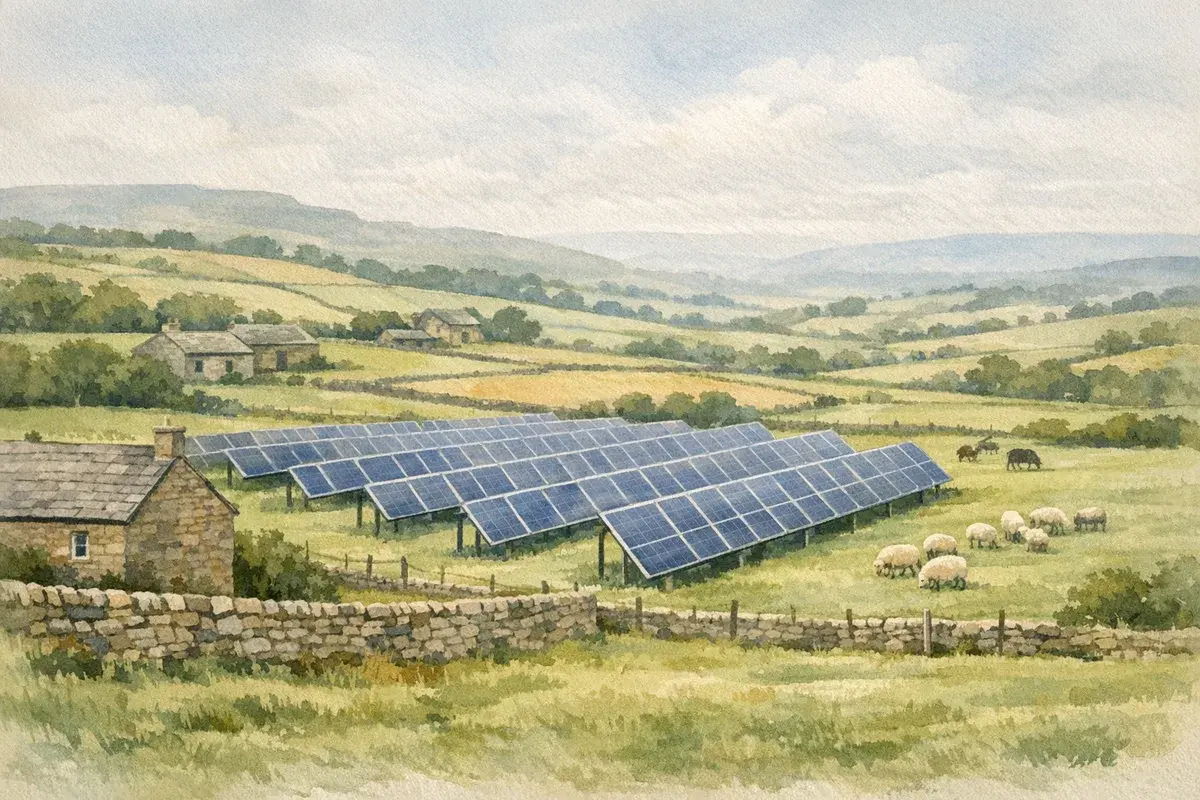
A field that's quietly underperforming on wheat margin can look very different when a developer starts talking about a ground-mounted solar scheme. The numbers can be tempting. But so are the traps: a grid offer that never materialises, planning objections you didn't see coming, or a lease that ties your hands for 40 years.
If you're weighing up ground mounted solar panels on farmland in the UK, whether you're a working farmer, a landowner with a long-term view, or a rural investor, this guide is about getting to "yes" (or "no") with your eyes open. We'll walk through site suitability, planning reality, grid connection due diligence, deal structures, tax considerations, and how solar can change day-to-day operations and land value.
Is Your Land Suitable For A Ground-Mounted Solar Scheme?
Most solar projects don't fail because the panels don't generate. They fail because something mundane gets missed early: the substation is full, access can't be agreed, or the site sits in a designation that turns a straightforward application into a multi-year saga.
Site Basics: Acreage, Slope, Aspect, And Grid Proximity
You don't need perfect south-facing, billiard-table-flat land anymore, modern layouts can work on gentle slopes and more varied aspects. But some fundamentals still drive viability:
- Scale and shape: Developers typically look for enough contiguous, workable area to justify grid and planning costs. Awkward, narrow fields can reduce usable panel blocks once you factor in buffers, landscaping, and cable corridors.
- Topography: Steeper slopes increase civils cost and can complicate visibility/landscape impacts. Gentle slopes can be fine: severe undulation can mean more cut-and-fill and more planning scrutiny.
- Access: You'll need construction access for HGVs (delivery and installation phase), then ongoing access for maintenance.
- Distance to grid: Proximity to a suitable connection point matters, but it's not just "nearest line wins." Capacity at the right voltage, the cost of reinforcement, and the ability to route cables lawfully are the real issues (we'll come back to this).
One practical move early on is to ask: If the grid offer came through tomorrow, could the project physically be built without relying on miracles, like persuading three neighbours to grant cable rights?
Constraints To Check Early: Flood Risk, Designations, And Rights
Before anyone talks rent, you want a fast, honest constraint scan. The common UK tripwires include:
- Flood risk and drainage: Flood Zone constraints, historic surface water issues, and ordinary watercourses can all affect layout, fencing, and maintenance. Solar doesn't automatically mean "no flood concern", in some areas it raises questions about runoff, swales, and access resilience.
- Landscape and environmental designations: National Parks, AONBs/National Landscapes, SSSIs, SPAs/SACs, local wildlife sites, each adds complexity. It doesn't always kill a project, but it changes the evidence burden.
- Public rights of way: Footpaths/bridleways through or adjacent to the site can be a planning and design issue (setbacks, screening, and perceived enclosure). Diversions are possible but slow and uncertain.
- Heritage constraints: Listed buildings, scheduled monuments, registered parks and gardens, and archaeology potential can trigger surveys and design changes.
If you want a planning-oriented deep dive, AgLand's resource on UK solar planning on farmland is a good companion read once you've done your initial site sense-check.
Agricultural Impact: Best And Most Versatile Land, Grazing, And Access
This is where UK policy and local politics often collide. Many local planning authorities take a cautious line on Best and Most Versatile (BMV) land (Grades 1, 2 and 3a). You may still succeed on BMV, but you'll likely need a stronger case: why this site, what alternatives were considered, and how agricultural use is being protected or integrated.
A few realities to think about:
- Grazing compatibility: Ground-mounted arrays can work well with grazing (sheep in particular), but it's not automatic. Stock management, water, fencing, and biosecurity design matter. If you're considering it, the practicalities in grazing sheep under solar arrays are worth understanding early, because "we'll graze it" is often waved around, but not always planned properly.
- Access and farm logistics: A solar layout that blocks a key internal track, complicates muck movements, or forces long detours during harvest can be more costly than it looks on paper.
- Soils and reinstatement: Even though panels are removable, construction can compact soils and disturb field drainage. Make sure reinstatement isn't treated as a footnote: it's central to protecting long-term land quality.
If the field is your best-performing block, ask yourself the awkward question: Would I still do this deal if commodity prices rise and that field becomes critical again? Your lease will likely outlast several market cycles.
Planning Permission In The UK: What Really Matters
Planning is rarely about whether solar is "good" in principle (national policy generally supports renewables). It's about whether this scheme, on this site, with this access, landscaping and ecology package, is acceptable to the local authority and community.
The Typical Route: Full Planning, Not Permitted Development
For ground mounted solar panels on farmland, you should assume full planning permission is required.
Permitted development rights in the UK are limited and tightly defined, and most commercial-scale ground-mounted arrays on agricultural land won't fit. Developers may reference "temporary" permissions or conditions, but it's still generally a full application with environmental reports and consultations.
If you want a broader overview of the process, planning, leases, grid, and long-term risk, AgLand's guide to solar on agricultural land in the UK gives a practical end-to-end picture.
Key Planning Considerations: Landscape, Glint And Glare, Ecology, And Heritage
In practice, planning turns on evidence, not enthusiasm. The recurring themes you'll see in UK solar applications:
- Landscape and visual impact: Viewpoints, cumulative impact with other schemes, boundary treatments, and realistic photomontages. Mature hedges can help, but "it'll be screened" doesn't wash without a proper landscaping plan and time-to-establishment.
- Glint and glare: Particularly where there are road corridors, rail lines, airports/airfields, or sensitive receptors. A glint and glare assessment is common.
- Ecology and biodiversity: Habitat surveys, protected species checks, hedgerow and tree impacts, and increasingly Biodiversity Net Gain expectations (especially in England). Well-designed solar can deliver biodiversity improvements, but you'll need management plans and measurable outcomes.
- Heritage and archaeology: Visual settings for listed buildings, and desk-based assessments that can lead to trial trenching.
- Traffic and access: Construction traffic management plans, visibility splays, and track upgrades.
- Agricultural justification: Especially if BMV is involved, how land is classified, what the agricultural baseline is, and how land will be managed during operation.
A useful mindset: planning officers are balancing policy support for renewables against localised harm. The best applications are calm, specific, and properly documented.
England, Wales, Scotland, And Northern Ireland: What Differs In Practice
You're still in UK planning territory, but the "feel" differs by nation and local authority:
- England: You'll encounter a strong focus on landscape character, BMV land arguments, cumulative impact, and (in many cases) clearer expectations around biodiversity delivery and ongoing management.
- Wales: Expect emphasis on landscape sensitivity and local policy alignment, with a strong interest in how schemes sit within wider land management and community context.
- Scotland: Applications often lean heavily on landscape/visual assessments given the scale of landscape designations and sensitivities. Grid capacity constraints can also be a defining factor in many areas.
- Northern Ireland: Planning and grid processes are distinct, and developers will typically need to navigate local policy nuances and consultation expectations carefully.
Wherever you are, don't rely on "a scheme got approved 10 miles away." Different landscape character, different grid node, different ecology baseline, planning is site-specific.
Grid Connection And Technical Due Diligence
If planning is the public test, grid is the private reality check. You can have a willing landowner, a supportive council, and still end up with a project that doesn't stack up because the connection cost is eye-watering or the queue is going nowhere.
DNO Applications, Queue Risk, And Timelines
In Great Britain, grid connections are typically handled through the relevant Distribution Network Operator (DNO) (or transmission where appropriate). The key points for you:
- Timelines can be long. Connection offers, design, reinforcement works, and energisation dates can stretch out, sometimes well beyond what a landowner expects when they first hear "solar farm."
- Queue risk is real. In many areas there's a backlog of projects, and some never reach construction. Developers may secure a grid position and then re-trade or re-scope.
- Costs can swing wildly. The offer might include significant reinforcement, new substations, or long cable runs.
If you want to get specific about what's being requested, what it tends to cost, and what to ask the developer for, see AgLand's explainer on solar farm grid connection, it's one of the areas where early clarity saves you months.
Cable Routes, Wayleaves, Easements, And Third-Party Land
Even if your land is perfect, the cable route can make or break the project.
You'll often see one of these scenarios:
- Cable stays within your ownership: simplest, but still needs careful mapping, reinstatement specs, and future access rights.
- Cable crosses third-party land: now you're into negotiations for wayleaves/easements, which can fail or become expensive.
- Road crossings and statutory consents: permissions and method statements become critical, and programme risk increases.
As the landowner, you should push for:
- a clear plan of the cable corridor,
- responsibility for securing rights (and paying for them),
- reinstatement and crop loss provisions,
- and a backstop if third-party rights can't be obtained.
Battery Storage And Ancillary Infrastructure: Extra Consents To Expect
More schemes now include battery energy storage systems (BESS) or at least reserve the right to add them later. That can be good for project economics and grid support, but it can add planning complexity.
Expect additional considerations such as:
- fire safety and emergency access,
- noise (inverters/transformers/containers),
- visual impact of containerised units,
- and potentially a separate planning application if storage wasn't consented initially.
Also watch for "ancillary" items that can take up more land than you expect: substations, compound areas, access tracks, CCTV poles, and landscaping buffers. They're normal, but they affect your retained farming layout.
Leases, Options, And Heads Of Terms: Getting The Deal Structure Right
Most landowners don't sign a lease on day one. The usual sequence is an option to lease (developer investigates planning and grid) and then, if successful, a long-term lease.
The trap is assuming the paperwork is "standard." Solar documents can be heavily developer-friendly unless you negotiate.
Option To Lease: Exclusivity, Term, And Developer Exit Rights
An option gives the developer exclusivity over your land for a defined period while they pursue planning/grid and finance. For you, the key questions are:
- How long is the option? Some are modest: others can be many years with extension rights.
- What must the developer actually do? You want obligations (not just intentions) around applications, reporting, and progress.
- How can they exit? Developers need genuine exit rights if planning or grid fails, but you don't want a free "land bank" where your field is tied up while they try their luck.
- What can you still do on the land? Grazing, cropping, stewardship, access, spelled out, not assumed.
Rent Structures: Fixed, Indexed, Turnover, And Hybrid Models
Solar rent structures in the UK tend to fall into a few buckets:
- Fixed rent: simple, predictable, but inflation can erode value over 30–40 years.
- Indexed rent: often linked to RPI/CPI (subject to caps/collars in some deals). More future-proof, but check definitions and review dates.
- Turnover-based: tied to revenue (or generation). Potential upside, but you'll need audit rights, transparency, and careful definitions.
- Hybrid: a base rent plus turnover "top-up." Often a sensible compromise.
You don't need to guess what's "normal" in today's market. AgLand's overview of solar farm lease rates per acre helps you benchmark structures and spot when a headline figure hides awkward terms.
Landowner Protections: Decommissioning, Bonds, And Reinstatement
If you remember one thing: your downside risk is usually contractual, not technical. Panels will come off one day: the question is whether the lease forces it properly.
Landowner protections you should take seriously:
- Decommissioning obligation: clear triggers (end of term, insolvency, prolonged non-operation) and a defined process.
- Financial security: a bond, escrow, parent company guarantee, or other mechanism that's robust enough to fund removal and reinstatement.
- Reinstatement standard: not "reasonable endeavours," but measurable outcomes, soil remediation, drainage reinstatement, track removal (where appropriate), and hedge replacement.
- Assignment controls: developers will often assign to funders/SPVs. You'll want consent provisions (or at least conditions) so you're not stuck with an under-capitalised operator.
Heads of Terms are where you set these expectations. Get them right before solicitors burn time negotiating from scratch.
If you like working from a structured checklist, AgLand's solar lease template guidance can help you sanity-check clauses and questions before you commit to a developer's draft.
Tax, Reliefs, And Estate Planning Considerations
Solar income can look straightforward, rent in, tax paid, job done. But land-based renewables can interact with Inheritance Tax reliefs, VAT decisions, and long-term capital planning in ways that catch families out (especially where succession is already delicate).
Inheritance Tax: APR, BPR, And When Solar Can Complicate Claims
Two reliefs come up again and again:
- APR (Agricultural Property Relief): generally relates to the agricultural value of land used for agriculture.
- BPR (Business Property Relief): can apply to business assets, but is highly fact-specific.
A long solar lease can complicate the narrative of "agricultural use," particularly if land is no longer occupied for agriculture in the same way. The interaction depends on the facts: how the business is structured, what proportion of activity is trading versus investment, and how the land is used under and around the scheme.
You're into specialist territory here. If inheritance planning matters to you (and for most family farms, it does), involve a rural tax advisor early, before you sign an option that locks in a direction of travel.
Income Tax And VAT: Rental Treatment, Registration, And Elections
Typically, solar rent is treated as income and taxed accordingly, but your wider position matters:
- VAT: Some landowners opt to tax land (or register for VAT) so they can recover VAT on professional fees and costs, but it can create ongoing obligations and affect other property interests.
- Who receives the rent: 개인 ownership, partnership, company, trust, each can shift tax outcomes and succession planning.
The paperwork is not glamorous, but it's where avoidable leakage happens.
Capital Gains And Land Value Uplift: Options, Premiums, And Disposals
Developers sometimes pay:
- Option fees/premiums (for exclusivity),
- lease rent, and occasionally
- payments for rights (easements, access, cable routes).
Each can have different tax treatments depending on structure and timing. Also, once a site has a consented scheme (or a credible grid offer), land value uplift can become real, whether you're considering a disposal, refinancing, or restructuring ownership.
If you're selling land with solar potential, watch for overage/clawback provisions that can get messy alongside options and leases. A good rural solicitor should be joining the dots between tax, title, and deal documents, not treating them as separate conversations.
How Solar Can Affect Farm Operations And Value
A solar scheme isn't just a rent cheque. It changes how you move through your holding, how buyers perceive the property, and how lenders view risk.
Farm Management: Security, Biosecurity, Drainage, And Access Design
Operationally, the better schemes feel almost "tidy" from a farm management perspective: the poor ones create friction every week.
Look closely at:
- Security design: fencing lines, gates, CCTV, and how they interact with your own livestock movements and yard security.
- Biosecurity: contractor access routes, wheel washing (if relevant), and protocols if you're running livestock.
- Drainage: construction can damage old clay drains and grips. Make sure the scheme includes drainage mapping, protection measures, and a clear responsibility for repairs.
- Access tracks: track placement can either help you (a new all-weather route) or cut across field logic.
If you're still assessing whether your holding is a good candidate in the first place, AgLand's guide to agricultural land solar development goes into the practical red flags and opportunities landowners tend to uncover mid-process.
Neighbour Relations: Visual Impact, Traffic, Noise, And Community Benefit
You can have a scheme that's technically sound and still end up with a bruising local process if neighbour concerns are ignored.
Common pressure points:
- Construction traffic: timing, routing, and road cleanliness.
- Visual impact: especially where properties overlook the site or where the approach road opens up long views.
- Noise: usually not major for pure PV, but inverters/transformers and especially batteries can raise questions.
- Community benefit offers: not always expected, but sometimes used to show local value, handled carefully and transparently.
A quiet, respectful approach helps. Developers who arrive with a fait accompli and vague drawings tend to create opposition they didn't need.
Valuation And Finance: Saleability, Lender Attitudes, And Overage Interactions
From a valuation perspective, a solar lease can do two different things depending on the buyer and structure:
- Investment-style buyers may like the contracted income.
- Owner-occupiers may discount land that's tied up, especially if it disrupts farm efficiency.
Lenders also vary. Some are comfortable with long leases and predictable income: others focus on break clauses, assignment, and whether the solar operator's rights could interfere with security.
If you have overage on your title (or you're negotiating it on a sale), solar introduces a big question: what counts as "development value" and when is it triggered? Don't assume a standard clause covers renewables sensibly, get it drafted with solar in mind.
And one more subtle point: if your holding includes stewardship/environment schemes, ensure the solar layout and management plan doesn't inadvertently breach your obligations. That's a solvable problem, but only if spotted early.
How To Market Or Find Solar-Ready Farmland
Whether you're marketing a site to developers or trying to buy land with solar potential, the best outcomes come from being organised. Solar is a paperwork-heavy world: the party who controls the information usually controls the timetable.
What Information Buyers, Agents, And Developers Will Ask For
Expect requests for:
- Title documents and plans: boundaries, access points, third-party rights, restrictive covenants.
- Farm tenancy details: if the land is occupied, the developer will need to understand possession and notices.
- Basic site constraints: flood risk, designations, rights of way, nearby dwellings.
- Grid context: proximity to substations/lines and any prior connection discussions.
- Evidence of agricultural use and land quality: particularly where BMV arguments might arise.
A simple but effective approach is to assemble a "solar pack" before marketing: annotated plan, constraints summary, photos from key viewpoints, and any relevant correspondence. It makes you look serious, and it helps you compare proposals on a like-for-like basis.
Using Specialist Search And Shortlisting To Target Grid And Planning Hotspots
If you're on the acquisition side, trying to find land with potential for ground mounted solar panels on farmland, general property portals often bury the detail you actually need.
Whichever side you're on. Buyers tell AgLand what they're looking for and hear the moment something fits. Owners advertise straight to the buyers who already match, for one flat fee and no commission. Register as a buyer or check your matches.
For a more specific framework on choosing the right sort of land for a viable scheme, AgLand's guide to what makes the best land for solar is useful when you're comparing multiple opportunities and trying not to be seduced by a single headline.
When To Use An Agent, Surveyor, Planner, And Solicitor
You don't need an army of professionals for a first conversation. But once an option is on the table, you should build a team that understands rural property and renewables.
Typically:
- Land agent (rural/renewables experience): to benchmark rent, run competitive tension, and negotiate heads of terms.
- Planning consultant: to assess deliverability and steer the application strategy.
- Surveyor/valuer: to sense-check impacts on value, lender acceptability, and any wider estate strategy.
- Solicitor: to negotiate option/lease, easements, decommissioning security, and assignment provisions.
A good rule: if the developer says "this is all standard," that's your cue to slow down, not speed up. Standard for them often means optimised for them.
And if you're marketing land (or looking for it), it helps to work with agents who actually handle agricultural property day-in, day-out. We've seen the difference it makes: fewer dead-end enquiries, better documentation, and much cleaner negotiations.
Conclusion
Ground mounted solar panels on farmland can be a genuine long-term win in the UK, stable income, diversified land use, and (when designed well) a biodiversity uplift that's more than box-ticking. But the projects that go wrong usually go wrong in predictable places: grid assumptions, vague reinstatement promises, and planning risks that were downplayed early.
If you take one pragmatic approach, make it this: treat solar like any other high-stakes rural transaction. Get the constraints mapped, insist on evidence for grid and programme, negotiate landowner protections as if you'll need them (because one day you might), and line up tax and estate planning advice before the option locks you in.
Disclaimer: AgLand.co.uk is a UK agricultural land and rural property matching service, where buyers register what they are looking for and owners advertise directly to the buyers who match, and a rural resource hub. Nothing in this text is intended as legal, financial, tax, or investment advice. You should carry out your own due diligence and take tailored advice from appropriately qualified professionals (for example, a rural solicitor, chartered surveyor, planning consultant, and tax adviser) before making decisions.