
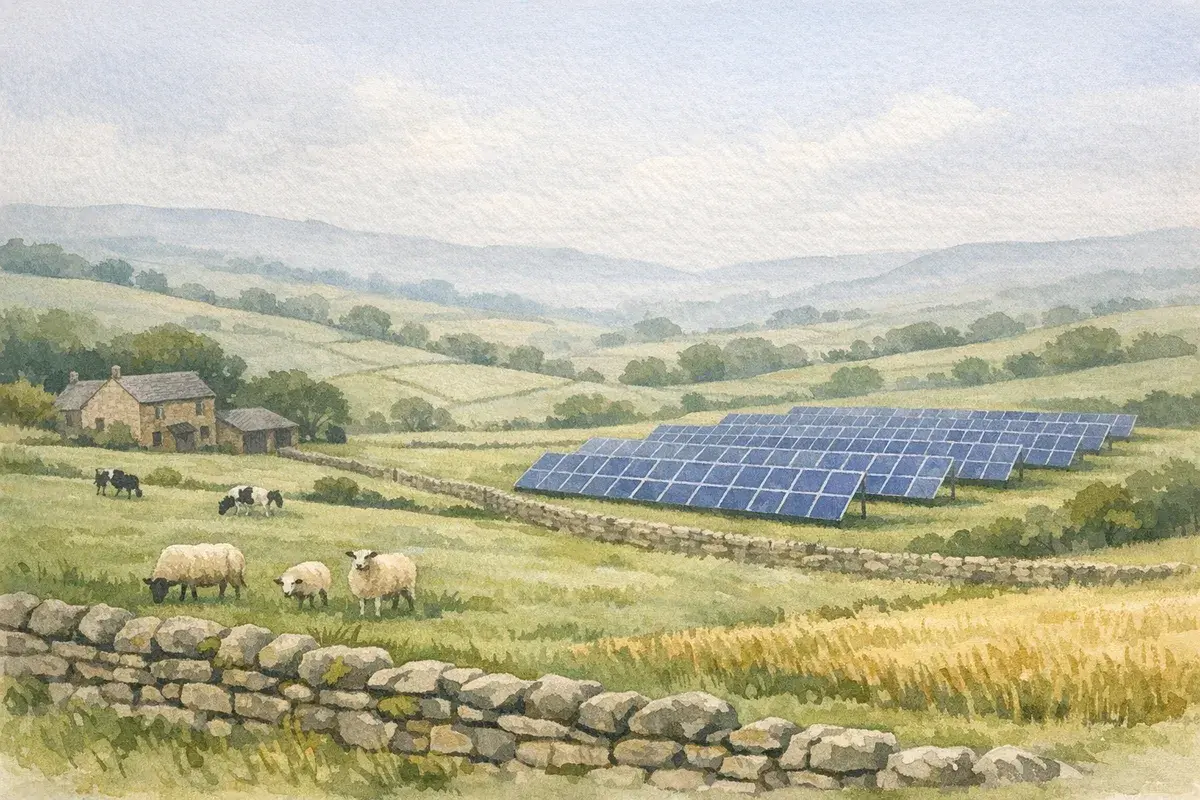
If you've had a solar developer slide into your inbox with a "£X per acre" headline, you're already in the most confusing part of the process. Not because they're necessarily being slippery, but because solar farm lease rates per acre are a blunt instrument for pricing something that's actually driven by grid capacity, planning risk, layout efficiency, and (crucially) how the contract allocates cost and risk over 30–40 years.
In 2026, the market is still active, but it's more selective. Grid queues, evolving planning expectations, and funder scrutiny have widened the gap between an average site and a truly bankable one. So this guide is about what you can realistically expect, what "good" looks like in practice, and how to benchmark the whole deal, not just the rent figure you can repeat down the pub.
You'll come away able to sense-check offers, understand why your neighbour's number may be irrelevant to your land, and know which clauses quietly move six figures over the life of a lease.
What Solar Farm Lease Rates Per Acre Mean (And What They Don’t)
Talk about solar rent "per acre" exists because land is tangible. You can point at it on a map, measure it, and compare it to other uses. But solar schemes don't earn revenue per acre, they earn it per unit of electricity exported (and, in some structures, per project returns). That mismatch is why solar farm lease rates per acre can mislead you.
A useful way to treat "per acre" is as a translation tool: it helps you compare a proposed solar use to your current agricultural margin, to a contracting arrangement, or to a diversified rental. It's not, on its own, evidence that the deal is fair.
Rent Per Acre Vs Rent Per MW: How Deals Are Commonly Priced
Most UK solar leases are priced using one of three approaches (or a hybrid):
- £ per acre per year: Simple, intuitive, and still common, especially in early-stage approaches or where a developer wants a clean headline.
- £ per MW (or MWp) per year: Often a better fit because it ties rent to generation capacity. It can also make indexing and future repowering discussions easier.
- Turnover rent / profit share: Less common as the sole rent, but it appears as an "uplift" or overage layer.
In practice, you'll often see a base rent expressed per acre, but with a schedule that defines the "net leased area" (excluding certain buffers) and then a separate payment structure for cable routes, compounds, or a substation.
If you're trying to make sense of offer documents, it helps to read a few "normal" structures first. Our practical explainer on ground-mounted solar layouts on farmland is useful for understanding what actually occupies land, what doesn't, and why acreage calculations can get contentious.
Why "Per Acre" Figures Vary So Widely Across Sites
Two sites of the same acreage can be worlds apart in value to a developer. Key reasons include:
- Connection value isn't evenly distributed. A site near a viable grid connection with export capacity can be worth multiples of one that's technically "perfect" agriculturally but stuck behind a constrained substation.
- Planning probability is priced in. If your site is likely to face landscape or ecology objections, the developer is carrying more risk (and their funder might not touch it).
- Acres per MW varies. A tight, efficient layout can deliver more capacity per acre, meaning a developer can afford a higher rent per acre while keeping rent per MW sensible.
- Deal structure shifts the headline. A high headline rent can be paired with restrictive clauses, weak decommissioning security, or developer-friendly definitions of "operational date" that delay full rent.
So if you're chasing a single number, "What's the going rate?", you'll always get a frustrating answer. The better question is: Given my grid/planning profile and a bankable layout, what range is realistic, and what protections do I need to keep it real over time?
Typical UK Solar Farm Lease Rates Per Acre In 2026
You'll see plenty of confident figures quoted online, but in the UK market the truth is: rates are negotiated, site-specific, and heavily shaped by grid and planning viability. Still, for 2026 you can work with realistic ranges as a starting benchmark, then adjust based on your particular risk profile.
Market Ranges For Option, Construction, And Operational Phases
A solar deal usually has phases, and your income changes across them.
1) Option / exclusivity period (pre-planning, pre-grid certainty)
- Often a modest annual payment to secure exclusivity while the developer spends on grid applications, surveys, and planning.
- Typical structures include a fixed annual option fee, sometimes stepping up if the option is extended.
2) Construction / access period (build-out)
- You may receive a higher short-term payment to reflect disruption, compound areas, and temporary loss of use.
- Some leases include damage/disturbance payments rather than a distinct "construction rent".
3) Operational lease (once exporting / commissioned)
This is the headline phase people mean when they talk about solar farm lease rates per acre.
In 2026, many operational rents you'll hear discussed in the UK fall broadly into a range of:
- Lower band (higher constraints / weaker grid economics): ~£800–£1,200 per acre per year
- Mid-market (bankable sites with workable grid/planning): ~£1,200–£1,800 per acre per year
- Upper band (strong grid position, efficient layout, high probability of consent): ~£1,800–£2,500+ per acre per year
Those are not promises, they're a way to sanity-check whether a proposal is plausible. If someone is offering a very high number, ask what they're assuming about capacity, acres per MW, and connection costs. If someone is offering a very low number, ask what risk you're being asked to absorb (and whether the scheme is actually financeable).
If you want the bigger picture of how planning, grid and long-term value interact, it's worth reading our guide to solar panels on agricultural land in the UK (particularly the parts on grid and lease risk).
How Indexation Works (RPI, CPI, Fixed Uplifts, And Caps)
Indexation is where "£X per acre" either holds up, or quietly erodes.
Common approaches:
- RPI-linked increases: Historically common in UK property leases. Some funders still prefer it, but it can be harder to agree post-volatility.
- CPI-linked increases: Often viewed as a more modern measure: sometimes considered "fairer" and more predictable.
- Fixed uplifts (e.g., 2% per annum): Simple, but can underperform inflation in some periods and overperform in others.
- Caps and collars: A cap limits how high increases can go: a collar sets a minimum increase even if inflation is low.
What you should care about isn't just which index, it's the exact drafting:
- When does indexation start, on signing, on first export, or on a defined "operational date" that can be delayed?
- Is the uplift applied annually or at five-year reviews?
- Are there caps/collars that look reasonable now but distort the economics later?
A small drafting tweak here can be worth more than a flashy headline rent, particularly on 35–40 year terms.
The Main Factors That Push Rent Up Or Down
A developer's rent offer is essentially the residue after they've priced in: grid costs, planning probability, buildability, finance terms, and their required return. If you want leverage, you need to understand the drivers.
Grid Capacity And Proximity To A Viable Connection Point
Grid is the big one in 2026. The practical question isn't "How close is the substation?", it's whether there's a viable connection offer at a cost and timescale that stacks up.
Rent tends to rise when:
- A connection point is nearby and reinforcement costs are manageable.
- The export capacity aligns with an efficient layout (not forcing awkward downsizing).
- The programme to energisation is credible.
And it tends to fall (or deals collapse) when:
- Grid constraints mean long delays, expensive reinforcement, or uncertain queue position.
- The developer wants you to accept long option periods with low fees while they "wait and see".
Planning Risk Profile: Designations, Landscape, Ecology, And Heritage
Planning risk is priced like insurance: more risk, lower rent or tougher terms.
Red flags that can suppress rent include (site-specific, and not always fatal):
- Sensitive landscapes and views (for example, near valued viewpoints).
- Ecology constraints requiring significant mitigation.
- Heritage settings where visual impact becomes a central issue.
- Cumulative impact if multiple energy schemes are nearby.
If you're at the early stage, it's worth getting your head around the UK planning pathway and typical sticking points. Our resource on solar panels on farmland planning sets out what tends to matter, what evidence is usually needed, and where landowners get caught out.
Land Quality, Topography, Access, And Buildability
Not all acres are equal. Developers pay for buildable, serviceable land:
- Slope and orientation: Steep or awkwardly undulating sites reduce layout efficiency and increase construction cost.
- Ground conditions: Flood risk, peat, high water tables, or contamination can add cost and delay.
- Access: A decent access point for construction traffic can be worth real money.
- Setbacks and buffers: If you lose a lot of land to boundary setbacks, archaeology exclusions, or ecological buffers, the "per acre" rent may look high but be spread over fewer usable acres.
Project Scale, Layout Efficiency, And Acres Per MW
This is where the per-acre conversation starts to make sense.
- A site that delivers more MW per acre can often support a higher rent per acre.
- A site with a low MW density may still be viable, but rent usually needs to sit lower to keep rent per MW within funder comfort.
That's why you should ask a developer for a concept layout early. It's not you being difficult, it's you checking whether their numbers have any relationship to reality.
Term Length, Break Clauses, Security Of Tenure, And Assignment
The long tail matters. A 40-year lease with strong indexation and robust decommissioning security can beat a higher initial rent on a shaky 30-year structure.
Points that move risk (and hence value):
- Break clauses: Who can break, when, and what compensation is due?
- Assignment: Can the developer assign the lease to a fund or special purpose vehicle you've never heard of, with no covenant strength?
- Security/covenant: What happens if the operator fails?
If a developer is pushing hard for landlord-unfriendly assignment rights, treat it as a sign that the headline rent is subsidised by hidden risk transfer.
What Makes Up The “Whole Deal” Beyond Rent
A good solar deal is rarely just "£X per acre". Your total value can be higher (or lower) depending on option structure, who pays professional costs, how infrastructure is treated, and what you can still do with the land.
Option Fees, Exclusivity Payments, And Promotion Costs
The option period can run for years. That's time your land is effectively sterilised from other opportunities.
Look for clarity on:
- Option length and extension rights (and whether extensions cost the developer more).
- Whether option fees are deductible from future rent (some proposals try to claw this back).
- Promotion costs: who pays for planning, grid studies, and consultation.
If you're comparing two offers, don't just compare option fee amounts, compare what the developer is committed to do within the option period and what happens if they don't.
If you want to see what "normal" documentation looks like, it can help to review a solar farm lease agreement template style structure, if only so you know which schedules and definitions tend to drive disputes.
Developer-Covered Costs: Surveys, Legal Fees, Agent Fees, And Landlord Advisors
In many credible UK deals, the developer covers a meaningful portion of your professional costs, because they need the contract to be bankable and properly advised.
You should still check:
- Is there a cap on reimbursable costs?
- Does reimbursement depend on the project reaching planning, or is it payable regardless?
- Are you free to appoint your own adviser (with relevant experience), or are you being nudged toward "their" people?
And be wary of false economy: the solicitor who's cheap but unfamiliar with energy leases can cost you far more in missed drafting points.
Wayleaves, Cable Routes, Substations, And Separate Payments For Infrastructure
Infrastructure can be where value leaks.
Common components:
- Cable easements/wayleaves across retained land or third-party land.
- Substation/compound areas that may sit outside the main panel footprint.
- Access track upgrades and rights to use them.
Best practice is usually:
- Separate identification and payment for infrastructure land.
- Clear reinstatement obligations for temporary works.
- Restrictions on moving routes later without your consent.
A developer may propose a great "per acre" rent for the panel area, then try to take cable routes and compound land on peppercorn terms. Don't let the deal drift like that.
Community Benefit, Grazing Rights, Biodiversity Net Gain, And Stewardship Compatibility
In 2026, you'll increasingly be asked how a scheme supports local benefit and land management outcomes.
Depending on the scheme and location, you may be able to negotiate:
- Grazing arrangements (often sheep) that keep agricultural activity on the site.
- Biodiversity measures that improve soils and habitats.
- Compatibility with your wider farm system, including access patterns and biosecurity.
If grazing is part of your thinking, it's worth understanding the practicalities and typical contractual approaches around sheep grazing under solar arrays, it's often viable, but it needs to be designed in from the start, not bolted on at the end.
Heads Of Terms: Clauses That Most Affect Your Net Income And Risk
Heads of Terms (HoTs) are where you win or lose value before lawyers start polishing definitions. Treat HoTs as commercial, not "just a draft". The clauses below tend to have the biggest impact on your net income and your sleep.
Rent Review And Indexation Wording To Watch
Indexation isn't one clause, it's a cluster of definitions.
Watch for:
- Start date: is it tied to commissioning, first export, or a developer-controlled milestone?
- Base rent vs stepped rent: do you get a lower rent for an initial period?
- Index substitution: what happens if an index is reformed or discontinued?
- Cap/collar asymmetry: a collar that protects the developer but a cap that restricts you can become one-sided fast.
If the developer wants CPI with a cap, you might push for either a higher base rent or a cap that only applies in extreme cases.
Repair, Drainage, Weeds, Pests, And Access Obligations
This is the unglamorous bit that can cost real money.
Key questions:
- Who is responsible for field drains damaged during construction?
- Who manages weed control (including invasive species) and to what standard?
- Who pays if access tracks cause run-off or neighbour disputes?
- Are you granting broad access rights that disrupt the rest of the farm?
The more precise the obligations, the fewer arguments later.
Decommissioning Security, Reinstatement Standards, And Insolvency Protection
If you remember one thing: a promise to reinstate is not the same as security to reinstate.
Ask for:
- A defined reinstatement standard (not vague "to the landlord's satisfaction" that becomes disputed).
- Decommissioning security (often staged, increasing over time) that can't evaporate if the operator fails.
- Insolvency protections, especially if the tenant is a special purpose vehicle with minimal assets.
Solar assets can change hands multiple times over decades. Your protections need to survive those transfers.
Overage, Profit Share, And Uplift Mechanisms (When They Help And When They Don't)
Overage/profit share sounds attractive: if power prices rise or the project is sold for a premium, you get a slice.
It can work, but only if:
- The mechanism is auditable (you can actually verify figures).
- The definitions of "profit" aren't so diluted by internal costs that it becomes meaningless.
- It doesn't replace a sensible base rent.
In many cases, landowners do better with a strong base rent plus indexation, and then a tightly drafted uplift only for specific triggers (like repowering that materially increases capacity). Don't accept a low base rent in exchange for a "maybe" upside you can't police.
Tax, Tenancy, And Estate Planning Considerations For Landowners
Solar income can look straightforward, rent in, land retained, but the knock-on effects can be anything but. Your tax position depends on your wider circumstances, ownership structure, and how the land is used before and after.
If you're weighing up whether a scheme is worth it in the round, our explainer on whether solar farming is profitable for landowners is a good companion piece because it looks beyond the headline rent to long-term economics.
How Solar Leases Can Interact With IHT Reliefs, CGT, And Income Tax
At a high level (and this is where you need bespoke advice):
- Income tax: rent is typically taxed as income. How it's treated can vary with structure and activities.
- Capital Gains Tax (CGT): you're not selling land if you lease it, but CGT can still appear in restructures, option payments, or later disposals.
- Inheritance Tax (IHT) reliefs: Agricultural Property Relief (APR) and Business Property Relief (BPR) are often central to farm succession planning. A solar lease can affect the character of the land and the business activities in ways that matter.
The key is to model scenarios early. If your estate plan depends on APR/BPR outcomes, don't treat solar as a bolt-on diversification without mapping the consequences.
Impact On Farm Tenancies (FBT, AHA) And Consent Requirements
If the land is tenanted, you can't assume you're free to sign.
Common UK situations:
- Farm Business Tenancies (FBTs): your agreement may restrict non-agricultural use, require landlord consent, or set out how diversification income is shared.
- AHA tenancies: these can be even more sensitive due to long-term security and statutory frameworks.
You need to establish:
- Who has the right to grant a lease to a developer.
- Whether the tenant has rights that could block or complicate the scheme.
- Whether surrender/variation is possible and on what terms.
This is an area where getting the wrong advice (or none) can land you in dispute territory.
VAT Treatment, SDLT Points, And Record-Keeping Practicalities
Practicalities matter because solar deals can run for decades and survive multiple ownership changes.
- VAT: whether you should opt to tax, charge VAT on rent, and how you recover VAT on professional fees depends on your position.
- SDLT: generally a tenant issue, but lease structures and premiums can have SDLT implications that feed back into negotiations.
- Record-keeping: keep a clean file of plans, titles, consents, correspondence, and every variation, future buyers, lenders, and successors will thank you.
If you're a landowner with multiple parcels and entities, it's often worth treating solar documentation like you'd treat a major finance facility: controlled, indexed, and not left in a drawer.
How To Benchmark And Negotiate A Fair Solar Rent
You don't need to be an energy economist to negotiate well, but you do need a method. The goal is to turn a vague "£X per acre" into a benchmarked, stress-tested, contractually protected income stream.
Comparable Evidence: What To Ask Agents We Work With To Pull Together
Comparable evidence is tricky because many solar leases are private and heavily customised. But good agents can still triangulate.
Ask for comparables that match:
- Region and grid context (same DNO area and similar connection type, if possible).
- Planning profile (similar designations and constraint load).
- Project size and acres per MW.
- Lease length and indexation method.
Also ask what was actually signed, not just what was marketed.
When you're still in site selection mode, it helps to know what kinds of land and locations developers consistently pursue. Our guide on what makes the best agricultural land for solar lays out the characteristics that tend to translate into stronger offers.
How To Pressure-Test A "Headline" Rate With Scenario Modelling
A simple model can stop you being dazzled by a big number.
Pressure-test:
- Timing risk: What if planning takes 24–36 months? What do you earn in that period?
- Indexation outcomes: Compare CPI vs fixed uplift over 35 years. Small differences compound.
- Acreage definitions: What's the rent if the "net leased area" shrinks after surveys and buffers?
- Infrastructure creep: What if the substation footprint expands or cable routes move?
You're not trying to "catch them out". You're trying to ensure the offer works under realistic UK development timelines.
Negotiation Levers: Term, Indexation, Cable Routes, Access, And Fees
If a developer says rent is non-negotiable, they're usually saying "rent is the easiest lever for us to talk about". Other levers often move value just as much:
- Indexation: tweak base rent vs caps/collars.
- Term and extensions: keep option extensions priced and purposeful.
- Infrastructure payments: separate and value cable routes, compounds, and access.
- Fees: ensure your legal and professional costs are covered to an agreed scope.
- Operational protections: stronger decommissioning security can be worth more than a marginal rent bump.
A fair deal is one you can live with if the operator changes twice, the grid timetable slips, and your farm business evolves. Because those things happen.
Due Diligence Checklist Before You Sign Anything
Before you sign HoTs or grant exclusivity, do enough diligence to avoid being boxed in. You're not trying to do the developer's job, you're protecting your asset.
Grid, Planning, And Land Title Checks That Save Pain Later
At minimum, you want clarity on:
- Grid route and connection point assumptions: what's the intended connection, and what's the developer's plan if that option fails?
- Planning pathway: local policy context, likely environmental assessments, and realistic programme.
- Title: boundaries, third-party rights, restrictive covenants, and whether you actually control the land needed for access and cables.
If you're considering broader development potential, our overview of agricultural land solar development explains the typical stages and the key documents you should expect to see as a project matures.
Constraints Mapping: Rights Of Way, Easements, Minerals, And Airports
A proper constraints map can save months.
Check:
- Public rights of way and permissive paths.
- Easements and servitudes (rights for others to cross or use parts of your land).
- Mineral rights and any historic reservations.
- Aviation and safeguarding constraints where relevant.
These don't always kill a scheme, but they can force redesigns that reduce MW density, which then feeds back into rent.
Professional Team: Land Agent, Solicitor, Surveyor, And Tax Adviser Roles
For most landowners, the winning formula is a small, experienced team:
- Land agent with solar lease experience to negotiate commercial terms and comparables.
- Solicitor who regularly drafts/negotiates energy leases (not just rural conveyancing).
- Surveyor / valuers as needed for evidence, boundaries, or compensation.
- Tax adviser to model income and relief interactions in the context of your farm and estate plan.
Developers do this every week. You might do it once in a lifetime. That's why proper advice usually pays for itself.
Thinking of selling? AgLand shows you how many registered buyers already match your land before you pay anything - no board at the gate, no commission, and your details stay private until a buyer asks to connect. Check your matches.
Conclusion
In 2026, the most accurate answer to "What are solar farm lease rates per acre?" is: it depends, then it depends again on the contract. The land that commands top-end rents is land that's grid-credible, planning-resilient, and layout-efficient. But even a strong site can be undermined by weak indexation, vague obligations, or toothless decommissioning provisions.
If you take nothing else: benchmark the deal in phases (option, construction, operation), translate per-acre into per-MW logic, and negotiate protections as hard as you negotiate rent. That's how you turn a tempting approach letter into a bankable, long-term income stream you won't regret.
Disclaimer: AgLand.co.uk is a UK agricultural land and rural property matching service, where buyers register what they are looking for and owners advertise directly to the buyers who match, and a rural resource hub. Nothing in this text is intended as legal, financial, tax, or investment advice. You should carry out your own due diligence and take independent advice from appropriately qualified professionals (for example, a solicitor, chartered surveyor/land agent, and tax adviser) before entering into any option, lease, or related agreement.