
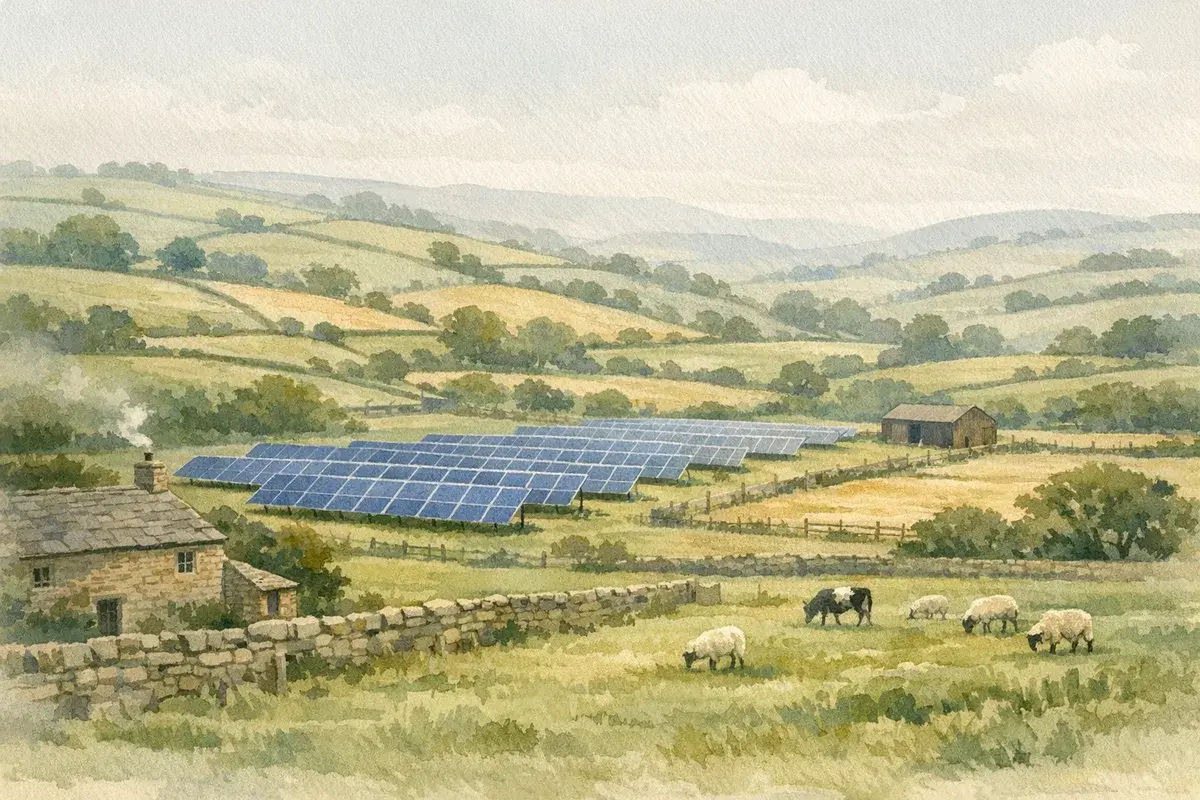
You've probably seen the headlines: record levels of solar being built, developers knocking on farmhouse doors, and neighbours quietly signing 30–40 year deals. Which naturally raises the question you actually care about, is solar farming profitable in the UK, for you, on your land, once you strip out the sales gloss and model the real-world constraints?
Profitability here isn't just "the rent looks decent". It's about bankability, grid reality, planning risk, tax outcomes, and whether the arrangement still works when commodity prices change, tenancies complicate matters, or your family's succession plan kicks in. Let's break it down the way landowners and their advisers do: what the returns can look like, what can blow them up, and how to stress-test any offer before you sign.
What “Solar Farming Profitability” Really Means
Solar farming can be profitable in the UK, but "profitable" depends on who is taking the development risk and how you're measuring return.
A developer's definition is usually project IRR after financing, grid, and construction. Your definition, as a landowner, is more often:
- dependable income you can plan around (and borrow against, if needed)
- protection against downside (planning refusal, grid delays, insolvency)
- minimal operational hassle
- a clean end-of-term position (reinstatement and liability nailed down)
In other words: profitability is as much about risk allocation as it is about the headline £/acre.
Developer-Led Lease Vs Landowner-Led Development
Most UK landowners choose a developer-led route: you grant an option, the developer pursues grid and planning, and if successful you move into a lease.
- Developer-led lease: Lower upside, much lower risk. You're paid for the right to tie up the land (option fee) and then paid rent if/when it's built.
- Landowner-led development: Higher upside if you can secure grid and planning and then bring in capital or a partner, but you carry material cost and execution risk. You're effectively acting like the promoter.
For many farms, the lease model is attractive because it behaves like an infrastructure-backed income stream. But it only does that if the lease is written well and the grid position is real.
If you want a wider grounding in how these projects are structured on UK farmland, planning route, grid realities and how value is captured, see AgLand's guide to solar panels on agricultural land (useful context before you even look at heads of terms).
Profit Metrics That Matter: Rent, IRR, Payback, And Indexation
When you're sense-checking is solar farming profitable, ignore "total rent over 40 years" (it's easy to make that number look huge). Focus on metrics that reflect risk and time value:
- Base rent (and what it's based on): Is it per acre, per installed MW, per exported MWh, or a hybrid? Each shifts risk.
- Indexation: RPI-linked uplifts are common. Some deals use CPI. Check whether there's a cap/collar.
- Rent review mechanics: Open market reviews sound good, but can be argument-heavy. Fixed uplifts are simpler.
- Option fee and option length: A long option can sterilise land for years if the developer can't get grid.
- Break clauses and step-in rights: These govern what happens if the project underperforms or ownership changes.
- Your "return" lens: For many landowners, the relevant metric is stable, inflation-linked income versus what the land can earn in agriculture plus stewardship, adjusted for practical disruption.
A good mental model is: the more of the developer's commercial risk you carry (export-based rent, performance-linked payments, weak indexation), the more you should be paid for it.
Typical UK Solar Farm Income Models
There isn't one standard income model, but most deals sit somewhere on a spectrum between simple rent and participation in revenue.
Option And Lease Structures: Heads Of Terms, Rent Uplifts, And Break Clauses
A typical UK structure looks like this:
- Option agreement (developer pays you to secure exclusivity while it pursues grid/planning).
- Lease (if the project is "exercised", you grant a long lease, often 30–40 years, sometimes longer with extensions).
The profit question is really: what are you being paid for during each phase, and what are you giving away?
Key commercial levers you'll see in heads of terms:
- Base rent (often expressed per acre or per MW installed)
- Rent uplift (RPI/CPI, fixed % uplifts, or review-based)
- Minimum rent vs performance rent (floor plus upside is ideal if you're accepting any performance risk)
- Developer rights (cabling, access routes, compounds, battery storage add-ons)
- Break clauses (developer exit rights: your termination rights for non-payment or breach)
Landowners often benchmark early using UK market commentary on rents, but the number only makes sense in context, grid proximity, planning sensitivity, tenancy status, access, and whether the developer is paying for your professional fees.
If you're trying to calibrate your expectations, AgLand's piece on solar farm lease rates per acre gives a UK-focused framework for what drives the range (and why "my mate got X" can be a dangerous benchmark).
Revenue Streams Beyond Rent: Co-Location, Storage, And Grid Services
Developers increasingly talk about "extra value" beyond the panels. Some of this can improve project bankability: some is mostly marketing.
Common add-ons in the UK include:
- Battery energy storage systems (BESS): Co-located storage can boost revenue by time-shifting export and providing services to the grid. If your lease allows BESS later, make sure rent covers it or triggers an uplift.
- Grid services: Frequency response and balancing services sit behind the scenes. You may never see them unless you negotiate revenue participation.
- Co-location with agriculture: Grazing (sheep most commonly) is the practical example. It doesn't usually move the needle on rent, but it can preserve agricultural character and help with land management.
A landowner-led "profit share" can sound attractive, but it can also create accounting complexity, VAT/income tax questions, and disputes over transparency. Many landowners prefer a strong, index-linked minimum rent and then negotiate separate uplifts if storage is added later.
If you're weighing whether your land is even a strong candidate for a developer (and what characteristics tend to attract better terms), AgLand's overview of the best agricultural land for solar is a good reality-check: not all acres are equal, and profitability follows suitability.
Cost And Risk Drivers That Make Or Break The Numbers
Solar can look straightforward, fences, frames, panels, inverters. In practice, UK profitability is often determined by two words: grid and planning.
Grid Connection And Curtailment: The Biggest Swing Factor
If you take one thing seriously, make it this: a "great rent" is meaningless if the scheme can't connect, connects years late, or ends up heavily constrained.
Key grid realities in the UK right now:
- Connection offers can take time and may be conditional.
- Reinforcement costs can be material and can kill marginal sites.
- Curtailment/constraints (limits on export at certain times) can undermine revenue, especially if rent is linked to export.
- Queue risk is real: a developer can tie up land under option while waiting for a viable grid route.
What you can do as a landowner is insist on clarity: what stage is the connection at, what assumptions underpin the programme, and what happens if milestones aren't met.
Planning, Landscape, And Environmental Constraints
Planning is not a rubber stamp. Expect scrutiny around:
- landscape and visual impact (especially near AONBs, National Parks, and sensitive settings)
- heritage constraints (listed buildings, scheduled monuments, setting impacts)
- ecology and biodiversity (protected species, habitats, and mitigation)
- highways and access (construction traffic routing, sight lines, upgrades)
- cumulative impact (nearby schemes can change the planning balance)
Your profitability is affected even if you're "just the landlord" because planning delays extend the option period and postpone rent. Worse, poorly handled planning can create reputational friction locally, and that matters when you still live and farm there.
For a UK-specific look at what typically triggers conditions, refusals, or prolonged determination, read AgLand's guide to solar panels on farmland planning.
Land Quality, Tenancies, And Agricultural Impacts
Two sites with identical acres can have very different outcomes because of what's already happening on the land.
Watchpoints include:
- Agricultural Land Classification (ALC): Higher-grade land can be more contentious in planning and politically sensitive.
- Drainage and soil condition: Groundworks, trenching and compaction risk can affect reinstatement costs.
- Tenancies: If the land is subject to an AHA tenancy or an FBT, you can't simply sign a solar option and hope it sorts itself out later. Consents, compensation, and possession are complex, and mishandling them can be expensive.
- Farm system impacts: Field shape, access routes, and biosecurity routines can be disrupted.
Profitability here isn't only the rent: it's the net effect on your wider enterprise. If solar sterilises your best yard access, blocks a future slurry route, or complicates livestock moves, you'll feel it every week.
How To Sense-Check A Solar Farm Offer On Your Land
A good solar offer reads like a boring document. A bad one reads like a brochure.
You're aiming to answer three questions:
- Is the project likely to happen? (grid/planning realism)
- If it happens, are you being paid fairly for the rights granted?
- If it doesn't happen, are you protected from years of sterilisation and cost?
Red Flags In Option Fees, Rents, And "Too-Good-To-Be-True" Uplifts
Common red flags we see landowners miss on first pass:
- Long option periods with weak milestones: e.g., 5+ years with easy extensions and minimal payments.
- Nominal option fee coupled with "big rent later": you're carrying the development risk for free.
- Rent phrased as "up to" a number, dependent on installed capacity or export, without a robust minimum.
- Developer discretion to add infrastructure (cables, compounds, storage) without automatic rent review.
- Overly broad rights over your retained land (access at any time, wide easements, unrestricted laydown areas).
A strong heads of terms will usually include milestone-based payments (or increasing option fees) and crystal-clear triggers for when you can walk away.
Legal And Valuation Checks: Land Agent, Solicitor, And Surveyor Roles
This is where you make (or save) serious money. In a well-run UK deal, you'll typically have:
- A specialist rural land agent/valuer to benchmark rent, negotiate heads of terms, and pressure-test assumptions.
- A solicitor experienced in renewables and rural property to handle option/lease drafting, easements, titles, lender consent and decommissioning provisions.
- A surveyor or project adviser (where appropriate) to sense-check layout, access, and reinstatement practicality.
Don't be shy about requiring the developer to cover your reasonable professional fees, many credible developers expect this.
And do read the paperwork before it's "nearly final". If you want a feel for the clauses that matter (and the ones that quietly shift risk onto you), AgLand's resource on a solar farm lease agreement template is a helpful starting point for understanding the moving parts, before your solicitor marks it up properly.
Tax, Reliefs, And Long-Term Estate Planning Considerations
For many families, the real profitability question isn't just annual income, it's what the arrangement does to the balance sheet, succession plan, and tax profile over decades.
Tax is fact-specific, and you should take advice early, not once the deal is "done". But you can still ask the right questions.
Inheritance Tax And Business Property Relief: What Can Change And Why
Inheritance Tax (IHT) planning is often a key motivation for keeping assets "trading" and structured sensibly.
Solar can complicate things because:
- if the land shifts from being used for agriculture to being primarily an investment letting, reliefs may be affected
- the exact lease terms, who operates what, and how the farm business is structured can change outcomes
In practice, many families plan around Agricultural Property Relief (APR) and Business Property Relief (BPR), but the interaction with renewables is nuanced. A solar lease can, in some cases, be viewed more like an investment asset than a trading activity.
This isn't a reason to avoid solar: it's a reason to model it as part of estate strategy, not as a standalone "nice earner".
Capital Gains Tax, VAT, And Income Tax Treatment In Practice
Three areas landowners commonly trip over:
- Income tax: Rent is generally taxable. If you have profit-share or operational involvement, treatment can become more complex.
- VAT: Whether VAT is charged on rent, whether you opt to tax, and how this affects your wider VAT position (and any partial exemption issues) matters.
- CGT: If you dispose of land or rights, or if the project triggers changes in use or value, CGT questions can arise. So can questions around hold-over/rollover in certain circumstances, again, advice-led.
The right answer is rarely "solar is tax efficient" or "solar is tax disastrous". It's "solar changes the picture, model it properly".
Holding Structures, Succession, And Lender Consent
Before you get comfortable with a deal term, check the practical blockers:
- Who owns the land? Personal name, partnership, limited company, trust, mixed ownership?
- What does the lender say? If the land is charged, most lenders will need consent to an option/lease, easements, and rights of access.
- Succession reality: A 40-year lease can outlive your current farming arrangement. If you expect to hand over in 10–15 years, make sure the solar deal doesn't box in the next generation.
A good adviser team will ask these questions early because renegotiating after heads of terms is when momentum and leverage typically swing away from you.
Making Solar Farming Work Alongside Farming
Solar and farming don't have to be "either/or". The UK market has moved well beyond the early days of sterile, over-engineered sites.
Grazing, Biodiversity Net Gain, And Soil Management Under Panels
The most common co-location model is sheep grazing, because it's low-height, manageable, and fits the physical constraints.
Practical upsides when it's done well:
- keeps sward down without constant mowing
- supports soil structure if stocking is controlled
- can help the planning narrative by retaining agricultural use
- can integrate biodiversity measures (hedgerow strengthening, wildflower margins, habitat features)
But details matter: panel height, row spacing, water provision, handling, dog access, and who is responsible for fencing and welfare.
If you're considering co-location, it's worth reading AgLand's guide to sheep grazing on solar farms, it covers the realities (including where grazing becomes more hassle than it's worth).
Biodiversity is also becoming a bigger part of scheme design. Even where Biodiversity Net Gain (BNG) rules don't apply neatly to every element of every project, local authorities increasingly expect credible ecological outcomes. The land management plan can be a real asset, if it's practical and funded.
Access, Biosecurity, Drainage, And Farm Operations
This is the stuff that decides whether you'll quietly resent the scheme.
Before you sign, walk the site like it's already built and ask:
- How do I move livestock and machinery around it?
- Where will construction traffic go, and what gets damaged?
- What's the biosecurity plan? (especially with contractors and multiple vehicle movements)
- How will drainage be protected? (and who pays when something fails)
- What happens in wet winters? Trackways and turning areas need honest design.
A strong lease and method statement will specify access routes, working hours, maintenance standards, and reinstatement obligations for damage outside the fenced area. If it's vague, assume you'll be the one chasing.
If you're still at the "is this land even right for solar?" stage, AgLand's hub on agricultural land solar development is a useful primer on how schemes typically progress and where landowners tend to get caught out.
Due Diligence Checklist Before You Sign Anything
If profitability is the headline, due diligence is the foundation. It's also where you avoid being tied into a weak option while the developer "has a go".
Title, Easements, Rights Of Way, And Mineral Reservations
At a minimum, you (and your solicitor/agent) should confirm:
- Title boundaries are correct (including any unregistered strips, ransom pieces, or adopted highway edges)
- Rights of way and access rights: public footpaths/bridleways, private rights, and whether diversions are feasible
- Easements for cabling: route to grid connection may cross third-party land
- Wayleaves and servitudes: if cables or infrastructure need third-party agreements
- Mineral reservations and sporting rights: who owns what, and could that interfere with construction or long-term operation?
Solar schemes are infrastructure projects. Infrastructure hates surprises.
Decommissioning, Reinstatement Bonds, And End-Of-Life Liabilities
End-of-life obligations are where "profitable" can quietly turn into "painful". Your documents should be unambiguous on:
- who pays for decommissioning and what "reinstatement" actually means
- timing (triggered by end of term, insolvency, abandonment)
- security: bond, parent company guarantee, escrow, something that survives if the project SPV fails
- waste handling: panels and equipment should be removed and disposed of legally (WEEE obligations sit in the background: your solicitor will guide on risk allocation)
If a developer resists providing meaningful security, treat that as a commercial signal.
Insurance, Health And Safety, And Ongoing Compliance
Operational solar is low-touch, but it's not zero-risk. Make sure responsibilities are clear for:
- public liability and property damage insurance (limits and policy scope)
- indemnities for injury, fire, pollution events (but unlikely)
- health and safety compliance: construction CDM duties, ongoing site safety, signage, access control
- maintenance access: when and how contractors enter, and how they protect your ongoing operations
One more practical point: record-keeping. Keep a complete file of plans, method statements, baseline condition surveys, and drainage/track specs. It's boring, but if a dispute arises five years in, that file is gold.
And if the scheme includes ground-mounted arrays, cabling corridors, and compounds, you'll want a clear understanding of layout and land-take. AgLand's guide to ground mounted solar panels on farmland can help you visualise the physical footprint you're actually agreeing to.
Conclusion
So, is solar farming profitable in the UK? It can be, and in the right location it can be one of the more dependable long-term income streams available to rural land. But the profitability you'll experience is rarely dictated by the first rent figure in the email.
If you want the odds in your favour, treat solar like any other high-stakes land transaction: verify the grid story, stress-test the option and lease terms, price the rights you're granting (including storage and cabling), and make sure tax and succession implications are modelled before you're committed.
The best deals are the ones you barely think about day-to-day, because the documents are tight, the access works with your farm, and the risk sits where it belongs.
Disclaimer: AgLand.co.uk is a UK agricultural land and rural property matching service, where buyers register what they are looking for and owners advertise directly to the buyers who match, and a rural resource hub. Nothing in this text is intended as legal, financial, tax, or investment advice. You should carry out your own due diligence and seek guidance from appropriately qualified professionals (for example, a rural solicitor, chartered surveyor/valuer, accountant, and planning and grid specialists) before taking action or entering into any agreement.