
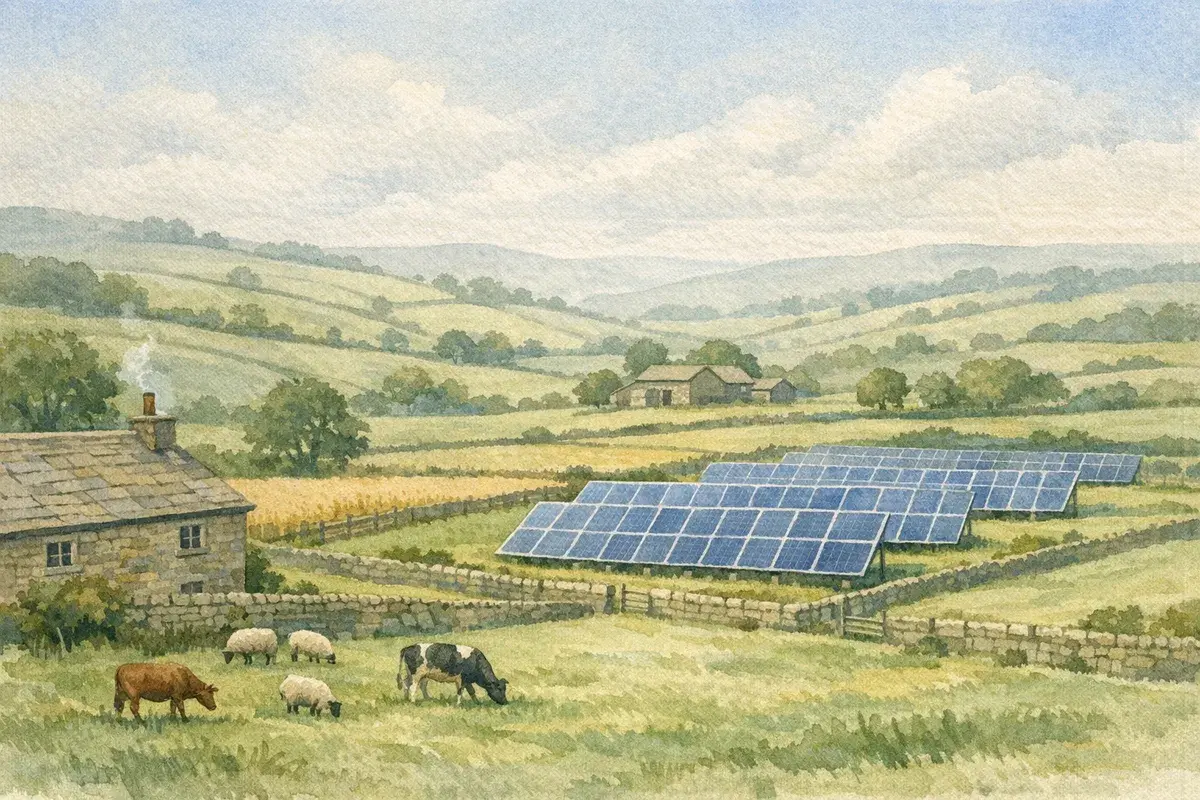
A solar developer rings you up (or drops a glossy letter through the door) offering a long lease, "secure income", and a project that's supposedly simple because "it's just panels on a field". If you've got land, it's tempting, especially when input costs are stubborn, subsidies have shifted, and reliable cashflow feels like gold dust.
But agricultural land solar development in the UK isn't a one‑page handshake. The viability often hinges on grid capacity you can't see from the gate, planning risk you can't wish away, and contract wording that can reshape your whole estate for 30–40 years.
This guide cuts through the noise: what's driving the boom, how sites are really chosen, how planning and leases work in practice, and where landowners most commonly get caught out, so you can negotiate from strength and protect the holding you're stewarding.
Why Solar And Why Now: The Rural Market Forces Behind The Boom
Agricultural land solar development has moved from "niche diversification" to mainstream land-use conversation across much of the UK. You're seeing more approaches because several market forces are lining up at the same time:
- National energy security and net zero commitments are accelerating the push for domestic generation. That doesn't mean planning becomes automatic, but it does mean more capital is chasing deliverable sites.
- Corporate demand for long-term power (and the contracts behind it) has increased developer appetite for schemes that can get built within realistic timeframes.
- Farming margins and volatility have made fixed, index‑linked lease income look unusually attractive, especially where a holding has awkward fields, lower-yield blocks, or operational pinch points.
- Policy direction is broadly supportive of renewables, but (crucially) the planning system still expects good site selection, evidence, mitigation, and local acceptability.
If you want a UK-specific baseline on how planning, grid, leases, and long‑term land value fit together, it's worth reading AgLand's practical explainer on solar projects on agricultural land once you've got the broad picture in mind.
Solar Farm Versus Rooftop And On-Farm PV: What Counts As "Land Solar"
In plain terms, "land solar" usually means ground‑mounted arrays, anything from a modest on-farm scheme powering buildings to a large solar farm exporting to the grid.
It helps to separate three categories, because the risks and returns aren't the same:
- Rooftop PV (farm buildings, sheds, dairies, barns)
- Often the least contentious in planning terms.
- Typically sized around your own demand (though export is possible).
- The big constraint is roof condition, orientation, and connection capacity.
- On-farm ground-mounted PV (smaller, private-wire, or mixed use)
- Can be designed around the farm's load profile.
- May avoid some of the headline concerns that come with large standalone schemes.
- Still needs careful attention to siting, access, ecology, and glare.
- Standalone solar farms (utility scale, export-led)
- Most developer approaches fall into this bucket.
- The commercial driver is export revenue, so grid connection and planning risk dominate.
- The legal structure is usually an option plus lease (or lease with conditionality).
If you're specifically weighing layout types, land take, and how schemes are designed on fields, AgLand's guide to ground-mounted solar on farmland adds extra on-the-ground detail you can sanity-check against any developer pitch.
A quick reality check: solar isn't "set and forget". It's a long, document-heavy process that can be worth it, if you choose the right site, the right counterparty, and the right contract.
How Developers Choose Sites: The Non-Negotiables And The Deal-Breakers
From your side of the fence it can feel random, why your block, why now, why this rent. From the developer's side it's brutal triage.
Most projects die for one of three reasons:
- They can't get a viable grid connection at a workable cost and timeframe.
- The planning risk is too high (designations, cumulative impact, landscape sensitivity, local opposition, policy conflict).
- The land control position is messy (tenure, access, rights, ransom strips, third-party consents).
A serious developer will screen for all three before spending real money. A less serious one may secure signatures first and only discover fatal constraints later, leaving you tied up in an agreement while nothing happens.
Grid Connection And Capacity: The Real Constraint On Most Projects
If you take only one point from this article, make it this: grid is the gatekeeper.
A site that looks perfect, flat, screened, near a substation, can still be non-viable if the local network is constrained, reinforcement costs are high, or queue positions are unrealistic.
What developers typically look for:
- Proximity to suitable connection points (substations/lines) and the right voltage level.
- A credible path through the Distribution Network Operator (DNO) process, including budget estimates and timescales.
- A connection offer that doesn't rely on heroic assumptions.
What you should watch for:
- Vague statements like "grid looks good" with no supporting correspondence.
- Long-stop dates that are so long you're effectively sterilising the land.
- Agreements that let the developer hold you without progressing grid applications.
Planning Risk And Designations: Green Belt, AONB, SSSI, Heritage, Flood Risk
Planning isn't a simple yes/no. It's a balancing exercise, and some constraints weigh heavier than others.
Common UK deal-breakers (or at least big risk multipliers):
- AONBs / National Landscapes and highly sensitive landscapes where harm is hard to mitigate.
- SSSIs, priority habitats, or species constraints where avoidance is difficult.
- Heritage assets (listed buildings, scheduled monuments, registered parks and gardens) and their settings.
- Flood risk (particularly functional floodplain) and associated drainage limits.
- Green Belt: not automatically impossible, but the planning bar is higher and the argument needs to be robust.
Also increasingly relevant: cumulative impact. If your area already has multiple renewables schemes, visual and landscape arguments get tougher.
Agricultural Land Quality, Tenure, And Access: Grade, Occupation, And Easements
You'll hear a lot about "best and most versatile" (BMV) land, typically Grades 1, 2 and 3a, because national policy expects planning authorities to consider the protection of higher-quality agricultural land.
But developers don't only chase poor land. They chase deliverable land.
In practice they'll assess:
- Agricultural Land Classification (ALC) and whether a likely survey could tip land into BMV.
- Field size and shape, slope, and screening potential.
- Access for construction and maintenance, including abnormal loads, visibility splays, and whether third-party land is needed.
- Occupation and tenure: if the land is tenanted, grazed under licence, or part of a contract farming arrangement, you need to understand who has what rights.
- Easements and wayleaves: a cable route or access track that crosses someone else's title can derail timelines.
The best conversations happen when you've already got a handle on the land's wider development prospects too, solar might be the right answer, or it might block a higher-value future use. If you're weighing those trade-offs, AgLand's piece on assessing development potential is a useful framework.
Planning And Consents In Practice: From Screening To Decision
Planning for agricultural land solar development is more like assembling a case file than filling in a form. You're building a defensible argument that the benefits outweigh the impacts, and that impacts are avoided or properly mitigated.
Expect a staged process:
- Early constraints screening (desk-based, then walkover)
- Pre-application engagement (sometimes informal, sometimes structured)
- Surveys and technical reports across seasons where needed
- Application submission with design iterations and mitigation
- Determination (conditions, committee, potential appeal)
If you want a more detailed look at how the planning pathway typically plays out for farmland schemes, AgLand covers the specifics in its guide to solar panels on farmland planning.
National Policy Versus Local Plans: What Carries Weight
In England, decisions are made within the plan-led system: the local plan is central, but it sits alongside national policy and material considerations.
In reality, what carries weight is:
- Local plan policy on renewables, landscape, biodiversity, and countryside protection.
- The quality of your Landscape and Visual Impact Assessment (LVIA) and how the design responds.
- Evidence on agricultural land classification and whether BMV land is being avoided or the impact is minimised.
- Local constraints mapping (heritage, ecology, flood, public rights of way) addressed transparently.
If you're in Wales or Scotland, the framework and policy terminology differs, but the principle is the same: demonstrate need/benefit, minimise harm, and show deliverability.
Environmental And Technical Reports You Will Be Asked For
A credible application usually includes (the exact list depends on site and scale):
- Landscape and visual assessment (LVIA) with verified viewpoints.
- Ecology: habitat surveys, protected species work, and seasonal constraints.
- Glint and glare assessment where receptors exist (roads, dwellings, aviation considerations where relevant).
- Flood risk and drainage strategy, solar arrays change runoff patterns and compaction can matter.
- Transport and construction management plans.
- Heritage assessment if assets are within influence.
- Agricultural land classification survey if BMV risk is in play.
This is where you can tell the difference between a developer who's done their assignments and one who's hoping to "push it through". If the plan is to submit thin documentation and see what happens, you may be the one carrying the reputational and practical fallout locally.
Biodiversity Net Gain And Habitat Delivery: Getting It Right Early
Biodiversity is no longer a bolt-on.
In England, Biodiversity Net Gain (BNG) requirements (for most developments under the Environment Act framework) push developers to quantify baseline habitat value and commit to measurable uplift for a minimum period. Solar schemes often can deliver meaningful habitat improvement, wildflower mixes, managed grassland, hedgerow strengthening, and better soil structure, if it's planned from day one.
Two practical points for you as a landowner:
- Don't let habitat commitments be vague. If the scheme relies on habitat creation to make planning acceptable, you want those obligations, responsibilities, and monitoring costs clearly allocated.
- Think beyond the red line. A smart design can improve the whole block, new hedgerows, better gateways, improved tracks, rather than just the fenced area.
BNG and habitat delivery also interact with your wider farm scheme choices. You don't want overlapping obligations that restrict future flexibility or cause double-counting issues later.
Heads Of Terms To Final Lease: How Solar Land Deals Are Structured
Most landowners first see a set of Heads of Terms that look reassuringly simple: term, rent, area, break clauses. The detail that matters is usually buried in the option, lease, and schedules.
A well-structured deal protects you in three ways:
- It forces progress (so your land isn't tied up for years without a build).
- It allocates risk fairly (planning, grid, third-party rights, abnormal costs).
- It protects the holding (access, reinstatement, insurance, and operational safeguards).
Option Agreements, Promotion Periods, And Exclusivity
Many solar arrangements start with an option agreement. You grant exclusivity for a period while the developer pursues grid and planning, and if conditions are met they can take a lease.
Key levers to negotiate:
- Option length and extensions: shorter initial terms with tightly defined extension triggers are usually better than open-ended discretion.
- Developer obligations: minimum spend, defined milestones, regular reporting, and an obligation to pursue consents diligently.
- Land sterilisation: what you can and can't do during the option (cropping, drainage work, environmental agreements, sporting rights).
- Assignment: can the developer sell the option on, and if so, what controls exist?
You can also see "promotion-style" structures in renewables, but the principle remains: you want clarity on who drives, who decides, and who pays.
Rent Models, Indexation, And Review Clauses: Avoiding Common Traps
Rents for solar are often quoted per acre, but two deals with the same headline figure can be worlds apart once you factor in:
- Indexation (RPI/CPI link, collars and caps)
- Rent commencement (on signing, on grid offer, on energisation)
- Payment frequency and late-payment provisions
- Rent review mechanics and dispute resolution
Also watch how "area" is defined:
- Is rent paid on the fenced array only, or also on access tracks, cable corridors, substations, and compounds?
- Are there separate payments for temporary construction areas?
If you want benchmarks and what influences them (project size, region, grid position, competitive tension), AgLand's guide to solar farm lease rates per acre is a helpful starting point, just remember every site is its own negotiation.
Decommissioning, Reinstatement, And Security: Protecting The Holding
Solar is reversible in theory. In practice, reversibility depends on the lease.
You should insist on clear obligations covering:
- Decommissioning: what must be removed (panels, frames, cabling, foundations, stone, fencing, CCTV poles).
- Reinstatement standard: what does "reinstated" mean, subsoil loosening, drainage repairs, topsoil replacement, reseeding?
- Timing: end of term, earlier termination, insolvency scenarios.
- Security: bonds, parent company guarantees, escrow, or other security mechanisms to ensure you're not left with a bill.
And don't ignore the practicalities: the construction phase can be the most disruptive period on the farm. Good leases spell out access routes, working hours, biosecurity, wheel washing, and liability for damage to tracks, drains, and boundary features.
Tax, Subsidies, And Wider Estate Impacts
This is where "good rent" can turn into "messy outcome" if you don't take advice early.
Solar income feels like property income, but tax treatment depends on the legal structure, the extent of your involvement, and how the arrangement sits alongside the farming business.
And beyond tax: a solar lease can influence lending, succession planning, and what reliefs are available on death or transfer.
Income Tax Versus Capital Treatment And VAT: Where Landowners Get Caught Out
Typical pinch points we've seen landowners stumble into:
- Rent vs trading income: if you're simply letting land, that's usually rental income. If you're more actively involved (for example, you develop and operate), the character can change.
- VAT: whether you opt to tax, whether rent is VAT-able, and how VAT is treated on professional fees and works.
- Upfront payments: signing fees, option payments, and wayleave/easement consideration can have different tax implications to pure rent.
You don't need to memorise rules, you do need to avoid signing structures you don't understand. Bring in a rural tax adviser before Heads of Terms harden into a contract.
Inheritance Tax, APR, And BPR: Understanding The Risk And The Mitigations
For many families, the biggest financial risk in agricultural land solar development isn't planning. It's how the land is treated for Inheritance Tax (IHT) relief.
Broadly speaking:
- Agricultural Property Relief (APR) can be sensitive to whether land remains in agricultural use.
- Business Property Relief (BPR) depends on the nature of the business activities.
A long lease that takes land out of agricultural use may reduce APR on that area, depending on the specifics. That doesn't automatically make solar a bad idea, but it makes early structuring and estate planning non-negotiable.
Mitigations might include:
- Careful layout to retain grazing or agricultural management where genuine and evidenced.
- Thoughtful entity structuring (case-by-case).
- Considering how the solar income sits within the wider farming business.
This is exactly the territory where generic internet advice can mislead you. Take bespoke advice and make sure your solicitor and tax adviser are talking to each other, not working in silos.
Interaction With Farming And Environmental Schemes: SFI, Countryside Stewardship, ELM
With the shift away from the old Basic Payment regime and towards environmental land management, you may be stacking income streams, farming, environmental payments, and renewables.
A solar scheme can complement environmental outcomes (species-rich grassland, hedgerows, pollen and nectar mixes), but scheme compatibility is technical and can change.
Practical steps to protect yourself:
- Map overlaps: don't assume you can claim for the same outcome twice.
- Check management prescriptions: some options have mowing/grazing windows that may conflict with construction or maintenance.
- Keep records: photos, grazing logs, and management notes help if eligibility is questioned.
The goal is a whole-farm plan where solar supports resilience rather than creating administrative headaches for the next 30 years.
Farm Operations, Neighbours, And Long-Term Land Strategy
The best solar sites aren't just technically viable, they're operationally sensible.
If the scheme forces machinery onto single-track lanes all summer, blocks a key livestock movement, or creates neighbour conflict that drags on for years, you'll feel it daily.
Grazing, Cropping, And Soil Management Under And Around Panels
Many UK solar farms are designed with continued grazing in mind (often sheep), and that can be a genuine win: low-intensity management, improved ground cover, and reduced mowing costs.
But it's not automatic. Ask hard questions about:
- Row spacing and panel height: are they actually compatible with grazing and maintenance kit?
- Water supply: will you need new troughs, and who pays?
- Fencing design: does it work for livestock and biosecurity, or is it purely security-led?
- Soil protection during construction: compaction, rutting, and drainage damage are common if it's built in the wrong conditions.
Cropping under panels (true agrivoltaics) is still relatively limited in the UK compared to grazing-based co-use, but you may see more pilot-style approaches over time. Schemes designed around the farming from the outset look different on the ground, using elevated high-clearance arrays, wider inter-row corridors or vertical bifacial panels to protect machinery access, and how agrivoltaics works on UK farms sets out what each layout costs you in energy yield per acre.
Rights Of Way, Glint And Glare, Security, And Community Benefits
Neighbour and community issues are often underestimated, especially in areas with heavy footpath networks.
Consider:
- Public rights of way: diversions are not trivial, and permissive paths can become politically sensitive.
- Glint and glare: not always a major issue, but where there are road receptors or nearby dwellings it needs proper modelling.
- Security: cameras, fencing, lighting, good security shouldn't create nuisance for neighbours or wildlife.
- Community benefit: some schemes include local funds or initiatives. Done well, it helps acceptance: done clumsily, it can inflame suspicion.
It's worth having an early, calm plan for communications. Not a PR campaign, just a transparent explanation of what's proposed, what's not, and how concerns will be handled.
How Solar Affects Value, Finance, And Future Development Potential
Solar can increase value in one sense (secure income stream), but it can also reduce flexibility:
- Lending and charges: your lender may need to consent: future lending may scrutinise the lease terms.
- Future development: a solar lease can sterilise land that might otherwise have long-term uplift potential (not just housing, commercial, minerals, diversification buildings, even infrastructure corridors).
- Saleability: some buyers love contracted income: others discount it due to complexity, obligations, and relief considerations.
If you're trying to judge whether solar is the "best use" for a particular block, AgLand's guide on the best agricultural land for solar explores the practical traits that tend to perform well, beyond the simplistic "poor land only" narrative.
A sensible approach is to treat solar as one element of your long-term land strategy. The right scheme on the right parcel can stabilise the business. The wrong scheme in the wrong place can close doors you didn't even realise you had.
Due Diligence Checklist Before You Sign Anything
Before you sign Heads of Terms, let alone an option, slow the process down and get your evidence in order. Developers are often in a hurry. You don't have to be.
Below is the checklist we encourage landowners to work through with their professional team.
Title, Boundaries, Third-Party Rights, And Mineral Reservations
Start with the unglamorous stuff. It's where deals unravel.
- Title plan and boundaries: are fences where the title says they are? Any slivers, unregistered strips, or ambiguous hedge lines?
- Rights and easements: rights of way, rights to lay services, drainage rights, sporting rights, and any historic agreements.
- Wayleaves: existing power lines or comms kit, do they restrict layout?
- Mines and minerals: who owns them, and could a reservation or leaseholder create a ransom risk for foundations or cable routes?
- Tenancies and occupiers: if anyone else has rights, their consent (and compensation) may be required.
If you're also considering an outright sale rather than a lease, the negotiation dynamics change again, overage, promotion, and planning risk allocation become central. AgLand's guide to selling land to developers is a useful companion for that decision.
Grid And Technical Evidence: What To Ask For In Writing
Don't accept verbal assurances. Ask for documents.
Request (as a minimum):
- Evidence of grid feasibility work and the name of the DNO contact process used.
- Copies of connection applications and any offers (even budget estimates), including constraints and reinforcement notes.
- A clear statement of project size (MW) and assumptions (export-only vs on-site use).
- Proposed cable route strategy: on your land, off your land, and what third-party consents are anticipated.
Also ask how they plan to handle curtailment risk and whether the commercial model assumes optimistic export conditions. You don't need to be the engineer, but you do need enough clarity to judge whether the proposal is real.
Professional Team And Red Flags: Agent, Solicitor, Surveyor, Tax Adviser
Solar is specialist. Your team should be too.
On most deals you'll want:
- A chartered surveyor/land agent with renewables lease experience (to benchmark terms and negotiate).
- A solicitor who routinely handles options, leases, easements, and lender consents in rural contexts.
- A tax adviser who understands rural estates, APR/BPR risk, and VAT structuring.
- Sometimes a planning consultant if the scheme is complex or politically sensitive.
Red flags to take seriously:
- Pressure to sign quickly "to secure the grid queue".
- Refusal to provide grid evidence.
- Heads of Terms that look generous but leave critical items "to be agreed".
- Assignment rights with no controls.
- Decommissioning obligations without meaningful security.
One final pragmatic tip: keep a written paper trail. If the project later changes hands (common in renewables), your ability to enforce obligations often depends on what was documented early.
Conclusion
Agricultural land solar development can be a genuinely transformative part of a UK farm or estate, steady income, improved habitat management, and a hedge against volatile commodity cycles. But it's only "easy money" if you ignore the hard bits, and the hard bits are exactly where the long-term consequences live: grid, planning, lease structure, tax reliefs, and operational fit.
If you're being approached, treat it like any other high-stakes land decision. Get the right professionals around the table early, demand evidence (especially on grid), and negotiate a structure that protects the holding, not just the headline rent. There's usually a good deal to be done, but rarely at the pace the first phone call suggests.
Disclaimer: AgLand.co.uk is a UK agricultural land and rural property matching service, where buyers register what they are looking for and owners advertise directly to the buyers who match, and a rural resource hub. Nothing in this text is intended as legal, financial, or investment advice. You should carry out your own due diligence and seek independent advice from suitably qualified professionals (for example, a rural solicitor, chartered surveyor/land agent, planning consultant, and tax adviser) before making decisions.