
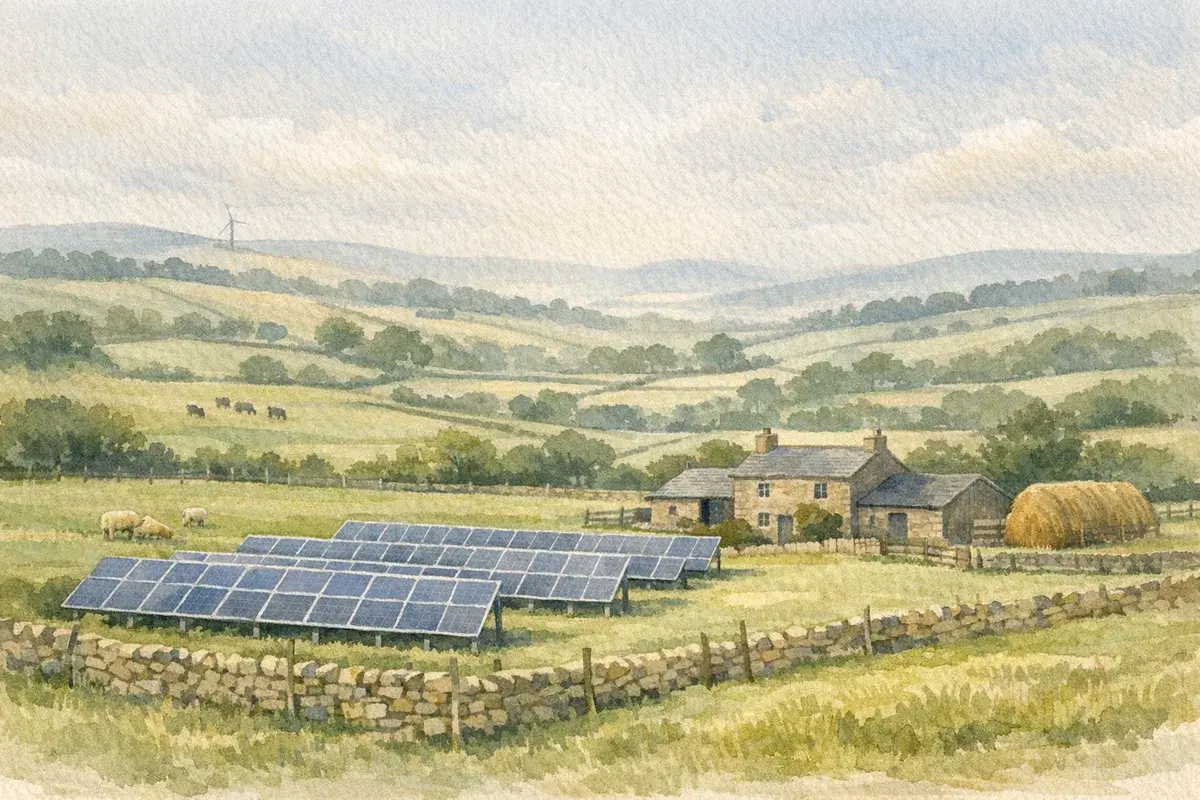
You don't need me to tell you why solar keeps coming up at the kitchen table and in the farm office. Power prices have been jumpy, lenders like long-term contracted income, and the grid is (slowly) creaking toward upgrade. But once you move from "could we?" to "should we?" you're straight into solar panels on farmland planning: policy tests, grid queueing, land quality arguments, and paperwork that can feel designed to trip you up.
The biggest mistake we see is treating planning as the starting gun. In reality, planning sits in the middle of the process. Before you spend money on surveys and drawings, you want a hard-headed feasibility check: land constraints, grid capacity, your control of the site, and whether the scheme genuinely fits your farm business for the next 30–40 years.
Below is a UK-only, practical guide to help you choose the right solar route (roof, ground-mount, or agrivoltaics), anticipate the policy and consultee issues that stall decisions, and take the next steps with fewer nasty surprises.
Start With Feasibility: Land, Grid, And Farm Business Fit
Solar panels on farmland planning goes smoother when you've already answered three blunt questions:
- Is the site physically and policy-wise plausible?
- Can you actually export the power (or use it)?
- Do you control the land strongly enough to sign what needs signing?
If any one of those is shaky, your "planning problem" is really a feasibility problem.
Site Constraints That Commonly Make Or Break A Scheme
Start with a constraints map and a reality check walkover. The things that most often sink or shrink schemes aren't mysterious, they're just easy to overlook:
- Proximity to homes and receptors: visual impact, perceived industrialisation, and construction disturbance become more sensitive close to villages, isolated dwellings, or equestrian uses.
- Landscape designations: National Landscapes (formerly AONBs), National Parks, Heritage Coasts, and locally valued landscapes raise the bar on design and justification under the National Planning Policy Framework.
- Flood zones and surface water: panels themselves don't "cause flooding", but access tracks, cable trenches, and altered runoff can create objections if drainage isn't thought through.
- Public rights of way (PROW): if a footpath cuts through your best-looking field for solar, expect layout compromises, screening requirements, and sometimes re-routing discussions.
- Heritage setting: you might not be near a listed building and still have a setting impact. Views out from a heritage asset matter.
- Farm operations: lambing fields, machinery routes, irrigation, shoot days, yard access, future building plans, if the scheme blocks how the farm works, it's not "passive income", it's friction.
A good early step is to gather what you already have: OS plans, drainage maps, tenancy documents, stewardship agreements, historic environment records you've seen in other applications, and anything about constraints from previous planning decisions on the holding.
Grid Connection Reality Check: Capacity, Queueing, And Costs
In 2026, the grid is often the limiting factor, not planning. You can have a textbook planning case and still be dead in the water if you can't secure a viable connection offer.
What to sanity-check early:
- Where's the nearest suitable point of connection? It might not be the closest pole or line: it's the network capacity and voltage that matter.
- Queueing and lead times: distribution and transmission constraints can mean multi-year timelines. That affects your option term, financing, and whether you can sensibly promise a land rent start date.
- Budget range: connection costs can move from "uncomfortable but manageable" to "project-killing" once reinforcement and substation works appear.
- Cable route practicality: you may need third-party land rights for cables and access. That's a negotiation and legal risk you can't magic away at month 11.
If you want a deeper run-through of the bottlenecks and how connection offers are structured, our explainer on getting a grid connection for a solar farm is a useful companion.
Ownership And Control: Freehold, Tenancies, And Lender Consent
Planning applications assume you can carry out the permission. In the real world, control is often the messy bit.
- Freehold with clean title: easiest, but still check restrictions, easements, and any covenants that might constrain development.
- Agricultural tenancies: if the land is let (or you're the tenant), you need to understand your ability to change use, assign rights, and grant leases. The landlord/tenant dynamic can dictate the entire deal structure.
- Lender consent: if your land is charged, your bank may need to consent to an option or lease. Some lenders are comfortable: others require tight documentation and step-in rights.
- Common land, shared access, or complicated boundaries: practical control matters as much as legal control. A "simple" access track that crosses a neighbour's corner can derail construction.
Before you spend heavily, ask yourself: Can you sign an option agreement today without breaching another agreement tomorrow? If you can't answer confidently, pull in a rural solicitor early, cheaper than unpicking a signed deal later.
Which Solar Route Are You Planning For? Roof, Ground-Mount, Or Agrivoltaics
Not all solar is equal in planning terms. The route you choose changes the likely policy friction, the evidence you'll need, and the farm impacts you'll live with.
Rooftop Solar On Farm Buildings: Typical Planning Position And Design Considerations
Rooftop PV is often the least contentious, because you're using existing built form. But "likely simpler" isn't the same as "always permitted". Watch for:
- Listed buildings and conservation areas: these are the classic tripwires. Even when the barn is functional, heritage policies can bite.
- Glint and glare: less common as a major issue on roofs, but still relevant if you're near roads, rail, or sensitive receptors.
- Structural capacity: not planning, but it becomes a project risk. Old portal frames and asbestos roofs need careful handling.
- Grid/export limits: rooftop is sometimes aimed at self-consumption. If you're exporting significant power, network constraints still matter.
If your goal is to cut farm electricity bills and lock in resilience, rooftop can be brilliant. If your goal is long-term land rent from a third-party developer, rooftop is usually not the shape of deal they're after.
Ground-Mounted Solar Farms: Scale, Layout, And Operational Footprint
Ground-mount is where solar panels on farmland planning gets properly "planning-heavy": landscape, land classification, ecology, traffic, and cumulative impacts can all appear.
A few practical layout realities that planners and consultees tend to scrutinise:
- Setbacks and buffers: from hedgerows, watercourses, and boundaries for ecology and maintenance.
- Access tracks and turning heads: especially during construction: highways teams want to see evidence, not assumptions.
- Inverters, substations, and battery containers: these are often the most visually "industrial" elements, site them thoughtfully.
- Security fencing and CCTV: necessary, but design matters: poorly handled fencing can inflame landscape objections.
If you're weighing this route, it's worth reading our dedicated piece on ground mounted solar panels on farmland, which goes into footprint and practical constraints in more detail.
Agrivoltaics: Combining Grazing Or Cropping With PV And What Planners Expect To See
Agrivoltaics sits in the interesting middle ground: panels on land, but with demonstrable agricultural use continuing. Done properly, it can help address the "loss of farmland" narrative. Done badly, it looks like a solar farm with a few sheep drafted in for the photo.
What planners tend to expect:
- A credible agricultural management plan: stocking rates, grazing rotations, water provision, handling, and access.
- Panel height and spacing: enough to allow machinery (if cropping) or at least practical livestock movement.
- Biosecurity and welfare: how you'll manage footpath users, dogs, and livestock interactions.
If grazing is your proposed co-use, it helps to ground it in real operational detail. Our guide to sheep grazing under solar arrays is useful for thinking through what "ongoing agriculture" looks like on the ground.
Planning Permission Pathways And The Core Policy Tests
In the UK, most meaningful ground-mounted schemes will involve a full planning application. Even when permitted development (PD) rights exist for certain works, PD is not a free pass, conditions, limitations, and prior approvals can still apply.
Permitted Development Vs Full Planning: What Usually Triggers An Application
As a rule of thumb:
- Rooftop solar on many non-domestic buildings can be simpler, but constraints (heritage, designations, protrusion, and other limitations) can trigger the need for permission.
- Ground-mounted solar on farmland typically heads to full planning because of scale, land use change, and impacts.
- Associated development, substations, battery storage, fencing, new access, and cable routes, can push you into full planning even if the panels look modest on paper.
The practical point: don't assume the "solar bit" is the application. Often it's the package, access, grid infrastructure, landscaping, ecology mitigation, that determines the planning pathway.
National Policy And Local Plans: How Proposals Are Assessed In Practice
Your Local Planning Authority (LPA) is balancing national policy aims (clean energy, climate resilience) against local plan policies (landscape, heritage, biodiversity, best and most versatile land, highways safety).
In practice, decision-making tends to come down to:
- Need and benefits: renewable energy contribution, potential farm diversification, local energy resilience, and, sometimes, community benefit proposals.
- Avoiding unacceptable harm: particularly to landscape character, heritage settings, ecology, and high-quality agricultural soils.
- Reversibility and restoration: the "temporary" nature of solar (with decommissioning and reinstatement) is often relied upon, but LPAs want enforceable detail.
- Cumulative impact: if your area already has multiple schemes, your LVIA and landscape strategy needs to address "why here, why this layout, why this scale".
For a more joined-up view of how planning, grid, and deal structure interact across a project lifecycle, see our overview of agricultural land solar development.
Key Planning Documents: Design And Access, Planning Statement, And Site Layout Evidence
Even relatively straightforward applications can fall over because the submission doesn't tell a coherent story.
Documents you'll commonly need (depending on scale and sensitivity):
- Planning Statement: ties the proposal to policy, explains the benefits, and addresses harms with mitigation.
- Design and Access Statement: more important where designations, heritage, or public realm issues apply.
- Site Layout Plan and parameters: panel rows, inverter locations, access tracks, visibility splays, buffers, landscaping.
- Landscape and Visual Impact Assessment (LVIA): with photomontages and viewpoint selection that won't get laughed out of the room.
- Ecology reports: PEA and targeted surveys.
- Construction Environmental Management Plan (CEMP): increasingly requested, particularly around watercourses and protected habitats.
The best applications read like they were prepared by people who've actually stood in the field in January, not just traced lines on a screen.
Environmental, Landscape, And Heritage Checks You Should Not Leave Late
If you want to avoid expensive redesigns, these checks need doing early, often before you've even finalised the red line boundary.
Landscape And Visual Impact: Glint And Glare, Screening, And Viewpoints
Landscape is where sentiment and policy collide. A few practical truths:
- Hedgerows don't instantly solve visual impact: new planting takes years. Your LVIA should address the "year 1" view, not just "year 10".
- Topography is everything: shallow bowls and ridgelines behave very differently in viewshed terms.
- Glint and glare: modern panels are designed to absorb light, but location relative to roads, rail, and aviation can still matter. A proportionate glint/glare assessment can de-risk objections.
Good mitigation is usually a blend of layout choice (avoiding the most prominent parcels), sensitive infrastructure siting (substations tucked away), and credible landscape planting (native, locally appropriate, and maintainable).
Ecology And Biodiversity Net Gain: Surveys, Seasonality, And Habitat Plans
In England, Biodiversity Net Gain (BNG) is now a familiar planning expectation, and even where mandatory requirements vary by scheme type, LPAs commonly want measurable biodiversity improvement.
What catches people out:
- Survey seasonality: if you miss windows for certain species surveys, you can lose months.
- Hedgerow and watercourse constraints: these can force a redesign when buffer requirements are applied properly.
- Management over the full term: habitat creation isn't a one-off. You'll need a management plan that's realistic for 30–40 years.
Solar can actually be a strong biodiversity opportunity, less intensive cultivation, wildflower margins, improved hedgerow management, but only if you commit to it on paper and in practice.
Heritage, Public Rights Of Way, And Sensitive Designations
Heritage impacts are often about setting, not direct harm. Your consultant may need to explain view relationships, historic landscape character, and why the proposal won't erode significance.
For PROW:
- Keep routes open, legible, and pleasant.
- Avoid creating "tunnels" of fencing.
- Consider permissive path enhancements carefully, nice idea, but they can increase footfall and farm management complexity.
For sensitive designations (SSSIs, scheduled monuments, etc.), early engagement with the right bodies is essential. You're trying to avoid a late-stage consultee objection that forces a re-think when everyone's already spent real money.
Agricultural Land Classification, Food Production, And Soil Protection Arguments
This is the section that tends to get political fast: "Should good farmland be used for solar?" Your job is to keep it practical and evidence-led.
Best And Most Versatile Land: How To Evidence Need And Avoidable Harm
"Best and Most Versatile" (BMV) agricultural land, typically Grades 1, 2 and 3a, often triggers closer scrutiny. That doesn't mean development is impossible, but it does mean you need to show you've:
- understood the land quality, not guessed it:
- considered alternatives where reasonable: and
- minimised harm through layout and design.
Evidence that helps:
- An Agricultural Land Classification (ALC) assessment at a proportionate level, using the system maintained by Natural England.
- A site selection narrative: why this parcel, why this size, why this access point.
- A commitment to continued agricultural use where relevant (especially with grazing/agrivoltaics).
If you're trying to choose land that's more likely to be acceptable in policy terms, without undermining the farm's long-term viability, our guide on what tends to make the best land for solar lays out the usual trade-offs.
Soils, Drainage, And Construction Method Statements: Protecting The Asset
Even if your permission is "temporary", your soil is not. LPAs and landowners alike increasingly focus on construction methods because compaction and drainage disruption can linger.
What to push for in a Construction Method Statement:
- Topsoil and subsoil handling: strip, store, and reinstate properly: avoid mixing layers.
- Compaction management: plant and vehicle routes planned, not improvised.
- Working windows: a simple "we'll avoid wet weather" statement won't cut it, spell out triggers and contingencies.
- Drainage protection: locate existing land drains: agree repair protocols.
This is also where you protect your negotiating position. If your land is damaged during build, your remedy needs to be clear and enforceable.
Demonstrating Ongoing Agricultural Use: Grazing Plans, Access, And Biosecurity
If you're arguing that agriculture continues, make it believable:
- Grazing plan: who owns the stock, how often you'll move them, how water will be supplied, what happens in lambing.
- Access and handling: gates, races, turning space, and safe movement that doesn't conflict with security.
- Biosecurity: footpath management, signage, dog control expectations, and how you'll reduce disease risk.
Planners are increasingly alert to "token agriculture". A simple letter saying "sheep will graze" won't carry as much weight as a proper management plan that reads like it was written by someone who's actually moved a flock in February.
Grid, Highways, Flood, And Aviation: The Technical Consultee Issues That Stall Decisions
When a solar application drags, it's often because one technical consultee isn't satisfied. And LPAs are understandably reluctant to approve with big unanswered questions.
Grid And Substation Works: Cable Routes, Easements, And Third-Party Land
Grid works can trigger planning issues beyond the red line:
- Cable routes might cross other holdings, highways, watercourses, or sensitive habitats.
- Easements and wayleaves can take time, and third parties can (politely) hold you hostage.
- On-site substations and switchgear need careful siting and screening.
A common pitfall is presenting grid connection as "to be confirmed later". If the likely route and connection design isn't at least scoped, consultees can object on uncertainty.
Highway Access And Construction Traffic: Swept Paths, Timing, And Conditions
Solar farms aren't huge traffic generators once operational. Construction is the issue.
Expect highways teams to look for:
- Construction Traffic Management Plan (CTMP): routes, timings, wheel washing, avoiding school run pinch points.
- Swept path analysis: can delivery vehicles actually make the turns?
- Visibility splays and entrance design: especially if you're using a field access that's fine for tractors but not HGVs.
If you get this right early, you reduce the risk of late conditions that become expensive to comply with.
Flood Risk, Watercourses, And Drainage Strategy
Even outside high flood zones, you may need to show:
- how runoff will be managed (and not dumped onto a neighbour):
- buffer zones to ditches and watercourses:
- no worsening of surface water flooding through tracks and compaction.
A proportionate drainage strategy, with maintenance responsibilities clearly defined, can prevent objections that otherwise feel "out of nowhere".
Aviation, Radar, And Safeguarding: When It Applies And What Evidence Is Needed
Aviation issues aren't everyday, but when they apply they're non-negotiable. Depending on location, you may need to consider:
- glint and glare impacts on nearby aerodromes or helicopter operations:
- radar and safeguarding zones:
- consultation responses requiring technical assessment.
The trick here is not to panic, but not to dismiss it. If you're in a sensitive area, address it explicitly with evidence, not reassurance.
Commercial Terms, Tax, And Legal Structure That Influence Planning Strategy
Your planning strategy is tied to your commercial deal. The wrong heads of terms can create pressure to over-promise (on timelines, grid, rent start dates) and that's when relationships sour.
Option Agreements, Leases, And Overage: What To Watch Before You Sign
Most land-led solar projects start with an option agreement, then move to a lease if planning and grid are secured.
Key points to scrutinise:
- Option length and extensions: do they reflect real grid lead times, not optimistic sales talk?
- Rent start and indexation: when does rent actually begin, and how is it reviewed?
- Decommissioning and reinstatement: who pays, what standard, and how is it secured (bond, parent company guarantee, etc.)?
- Access rights and cable rights: make sure they're precise and not a blank cheque over the whole holding.
- Overage (clawback): if land value uplifts occur (or if battery storage is added later), how do you share in that?
If you want a sensible baseline for what clauses and schedules typically appear, start with our solar farm lease agreement guidance and template approach, then get a rural solicitor to tailor it to your holding.
Farm Subsidies And Environmental Schemes: Managing Interactions And Compliance
You'll want to map how solar interacts with:
- Environmental land management agreements (where applicable) and any options that affect land use, grazing, mowing, or habitat creation.
- Cross-compliance style expectations that still exist through scheme rules and good agricultural and environmental condition standards.
The practical risk is double-counting: claiming for an option that you can't deliver because the land is effectively taken out of your control, or committing to habitat work that conflicts with construction and maintenance.
Tax And Reliefs: VAT, Inheritance Tax, And Trading Vs Investment Considerations
Tax is where "it depends" genuinely applies, and you should get bespoke advice. But a few themes come up repeatedly:
- VAT: supplies of electricity and lease arrangements can have VAT implications. Don't assume you can ignore VAT just because it's land.
- Inheritance Tax (IHT) and reliefs: changes in land use and income type can affect eligibility for Agricultural Property Relief (APR) and Business Property Relief (BPR). The detail matters: who's doing what activity, and is it trading or investment?
- Structuring: the party that contracts with the developer (you personally, a partnership, a company, a trust) can change outcomes.
This is not the place for guesswork. If a developer is pushing you to sign quickly, that's your cue to slow down and run the numbers properly, especially if your succession plan relies on certain reliefs.
A Practical Application Timeline And De-Risking Checklist
A good solar project feels steady. A bad one feels like repeated last-minute firefighting. Here's a pragmatic way to structure the process.
Pre-Application, Community Engagement, And Design Iterations
Before submission:
- Do a constraints-led layout: start with what you can't do, then design what you can.
- Speak to the LPA (pre-app): you're looking for early steer on landscape, heritage scope, ecology, and whether they'll expect BNG detail at validation.
- Engage neighbours early (selectively, but honestly): a quiet, factual conversation can prevent rumours hardening into objections.
- Iterate design: moving inverters, lowering fencing visibility, or shifting arrays away from a ridgeline can be cheaper now than after an objection.
If you want a broader planning-and-commercial overview to sense-check your approach, our resource on solar panels on agricultural land in the UK is a helpful reference point.
Submission, Determination, And Typical Conditions You Will Be Asked To Accept
Once submitted, you're typically in the world of validation checklists, consultee responses, and negotiated conditions.
Common conditions include:
- Time limits and approved plans: the usual legal framework.
- Landscaping scheme and maintenance: species, planting seasons, replacement, and management.
- Ecological mitigation and monitoring: habitat creation, timing constraints, and sometimes clerk of works requirements.
- Construction management: CTMP, working hours, wheel washing, noise controls.
- Decommissioning plan: what happens at the end of life or if the site becomes redundant.
Read conditions carefully. Some are reasonable: others can be drafted in a way that creates ongoing operational headaches if you don't refine them.
Appeals, Enforcement Risk, And How To Keep Records Audit-Ready
If refused, an appeal may be possible, but it's rarely the first choice if redesign or further evidence could address the reasons for refusal.
A few risk-management habits we'd strongly recommend:
- Keep a decision log: why you chose the site, what alternatives you considered, and how you mitigated impacts. This helps if challenged later.
- Keep survey evidence organised: ecology, ALC, drainage, and consultation correspondence in one place.
- Don't improvise on site: changes during construction without approval can trigger enforcement. Planning compliance is a system, not a box-tick.
Whichever side you're on. Buyers tell AgLand what they're looking for and hear the moment something fits. Owners advertise straight to the buyers who already match, for one flat fee and no commission. Register as a buyer or check your matches.
Conclusion
Solar panels on farmland planning isn't just a planning application, it's a long-term land-use decision wrapped in grid constraints, policy tests, and contract terms that can last a generation.
If you do one thing after reading this, make it this: treat feasibility as a gated process. Confirm grid reality, confirm land control, and confirm the planning constraints before you let anyone rush you into an option agreement or a design that only works in a PowerPoint.
When the basics are solid, the rest becomes much more predictable: better consultant briefs, calmer community conversations, fewer consultee surprises, and a scheme that still fits the farm business when the novelty has worn off.
Disclaimer: AgLand.co.uk is a UK agricultural land and rural property matching service, where buyers register what they are looking for and owners advertise directly to the buyers who match, and a rural resource hub. Nothing in this text is intended as legal, financial, tax, or investment advice. You should carry out your own due diligence and take advice from suitably qualified professionals (for example, a rural solicitor, chartered surveyor, planning consultant, accountant/tax adviser, and grid specialist) before making decisions or entering into agreements.