
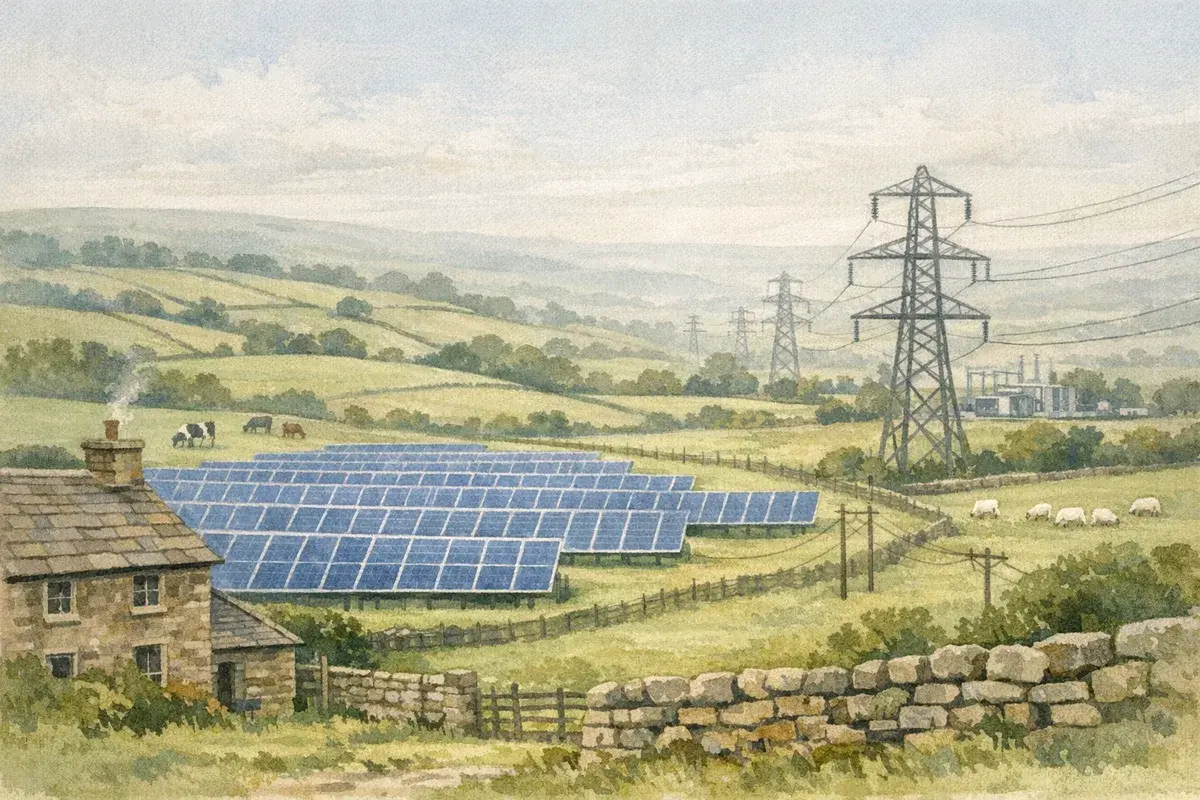
A solar farm can look perfect on paper: good irradiation, sensible layout, a willing landowner, and a developer talking confidently about "getting planning in." Then the grid conversation starts, and suddenly the whole project lives or dies on a single question: can you actually export power, when, and on what terms?
In the UK, the grid connection is often the real bottleneck, not the land. Connection queues, reinforcement works, curtailment and shifting rules can turn an apparently bankable scheme into a slow-moving (and expensive) option agreement that never reaches first export.
This guide cuts through the noise and walks you through solar farm grid connection reality in 2026: who controls what, what the end-to-end process looks like, what it tends to cost, where timelines slip, and the due diligence you should do before signing anything that ties up your land for years.
Why Grid Connection Is The Real Constraint On Solar Farm Viability
If you've been around rural property long enough, you'll have heard the same refrain: "Planning is the hard part." For solar, that's increasingly outdated. In many areas, grid connection capacity, and the terms attached to it, is what decides whether the project is financeable.
A developer can secure control of land relatively quickly (option, lease, promotion agreement). But they can't magic up a viable grid offer. And as a landowner, you can't rely on "we'll sort the grid later" without exposing yourself to long tie-ins, sterilised land, and a project that may never build.
Connection Capacity, Queue Position, And Curtailment Risk
Grid viability is really three interlocking issues:
- Is there physical capacity locally? That's about feeder headroom, transformer limits, and wider constraints on the distribution or transmission network.
- Where are you in the queue? A scheme with an early connection date can still get pushed back if it's not progressing to milestones, or if the network company reprioritises based on "readiness".
- How much can you export in practice? Even if you're "connected", you may be subject to export limits or curtailment (your output being reduced to manage network constraints). That directly impacts revenue and lender appetite.
Curtailment is the silent killer because it doesn't always show up in a headline capacity number. You'll see it in the connection agreement as operational constraints, or via Active Network Management (ANM) arrangements. If you're comparing offers, or weighing up whether a developer's rent looks "high", curtailment risk needs to be part of the conversation.
If you're at the very early stage of assessing whether your holding is suitable, it's worth grounding yourself in the broader development picture as well as grid. Our guide to solar development on agricultural land explains how grid, planning, ecology, and land terms interact, because none of these sits in a neat silo.
DNOs Vs National Grid ESO: Who Controls What
In Great Britain, two layers matter:
- DNO (Distribution Network Operator): This is typically who you deal with for most solar farms, especially smaller and mid-size projects connecting at LV/HV or up to certain EHV points on the distribution network.
- Transmission / National Grid ESO (Electricity System Operator): Historically the ESO has managed the transmission-side connections and system balancing. (There's ongoing structural change in how system operation is governed, but for your day-to-day project decisions, the key is still: distribution connection vs transmission connection.)
In plain terms: most land-led solar opportunities start with a DNO conversation, but bigger schemes, and many battery/solar hybrids, quickly bump into transmission constraints or processes that feel more "National Grid" than "local lines."
What you should take from this as a landowner: a developer's confidence isn't proof of capacity. A credible developer will show you the actual connection pathway, voltage level, substation point, route assumptions, and what studies or reinforcements are implied.
The UK Grid Connection Landscape In 2026
2026 is a different world from the "apply and wait" era that created huge speculative queues. The direction of travel is clear: fewer zombie projects, tougher milestones, and more emphasis on evidence that a scheme is genuinely deliverable.
That's good news if you're serious. It's awkward if you're dealing with a developer who wants to lock up your land cheaply while they "have a go" at the queue.
G99, Contestable Works, And The Role Of ICPs/IDNOs
Most solar farms connect under UK engineering recommendations such as G99 (generation). Your export capacity, protection settings, and compliance testing are shaped by these rules.
Then there's the practical build:
- Some parts of the connection are contestable works, meaning they can be designed and built by an appropriately accredited third party rather than solely the network company.
- That's where ICPs (Independent Connection Providers) and IDNOs (Independent Distribution Network Operators) can come in.
Why does this matter to you?
- It can affect cost (sometimes competitive, sometimes not once complexity is added).
- It can affect programme risk (lead times for equipment, coordination with outages, and who actually owns/maintains assets).
- It can affect land rights (cable routes, access for maintenance, and the need for easements/wayleaves).
If a developer pitches "we'll use an ICP to speed it up," don't treat that as a guarantee. Ask what's contestable in this design, and what still depends on the DNO's critical path.
Reforms, Queue Management, And What "Ready To Build" Means
Across the sector, reforms have pushed connection queues toward a "progress or step aside" model. In practice, "ready to build" generally means the project can evidence things like:
- Land rights are secured (not just a vague handshake)
- Planning is progressing in a credible way (or a planning strategy is in place)
- Technical design is sufficiently developed to support studies and firm costs
- Financing and delivery capability aren't purely hypothetical
For you, the takeaway is simple: options with no grid strategy are riskier than they look. You might be tying up land for a rent that only starts years later, if ever.
Grid isn't the only permissioning hurdle, of course. If you want the planning side in one place, our article on UK solar planning on farmland lays out what tends to trigger objections, which reports matter, and how agricultural justification is typically evidenced.
The End-To-End Grid Connection Process For A Solar Farm
A solar farm grid connection is a process, not an event. It typically moves from rough feasibility to a formal offer, then into detailed design and build, then to testing and energisation.
The exact steps vary by network area and connection voltage, but the shape is broadly consistent.
Step 1: Feasibility Screening And High-Level Connection Options
Before anyone spends serious money, the sensible approach is a feasibility screen. That normally looks at:
- Nearby substations and their voltage (and whether they're realistically accessible)
- Potential connection points and indicative cable routes
- A rough view of whether the network is constrained (and whether ANM/export limits are likely)
- Physical constraints on your land: access, topography, crossings, third-party ownership boundaries
As the landowner, you can ask for a simple "options note" that sets out at least two viable connection concepts. If a developer can't explain their intended connection point in plain English, they're not ready to control your land for 30–40 years.
And it's worth keeping the grid conversation tied to layout decisions. For example, ground-mounted arrays, inverter locations and on-site substations can influence both design and routing. If that's relevant to your holding, see our practical overview of ground-mounted solar on farmland.
Step 2: Application, Offer, Acceptance, And Securities
Once a developer applies formally, the network company issues a connection offer. This is a pivotal document. It usually includes:
- Connection capacity (MW) and the technical connection point
- Required reinforcement works (if any) and a cost estimate
- Programme assumptions and a target connection date
- Milestones, termination rights, and sometimes "use it or lose it" conditions
- Securities or payment structures (often staged)
Acceptance typically requires signing the offer and paying an amount up front. From your perspective, this is where you should start seeing whether the developer is serious (and funded), because real money is committed.
Step 3: Detailed Design, Consents, Build, Testing, And Energisation
After acceptance, the work becomes more engineering-heavy:
- Detailed electrical design, protection studies, metering strategy
- Civil design for trenches, ducts, compounds and potentially a substation
- Securing land rights for off-site works (more on that below)
- Construction, commissioning, compliance testing, and finally energisation
The "gotcha" here is that a project can have planning consent and still be stuck for months (or longer) waiting on:
- equipment procurement (switchgear and transformers can be long-lead)
- outages and network access windows
- third-party consents (roads, rail, waterways)
A developer who talks only about planning timelines, without a grid build programme, is giving you half a picture.
Connection Design Choices That Change The Numbers
Two solar farms with the same MW capacity can have wildly different grid outcomes depending on design choices. This is where experienced developers earn their keep, and where landowners can protect themselves by asking the right questions early.
HV Vs EHV, Substation Requirements, And Route Constraints
Voltage level is a big driver of both feasibility and cost:
- HV (High Voltage) connections may suit smaller schemes, but are often constrained locally.
- EHV (Extra High Voltage) connections can handle larger exports but may require a new or upgraded substation, more complex protection, and more land.
Then there's the route. Cable distance isn't just a number on a map: it's about:
- road crossings and traffic management
- third-party land you don't control
- environmentally sensitive areas
- physical obstacles (rivers, rail, steep ground)
This is where you should be cautious about "we'll run it along the hedge line" optimism. Unless there's evidence of deliverable land rights, a neat line on a plan can turn into a nasty surprise.
Export Limits, ANM, Batteries, And Hybrid Schemes
To deal with constraints, developers may propose:
- Export-limited connections (cap export at certain times)
- ANM (a managed connection where output is curtailed dynamically)
- Co-located battery storage to soak up energy when export is limited
- Hybrid arrangements that blend solar, storage, and sometimes other technologies
A battery can improve the economics in the right place, but it also adds:
- planning and fire safety considerations
- different grid compliance requirements
- a more complex commercial model
If you're offered a premium rent because "we'll add batteries later," be careful. Later is doing a lot of work in that sentence. Make sure the lease/option structure doesn't give away too much upside without binding commitments.
If you're comparing a solar lease against other income sources, it helps to understand what's actually driving returns and what can erode them. Our piece on whether solar farming is profitable breaks down the main revenue levers and real-world risks (including grid constraints) without the glossy brochure assumptions.
How Much A Solar Farm Grid Connection Costs (And Who Pays)
Connection cost is one of the hardest things to "ballpark" accurately at the start, because the early numbers often exclude the unpleasant bits: reinforcement beyond the immediate point, third-party consents, traffic management, and programme risk.
As a landowner or investor, you don't need to become a power systems engineer, but you do need enough clarity to spot when a developer's numbers are fantasy.
Shallow Vs Deep Charges, Reinforcement, And Ongoing DUoS/TNUoS Impacts
Connection charging can be described (simplistically) as:
- Shallow-ish costs: assets and works close to the connection point that are attributable to your project.
- Deeper reinforcement: wider network upgrades triggered by your export.
The exact boundary depends on the connection type, network policies, and current charging arrangements. The important bit for you: reinforcement can dwarf the "cable-to-substation" cost.
Also, remember the ongoing operational charges in the background. Generators and consumers interact with network charging in different ways, but terms like DUoS (distribution use of system) and TNUoS (transmission network use of system) matter to project economics, especially for larger exports and hybrids. These aren't line items you pay as the landowner, but they influence how much rent a developer can sustainably offer.
Budget Ranges, Cost Drivers, And Typical Surprise Items
At a very broad UK level, connection cost can range from hundreds of thousands to several millions of pounds, driven by:
- distance to the connection point and complexity of the route
- whether a new substation/transformer is needed
- the scale of reinforcement works
- contestable vs non-contestable scope split
- programme constraints (outage windows, procurement lead times)
Surprise items we see trip people up:
- Wayleave/easement compensation demanded by third-party landowners
- highway authority requirements and reinstatement costs
- rail or river crossings and specialist drilling
- unexpected protection upgrades at the substation
- delays that force redesign (which is cost as well as time)
If you're negotiating terms, it's also worth understanding what a "good" commercial offer looks like beyond the grid. Rent levels vary hugely by region and connection quality. For context, our guide to solar lease rates per acre explains what typically sits behind headline numbers, and why grid quality is often the invisible hand in the deal.
Realistic Timelines And The Critical Path To First Export
The honest answer on timing is: it depends where you are, what you're connecting to, and how congested the local network is. But you can still sanity-check a programme.
For a typical UK solar farm, the timeline from first discussions to first export is commonly measured in years, not months, particularly where reinforcement, third-party land rights, or complex consents are involved.
Common Delay Points: Studies, Wayleaves, Procurement, And Outages
The repeat offenders are boring, administrative, and hugely consequential:
- Network studies (and re-studies) that take longer than expected
- Wayleaves/easements: one awkward neighbour can stall a whole route
- Procurement lead times for transformers and switchgear
- Outage planning: you may only get certain windows to tie-in safely
- road-opening licences and traffic management constraints
A developer can do many things well and still be held hostage by a single missing consent.
De-Risking The Programme With Parallel Planning And Land Rights
The strongest projects run key workstreams in parallel:
- grid application and early design while planning preparation begins
- land rights strategy for cable routes as soon as a preferred connection point is identified
- ecological and agricultural baseline work early, so surveys don't slip a whole season
As a landowner, you can protect yourself by insisting that "progress" is defined. If the option agreement allows endless extensions with minimal cost to the developer, the risk is basically sitting with you.
If you want a fuller view of how grid and planning interact with leasing structures (and what good looks like), our longer guide to solar panels on agricultural land connects the dots, especially around due diligence and long-term value impacts.
Landowner And Investor Due Diligence Before You Sign Anything
This is the section that saves people serious money and stress.
A solar deal can be perfectly legitimate and still be poorly structured for you, especially if the grid connection is uncertain. Before you sign an option, lease, or heads of terms, you want to line up three things: the grid offer reality, the land rights reality, and the lease reality.
What To Check In The Grid Offer: Capacity, Milestones, Curtailment, And Liabilities
Ask to see the actual offer (not a summary slide). Then focus on:
- Export capacity and connection point: Is it firm or conditional? Is it an export cap or managed arrangement?
- Curtailment / ANM terms: Are there expected constraints? Any modelling of likely curtailment in that network area?
- Milestones and drop-dead dates: What must be achieved by when? What happens if it isn't?
- Cost exposure: Are there provisions for cost increases, re-quotes, or re-design? Who carries that risk?
- Liabilities: What happens if the developer walks away? Are there securities that could be forfeited?
You're not trying to micromanage engineering, you're checking whether the commercial promise rests on a grid offer that is credible, financeable, and timed sensibly.
Land Rights For Cables And Substations: Options, Wayleaves, And Ransom Strips
Grid connections often need land outside the red line of the solar site:
- off-site cable routes
- access tracks
- a substation compound
- temporary construction rights
The land rights toolkit includes:
- Options (secure the right to take a lease/easement later)
- Wayleaves (permission, sometimes more temporary/terminable, depending on structure)
- Easements (stronger, registrable rights that lenders tend to like)
The classic pitfall is the ransom strip problem: a small piece of third-party land that sits exactly where you need to cross. If that person knows the project can't connect without them, your negotiating leverage disappears fast.
As a landowner, you should be clear whether your developer expects you to help secure third-party rights, or whether they'll handle and fund it. Either can work, but it must be explicit.
Lease Terms That Must Align With The Connection: Longstop Dates, Break Clauses, And Security
Your land agreement is where grid uncertainty should be managed, not ignored.
Key points to push for (with proper professional advice):
- A sensible longstop date: if grid (or planning) isn't achieved by X date, you can walk away.
- Defined progress obligations: not vague "reasonable endeavours," but specific steps and evidence.
- Break clauses that work for you if the scheme stalls.
- Rent commencement clarity: is there an option fee only, or does rent start on a defined trigger?
- Decommissioning security: bonds/escrow and clear reinstatement obligations.
If you want a starting point for what clauses tend to appear (and which ones deserve attention), you can review our solar lease template guidance, not as a substitute for a solicitor, but as a practical way to understand the moving parts before you're sat at the negotiating table.
One more landowner reality check: solar doesn't automatically mean the land becomes "dead" for farming. Dual-use can be very real, especially grazing. If your priority is keeping an agricultural thread running (and demonstrating good stewardship), our piece on grazing sheep under solar arrays is a useful window into what works in practice, and what needs designing in from day one.
A pragmatic approach we've seen work well:
- Get an independent land agent or surveyor to sanity-check the commercial terms.
- Get a grid specialist (or an engineer) to review the offer and curtailment risk.
- Get a solicitor who actually does energy projects to align the lease with the grid milestones.
Yes, it costs money upfront. But it's cheap compared to a decade of constrained land and an agreement that never becomes income.
Conclusion
A UK solar farm is only as good as its ability to export power on workable terms. In 2026, that means treating solar farm grid connection as the first-order question: capacity, queue position, curtailment, deliverable land rights, and a programme that stands up to scrutiny.
If you're a landowner, your leverage is highest before you sign. Use it to demand clarity: the actual grid offer, a credible route plan, milestones with teeth, and lease terms that don't leave you carrying all the downside if the scheme stalls. If you're investing, assume the grid is a project in its own right, because it is.
Disclaimer: AgLand.co.uk is a UK agricultural land and rural property matching service, where buyers register what they are looking for and owners advertise directly to the buyers who match, and a rural resource hub. Nothing in this text is intended as legal, financial, or investment advice. You should carry out your own due diligence and seek guidance from appropriate professionals (for example, a solicitor, chartered surveyor, tax adviser, planning consultant, and qualified grid engineer) before making decisions.