You've probably seen the headlines: solar farms spreading across the countryside, and farmers wondering where they fit. The reality on the ground is more interesting (and more practical) than the debate makes it sound.
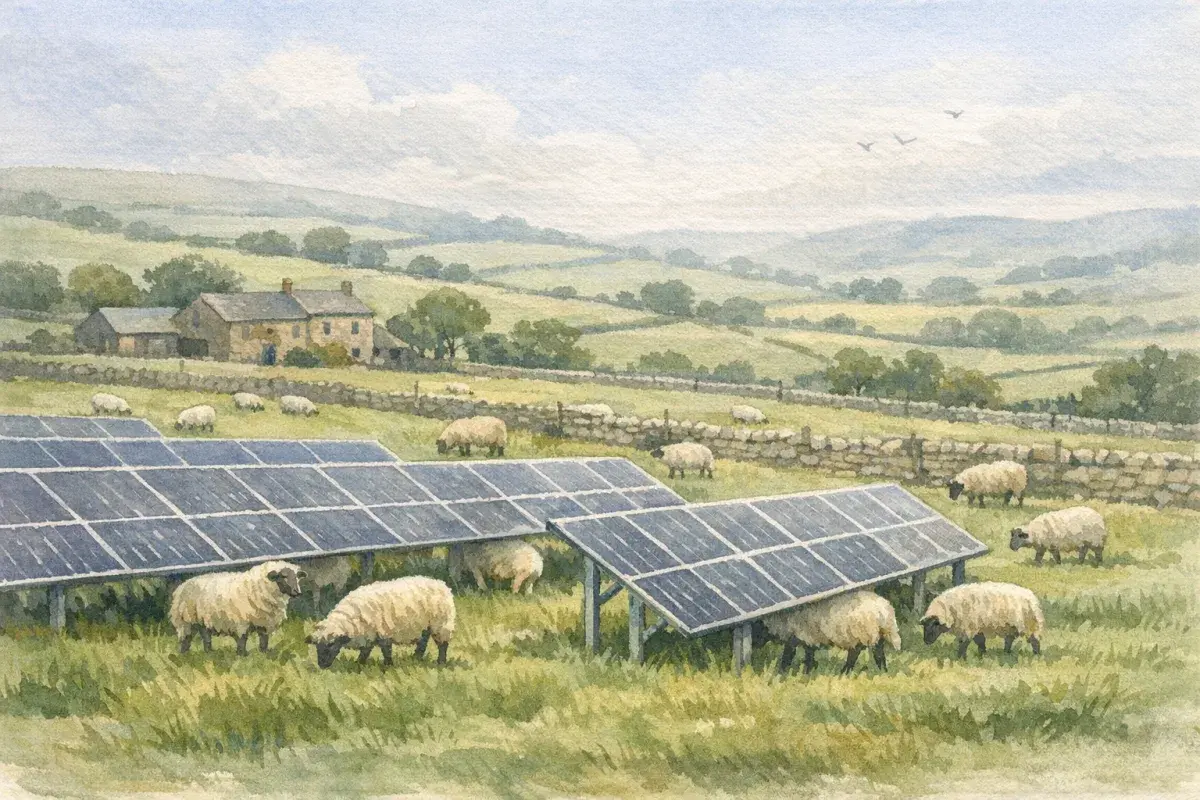
Sheep grazing solar farms is one of the simplest forms of agrivoltaics you can actually run day-to-day in the UK. Done well, it keeps vegetation under control, improves site presentation, supports biodiversity goals, and gives you a steady farm job that isn't tied to lamb price swings alone. Done badly, it turns into a tangle of access rules, welfare headaches, and "who pays for what?" arguments.
This guide is written for you as a UK landowner, farmer, or rural investor, whether you're negotiating a new solar lease, looking to place sheep onto an existing site, or weighing up if grazing is worth the hassle. We'll get into what makes a site workable, how to manage sheep under panels, how agreements are typically structured, and the compliance checks worth doing before the first trailer arrives.
Why Sheep And Solar Work Together On UK Sites
Sheep are the obvious livestock choice for solar because they're small, selective grazers and, crucially, less inclined to treat infrastructure as a playground. But "obvious" isn't the same as "automatic". If you want sheep grazing solar farms to be more than a tick-box, it helps to understand what each side is really trying to achieve.
Dual Income And Risk Diversification
From your perspective, grazing a solar site can sit in a few different roles:
- A reliable grazing block that takes pressure off your core holding in summer or shoulder seasons.
- A paid service (vegetation management) that steadies cashflow when other margins are tight.
- A way to keep land in agricultural use while a long-term energy project runs its course.
If you're the landowner considering solar as well as grazing, it's worth stepping back and looking at the project as a whole: lease structure, development risks, and long-term value. The economics aren't one-size-fits-all, but a solid starting point is understanding the moving parts that drive returns, rent, indexation, grid, and restoration obligations, covered in AgLand's guide to solar panels on agricultural land.
Animal Welfare Benefits And Microclimate Effects
You're not imagining it: panels change the microclimate. On many UK sites, that can be a welfare positive, if the design and management are sensible.
Common welfare upsides you'll see reported by graziers:
- Shade in hot spells (increasingly relevant during summer heatwaves).
- Reduced wind exposure in open landscapes.
- More stable sward growth in dry periods where shading reduces evapotranspiration.
But there are trade-offs:
- Wet, still corners can become fly pressure zones.
- Shade-tolerant weeds can creep in if grazing pressure isn't controlled.
- Poor drainage + heavy soils can turn into poaching quickly in a wet winter.
Your job is to treat the site like its own "field type", not just an extension of your usual system.
What Solar Developers Need From Grazing To Meet Planning And ESG
Developers don't ask for sheep because it's trendy. They ask because it helps them meet practical and reputational requirements:
- Vegetation control without constant mowing (and without stones thrown into panels by flails).
- Fire risk management through reduced biomass.
- Planning compliance where conditions reference landscape mitigation, habitat management, or agricultural use.
- ESG reporting that can evidence lower chemical use and improved habitat outcomes.
In other words: your grazing plan can become part of their compliance narrative. That's useful leverage when you're negotiating access, payments, and what "good performance" actually means.
Site Suitability: What To Check Before You Agree To Graze
Not every solar farm is grazeable in practice. Before you commit, treat it like taking on a new block of rented ground, except with far more fixed kit and rules.
Panel Layout, Row Spacing, Ground Clearance, And Access Routes
Start with the physical reality. Walk it with the site manager (or your agent) and ask blunt questions.
Key checks:
- Ground clearance: Can sheep move comfortably under the lowest edge at all points, including dips? Low-clearance arrays can funnel sheep into awkward spots and increase rubbing.
- Row spacing: Enough for a quad/UTV and for you to get a small trailer in if you need to move hurdles, minerals, or a casualty.
- Turning circles and gates: If you can't turn a trailer or get a contractor in, it will bite you during lambing or when weather flips.
- Track standard: Is there all-weather access to every block, or are you expected to "make do" across soft ground?
If you're comparing sites (or negotiating a new build), it pays to understand how layout differs between schemes. AgLand's piece on ground-mounted solar on farmland is a helpful reference point when you're sanity-checking what you're being offered.
Fencing, Gates, Water, Handling Pens, And Biosecurity
Infrastructure is where most arguments start, because everyone assumes someone else is paying.
Minimum practical set-up for most grazing arrangements:
- Stock-proof perimeter fencing (and ideally a second internal line near sensitive kit).
- Gates you can use with a trailer, plus a clear rule on who holds keys / codes.
- Water: troughs that don't rely on you dragging bowsers every week unless you've priced that in.
- Handling area: even a simple pen and race solution matters for dagging, dosing, and emergency checks.
Biosecurity questions you should ask early:
- Are there multiple graziers using the site across the year?
- Is there a requirement for quarantine or specific treatment protocols?
- How is carcase disposal handled if an animal dies on site?
Soils, Drainage, Shade Tolerance, And Pasture Establishment
Some sites look fine in June and fall apart in January.
Walk it after rain if you can. If not, interrogate the history:
- Soil type and compaction risk: heavy clays plus frequent vehicle movements can become a mess.
- Drainage routes: panels can concentrate drip lines: you'll get wet strips under edges.
- Establishment method: was the site reseeded well, or was it "green-painted" for planning?
Ask what species mix was used. Under panels, you typically want:
- hard-wearing grasses (for traffic)
- some shade tolerance
- a clover component if it can survive grazing pressure and you're not stuck with strict mowing specs
Constraints: SSSIs, AONBs, Rights Of Way, And Neighbour Sensitivities
UK sites come with constraints that affect your practical management as much as any technical spec:
- Public rights of way: expect dogs, gates left open, and "my child wants to pet the lambs" moments.
- Neighbour relations: lambing sheds, lighting, or vehicle movements can trigger complaints.
- Protected landscapes and habitats: management prescriptions may be tight, and monitoring may be frequent.
If the grazing is tied to planning conditions, you need to know exactly what the development consent says (and what happens if a condition is breached). For new or expanding schemes, it's worth reading up on the planning pathway and common sticking points in AgLand's guide to solar panels on farmland planning.
Grazing Management Under Panels
Once you're on site, success is mostly boring: routine, records, and not letting small issues drift into expensive ones.
Stocking Rates, Rotations, And Seasonal Grazing Plans
There isn't a universal stocking rate for sheep grazing solar farms because output depends on:
- sward productivity (often lower in shade)
- soil moisture and poaching risk
- the developer's required grass height window
- your breed type and system (store lambs vs breeding ewes)
In practice, many graziers run lighter stocking but more frequent moves than on open pasture. Rotational grazing helps you:
- keep grass within an agreed height range
- reduce parasite burden
- avoid sheep camping under favourite arrays and hammering one spot
A simple approach that usually works:
- Agree a target sward height range in writing.
- Split the site into manageable blocks using temporary fencing where permitted.
- Build a wet-weather plan that triggers a move off site (or onto hardstanding) before poaching becomes a dispute.
Sward Choices And Weed Control Without Herbicide Reliance
Most solar owners prefer minimal spraying for optics and biodiversity commitments, and sometimes because of scheme constraints.
So your weed control toolkit becomes:
- timing and grazing pressure (hit docks/nettles early with the right class of stock)
- topping where access allows and where the developer permits it
- reseeding/overseeding thin areas before weeds establish
Watch for:
- bramble and scrub creeping in along fences (a compliance issue as well as a grazing one)
- ragwort, your responsibility to manage it doesn't disappear because panels are present
The best weed strategy is often preventative: don't let a "cosmetic" problem become a site-manager complaint.
Protecting Cables, Inverters, And Substations From Livestock Damage
This is where developers get nervous, and it's where you need clarity.
Risks to manage:
- rubbing on cabinet edges, posts, or anything with corners
- chewing (less common with sheep than cattle, but not impossible if minerals are lacking)
- compaction and wear around inverters and substations where sheep congregate for shelter
Practical mitigations:
- keep mineral provision consistent so sheep aren't exploring for "salty" smells
- use physical barriers around sensitive equipment (developer-provided, ideally)
- plan rotations to avoid sheep sitting in one sheltered spot for weeks
Also ask what the developer considers "no-go zones" and how they're marked. You don't want a retrospective rule change after you've set your system up.
Lambing, Dagging, Flystrike Control, And Practical Day-To-Day Logistics
Most solar sites aren't designed for lambing, and many developers won't allow it. If you're thinking of putting in ewes, get explicit permission and think hard about the day-to-day reality.
Questions to settle:
- Are you allowed to bring dogs for gathering (and under what controls)?
- Can you use temporary pens/hurdles, and where can they be stored?
- What are the rules for night checks, lighting, and vehicle access?
Flystrike control matters because shaded, still zones can hold dampness. Your plan might include:
- routine dagging schedule
- strike risk monitoring during warm, wet periods
- agreed procedure for catching and treating animals on site
And keep it practical: if you can't safely handle sheep on site, you're setting yourself up for welfare risk and a contractual argument.
Commercial Models And Agreement Structures
The biggest mistake you can make is assuming a "grazing deal" is informal. Solar sites are valuable infrastructure projects: the paperwork culture is different from ordinary keep.
Service Grazing Versus Tenant Grazing: Who Carries What Risk
Most arrangements fall into two buckets:
- Service grazing (vegetation management): you're paid to deliver a grass height outcome. The developer retains control: you follow site rules: you may have tighter KPIs.
- Tenant grazing / grazing licence: you're effectively renting grazing and taking more day-to-day farming risk, sometimes with less oversight.
Service grazing can be attractive if you want predictable income, but it often comes with:
- reporting requirements
- restrictions on medicines, feeds, or supplementary forage
- tighter access windows
Tenant-style arrangements can be simpler, but you must be careful around liability, security, and what happens if the developer changes site operations.
Typical Payment Structures, Indexation, And Performance Standards
Payments vary widely by region, site design, and how much hassle the work entails.
Common approaches include:
- £/acre (or £/ha) grazing payment
- £/visit (inspection and husbandry tasks priced separately)
- performance-linked payments tied to grass height or visual standards
If you want a benchmark for the wider solar market, it's useful context to read about solar farm lease rates per acre, even if your grazing deal is not the main lease, it influences how much the site can realistically afford to pay.
Make sure indexation is clear (RPI/CPI linkage is common in longer contracts) and that "performance" is objectively measurable, not just "site manager didn't like the look of it".
Access Rights, Working Hours, And Health And Safety Rules On Site
Solar farms run on rules: inductions, RAMS, sign-in procedures, PPE requirements, and locked compounds.
Agree, in writing:
- your access windows (including weekends and bank holidays)
- whether you can enter during maintenance shutdowns
- who escorts you, if anyone
- rules for vehicles (speed limits, parking, wet-weather restrictions)
And don't gloss over emergency access. If you've got a stuck ewe, you need a clear route to act quickly, without breaching site security.
Insurance, Indemnities, And Liability For Escapes And Damage
You'll usually be expected to carry appropriate insurance (often public liability plus employer's liability if you have staff).
Key clauses to check with your broker/adviser:
- liability for damage to panels, cables, or fencing
- responsibility for third-party claims (e.g., dog walkers, trespassers)
- who pays if sheep escape due to a failed fence line
It's also worth ensuring the actual agreement reflects what you've negotiated. Even if you never use a template "as-is", reviewing a structure like AgLand's solar farm lease agreement template can help you spot missing essentials, definitions, access rights, repair duties, and termination triggers.
Planning, Compliance, And Cross-Checks To Do With Your Advisers
This is where you protect yourself. A solar site can involve planning conditions, ecological commitments, and scheme interactions that don't exist on normal keep ground.
Planning Conditions And Landscape/Biodiversity Commitments
Ask to see the planning decision notice and any approved management plans that affect grazing:
- Landscape and visual mitigation planting
- Habitat creation (species-rich grassland, wildflower mixes, buffer strips)
- Seasonal restrictions (e.g., no operations during certain nesting periods)
- Limits on mowing, spraying, or soil disturbance
If the project is still evolving (repowering, extensions, altered layouts), you should understand how the developer views the site's "future phases". As background, AgLand's guide to agricultural land solar development gives a useful overview of how projects progress and where land management commitments often get tightened.
Movement Records, Medicine Use, And Assurance Scheme Fit
Nothing about a solar perimeter fence removes your legal duties as a keeper.
Keep on top of:
- sheep movement reporting (England, Wales, Scotland and Northern Ireland all have slightly different systems and expectations)
- medicine records and withdrawal periods
- fallen stock procedures and access for collection
If you're in an assurance scheme, check whether the site's restrictions (e.g., access rules, visitor controls, chemical use policies) create any compliance friction.
SFI And Countryside Stewardship Compatibility: Avoiding Double Funding Pitfalls
If you're thinking, "Can I graze a solar site and claim an environmental scheme?", you're asking the right question.
The key risk area is double funding: being paid twice for the same action/outcome. Compatibility depends on:
- who has management control of the land (developer vs landowner vs grazier)
- what the agreement says you're delivering
- what the SFI/CS options require and whether they can apply to the same parcels
This is firmly "talk to your adviser" territory. Bring your agreement, maps, and the scheme guidance to someone who can interpret the specifics.
How Grazing Can Support Biodiversity Net Gain Monitoring
Many solar projects now frame biodiversity as a deliverable, not an afterthought. Grazing can genuinely help, especially where the target habitat needs controlled sward height and reduced scrub.
If the site has monitoring obligations, you can make your life easier by agreeing:
- what success looks like (e.g., sward structure, scrub cover, indicator species presence)
- who collects baseline and follow-up data
- how your grazing records (stock days, rotation dates, photos) feed into reporting
A practical tip: take repeat photos from fixed points every month. It's low effort, and it can end arguments before they start.
Common Problems And How To Prevent Them
Most problems on sheep grazing solar farms are predictable. That's good news, because predictable problems can be designed out with the right agreement and routines.
Escapes, Dogs, Fly-Tipping, And Public Access Pressure
If there's a footpath, expect pressure. Even without one, solar sites attract curiosity.
Preventative measures that actually work:
- clear signage at entry points (developer responsibility, but you can push for it)
- a defined procedure for gates (self-closing mechanisms where appropriate)
- routine fence-line checks after storms
Fly-tipping is more than annoying, it can be dangerous (wire, nails, contaminated waste). Agree who is responsible for removal and how quickly it happens.
Predation, Lamb Losses, And Night-Time Site Security
Solar sites can be quiet, sheltered places, great for foxes and, in some areas, increasingly, dogs roaming at night.
If you're running ewes (where permitted), ask about:
- on-site security patrols or CCTV coverage
- lighting rules (some sites restrict it for ecology reasons)
- what happens if you need urgent access outside normal hours
And be honest with yourself: if you can't check stock easily, don't push the system into a lambing enterprise just because it looks convenient on paper.
Wet Winters, Poaching, And Track Damage: Setting Stop/Start Triggers
The UK's winter pattern is the make-or-break for many sites.
You need a written, pre-agreed rule for when to come off:
- rainfall thresholds (simple and pragmatic)
- visible poaching levels in key areas
- track deterioration (because once ruts form, everyone argues about who caused them)
A stop/start trigger protects both you and the developer. It turns an emotional decision into a planned one.
Disputes Over Standards: Photos, KPIs, And Clear Records
Disputes usually boil down to "You didn't do what we expected" versus "You never told me what you expected".
Fix it early with:
- measurable KPIs (sward height range, inspection frequency)
- an agreed reporting format (short monthly email is often enough)
- dated photos
- a clear escalation route (site manager → asset manager → formal notice)
If you do nothing else, keep records. They're boring, until they're the only thing standing between you and a deduction.
How To Find Solar Grazing Opportunities In The UK
Opportunities come from three directions: existing operational sites needing a better grazing solution, new projects designing grazing in from day one, and landowners wanting a local grazier they can rely on.
What To Ask Land Agents, Developers, And EPC Contractors
When you're speaking to agents or developers, you'll get further with specific, operational questions than with general enthusiasm.
Ask:
- Who is the asset manager and who is the day-to-day site contact?
- Is the site already fenced and watered, and who maintains it?
- What are the vegetation standards (height, species mix, noxious weeds)?
- Are there seasonal restrictions for ecology or construction works?
- What is the security and access process (induction, keys, escorted access)?
If you're a landowner exploring whether your land is even attractive for solar + grazing, it helps to understand what developers typically look for in location, topography, and constraints. AgLand's guide on the best agricultural land for solar is a useful sense-check before you invest time in conversations that won't go anywhere.
What A Good Grazing Spec Looks Like In A Tender Or Heads Of Terms
A "good spec" removes ambiguity. You're aiming for a document that answers: What do I have to do, when, and what happens if conditions change?
A practical grazing spec often includes:
- target sward height range and method of measurement
- stocking approach (rotational vs set-stocking)
- topping/mowing permissions and constraints
- no-go zones and infrastructure protection measures
- wet-weather removal triggers
- reporting cadence (and who signs off)
It should also define what isn't included. For example: ragwort control, fence repairs after vandalism, or fly-tipping removal, each one can be priced and assigned.
Due Diligence Checklist Before You Put Sheep On Site
Before your first delivery, run through a short due diligence list. It's the difference between a tidy sideline and a constant friction point.
Checklist:
- Read the agreement end-to-end and confirm it matches what you believe you agreed.
- Confirm access: hours, keys, induction, emergency procedures.
- Map the site: gates, water points, handling area, no-go zones.
- Check fencing: perimeter integrity, gate latches, weak points near footpaths.
- Validate welfare practicality: can you gather, handle, and treat sheep safely?
- Confirm responsibilities: fencing repairs, water maintenance, waste removal.
- Set up record-keeping: movements, medicines, inspection logs, photos.
If you're entering solar as a landowner as well, and you're weighing the broader commercial picture, it's worth assessing the project's profitability drivers in the round. AgLand's breakdown of whether solar farming is profitable provides a grounded UK view you can use to pressure-test assumptions before you sign anything long-term.
Conclusion
Sheep grazing solar farms can be a genuinely workable win-win in the UK, but only when you treat it like a professional land management contract, not a casual bit of keep. The best outcomes come from clarity: a grazeable layout, proper infrastructure, written triggers for wet weather, and an agreement that spells out access, liability, and standards in plain English.
If you're a landowner, the opportunity is bigger than "keeping the grass down". Grazing can protect your site's presentation, reduce maintenance friction, and help meet biodiversity commitments that planners and communities increasingly expect. If you're the grazier, the opportunity is stable work, provided you price the constraints properly and keep records like your future self will thank you for.
Disclaimer: AgLand.co.uk is a UK agricultural land and rural property matching service, where buyers register what they are looking for and owners advertise directly to the buyers who match, and a rural resource hub. Nothing in this text is intended as legal, financial, tax, or investment advice. You should carry out your own due diligence and take advice from appropriately qualified professionals (for example, a chartered surveyor, agricultural solicitor, accountant/tax adviser, and planning or environmental consultant) before making decisions.