
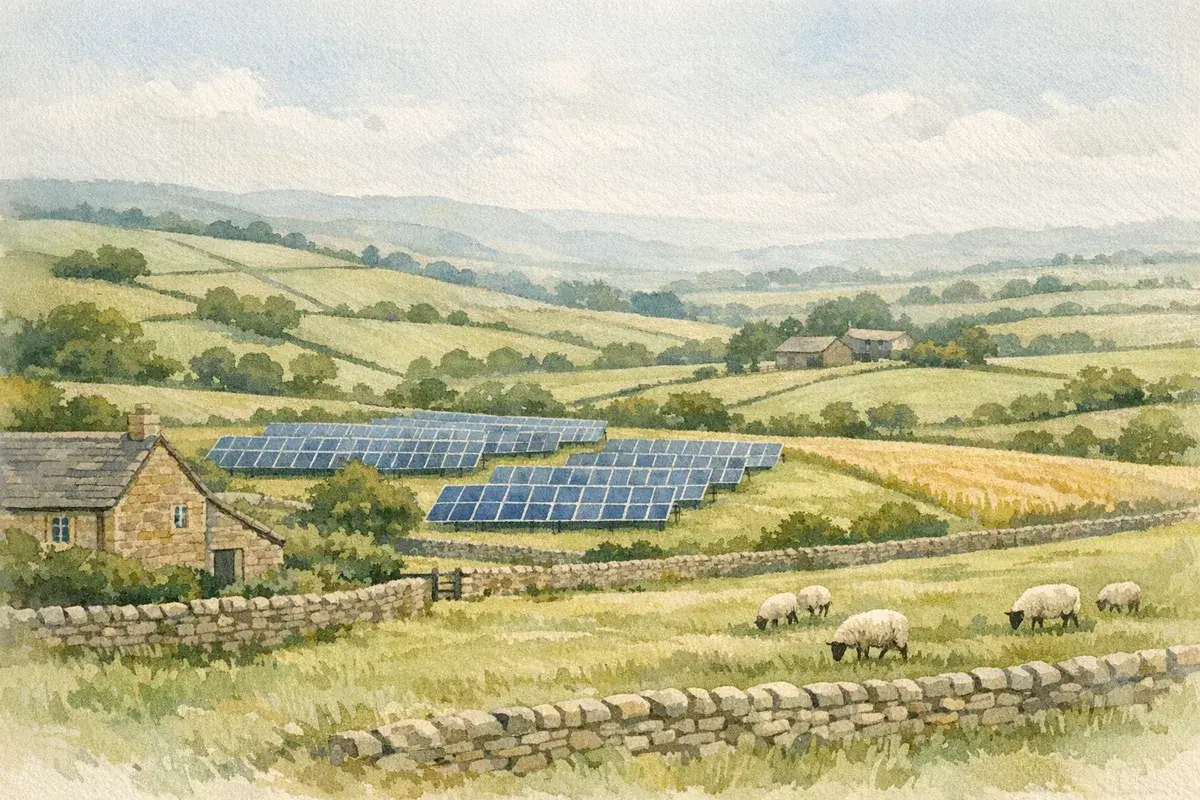
If you've had a solar developer on the phone (or a neighbour quietly doing a deal you only hear about later), you'll already know this: the "best agricultural land for solar" isn't necessarily your best land. It's the land that can clear planning, secure grid, satisfy funders, and still leave your farming business in one piece.
The uncomfortable bit is that plenty of solar proposals never get built. Some die in the grid queue. Some hit policy constraints. Others unravel when title issues, tenancies, rights, or weak lease clauses surface. So the real win isn't just getting an impressive headline rent, it's getting a scheme that's bankable and deliverable, with terms you can live with for decades.
Below is a practical UK-focused framework for choosing the right fields, filtering out time-wasters early, and negotiating a solar land deal that stands up to planning officers, lenders, and your own long-term plans for the holding.
What “Best” Means For A Solar Land Deal (Income, Risk, And Long-Term Flexibility)
"Best" is a loaded word in solar. Developers may mean "cheapest grid and easiest planning". You probably mean "strong income with minimal hassle and no nasty surprises for my farm or family later". A bank might mean "lease terms we can lend against".
In practice, the best agricultural land for solar in the UK sits at the overlap of four things:
- Deliverability: planning and grid aren't just "possible", they're likely.
- Commercial resilience: rent, review mechanics, security package, and decommissioning hold up under scrutiny.
- Operational survivability: you can still run the holding (and access the rest of it) without constant friction.
- Strategic flexibility: the deal doesn't block future diversification, housing, track upgrades, or succession planning.
If you want a deeper run-through of how UK solar projects stack up on planning, grid and long-term value, it's worth reading our guide to UK solar schemes on agricultural holdings before you accept anyone's "standard" heads of terms.
Rent Vs Revenue Share Vs Sale: Which Structure Fits Your Objectives?
Most land-led solar deals are structured as an option (developer pays for exclusivity while they pursue planning/grid), followed by a lease if it's consented and fundable. But your income model can vary.
1) Fixed rent lease (most common in the UK)
You receive an agreed annual rent (often indexed), usually with landlord obligations kept light. It's simpler, easier to finance, and easier to compare between bidders.
- Best for: predictable income, straightforward accounting, low admin.
- Watch-outs: weak indexation, rent reviews that lag inflation, and unclear repair/insurance responsibilities.
2) Revenue share / turnover rent (less common, more complex)
You take a percentage of project revenue or profit.
- Best for: those willing to take risk for upside, and who can monitor/reporting properly.
- Watch-outs: transparency, curtailment risk, balancing costs, corporate structuring, and the fact that lenders often prefer clarity.
3) Outright sale (occasionally proposed)
A developer (or aggregator) buys the land.
- Best for: capital extraction now, especially where the land has limited farming value to you.
- Watch-outs: tax consequences, future regret, and losing control of access/amenity in perpetuity if boundaries aren't handled well.
In 2026 conditions, the "best" structure is usually the one that still looks good after you model: inflation, farming displacement, professional fees, and a realistic probability the scheme reaches energisation.
Hidden Deal Drivers: Indexation, Term Length, Break Clauses, And Decommissioning
This is where you can win or lose six figures over time without noticing on day one.
Indexation and rent reviews
- If rent is indexed, to what and how matters. Some formulas protect you better than others in high-inflation periods.
- Check whether there's any cap/collar, and whether indexation applies from day one of operation or from lease completion.
Term length
Solar leases commonly run 30–40 years including option/extension mechanisms. That's long enough to span a generation. Make sure the lease interacts properly with:
- farm succession and partnership changes,
- lender refinancing on the agricultural business,
- and any hope of future non-solar development (even if that feels far away today).
Break clauses and flexibility
Developers often want as much control as possible, but you should understand:
- whether you ever get a break right,
- what triggers it (breach? non-payment? grid failure?),
- and how reinstatement/decommissioning is enforced.
Decommissioning is not a footnote
Your key questions:
- Who pays to remove kit and reinstate, and when?
- Is there a financial security mechanism (bond/escrow/parent company guarantee) that's actually enforceable 25–35 years from now?
- What happens if the tenant sells the project into a special-purpose vehicle with minimal assets?
A good solar rent can be undone by a weak end-of-life plan. Don't accept "industry standard" without seeing it in writing, costed, and secured.
The Core Site Criteria Developers Actually Pay For
Developers talk about "acreage" because it's easy. But when they run their model, they're really paying for grid probability, planning probability, buildability, and a site that doesn't explode their programme with constraints.
If you want a practical lens on what makes land genuinely versatile (not just for solar, but for value retention and alternative uses), cross-check your parcel against the Agricultural Land Classification grades and our guide to identifying versatile UK farmland. It helps you see what you're giving up, and what you aren't.
Grid Connection Reality: Capacity, Queue Risk, And Proximity To Substations
In today's UK market, grid is often the gating item, not planning.
What matters in plain terms:
- Distance to a suitable connection point (substation or feasible tie-in). Longer cable routes mean more land rights, more third-party negotiations, and bigger cost.
- Capacity and "queue" position. A site can look perfect on a map and still be years away from a viable connection.
- Offer risk. Even with a connection offer, timelines and reinforcement can change.
What you can do early (without becoming a grid engineer):
- Ask the developer to explain which network they intend to connect to (distribution vs transmission) and why.
- Ask what's been done beyond a "desktop look" (e.g., initial enquiry/feasibility, budget estimate, and a realistic programme).
- Ask who carries the cost if grid upgrades make the project unviable.
If the developer is vague on grid, treat every other promise as soft.
Topography And Buildability: Slope, Flood Risk, Access, And Construction Practicalities
You don't need billiard-table flat land, but you do need something that can be built efficiently.
Developers (and their EPC contractors) will look closely at:
- Slope and aspect: steep slopes can increase piling complexity, earthworks, and access risk.
- Flooding and drainage: Flood Zone mapping, historic ponding, and the presence (or absence) of robust outfalls.
- Ground conditions: peat, made ground, contamination, and archaeology can all add time and cost.
- Construction access: can HGVs get in safely, and can they do it without wrecking your yard, tracks, and neighbours' patience?
A quiet truth: a solar scheme can be technically possible but commercially unattractive once enabling works stack up.
Land Quality And Farming Impact: BMV Grades, Drainage, And Ongoing Operations
Land quality isn't just a moral debate ("should solar be on good land?"). It's a planning and business issue.
In England and Wales especially, planners often expect strong justification if you're proposing to develop Best and Most Versatile (BMV) land (Grades 1, 2 and 3a). That doesn't automatically rule it out, but it raises the bar.
From your perspective, the key is balancing solar income against what you lose:
- Cropping flexibility: Are you giving up a reliable block used for rotations, forage, or contract farming?
- Drainage performance: some parcels look "average" until you remember they're the only fields that carry you in a wet autumn.
- Fragmentation and access: a solar block can create awkward shapes and longer travel times.
Sometimes the best agricultural land for solar is not your best soil. It's the block that's:
- less productive or more constrained,
- near viable grid,
- and can be fenced and accessed without compromising the rest of the farm.
For certain holdings, poorer land can actually be a sweet spot, particularly where you're weighing alternative uses. If that's you, our guide to practical options for Grade 5 land can help you sanity-check whether solar is genuinely the best play for that parcel, or just the loudest offer.
Planning And Policy Filters You Must Check Early
Solar planning in the UK isn't one rulebook. Policy is layered: national policy, local plans, landscape designations, heritage constraints, ecology, highways, and sometimes strong local sentiment.
What matters is speed and realism. You don't want to spend 12–24 months in an option while a basic constraint (that you could have spotted week one) quietly kills the scheme.
England, Wales, And Scotland: Key Differences In Policy And Consenting Routes
England
Most ground-mounted solar farms require planning permission from the local planning authority, unless the project falls into specific nationally significant infrastructure categories (which is a different pathway). Policy emphasis often includes landscape, BMV land, cumulative impact, and increasingly biodiversity and community benefit.
Wales
You'll still be dealing with planning policy and local constraints, with a strong focus on landscape, ecological considerations, and strategic energy priorities. In practice, the success of an application can hinge on how well the scheme fits local place-based policy.
Scotland
Scotland's policy context differs again, and decision-making can be particularly sensitive to landscape and visual impacts in certain areas. Grid constraints can be a dominant factor depending on location.
The practical takeaway: don't rely on a developer's "we've done loads like this". Ask them to show how your specific local authority (or Scottish planning context) has treated similar schemes.
Constraints That Kill Schemes: AONB, SSSI, Heritage, Ecology, And Glint And Glare
Some constraints don't automatically prevent solar, but they can make it slow, expensive, or politically toxic.
Common UK tripwires include:
- National landscape designations (and their settings), where visual impact is scrutinised hard.
- SSSIs and sensitive habitats: even if your boundary doesn't touch a designation, impacts on species and hydrology can matter.
- Heritage assets: listed buildings, scheduled monuments, registered parks and gardens, and their setting.
- Public Rights of Way: rerouting is rarely straightforward: screening needs thought.
- Glint and glare: particularly near roads, rail, aviation constraints, or sensitive receptors.
Here's the move that saves you time: insist on an early, written constraints summary from the developer (or your adviser) that covers mapping, likely surveys, and where the planning risk actually sits.
If you're drilling into process detail, see our explainer on how planning works for solar on farmland in the UK. It's the stuff that's often waved away as "paperwork" until it isn't.
Biodiversity Net Gain And Environmental Delivery: Turning A Requirement Into Value
In England, Biodiversity Net Gain (BNG) has become a real design and cost line, not a box-tick. The best schemes treat it like an opportunity:
- Better planting and habitat design can reduce objection risk and improve scheme acceptance.
- Meadow mixes, hedgerow enhancements, and wetland features can complement grazing and stewardship.
- Management plans can be integrated with your wider farm objectives, instead of creating isolated "solar island" ecology.
Two cautions:
- BNG delivery has to be measurable and maintained over time. Make sure responsibility, cost and monitoring are clearly allocated in the lease.
- If you're already in environmental schemes, check compatibility carefully. The wrong overlap can create clawback or breach risk.
Done well, environmental delivery can become part of the value story: a scheme that's easier to consent and easier to live alongside.
Due Diligence On The Land Title And Rights (Where Solar Deals Commonly Unravel)
If solar deals were lost only on planning, most options would convert. In reality, a chunk of projects wobble when solicitors start pulling the title apart.
This is also where your negotiating leverage can improve, because a site that's "clean" on rights and access is genuinely worth more.
If you're new to rural conveyancing risks, our broader guide to buying and owning agricultural land in England is a useful companion for understanding easements, occupation and the kinds of issues that affect value (solar or otherwise).
Access, Easements, And Cabling: Securing Routes From Highway To Substation
Solar isn't just panels on a field. It's:
- construction access,
- operational access for maintenance,
- cable routes to the point of connection,
- and sometimes off-site works.
Key checks:
- Is your access legally documented (and wide enough, with suitable rights for construction traffic)?
- Are there ransom strips or third-party ownership along likely cable routes?
- Do you need rights across neighbours' land for cabling, drainage, visibility splays, or junction works?
A scheme can be "perfect" until you realise the only viable cable route crosses a neighbour who wants a premium, or refuses outright.
Tenancies And Occupation: FBT, AHA, Grazing, And How Consent Is Handled
Occupation is often the hidden iceberg.
- Farm Business Tenancies (FBTs): your ability to grant rights can be limited by the tenancy terms.
- AHA tenancies: typically more complex, with long-term rights and statutory protections that can restrict development.
- Grazing licences and informal arrangements: still matter if they create expectations or practical disruption.
If anyone else is in occupation, you need clarity on:
- who has the right to consent,
- how compensation is handled,
- what happens to Basic farm operations (water supply, access, handling),
- and whether the developer's programme allows for proper notices and negotiations.
It's not unusual for a developer's "we'll sort it later" to translate to "you'll sort it later, at your cost". Don't.
Minerals, Wayleaves, And Third-Party Rights: What To Investigate Before Heads Of Terms
The main culprits:
- Mineral reservations (including rights to work minerals) that could, in theory, interfere with the site.
- Existing wayleaves and utility easements crossing the land, these can constrain layout or impose access obligations.
- Restrictive covenants that limit development.
- Sporting rights and other third-party interests that can create conflict during construction.
You're aiming for a simple outcome: a site map showing what's burdened, what's free, and what can be insured or negotiated.
Good advisers will push for early title review so you don't grant a long option period on a site you can't actually deliver.
Commercial Terms And Negotiation: Getting To A Bankable Option And Lease
Negotiation isn't just about "more rent". It's about getting a document set that a funder will accept, that your solicitor can defend, and that doesn't box you in.
If you want a structured overview of how solar land deals are typically put together (and where landowners often concede too much), you'll find more detail in our resource on solar development on agricultural land.
Option Periods, Promotion Agreements, And Exclusivity: Where Value Is Won Or Lost
Most developers ask for an option because they need time to spend money on surveys, grid applications and planning. Fair enough. But your job is to stop "time" becoming "free control".
Pragmatic points to push:
- Option length that reflects reality, not optimism. If grid in your area is a 4–6 year journey, a 12–18 month option is fantasy (and you'll just sign extensions). Better to agree a realistic term with clear milestones.
- Milestone obligations: evidence of grid application steps, survey progress, and a planning submission timetable.
- Exclusivity boundaries: define the land precisely and prevent "option creep" into other parcels.
- Option fee structure: not just the amount, but whether it's staged, refundable, and how it's treated if the developer assigns the option.
In some cases, landowners explore promotion agreements where a promoter runs the planning process and takes a fee from the uplift. That's more common in residential land, but the logic can appear in renewables too. The key is aligning incentives and keeping reporting transparent.
Rent Benchmarks, Uplifts, And Review Mechanics: What To Push For (And What To Avoid)
It's tempting to compare offers on the headline rent per acre. Don't stop there.
Focus on the mechanics:
- Rent commencement: does full rent start at first export, practical completion, or lease completion? The date can materially change cashflow.
- Indexation: understand the formula and ensure it's not quietly diluted.
- Rent review events: are reviews time-based, or triggered by capacity changes/repowering?
- Deductions: avoid clauses that allow the tenant to deduct "tenant costs" from rent.
Also watch for "soft" numbers: some bids look generous but assume a larger developed area than is realistically consentable once buffers, ecology, and layout constraints are applied.
Security, Lender Requirements, And Step-In Rights: Why "Standard" Clauses Matter
A bankable solar project usually involves project finance. That brings lender requirements, including:
- Step-in rights: if the tenant defaults, the lender can step in to keep the project alive.
- Assignment rights: the project company may be sold. You need sensible controls and notification.
- Insurance obligations and reinstatement: who insures what, and to what standard?
None of this is automatically bad. But it can create two common landowner risks:
- You lose practical control without adequate safeguards (e.g., you don't know who's operating on your land).
- Your remedies are weakened (e.g., decommissioning becomes harder to enforce if obligations are not secured).
The best outcome is balance: lenders get what they need to fund, and you get what you need to protect the holding for 30–40 years.
Tax, Accounting, And Business Structure Considerations For Landowners
Tax is where "great rent" can turn into "why is the net so disappointing?", or where a well-meaning solar deal accidentally complicates inheritance planning.
You can't responsibly treat this as generic advice because it depends on your ownership structure, other income, existing reliefs, and what the lease actually says. But you can know what to ask.
Income Tax Vs Corporation Tax, VAT, And The Treatment Of Option Fees
Typical UK touchpoints to discuss with your accountant/tax adviser:
- Option fees: often treated differently to annual rent: timing and character matter.
- Rent under the lease: generally taxable, but the rate and treatment depend on whether land is held personally, via partnership, or a company.
- VAT: whether the land is opted to tax, whether VAT is chargeable on rent, and how that affects a developer's appetite and your cashflow.
A practical tip: push for clear drafting on who is responsible for any VAT implications and how invoicing works. "We'll sort it later" can become a messy back-and-forth once the lease is signed.
Capital Taxes And Reliefs: CGT, IHT, APR/BPR Risk, And Rollover Possibilities
This is the bit that keeps families up at night.
Consider:
- Inheritance Tax (IHT) reliefs: agricultural and business relief positions can be sensitive to changes in land use. A long solar lease can affect how some reliefs apply, depending on the facts.
- CGT considerations: particularly if you restructure ownership, grant rights, or dispose of part of the holding.
- Rollover/hold-over concepts: sometimes relevant where there are disposals and reinvestments, but the detail is highly fact-specific.
You don't need to be a tax technician, but you do need to bring advisers in early enough that tax doesn't get "solved" by last-minute clause tweaks.
Partnerships, Trusts, And Succession: Aligning Solar With Long-Term Estate Planning
Solar leases are long. Your business structure will probably change during the term.
Questions to work through:
- If the farm is a partnership, who signs and what consents are required?
- If land is held in a trust, do the trustees have power to grant the option/lease?
- If you expect succession in 5–10 years, will the lease restrict the next generation's plans, or provide stable income that actually makes succession easier?
In well-run estates, solar isn't treated as a standalone "deal". It's treated as a strategic asset: stable income, risk-managed, and compatible with the rest of the holding's long-term direction.
Operational Integration: Keeping The Holding Working Alongside Solar
A solar site is a neighbour you can't move for 30–40 years. The best agricultural land for solar is land you can integrate operationally, not land that forces you to redesign your whole farm around a fence line.
Grazing, Stewardship, And Dual Use: What Is Realistic In UK Conditions
"Dual use" is often promised. Sometimes it's real. Sometimes it's brochure language.
In UK conditions, realistic options may include:
- Sheep grazing under and between rows (depending on panel height, fencing layout, and water provision).
- Species-rich grassland management that dovetails with biodiversity objectives.
- Buffer strips and hedgerow enhancements that improve screening and habitat.
But you need clarity on:
- who controls stocking rates and timings,
- how biosecurity is handled (especially if the developer's contractors come and go),
- who pays for water infrastructure or fencing modifications,
- and whether the lease allows you meaningful access for grazing management.
If the site will be effectively "hands off" to you, price that reality into the rent.
Water, Drainage, And Biosecurity: Practical Management During And After Build
Construction is where farms feel the impact.
Protect yourself with:
- method statements for access routes, wheel washing, and wet-weather working,
- drainage protection clauses (and a plan for repairs if land drains are damaged),
- weed and pest control responsibilities, solar sites can become a problem if neglected.
Also think about long-term water movement. A poorly designed site can change run-off patterns. It's manageable, but only if someone is responsible and the design is reviewed with local ground truth.
Community And Neighbour Relations: Screening, Public Rights Of Way, And Communications
You don't need to win a popularity contest, but you do need a workable relationship with neighbours and the parish.
Practical ways to reduce friction:
- honest early visuals (not flattering angles only),
- thoughtful screening, hedges that are actually maintainable,
- a clear plan for Rights of Way users during construction,
- named contacts for complaints and practical issues.
One overlooked point: if your access route goes past someone's house, the build phase can become a daily stress test. Good developers plan for that and budget for mitigation: weak ones shrug and let you carry the reputational cost.
Finding And Comparing Opportunities Without Getting Played
The solar market is noisy. Some approaches are serious. Others are speculative "land grabs" designed to secure options cheaply and trade them on.
Your edge is process: create a controlled way to compare offers, and don't give exclusivity until you've tested the bidder.
How Developers Source Land: Direct Approaches, Agents, And Off-Market Networks
Developers typically source land via:
- direct letters and calls to landowners,
- land agents who assemble parcels and introductions,
- off-market networks where serious operators quietly build pipelines.
Whichever side you're on. Buyers tell AgLand what they're looking for and hear the moment something fits. Owners advertise straight to the buyers who already match, for one flat fee and no commission. Register as a buyer or check your matches.
How To Compare Competing Bids: A Simple Scorecard For Heads Of Terms
If you receive multiple heads of terms, score them. Don't just read them.
A simple scorecard (out of 5 for each) works well:
- Grid credibility: evidence, programme, and who carries reinforcement risk.
- Planning credibility: constraints awareness, survey plan, local precedent.
- Financial strength: who's behind the SPV, track record, funding route.
- Commercial terms: option fee, rent start date, indexation, review clauses.
- Land protections: decommissioning security, access controls, drainage repairs.
- Flexibility: layout buffers, rights reserved for your retained land.
- Professional approach: willingness to provide information, realistic timelines.
You'll be surprised how quickly "best rent" drops down the ranking once you apply this.
What To Prepare Before You Go To Market: Plans, Constraints, And Evidence Pack
If you're serious about finding the best agricultural land for solar on your holding, preparation pays.
A tight evidence pack might include:
- title plan and boundaries (including any ransom strips you know about),
- access points, track quality, and any known third-party rights,
- cropping/rotation context (so bidders understand what disruption looks like),
- known drainage and flood behaviour,
- initial constraints map (designations, heritage, rights of way),
- photos from key viewpoints.
Then instruct a land agent (ideally renewables-literate) and a solicitor who has seen solar leases go wrong.
One more perspective that's easy to miss: if you're weighing solar against other long-term strategies, treat it like an investment decision, not just a planning decision. Our guide to UK farmland investment risks and due diligence gives you a useful checklist mindset, because solar income is only "safe" when the underlying contract and counterparties are solid.
Conclusion
The best agricultural land for solar in the UK is land that clears grid and planning with the least drama, can be built without turning your holding upside down, and is tied up on terms that still look sensible when you're 10, 20, or 30 years older.
If you take one practical step after reading this, make it this: stop judging offers by rent alone. Ask for evidence on grid, insist on early constraints work, and treat the option and lease as a financial instrument you'll live with for decades. Then get the right professionals around the table, agent, solicitor, and tax adviser, early enough to shape the deal rather than just react to it.
Disclaimer: AgLand.co.uk is a UK agricultural land and rural property matching service, where buyers register what they are looking for and owners advertise directly to the buyers who match, and a rural resource hub. Nothing in this text is intended as legal, financial, tax, or investment advice. You should carry out your own due diligence and seek advice from appropriately qualified professionals (for example, a rural solicitor, accountant/tax adviser, chartered surveyor, and planning consultant) before making decisions or entering into any agreement.