
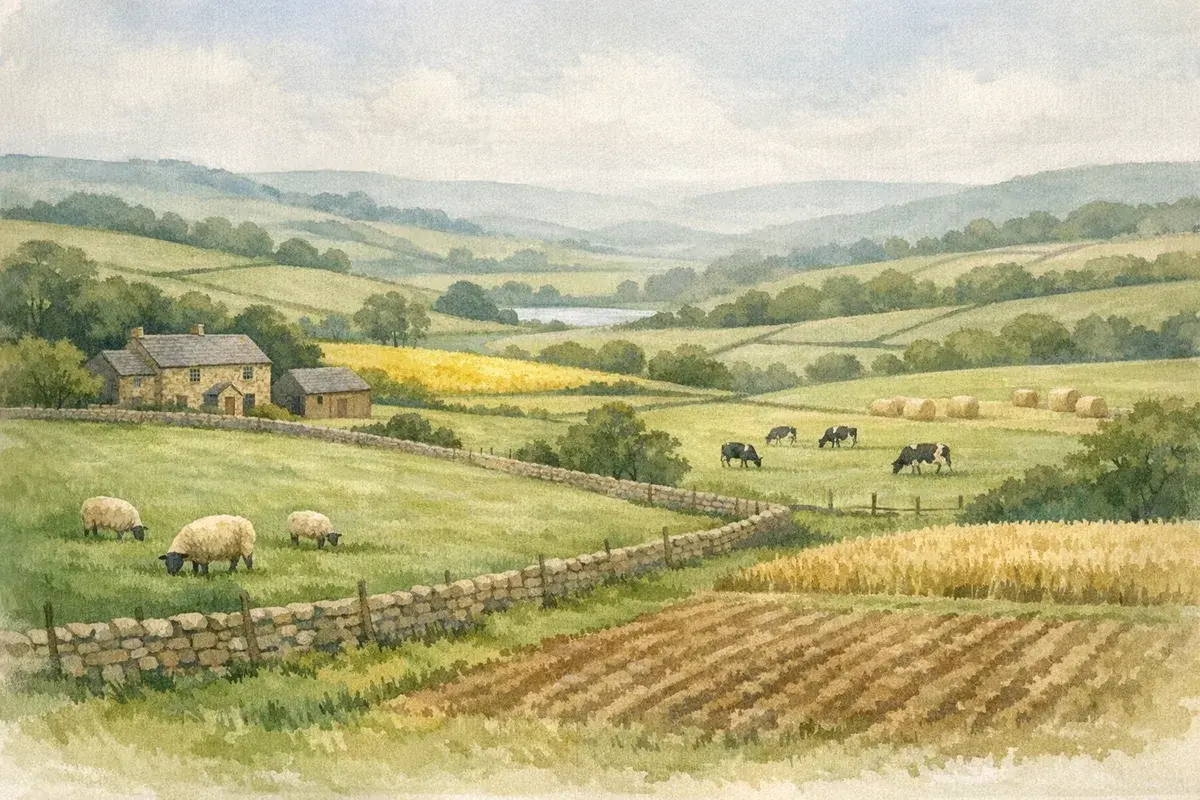
Grade 5 agricultural land has a reputation problem. It's often dismissed as "only good for rough grazing" or "too wet to bother with", and yes, some of it really is that challenging. But in the UK market, Grade 5 can still be strategically useful if you match the land to the right enterprise, keep a tight grip on costs, and stay realistic about what the soil and climate will (and won't) let you do.
If you're buying, renting, or trying to sweat an underperforming block, the question isn't "How do I make Grade 5 behave like Grade 2?" It's: what's the best-fit use for this specific parcel, what are the planning and legal tripwires, and where can you add value without throwing money into a peat bog? Let's get practical.
What “Grade 5” Land Means In Practice
Grade 5 is the bottom of the Agricultural Land Classification (ALC) scale. In plain terms, it's land with very severe limitations that restrict use to permanent pasture or rough grazing, with very limited scope for arable or more demanding grass systems.
That doesn't mean it's worthless. It means it's specialist: you need to understand what the limitations are, how persistent they'll be, and which uses work with them.
Agricultural Land Classification (ALC) In Plain English
The UK ALC system, published by Natural England, grades land primarily by how well it can support agriculture, based on climate, site and soil factors. Grades 1–3a are commonly referred to as "best and most versatile" (BMV) land, because they're capable of a wide range of crops with fewer constraints.
If you want a refresher on how the grading works (and why two neighbouring fields can have very different grades), it's worth reading AgLand's explainer on how ALC grades are used in practice.
One key point many buyers miss: ALC is a capability classification, not a price label. Market value can still be strong if the location is right, there's diversification potential, or it fits a neighbour's farming system.
Typical Constraints You'll See On Grade 5 Parcels
Grade 5 usually shows up where the limitations are so severe that "improving" them is either uneconomic or temporary. In the UK, the common culprits are:
- Wetness and poor drainage (heavy clays, high water tables, springs, or slow permeability)
- Steep slopes and awkward topography that limits machinery access
- Very shallow or stony soils, often over rock or with high stone content
- Peaty or organic soils that are vulnerable to damage and compaction
- Exposure (upland climate, wind, late spring growth, short grazing season)
- Access and fragmentation (no track, narrow gates, roadside hazards)
A lot of Grade 5 falls into the broader bucket of poor quality agricultural land, but the reason it's poor quality matters, because it affects which enterprise (if any) can thrive.
How Grade 5 Differs From Grades 1–4 For Farming Decisions
Grade 5 isn't just "a bit worse than Grade 4." The decision-making changes in a few hard-edged ways:
- Input response is limited. Lime, fertiliser and reseeding can help some Grade 4 land materially: on Grade 5, returns can be marginal and short-lived if the underlying constraint is wetness, peat, slope, or exposure.
- Timing windows are narrower. Getting on at the right moment is everything. If you miss it, you can do lasting damage, ruts, compaction, poaching.
- Grass utilisation is usually the win, not grass production. You often focus on grazing management, fencing and water rather than chasing high yields.
- Alternative uses can outperform "traditional improvement." Sometimes the best value comes from habitat-led management, woodland creation, or carefully structured diversification rather than trying to force a high-output system.
As a quick sanity check, it helps to think in terms of capability vs ambition. Ambition is flexible: capability isn't. (And if you're comparing parcels, AgLand's guide to agricultural land capability is a useful way to frame that conversation.)
Best-Fit Farming And Land Management Uses For Grade 5
The best farming uses for Grade 5 land tend to share three characteristics:
- They tolerate variability (wet corners, rushy areas, late growth)
- They're low-input (because inputs don't reliably translate into output)
- They don't require perfect access (or they justify building it)
Extensive Grazing And Livestock Systems
Extensive grazing is often the most straightforward fit, particularly where the land is already in permanent pasture.
What tends to work:
- Suckler cows or hardy native breeds where you can keep stocking rates sensible
- Sheep systems that suit upland or marginal ground (again, stocking rate is the lever)
- Outwintering only where ground conditions allow and you're set up to protect soils
But the economics are rarely "set and forget". The margin is made on:
- Infrastructure efficiency (fencing, gates, handling)
- Health and performance (parasite control, mineral issues, foot problems on wet ground)
- Grazing discipline (avoiding poaching and preserving sward)
If you're buying Grade 5 as part of a wider holding, it can be excellent as a "buffer" block, taking pressure off better fields at peak times.
Rough Grazing, Hay, And Silage: When It Works (And When It Doesn't)
Rough grazing can be perfectly rational, especially on land that would be damaged by frequent traffic.
Hay or silage is more situational. It can work when:
- You've got reliable access for machinery
- The ground carries equipment without rutting
- You can cut at the right time (and not two weeks late because it's too wet)
It often doesn't work when:
- You're forced onto the land with heavy kit in narrow weather windows
- Drainage is fundamentally poor (not just "a bit tired")
- The parcel is small, awkwardly shaped, or remote from the yard
A practical tip we've heard repeatedly from agents we work with: if you're only making conserved forage because "it feels like you should", do the sums as if you were buying it in. You may find your best use is grazing plus bought-in forage, rather than fighting for a cut every year.
Woodland, Agroforestry, And Shelter Belts
Woodland can be a strong long-term option on Grade 5, particularly where the constraints are slope, exposure, or wetness, and in England the Forestry Commission administers woodland creation support and felling licences. Even where you keep land in agriculture, shelter belts can improve stock welfare and reduce wind exposure.
What to think about before you plant:
- Species choice and establishment: wet ground and exposure change what's viable
- Access for planting and maintenance: can you get kit in without creating a mess?
- Deer and rabbit pressure: fencing and protection are often a bigger cost than people expect
- Long-term intent: timber, shelter, carbon, amenity, biodiversity, or a mix?
Agroforestry (trees plus grazing) can work, but only if you're realistic about tree protection and grazing pressure. If it becomes a mud-bath around guards every winter, you're paying twice, once for trees, once in lost grass utilisation.
Habitat-Led Management And Environmental Schemes
Grade 5 land is often where habitat-led approaches shine, because the opportunity cost (in lost agricultural output) is lower than on BMV land.
Depending on where you are in the UK and the characteristics of the site, you may be looking at:
- Species-rich grassland restoration
- Wet grassland management
- Rush and scrub control
- Peatland restoration (where relevant)
- Buffer strips and watercourse protection
The important nuance: these options can be financially sensible, but they're rarely "free money". They require compliance, record-keeping, and a management plan that fits your wider operation. A good land agent or rural surveyor can help you avoid the classic mistake, signing up to prescriptions that clash with how you actually farm.
Non-Traditional Rural Uses That Can Suit Grade 5 Land
Grade 5 land can be attractive for non-traditional rural uses because you're not paying BMV premiums. But the constraint doesn't disappear, it just changes shape. Wetness becomes a resurfacing bill. Poor access becomes a highways conversation. Exposure becomes customer experience.
Equestrian Use: Paddocks, Turnout, And Manege Considerations
Equestrian is commonly suggested for "less productive" land, but Grade 5 can be a mixed bag.
Turnout and paddocks can work if:
- You can manage poaching (track systems, restricted turnout, seasonal rotation)
- You're willing to invest in fencing and water
- You accept that winter use may be limited on heavy or wet ground
Menages are where the chequebook comes out. If the site is wet, you'll need proper drainage and a well-designed base, not just a quick scrape and some sand. And you'll need to think about planning, lighting, access and neighbours.
A quiet warning from experience: horse use can intensify soil damage fast. If your exit plan is to return to agriculture later, build that into how you structure the use and how you manage the ground.
Recreation, Tourism, And Diversification (Low-Impact Options)
Low-impact recreation can suit Grade 5 because it often requires less soil productivity and more "setting": views, privacy, and sense of space.
Potential options (planning and local constraints permitting):
- Seasonal camping in appropriate locations
- Wildlife watching / nature walks
- Dog exercise fields (often popular near towns)
- Low-key storage (where access and screening are sensible)
But don't ignore the dull bits that kill projects:
- Vehicle access and visibility splays
- Parking and turning (especially if you're near a fast road)
- Waste, water, and noise
- Neighbour relationships (more on nuisance later)
Renewables And Utilities: Solar, Wind, Battery Storage, And Wayleaves
Renewables can be viable on lower-grade land, but suitability is site-specific and planning-led.
Broadly:
- Solar tends to favour flatter sites, grid proximity, and manageable access for construction and maintenance.
- Wind is heavily constrained by landscape, aviation, radar, and local policy: micro-siting is critical.
- Battery storage is grid-led and can be controversial locally, screening, traffic during build, and safety considerations all matter.
- Wayleaves/easements (for poles, cables, pipelines) can provide income, but can also restrict future options.
If you're considering any of these, your "grade" is only one factor. Grid capacity, planning policy, and constraints will do most of the deciding.
Letting, Licences, And Seasonal Uses: Structuring Income Without Losing Control
Short-term income from Grade 5 often comes from letting arrangements, grazing, mowing, or seasonal uses. The structure matters.
You'll typically be balancing:
- Control (you don't want to accidentally grant security of tenure)
- Liability (who maintains fences, ditches, gates?)
- Practical outcomes (stocking rates, poaching risk, weed control)
If you're unsure of the land's best long-term use, shorter licences can buy you time while still generating income. This is also where having a clear paper trail pays off, especially if the land is part of an estate plan or you may sell later.
Planning And Legal Considerations Before You Change Use
Here's where Grade 5 landowners can get caught out: because the land is "poor", people assume the planning system will be relaxed. In reality, planning is usually about impacts (traffic, landscape, ecology, neighbours), not soil quality.
If you're moving away from straightforward agriculture, equestrian, tourism, renewables, storage, you need to get crisp on what counts as agriculture, what triggers a material change of use, and what permissions (if any) you can rely on.
Agricultural Use Vs Material Change Of Use: The Core Test
Agricultural use is generally what you'd expect: growing, grazing, husbandry. But the moment the primary use becomes something else, horse livery, commercial dog exercise, event space, you may be looking at a material change of use.
The tricky bit is the grey zone:
- Horses kept for agriculture (e.g., working horses) is rare.
- Horses kept for recreation is typically equestrian use, not agriculture.
- Mixed use can exist, but you need to be honest about what's actually happening on site.
If you're contemplating a shift, AgLand's guide on how change of use tends to work on rural land is a good starting point before you spend money on plans.
Permitted Development Rights: What They Can And Can't Do On Grade 5 Land
Permitted Development (PD) rights can help with certain agricultural buildings and operations, but they're not a magic wand, and they're not identical across the UK.
A few reality checks that matter in practice:
- PD often depends on units and thresholds (and sometimes prior approval / prior notification processes).
- PD doesn't override other regimes (highways, environmental constraints, protected species, building regs where applicable).
- Using PD to put up a building doesn't necessarily authorise a non-agricultural use of that building.
Because PD is technical and fact-specific, it's one of those areas where a quick conversation with a planning consultant (or a land agent who deals with rural PD weekly) can save you months.
Constraints To Check Early: Access, Highways, Flood Risk, Designations, And Rights Of Way
Before you fall in love with a plan for Grade 5 land, check constraints early, ideally before you exchange.
Key ones include:
- Access and highways: visibility splays, passing places, surfacing, HGV suitability
- Flood risk and drainage: surface water flooding can be a deal-breaker for tourism or storage
- Environmental designations: SSSI, SAC/SPA, Local Wildlife Sites, priority habitats
- Landscape constraints: National Parks, AONBs (now often branded as National Landscapes)
- Public rights of way: footpaths and bridleways through a site change how you can manage it
Also, be cautious with mapping. Desktop tools are useful, but they're not gospel. If you're using an agricultural land grading map to screen parcels, treat it as a starting point, not the final word.
Tenancies, Grazing Licences, And Sporting Rights: Avoiding Costly Disputes
If the land is occupied, or you plan to let it, get proper advice on structure.
Common friction points we see in transactions:
- Informal grazing arrangements drifting into something that looks more like a tenancy
- Repairing obligations not being clear (fences, ditches, culverts)
- Who controls sporting rights (shooting, fishing) and who carries liability
- Access rights for the occupier (and whether they can improve or sublet)
For Grade 5, where margins are tight, disputes can wipe out years of income. A well-drafted agreement is usually cheaper than "sorting it out later".
Practical Due Diligence: Assessing Suitability And Cost Before You Commit
Grade 5 purchases (and improvement projects) go wrong for one main reason: people budget for the land price, but not for the reality cost, the ongoing cost of making it usable for the intended purpose.
Think like a sceptic. Walk it after heavy rain. Look at the gateways. Ask how it's been managed. Then cost the fixes.
Soils, Wetness, And Topography: Simple Field Checks And When To Commission Surveys
You don't need a laboratory to spot many Grade 5 constraints.
Simple field checks you can do:
- Look for standing water, rushes, poached areas, or persistent moss
- Dig a small inspection hole: check topsoil depth, structure, and whether it turns to soup
- Notice stone content and whether you're hitting rock quickly
- Walk slopes and imagine moving stock, feed, and machinery safely
When to commission help:
- You're planning capital works (tracks, arenas, buildings)
- You're relying on drainage improvement for the business case
- You need clarity for valuation, lending, or disputes
If you're unsure what grade the land actually is (or whether a small pocket of better land changes the economics), it's worth using a structured approach like AgLand's guide on how to find agricultural land grade.
Water: Mains, Boreholes, Abstraction, Drainage, And Trough Supply
On marginal land, water is either your biggest headache, or your quiet competitive advantage.
What to confirm:
- Is there mains water? If not, what's the realistic alternative?
- If a borehole exists, is it functioning, and what are the ongoing costs?
- Are there watercourses and do you need abstraction considerations for your intended use?
- Where does water sit after rainfall, and where does it try to go?
For grazing, the practical detail is trough placement and supply. Long pipe runs, exposed lines, and freezing points can turn "cheap land" into "expensive winter".
Infrastructure And Operations: Fencing, Tracks, Handling Systems, And Power
Grade 5 land can be workable if it's set up properly. It becomes miserable when it isn't.
Budget lines that often matter more than reseeding:
- Stock fencing and division for grazing control
- All-weather tracks to prevent rutting and reduce time loss
- Handling facilities sized for your system (and safe in wet conditions)
- Power for energisers, water pumps, lighting, or small-scale enterprise
If you're buying remotely from the yard, also price in the "time tax". A cheap block that takes you an hour to reach and can't be accessed in winter is rarely a bargain.
Neighbouring Uses And Nuisance Risk: Odour, Noise, Dogs, And Biosecurity
Grade 5 is often closer to upland edges, village fringes, or "in-between" land that ends up with multiple users. That creates nuisance and biosecurity risks you should price in.
Consider:
- Public access pressure: loose dogs during lambing, gates left open
- Neighbour complaints if you diversify (traffic, noise, lighting)
- Disease management if stock from different holdings are nearby
- Fly-tipping risk if you're near roads with easy pull-ins
The best defence is layout: clear boundaries, good gates, signage where appropriate, and a plan for how you'll manage visitors (intentional or otherwise).
Value, Tax, And Long-Term Strategy For Grade 5 Landowners And Buyers
Grade 5 land value is rarely driven by yield potential alone. It's driven by fit, location, access, and sometimes by the market's favourite four-letter word: hope.
That's not cynical, it's just how rural property behaves when you're close to population, infrastructure, or policy-driven opportunities.
What Drives Value On Grade 5: Location, Access, Uplift, And "Hope Value"
The biggest value drivers we see in UK transactions include:
- Proximity to towns (equestrian, recreation, smallholdings)
- Road frontage and good access (or the realistic ability to create it)
- Ability to improve usability cheaply (fencing, water, basic tracks)
- Adjacency value (the neighbour who needs it will often pay more than the open market)
- Uplift potential (renewables interest, infrastructure projects, or future policy shifts)
Be careful with hope value. Hope is not a plan.
If you're comparing Grade 5 to better parcels, remember you're not just buying "less productive land": you're buying different optionality. For context on what the market typically prizes in higher grades, AgLand's piece on best and most versatile agricultural land helps clarify what Grade 5 is not competing with.
Tax Reliefs And Traps: APR, BPR, CGT, BADR, And Income Vs Capital Treatment
Tax can materially change the attractiveness of Grade 5 land, especially when you diversify.
Key themes to discuss with a tax adviser (early, not after you've signed something):
- APR (Agricultural Property Relief) may apply to agricultural value, but diversification can complicate the picture.
- BPR (Business Property Relief) can be relevant where there's a qualifying trading business, but it's fact-specific.
- CGT (Capital Gains Tax) position depends on ownership structure, use, and relief eligibility.
- BADR (Business Asset Disposal Relief) (formerly Entrepreneurs' Relief) can be valuable in the right circumstances, but eligibility is tight.
- Income vs capital: letting structures, wayleaves, and renewable leases can shift receipts into income treatment.
The trap to avoid is assuming "it's farmland, so it's tax-efficient by default". On Grade 5, you're more likely to consider non-agricultural income, which is exactly where reliefs can get messy.
Overage, Options, And Promotion Agreements: When Uplift Potential Is Real
If Grade 5 land has credible non-agricultural potential, solar interest, infrastructure route, edge-of-settlement dynamics, you may encounter:
- Overage/clawback (seller shares in future uplift)
- Options (a developer/solar promoter secures rights to pursue consent)
- Promotion agreements (a promoter funds planning and markets the land for a share)
These can be sensible, but only if:
- The planning pathway is realistic (policy, constraints, access)
- The contract terms are balanced (trigger events, timescales, deductions)
- You understand what you're giving up in control and future flexibility
If you're buying, overage can change your resale calculus. If you're selling, it can protect upside, but it can also put buyers off. You want specialist advice and a clear view of your endgame.
Financing And Insurance Considerations For Lower-Grade Land
Lenders and insurers don't automatically dislike Grade 5, but they do care about:
- Access and services (particularly if there are buildings or diversification uses)
- Flood risk and historical claims
- Tenure and occupancy (tenancies, licences, and the documentation quality)
- Project risk if you're funding capital works (tracks, drainage, arenas)
If you're purchasing in England specifically, AgLand's broader buying-and-managing overview can help you frame lender-style questions and transaction checks, see the guidance on buying and managing agricultural land in England (many principles are UK-wide, even where policy differs).
The practical takeaway: with Grade 5, the "boring" details, access, water, boundaries, paperwork, often matter more to value than squeezing another half tonne of dry matter out of the sward.
Conclusion
Grade 5 agricultural land isn't a blank canvas, and it's not a lost cause either. When you treat it as what it is, land with hard limitations, you stop wasting money trying to force high-output systems and start building a plan around resilience: extensive grazing that protects soils, habitat-led management that pays its way, or carefully chosen diversification that doesn't collapse under the weight of access, drainage and neighbour impacts.
Your best next step is simple: be brutally specific about constraints (not just the ALC label), cost the infrastructure honestly, and sanity-check planning risk early. Do that, and Grade 5 can become a useful, defensible part of your wider land strategy, sometimes even the bit that surprises you.
Disclaimer: AgLand.co.uk is a UK agricultural land and rural property matching service, where buyers register what they are looking for and owners advertise directly to the buyers who match, and a rural resource hub. Nothing in this text is intended as legal, financial, tax, or investment advice. You should carry out your own due diligence and seek advice from appropriately qualified professionals (for example, a chartered surveyor, land agent, planning consultant, solicitor, and tax adviser) before making decisions or entering into any transaction.