
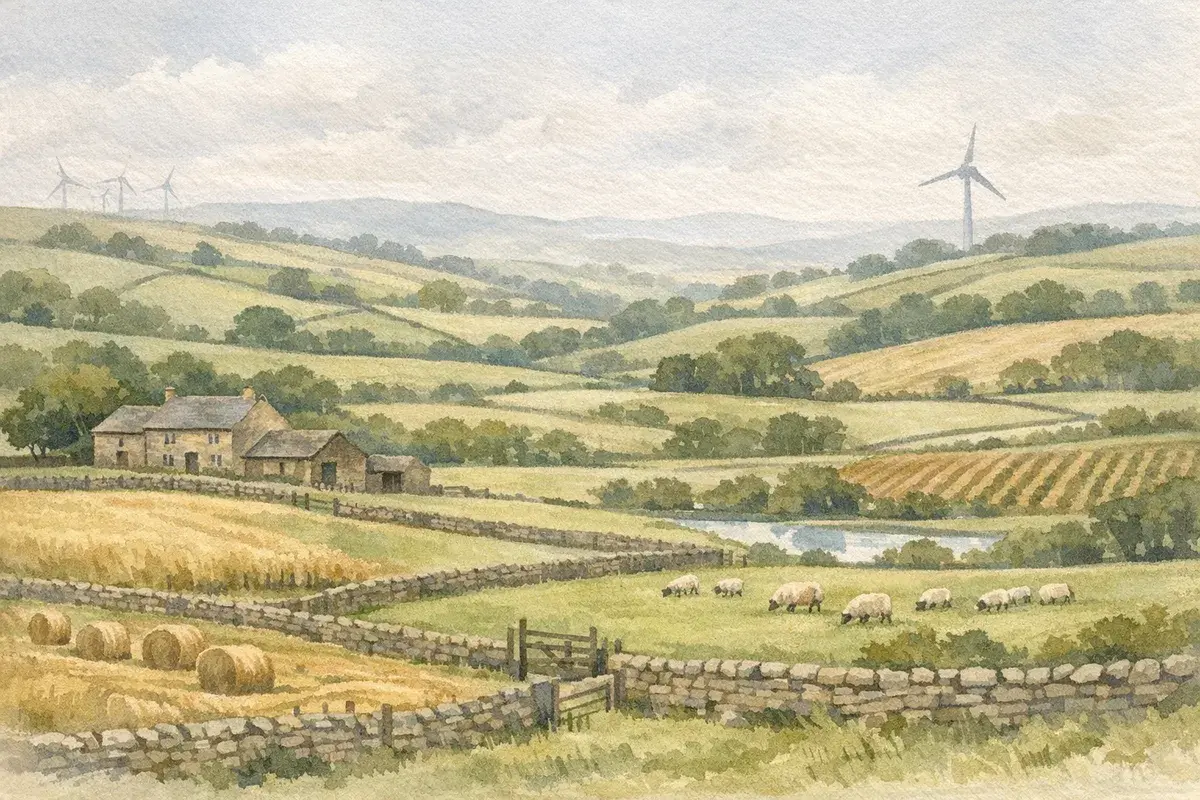
If you've ever looked at two seemingly similar blocks of farmland, same county, similar acreage, and wondered why one sells for dramatically more, you're not missing something obvious. You're bumping into a market where "agricultural land value" is shaped by a stack of overlapping forces: productivity, local buyer pressure, planning constraints, tenancy law, tax motivations, and (increasingly) non-farming income streams.
This guide breaks down the real-world factors affecting agricultural land value in the UK in 2026, with a practical lens: what actually moves the needle when you're buying, selling, refinancing, or negotiating a tenancy. And, just as importantly, where people commonly misread the numbers and pay for it later.
The UK Farmland Market Context: What “Value” Really Means
Before you can judge whether a guide price is "strong" or "cheap", you need to pin down what's actually being valued. In UK rural property, people often talk as if there's one single market price per acre. In reality, there are several overlapping markets, and the headline per-acre figure can hide more than it reveals.
A good working definition is this: land value is the price a specific buyer will pay for a specific legal and physical asset, given what they can realistically do with it (now and in the future), and what alternatives exist in that local market.
Bare Land Vs Equipped Farms Vs Rural Residential Uplift
Not all "farmland" is being bought for the same purpose, even when the listing looks similar.
- Bare land (no buildings, no house) is the cleanest comparison, yet even that varies hugely by soil, access, and local demand.
- Equipped farms (buildings, yards, grain stores, livestock kit, sometimes a farmhouse) introduce a different pricing logic: buyers may be valuing operational efficiency, replacement cost, and the ability to scale quickly.
- Rural residential uplift can swamp the agricultural value. A farmhouse with amenity appeal, a second dwelling, or even "just" a lovely setting can push value well beyond what the acres alone justify.
If you're comparing two sales, ask yourself: was the buyer effectively paying for agricultural output, a going concern, or a rural lifestyle asset? Often it's a blend.
Price Per Acre Benchmarks And Why Comparisons Often Mislead
People love a simple benchmark: "What's land making per acre round here?" It's useful, but only if you treat it as a starting point.
Per-acre comparisons mislead when:
- Parcel size differs (small blocks can achieve a premium because more buyers can fund them).
- The land comes with a tenancy (or vacant possession).
- Hope value is baked in (near settlements, grid, or development land).
- Basic attributes differ (access, drainage, soil indices, services).
- The sale date matters (even a 12–24 month shift can change the mood of the market).
If you want a sharper read on recent movements and what's driving them into 2026, it's worth cross-checking with AgLand's breakdown of where UK farmland prices are heading and what's moving them, then bring it back to your exact parcel and its constraints.
Eventually, "value" isn't a single number. It's a range, tight or wide depending on uncertainty, and your job is to narrow that range with evidence.
Location And Local Demand Drivers
If you want to understand factors affecting agricultural land value, start with location, not just county lines, but the micro-market within a few miles. UK farmland is thinly traded: a handful of sales can reset local expectations, and a single motivated buyer can skew a "going rate".
Regional Strength, Neighbouring Sales, And Buyer Mix
Two big realities shape location premiums:
- Regional strength: productivity, rainfall, infrastructure, and the local farming mix (arable vs grassland, dairy intensity, veg, etc.) matter. But so does the "wealth profile" of buyers in that area.
- Neighbouring sales: farmers buying for adjacency, estates consolidating, or investors seeking a long-term store of value can drive competitive bidding.
Buyer mix is where things get interesting. In some areas, the strongest bidder is the neighbouring farmer who can unlock operational efficiencies immediately. In others, it's a lifestyle buyer, equestrian buyer, or an investor attracted to long-term fundamentals.
If you've ever asked yourself (or been told) "why is agricultural land so expensive?", part of the answer is that farmland is often not priced purely on agricultural return. AgLand digs into that dynamic here: what's really behind today's higher land prices.
Access, Road Frontage, Parcel Shape, And Field Size Efficiency
In valuation meetings, these "boring" details can move a figure faster than broad market commentary.
- Road frontage and access: A proper, adopted-road access with good visibility can be worth real money. A track shared with others (or access "by permission") invites disputes and knocks confidence.
- Field size and shape: Squarer, larger fields suit modern machinery and reduce time wasted turning, headland compaction, and awkward margins.
- Fragmentation: Several small parcels separated by roads, villages, or pinch points are harder to farm efficiently and can deter bidders.
These are also the details lenders and professional valuers look at when assessing saleability and "marketability". In short: access and efficiency aren't cosmetic, they're fundamental.
Nearby Development Pressure, Settlement Boundaries, And Hope Value
Hope value is the premium paid for land that might secure development consent in future. It's especially potent:
- on the edge of settlements (or near services)
- where local plans are under review
- where infrastructure upgrades are happening
- where there's obvious "infill" logic
But hope value is not guaranteed value. In the UK, planning is policy-led and intensely local. A site that looks "obvious" to you can be blocked by landscape constraints, highways issues, nutrient neutrality pressures in certain catchments, flood risk, heritage constraints, or simply local policy.
If development potential is part of your strategy, don't rely on pub talk or a pin on a map. Treat it as a specialist due diligence line item, with advice and a clear-eyed view of risk and time.
Land Quality, Productivity, And Physical Attributes
When you strip away amenity and policy noise, farmland is still an economic asset. Its physical capability sets the ceiling on what you can do with it, cropping choices, stocking rates, timeliness, machinery costs, and resilience in poor seasons.
That's why "same acreage" doesn't mean "same value". The ground can behave completely differently.
Soil Type, Drainage, Compaction Risk, And Indices
Soil is one of the most direct, bankable drivers of agricultural value, yet it's also one of the most misunderstood.
A quick, practical way to think about soil's impact on value is to ask:
- How often can you travel? Heavy land that you can't get on in a wet spring can wreck output even if it looks fine in August.
- How consistent are the yields? Stability matters to both farming margins and rental strength.
- What's the drainage story? Old clay drainage systems can be brilliant, until they fail and the bill lands.
- What's the compaction risk? Poor structure increases input costs and reduces resilience.
If you want a deeper, UK-specific run-through of what to look for (and what to ask for), AgLand's guide to checking soil quality and what it means for value is a solid companion read.
Topography, Altitude, Exposure, And Microclimate
Topography isn't just about whether a tractor can climb it.
- Slope affects machinery efficiency, erosion risk, and the practicality of certain crops.
- Altitude and exposure influence growing season length and grass growth patterns.
- Microclimate (shelter belts, proximity to coast, frost pockets) can change real yields and crop reliability.
These factors also influence alternative uses: equestrian, tourism, small-scale horticulture, or woodland creation. A "challenging" farm for arable might still be attractive for the right diversified model, but it needs valuing on the right basis.
Water Availability, Irrigation Potential, And Abstraction Constraints
Water is becoming a sharper differentiator in UK land values, particularly where high-value cropping, veg, or resilient grass production matters.
Key value levers include:
- existing mains water and on-farm distribution
- private supply reliability and quality
- existing abstraction licences (where applicable)
- physical potential for reservoirs or storage (subject to consents)
The catch: water regulation and catchment pressures can tighten over time, and "it's always been fine" isn't the same as "it's secure for the next 20 years". If irrigation is central to your plan, treat water documentation as core due diligence, not an afterthought.
Legal Title, Tenure, And Rights That Add Or Strip Value
This is where agricultural land valuation gets brutally real. Two parcels can farm the same, look the same, and yet be worth very different sums because the legal interests and rights attached to them change what you can do, and when.
Vacant Possession Vs Tenanted Land (FBTs, AHA, Grazing Licences)
Vacant possession is often the "gold standard" for buyers because it offers flexibility. But tenancies aren't automatically bad, they simply change the buyer pool and the valuation logic.
In broad terms:
- Farm Business Tenancies (FBTs) (common since the mid-1990s) can be relatively flexible, but terms matter: length, rent review pattern, tenant improvements, and break clauses.
- Agricultural Holdings Act (AHA) tenancies (generally pre-1995) can materially reduce open market value because of security of tenure and succession rights. They can still be a good fit for certain investors, but you need specialist advice.
- Grazing licences and short-term arrangements are often presented as "easy to end", but the paperwork and reality must align. If it walks like a tenancy and quacks like a tenancy, expect risk.
The takeaway: value depends on whether you're buying a flexible asset to occupy, or an income stream with restrictions. Price expectations should adjust accordingly.
Rights Of Way, Easements, Wayleaves, And Ransom Strips
Rights can be value-neutral or value-destroying depending on severity and location.
- Public rights of way can limit privacy, complicate livestock management, and reduce amenity value (but many working farms live with them just fine).
- Private easements (access rights, service routes) can constrain development layout and future options.
- Wayleaves for overhead lines, poles, masts, and pipelines can affect future building locations and sometimes arable efficiency.
- Ransom strips and uncertain access are the big red flags. If your access relies on third-party land and isn't legally secured, you don't own "a field", you own an argument waiting to happen.
If you're buying, you want the title documents and plans checked early, not after you've emotionally committed.
Sporting, Timber, Mineral, And Renewable Rights Reservations
In the UK it's common for some rights to be reserved or excluded from a sale.
- Sporting rights (shooting/fishing) may be retained by a third party, affecting income potential and control.
- Timber rights can matter where woodland value is material.
- Mineral rights are a niche issue for many buyers, but they can affect compensation discussions if infrastructure projects arise.
- Renewable rights (or control of them via option agreements) are increasingly important. If a seller has already signed an option for solar or batteries, it can enhance value, or constrain your freedom, depending on terms.
You're not just buying land: you're buying a bundle of rights. Make sure you know which ones are actually in the bundle.
Planning, Policy, And Regulatory Constraints
Planning risk is one of the most misunderstood drivers of farmland value. People either ignore it ("it's agricultural, so it's fine") or overplay it ("it'll get houses one day"). The truth is more specific: policy and constraints shape what you can build, what you can change, and how much uncertainty sits in the price.
Agricultural Ties, Occupancy Conditions, And Restrictive Covenants
An agricultural occupancy condition (often called an "ag tie") can affect the value of a dwelling and, by extension, the overall value of a farm.
For you as a buyer, the key is understanding:
- what the condition actually says (wording matters)
- whether it's been complied with historically
- what your realistic exit options are (removal isn't straightforward)
Restrictive covenants can also bite: limits on building, user restrictions, or requirements to maintain boundaries. Some are historic and toothless: others are actively enforceable.
If a farmhouse is a significant part of the price, get specialist advice early, because a "small" condition can translate into a very large value adjustment.
Designations And Constraints (Green Belt, AONB, SSSI, NVZ)
Designations don't automatically prevent farming use, but they can change the probability of consent for diversification, new buildings, tracks, and changes of use.
Common UK constraints include:
- Green Belt: not a blanket ban, but it does increase policy hurdles for certain developments.
- AONB / National Landscapes: heightened landscape sensitivity: design and justification need to be strong.
- SSSI: natural features protected: management and operations may be constrained.
- NVZs (Nitrate Vulnerable Zones): can increase compliance costs and affect livestock strategy, storage requirements, and investment plans.
These constraints matter to value because they affect future optionality. Optionality is valuable, and the market prices it.
Permitted Development Rights, Prior Notifications, And Enforcement Risk
Permitted development rights (PDR) under the GPDO can be a genuine value enhancer, especially where buildings are needed to modernise a unit. But here's the catch: PDR is a privilege, not an automatic right, and it comes with conditions.
In practical terms, value is affected by:
- whether the unit meets qualifying thresholds (e.g., size of holding)
- siting constraints (proximity to roads, protected buildings, etc.)
- prior notification requirements and timescales
- local authority interpretation and enforcement appetite
If you're paying a premium because you believe you can add buildings quickly, your valuation should be based on what's likely and compliant, not what's merely possible.
If development potential is a major part of your reasoning, you'll also want to read AgLand's guide on how buyers assess agricultural land's development upside, because the risk usually sits in the detail.
Income Potential Beyond Cropping: Diversification And Uplifts
In 2026, it's hard to talk about UK agricultural land value without talking about income streams that sit alongside (or even replace) traditional cropping and livestock margins.
This isn't just about "nice extras". In some deals, diversified income is the difference between a valuation that stacks up and one that doesn't.
Farm Business Tenancies, Contract Farming, And Long-Term Letting Potential
Where you don't intend to farm in-hand, the land's letting potential becomes central.
- FBTs can provide relatively clean income, but rent depends on local demand, land quality, and the tenant's confidence in their margins.
- Contract farming agreements can suit owners who want exposure to farming profits without running day-to-day operations, though they need careful structuring.
- Longer-term lettings may appeal to certain tenants, but longer commitment can reduce flexibility for you.
If you're valuing land as an investment, be honest about the net income after costs: insurance, hedge and ditching, drainage maintenance, professional fees, and compliance.
Renewables (Solar, Wind, Batteries), Grid Capacity, And Option Agreements
Renewables can introduce large, sometimes transformative uplifts, but it's rarely as simple as "stick solar on it". The market increasingly prices in the probability of success.
What drives value here:
- Grid capacity and proximity: if you can't get a viable connection, the project may stall.
- Land characteristics: slope, aspect, flood risk, access, and cabling routes.
- Planning context: landscape designations and local policy.
- Option agreement terms: rent, indexation, term length, break clauses, decommissioning, and who controls the process.
If you're the buyer, check whether an option exists, what it restricts, and whether you're inheriting obligations. If you're the seller, don't sign something because it "sounds standard", get it reviewed.
Natural Capital, Woodland, Biodiversity Net Gain, And Carbon Markets
Natural capital is no longer fringe. Depending on location and scheme eligibility, it can materially influence value.
Key drivers include:
- suitability for woodland creation (and the opportunity cost of giving up productive land)
- potential for habitat creation that aligns with local demand for biodiversity net gain (BNG)
- credibility and permanence requirements in carbon markets
Two cautions that affect valuation:
- Stacking and eligibility rules can be complex, and they change. You need scheme-specific advice.
- Some agreements can sterilise future options (including development). That can reduce value even if there's income.
The best approach is to treat natural capital like any other enterprise: forecast the net position, price in admin and compliance burden, and stress-test what happens if policy shifts.
If you're trying to frame what land is capable of (not just what it's done historically), AgLand's explainer on how land capability classifications influence use and value is useful context.
Tax, Subsidy, And Transaction Mechanics That Move The Needle
This is the part many people skip in casual conversations about land value, right up until it changes what someone can afford to pay.
In the UK, buyer motivations can be heavily influenced by tax planning, succession planning, and how a transaction is structured. That doesn't mean "tax is everything", but it does mean you can't value land properly in isolation.
IHT, APR/BPR, And How Buyer Profiles Influence Pricing
Inheritance Tax (IHT) reliefs are a major reason certain buyers are willing to pay strong prices for farmland. Agricultural Property Relief (APR) and Business Property Relief (BPR) can be relevant, but eligibility is fact-specific, and the details of occupation, use, and trading status matter.
What this means for value in practice:
- Some buyers place a premium on assets they believe fit within a long-term estate plan.
- Others (particularly working farmers) are more anchored to operational return.
- The same land can attract different "ceilings" depending on who turns up at the table.
If you're selling, understanding the likely buyer pool helps set strategy. If you're buying, don't assume reliefs apply to you in the way they applied to the last owner.
Capital Gains Tax, Rollover Relief, And Overages In Sale Contracts
Capital Gains Tax (CGT) can influence seller behaviour: timing, lotting strategy, and willingness to accept (or demand) overage.
Overage (also called clawback) can affect value because it changes the risk/reward split if future development occurs. From your perspective as a buyer:
- Overage can be reasonable where genuine hope value exists.
- But it can also make land harder to finance or sell on if terms are too aggressive or too long.
Rollover Relief and hold-over type planning can also affect how deals are structured, especially where sellers are reinvesting into other qualifying assets. You need tax advice tailored to your facts, small details (dates, use, documentation) matter.
Finance, Interest Rates, And Liquidity In The Farmland Buyer Pool
Even in a market with cash buyers, interest rates and credit conditions still matter.
- Higher borrowing costs reduce leveraged bids and can soften competition for certain lots.
- Lender appetite can shift by land type (tenanted vs vacant, diversified income, development angle).
- Liquidity matters: farmland is a long-term asset. If buyers fear a slower resale market, they discount risk.
One subtle point: "financeability" is a value factor. Clean title, clear access, sensible lotting, and transparent documentation can widen your buyer pool, and that supports price.
How To Value Agricultural Land Properly And Avoid Costly Mistakes
If you're serious about buying or selling, treat valuation as a process, not a number plucked from a neighbour's sale.
You're aiming to answer two questions:
- What is the land worth in today's market, given comparable evidence?
- What is it worth to you, given your plans, costs, and risk tolerance?
The gap between those two figures is where good deals (and expensive mistakes) happen.
Due Diligence Checklist: What To Verify Before You Offer
A practical checklist, high level, but the kind that prevents "wishful thinking" offers:
- Title and boundaries: are the plans clear, are there any disputed edges, are hedges/ditches where you assume?
- Access: is it legally secured, suitable for modern kit, and usable year-round?
- Tenure: vacant possession or tenanted, what agreements exist and what are the key clauses?
- Rights and third-party interests: rights of way, wayleaves, easements, sporting reservations.
- Services and water: mains availability, private supplies, irrigation infrastructure, abstraction documentation.
- Physical condition: drainage function, soil structure, weeds, compaction, fencing, gateways.
- Planning history: prior consents/refusals, enforcement issues, restrictive conditions.
- Designations/constraints: Green Belt, AONB, SSSI, NVZ, plus any local plan context.
- Environmental scheme obligations: what's signed, for how long, and what it restricts.
If you want a structured UK-specific buying journey (including what to ask professionals and when), use AgLand's walkthrough on how to buy agricultural land step by step as your backbone.
Valuation Methods: Comparable Evidence, Income, And Residual Land Value
Most agricultural valuations lean heavily on comparables, but the best valuations triangulate.
- Comparable evidence (market approach): what truly similar parcels achieved, adjusted for differences (soil, access, tenure, lot size, location).
- Income approach: what sustainable net income the land can produce (rent, contract farming margin, diversified income), capitalised at an appropriate yield.
- Residual land value: used where development or a change of use is credible, start with end value, subtract build/fees/planning risk, and see what land value is left.
A common mistake is applying a development-style residual approach to pure farmland, or applying a straight per-acre comparable to land with material hope value. You want the method that matches the value driver.
Also: don't ignore "special purchaser" scenarios. If the neighbour will pay a premium for adjacency, that premium is real, but it's not necessarily a stable open-market benchmark.
Working With Specialists: RICS Valuers, CAAV Advisers, And Land Agents
You don't need a cast of thousands, but you do need the right expertise at the right time.
- RICS Registered Valuers help with defensible valuations for lending, accounts, negotiations, and disputes.
- CAAV advisers (and similarly experienced rural consultants) are valuable for tenancy issues, compensation, and strategic estate matters.
- Land agents bring the local buyer intelligence you can't get from spreadsheets, who's active, what's in short supply, what's quietly available.
If you're operating across borders, remember the UK isn't one uniform market. Scotland has its own patterns, buyer dynamics, and legal context in places, so tailor your assumptions. For readers focused north of the border, AgLand's practical guide to buying and valuing agricultural land in Scotland is a helpful reference.
And if you're in England, the framework around tenancies, due diligence, and management decisions is worth revisiting periodically, AgLand's overview of how agricultural land deals tend to work in England is designed for that.
The point isn't to "over-professionalise" the process. It's to avoid paying 2026 prices with 1996 assumptions.
Conclusion
Agricultural land value in the UK isn't set by one magic metric. It's the outcome of what your land can produce, what it might become, what it legally includes (and excludes), and who's competing to buy it at that moment.
If you're buying, the best way to protect yourself is to separate confidence from hope: pay strong money where the fundamentals are provable (title, access, soil, water, tenure clarity), and price uncertainty properly where policy, planning, or income relies on future permissions.
If you're selling, you'll usually do better by reducing ambiguity, clean paperwork, clear boundaries, transparent rights, and a sensible lotting strategy can widen your buyer pool and support stronger bids.
Disclaimer: AgLand.co.uk is a UK agricultural land and rural property matching service, where buyers register what they are looking for and owners advertise directly to the buyers who match, and a rural resource hub. Nothing in this text is intended as legal, financial, tax, or investment advice. You should carry out your own due diligence and take advice from appropriately qualified professionals (for example, solicitors, RICS valuers, CAAV advisers, accountants, and planning consultants) before making decisions or entering into any transaction.