
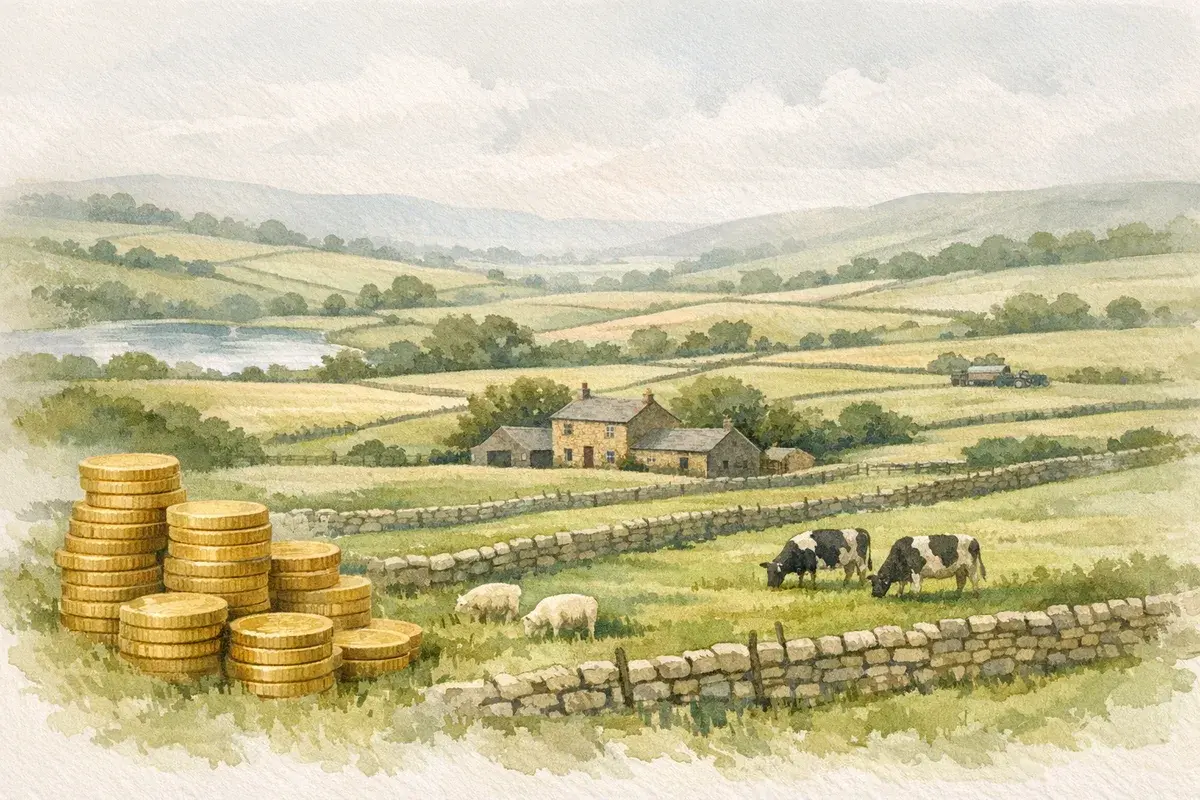
You've probably had the same moment as everyone else in the market: you see a block of decent ground come up, you do the maths per acre, and you think, "How on earth is it worth that?"
The uncomfortable truth is that UK farmland isn't priced like a simple productive asset. Yes, it grows crops and carries stock. But it's also a scarce, tightly held, regulation-shaped, tax-influenced, occasionally "hope value" fuelled store of wealth, and it attracts buyers who are often playing very different games.
So if you're asking why agricultural land is so expensive, this guide cuts through the noise. We'll look at what "expensive" actually means on the ground, why supply stays stubbornly low, who's bidding, and how policy, tax and macro conditions all feed into the price you're seeing on the particulars.
What “Expensive” Really Means: UK Farmland Price Benchmarks And How They Vary
"Expensive" is a slippery word in farmland. The right question is usually: expensive relative to what, income, alternative land uses, or scarcity?
Across the UK, values can vary dramatically even within the same county. Two fields with identical acreages can trade miles apart in price because one has better road access, squarer boundaries, cleaner title, stronger soils, or a realistic shot at non-agricultural uplift.
If you want a deeper run-through of the moving parts valuers actually weigh up, it's worth reading AgLand's guide to the factors that shape farmland values, because "price per acre" is rarely the whole story.
Arable Vs Pasture Vs Mixed: Why Land Type Shifts The Price Per Acre
Arable land typically commands a premium because it offers flexibility and, in many areas, stronger gross margins and more options over time. Even if you're not going to push for maximum output, good arable ground gives you choices: rotation options, contract farming interest, and often a broader buyer pool when you come to sell.
Permanent pasture can look "cheaper" on paper, but it's not automatically poor value. In livestock regions, reliable grass with water, access and sensible field sizes can be fiercely contested, especially if it stitches neatly into an existing unit.
Mixed land sits in the middle and can be priced either way depending on:
- how much of it is truly workable (not just "can be worked in a dry May"),
- whether the grass is productive and well-fenced,
- and whether the layout supports efficient farming without constant time on the road.
So the expensive land isn't always the land with the highest theoretical output. It's often the land with the lowest operational friction.
Location, Access, And Parcel Size: The Practical Factors Buyers Pay For
Farmers don't buy "acres": you buy efficiency.
A ring-fenced block beside your existing holding can be worth materially more to you than an equally good block ten miles away. Why? Because travel time, diesel, labour, machinery wear, biosecurity, and simple management attention all have a cost.
Buyers consistently pay for:
- Proximity to the home farm (or to where you can realistically base staff and kit)
- Good access (a proper entrance, visibility, width for modern machinery)
- Field shape and boundary quality (fewer awkward corners: less fencing grief)
- Parcel size (bigger, more coherent blocks reduce overhead per acre)
Small parcels can still fetch strong money if they're strategic "add-on acres". But if a block is too fragmented, has shared tracks, or relies on informal access arrangements, it can go from "must-have" to "headache" quickly, often reflected in what bidders are prepared to offer.
Planning Upside And "Hope Value": When Future Potential Gets Priced In
You don't need planning permission in place for a buyer to price in possibility. That's where "hope value" creeps in, money paid today for the chance of a different use tomorrow.
This can be triggered by things like:
- proximity to settlements and services
- access to a road network
- nearby development activity
- a site that "feels" like it could work for alternative uses
Sometimes that optimism is justified: sometimes it's expensive wishful thinking.
If you're weighing any kind of non-agricultural uplift, whether that's diversified commercial use, residential, solar, or other angles, read AgLand's breakdown of agricultural land development potential so you're clear on what's realistic, what's speculative, and what due diligence should look like before you pay for upside.
Supply Is Tight: Why Good Farmland Rarely Comes To Market
In most UK regions, the biggest reason agricultural land is so expensive is simple: there isn't enough of it for sale at any one time.
Land trades infrequently, and quality blocks trade even less. When something good does come up, especially with vacant possession and decent access, it often attracts multiple serious bidders who already know exactly what it's worth to them.
Ownership Patterns And Hold Incentives: Family Farms, Estates, And Long Time Horizons
A large share of UK farmland is held by families and estates with long time horizons. That matters because it changes the decision-making.
If you're holding land for succession, flexibility, or generational security, you don't behave like a typical "sell when the return is weak" investor. You sell when there's a need: death, divorce, debt, restructuring, or a strategic switch.
Even when farming profits are under pressure, land is still a productive base, a home for diversified income, and (for many owners) a form of security that's psychologically hard to replace.
Tenancies, Vacant Possession, And Sporting Rights: What Actually Trades And Why It Matters
Not all farmland for sale is equal.
- Vacant possession tends to command a premium because you can farm it, let it, or diversify it on your timetable.
- Tenanted land can be very attractive, but it's priced in the context of the tenancy terms, rent level, and the buyer's strategy.
- Sporting rights (and other retained rights) can affect both value and buyer appetite, depending on how they're structured and whether they create management friction.
In plain terms: what you're buying isn't just soil, it's a bundle of rights and constraints. The more control you have on day one, the more buyers will compete.
The "Best Bits" Effect: Competition For Ring-Fenced Blocks And Add-On Acres
Here's a pattern we see repeatedly: the market overpays (or looks like it) for the right block.
A 50-acre parcel that completes a ring-fence, straightens boundaries, or creates a clean access route can be worth more to one neighbouring farm than it is to everyone else put together. That's why guide prices can be smashed when two neighbours decide they can't afford to lose it.
Meanwhile, awkward fragments, but "good" on a soil map, can sit longer or trade softer.
This is the "best bits" effect: scarce, workable, well-located land attracts a premium that isn't purely about agricultural yield. It's about operational advantage and long-term control.
Demand Keeps Rising: Who’s Buying And What They’re Competing For
To understand why agricultural land is so expensive, you have to accept that you're rarely bidding against a single buyer type.
In many sales, you're in a mixed room: farmers, long-term investors, lifestyle buyers, and occasionally buyers focused on future options. They value the same acres differently, and that pushes the clearing price upward.
Farmers And Neighbours: Scale, Efficiency, And Control Of Boundaries
When you buy next door, you're often buying:
- more efficient machinery use
- fewer travel miles
- better cropping and grazing flexibility
- simpler boundary management
- and long-term security (no surprises from a new neighbour)
That last point is underrated. Control of boundaries and biosecurity can have a real value that doesn't show up on a spreadsheet.
Farmers also tend to think in decades. If you're buying a block you expect to hold (and perhaps pass on), the price feels different than if you're buying for a short-term yield.
Investors: Inflation Hedging, Long-Term Capital Growth, And Portfolio Diversification
Some buyers are happy with relatively modest income returns because they're prioritising capital preservation and long-term growth.
In UK terms, farmland has historically been seen as:
- a scarce real asset
- a hedge against inflation (not perfect, but often resilient)
- a diversifier away from mainstream financial markets
That's why you'll sometimes see farmland values hold up even when agricultural profitability is volatile.
If you're looking at land as an asset class (or you suspect you're bidding against people who are), AgLand's overview of agricultural land investment in the UK is a useful lens, particularly around what "return" means in practice once you account for costs, risk and time.
Lifestyle, Equestrian, And Amenity Buyers: A Different Value System
Not every buyer is chasing farm margin.
Lifestyle and amenity buyers may prioritise:
- privacy and views
- a house with land "in one block"
- space for horses
- woodland, water, and recreation
When you're valuing land as part of a lifestyle package, the emotional component is real, and it can be price-setting on smaller acreages.
This is also where confusion creeps in around comparisons with residential land. Agricultural land can look "cheap" beside consented residential plots, but once a parcel has any realistic residential angle, pricing psychology shifts fast.
If you want a clear explanation of what sits behind that gap, and why it doesn't close neatly, see AgLand's guide to agricultural land vs residential land prices.
Policy, Subsidies, And Environmental Markets: Income Streams That Support Higher Values
Even though UK agricultural policy has been through a major transition, public money and environmental markets still influence what buyers will pay.
Not because everyone expects "free money forever", but because income stability, any income stability, supports confidence.
The Post-BPS Landscape: How Support Changes Can Still Prop Up Values
Basic Payment Scheme (BPS) has been phased down in England, and the overall policy direction has shifted toward "public money for public goods". That has created uncertainty, but it hasn't removed support from the system.
In practice, land value is influenced less by any single scheme and more by whether a holding can:
- maintain reasonable profitability without overly stretching risk,
- access alternative support streams,
- and stay flexible as rules evolve.
The land that adapts (good access, workable soils, decent infrastructure, flexible management) tends to be the land that stays most liquid, so it stays expensive.
ELM Schemes, SFI, And Nature Recovery: When Environmental Options Add Value
In England, Environmental Land Management (ELM) initiatives, including the Sustainable Farming Incentive (SFI), have pushed environmental options into mainstream business planning.
That doesn't automatically mean "higher value per acre", but it can add to demand for:
- parcels suited to low-input grassland management
- land with hedgerows, buffers, and manageable features
- farms that can stack viable options without compromising the core business
If you're buying, the question isn't "can I get a scheme payment?" It's "does this land let me choose the right mix of production and environmental management without painting myself into a corner?"
Biodiversity Net Gain, Nutrient Neutrality, And Carbon: Opportunity And Risk In Pricing
Environmental markets are now a serious part of rural land conversations.
Depending on location and circumstances, you may hear about:
- Biodiversity Net Gain (BNG) opportunities tied to development
- catchment-specific issues like nutrient constraints that can increase demand for mitigation land
- carbon and natural capital projects (with wide variation in quality and credibility)
These can create upside, but they also create risk. Agreements can be long-term, restrictive, and complex. Some buyers price opportunity aggressively: others discount land because they're wary of locking it up or dealing with future compliance.
If you're tempted to "pay up" because a seller hints at environmental upside, slow down and get proper advice. A good valuer will separate credible, evidenced opportunity from marketing spin.
Tax And Structuring: How Reliefs Can Influence What Buyers Are Willing To Pay
Farmland pricing in the UK is heavily shaped by tax planning. That isn't a moral judgement, just a reality.
When land plays a role in inheritance planning or capital gains planning, buyers and sellers can make decisions that look odd if you're only thinking about annual farming profit.
IHT (APR/BPR) And Succession Planning: The Long Game Behind Holding Land
For many families, land is a succession plan.
Agricultural Property Relief (APR) and Business Property Relief (BPR) can be relevant in inheritance tax planning, depending on use, occupation, and the wider business structure. This helps explain why owners may hold onto land even when the farming return is modest: the strategic value to the family can be enormous.
If you're buying, you can't assume a seller will be motivated by yield or even by "market timing". Sometimes the driver is a family event, sometimes it's a restructure, sometimes it's simply that the next generation wants a different path.
CGT, Rollover Relief, And Timing Sales: Why Motivation Isn't Always About Yield
Capital gains tax (CGT) considerations can shape the timing of sales and purchases, and rollover relief may be relevant in some circumstances when proceeds are reinvested in qualifying business assets.
The practical point for you: a seller's "reasonable" price might be influenced by their tax position. Equally, a buyer who can structure things efficiently may be able to bid harder than someone who can't.
This is exactly where you should involve a rural accountant or tax adviser early, before you assume a deal is "too expensive" or "too cheap".
The Trading Vs Investment Mindset: When "Return" Isn't The Main Objective
Some buyers are trading businesses (they need the land to farm and generate operating profit). Others are investors (they want a resilient asset). Others are a blend.
That difference matters because it changes what "return" means:
- A trading buyer might justify price through efficiency, scale and cost control.
- An investor might accept a low running yield because they believe the long-term capital story.
- A succession-minded buyer might care most about stability, control, and long-term family outcomes.
If you're a farmer competing with non-farming money, it can feel frustrating. But it's also why well-presented, well-located farmland keeps clearing at prices that don't neatly match annual net income.
Finance, Interest Rates, And Inflation: Why Macro Conditions Still Push Prices Around
Even in a market dominated by long-term owners, macro conditions matter.
Interest rates change what debt costs. Inflation changes what cash is "worth" over time. And both influence how different buyer groups behave.
Borrowing Costs And Buyer Behaviour: When Rates Bite, And When They Don't
Higher interest rates typically reduce the maximum price a heavily leveraged buyer can pay. That's the textbook.
But farmland isn't only bought with high leverage. Many purchasers are well-capitalised, selling other assets, refinancing portfolios, or buying through long-term family structures. So rates don't always "crash" farmland values in the way they might in more debt-dependent markets.
What you often see instead is:
- fewer speculative bids
- more scrutiny on property condition, access and title
- a bigger price gap between "prime, clean" farms and compromised holdings
Commodity Cycles And Farm Profitability: How Much Do They Really Matter To Values?
Profitability matters, but it's not the only engine.
Good commodity years can boost confidence and encourage expansion. Tough years can reduce farmer bidding intensity. Yet land values can stay supported if investor demand remains steady and supply stays tight.
A more realistic way to think about it is:
- Farm profitability affects who's active (and how aggressive they can be).
- Scarcity and long-term confidence affect the price floor.
So if you're expecting land prices to track grain or milk month-by-month, you'll be disappointed. The farmland market moves slower, and it's often driven by who must buy (strategic neighbours) rather than who might buy.
Land As A Store Of Value: Scarcity, Inflation, And The UK Safe-Haven Effect
UK farmland has a "safe-haven" reputation among certain buyers. That tends to strengthen when inflation is high or when mainstream assets feel shaky.
It's not that farmland is risk-free, it absolutely isn't. But it is finite, tangible, and historically resilient across long timeframes.
If you want a current, UK-specific view of what's moving prices and how patterns differ by region and type, AgLand keeps an updated explainer on UK agricultural land prices and what's driving them (useful context before you set expectations for a purchase or a sale).
What Smart Buyers And Sellers Do Next: Valuation, Due Diligence, And Search Strategy
Knowing why agricultural land is expensive is helpful. But if you're transacting, you need practical next steps that stop you paying for problems, or missing the one block that actually makes strategic sense.
Due Diligence That Moves The Dial: Soil, Water, Access, Rights, And Title
The boring checks are the ones that protect your downside.
Focus hard on:
- Soils and cropping reality: not just a classification, but drainage, compaction risk, stoniness and workable windows. AgLand's guide to soil quality in agricultural land is a strong starting point if you want to know what to look for (and what to ask in plain English).
- Water: supply, abstraction constraints (if relevant), trough and mains capacity, flood history.
- Access: legal access on title, width, maintenance responsibility, and whether you'll be sharing.
- Rights and reservations: wayleaves, easements, sporting rights, mineral reservations, public rights of way.
- Tenure and occupation: who's in possession, what agreements exist, what notices have been served.
You're not doing this to find reasons not to buy. You're doing it to understand what you're really buying, and to price it correctly.
Pricing Reality Checks: Comparable Evidence, Overpayment Traps, And Professional Valuations
If you're serious about bidding (or setting a guide price), treat pricing like an evidence exercise, not a gut feeling.
Practical reality checks:
- Compare like-with-like: land type, block size, access, location, tenure, and any development angle.
- Separate "strategic value to you" from "market value": it's OK to pay a premium for the right block, but you should do it knowingly.
- Use proper professional valuation for high-stakes purchases, partnership changes, tax planning, or estates. In rural property, small details can move the number a lot.
Overpayment traps we see:
- paying for "hope value" without a credible planning route
- underestimating infrastructure costs (tracks, fencing, water)
- assuming access is fine because "it's always been used"
Finding The Right Opportunities: Registered Requirements, Off-Market Networks, And Working With Specialist Agents
Because supply is tight, your search strategy matters more than people admit.
A sensible approach usually combines:
- A specialist rural service where you set out what you're after rather than sifting irrelevant property types
- A registered requirement covering your target counties, acreage ranges, land types and price brackets, so matches reach you as they're advertised
- Agent relationships, especially if you're looking for ring-fenced blocks, add-on acres, or anything with a bit of complexity
- Off-market awareness (where appropriate) through professional networks
If you're buying in different parts of the UK, remember that the rules and practicalities vary.
For England-specific considerations (tenancies, planning risk, and how people structure deals), you can lean on AgLand's practical England buying guide.
And if Scotland is on your radar, don't treat it as "England but further north", crofting, local market norms and due diligence expectations can differ materially. AgLand's overview of buying agricultural land in Scotland is a solid orientation before you view anything.
The bottom line: the expensive land is the land that's hard to replace. Your job is to make sure you're paying for genuine scarcity and genuine utility, not hidden complications.
Conclusion
Agricultural land is so expensive in the UK because it sits at the crossroads of scarcity, strategy and competing definitions of value. You're not just buying productive acres, you're buying control, optionality, resilience, and (sometimes) future upside. And you're doing it in a market where the best land doesn't come up often.
If you're buying, your edge comes from clarity: what the land is worth to you, what it's worth to the wider market, and what risks could quietly turn an "expensive" purchase into an unaffordable one. If you're selling, the same clarity helps you present the asset properly, choose the right route to market, and avoid leaving value on the table.
Disclaimer: AgLand.co.uk is a UK agricultural land and rural property matching service, where buyers register what they are looking for and owners advertise directly to the buyers who match, and a rural resource hub. Nothing in this text is intended as legal, financial, tax, or investment advice. You should carry out your own due diligence and seek independent advice from suitably qualified professionals (for example, a chartered surveyor, solicitor, accountant, or planning consultant) before making decisions about buying, selling, letting, or investing in agricultural land.