
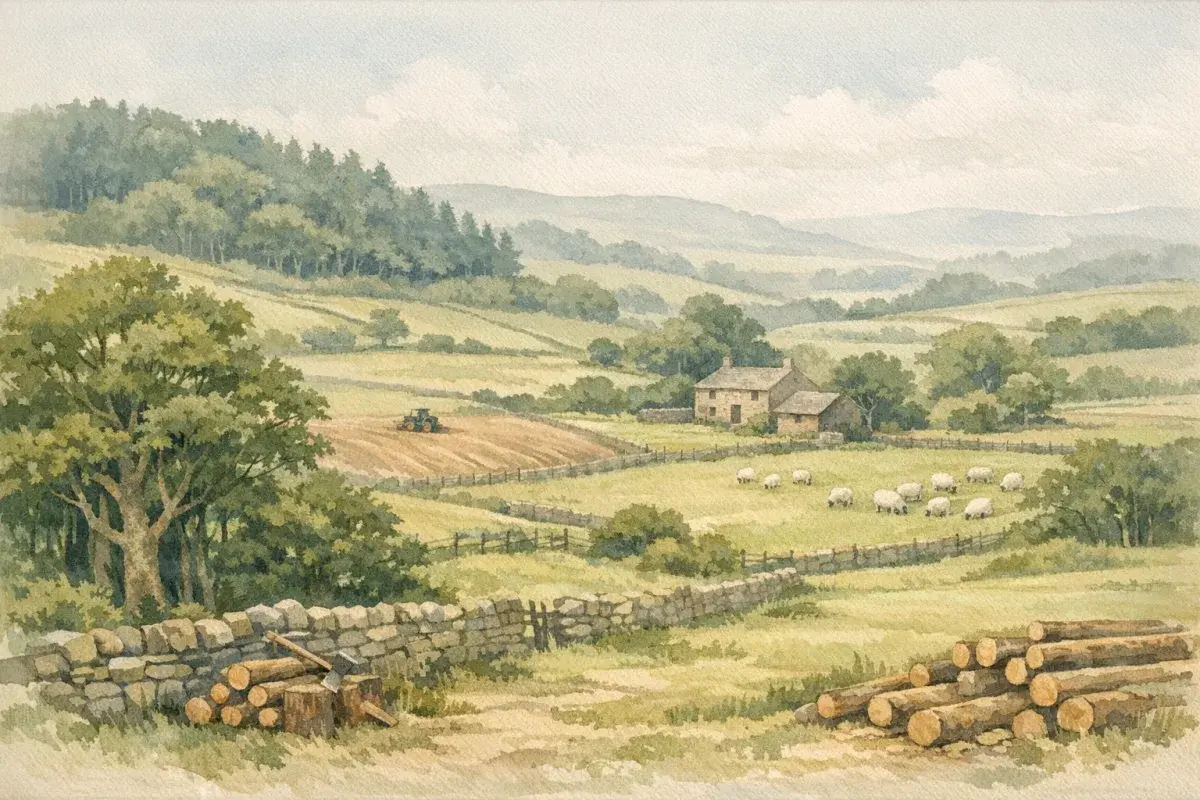
Woodland prices in the UK can feel oddly slippery. One advert suggests you can pick up a few acres for the price of a decent tractor: another asks development‑land money for what looks like "just trees". The truth is that the cost of woodland per acre isn't a single number, it's a range shaped by access, timber, rights, restrictions, local demand, and (sometimes) a bit of romance.
In this guide, you'll get a clear view of what woodland typically costs per acre right now, why those figures swing so widely, how prices differ across England, Scotland and Wales, and, crucially, what you'll really pay once fees, taxes and ongoing management are counted in. The aim is simple: help you price woodland like a pro, avoid expensive surprises, and negotiate with confidence.
What UK Woodland Costs Per Acre Right Now
If you ask three land agents for a single "going rate", you'll get four answers. That's not evasiveness, it's because woodland value is driven as much by use case (commercial timber vs amenity/recreation vs long‑term investment) as it is by acres.
As a 2026 rule of thumb, UK woodland often trades somewhere between roughly £4,000 and £15,000+ per acre, with outliers below and above that range depending on the factors we'll unpack later. Small, accessible, "weekend" woods near population centres can command a surprising premium per acre: larger commercial blocks can look cheaper per acre but come with management complexity.
Typical Price Ranges By Woodland Type And Size
Below are typical bands you'll see in the market. They're not guarantees, think of them as a starting point for your valuation conversation.
- Amenity / recreational woodland (small parcels, high demand): often £8,000–£15,000+ per acre where access is good and the setting is attractive. Buyers here are frequently motivated by privacy, shooting potential, family use, or "owning a bit of countryside" rather than a spreadsheet.
- Mixed woodland with some timber potential: commonly £6,000–£12,000 per acre, depending on species mix, age class, and the practicality of extracting timber.
- Commercial forestry blocks (scale, timber focus): frequently £4,000–£9,000 per acre (sometimes lower for very large or remote holdings), with pricing anchored to timber crops, roading, and management history.
- Ancient / high‑constraint woodland: values can sit either side of the amenity bands. Some buyers pay a premium for the rarity and setting: others discount heavily because management and change are constrained.
If your goal is specifically investment-led ownership, it's worth reading the angle on yield, risk, and market behaviour in our woodland investment UK resource, because the "best value per acre" isn't always the lowest asking price.
Freehold Woodland Versus Woodland Lots And Small Parcels
Two woods can share a fence line and still have very different £/acre values based on how they're being sold.
- Freehold woodland (single title, clean boundaries): tends to be easier to finance, insure, and manage. You're buying control. That often supports a stronger price.
- Woodland lots (split from a larger estate): can be excellent buys, but watch for newly created boundaries, retained rights (sporting/minerals), and access arrangements that haven't been "road-tested" in practice.
- Very small parcels (1–5 acres): typically carry the highest £/acre because more buyers can afford them and they're often close to towns. But per acre is only half the story, small woods can have disproportionately high fixed costs (gates, fencing, legal work, insurance).
If you're actively assessing the market, start with a broad read of woodland values across the UK, then bring it back to access, size, and your intended use. It's a quicker way to calibrate what "normal" looks like in your chosen county.
Why Woodland Prices Vary So Much
Woodland isn't priced like a uniform commodity. One acre can be a mature, roaded, productive conifer stand: another can be steep, landlocked broadleaf with public footpaths and multiple designations. Both are "woodland". Only one behaves like an investable forestry asset.
Here are the drivers that most often explain why the cost of woodland per acre jumps around.
Location, Access, And Local Demand Hotspots
Location matters in woodland even more than in farmland because amenity buyers push prices in particular pockets.
Key location factors that change value:
- Distance to population centres: Closer woods attract weekend buyers and lifestyle demand, especially where road access and parking are straightforward.
- Access type: A legal right of way is one thing: an all‑weather track that a timber wagon can actually use is another. Poor access tends to reduce value sharply, or it narrows your buyer pool.
- Neighbouring land use: A peaceful boundary beside pasture and hedges feels very different to a boundary beside an industrial yard, a quarry, or a busy A‑road.
- Local cultural demand: Some areas have deep markets for shooting, stalking, or pony/amenity use, which can lift values even where timber quality is average.
A practical point: if access isn't crystal clear on the title, assume it's a valuation problem until proven otherwise. "The neighbour's always let us through" isn't bankable.
Timber Quality, Age Class, And Management History
For commercial and semi-commercial woods, price is anchored to what you can actually manage and harvest.
You'll see the biggest pricing differences based on:
- Species mix: Productive conifers vs mixed broadleaf, and whether the crop matches local markets.
- Age class: A wood with a near‑term harvest profile (or an established thinning programme) can carry very different economics from a young plantation that won't pay back for years.
- Management history and records: A well‑managed woodland with a plan, mapped compartments, track maintenance, and evidence of past operations is simply less risky. That tends to support a higher price.
- Roading and extraction practicality: You can have excellent timber on paper, but if you can't get it out without damaging neighbours' land or violating conditions, value leaks away.
Designations And Constraints (SSSI, AONB, TPOs, Conservation Covenants)
Constraints aren't "bad" by default. But they do change what you can do, how long permissions take, and what management looks like in practice.
Common UK constraints that can affect value:
- SSSI (Site of Special Scientific Interest): usually increases scrutiny on operations and can limit interventions.
- AONB / National Landscapes and similar landscape designations: can raise the bar for any development or change of use.
- TPOs (Tree Preservation Orders): more relevant in/near settlements: can complicate felling and works.
- Conservation covenants / long-term obligations: can be positive if you want biodiversity outcomes, but they may reduce flexibility and buyer appetite.
If you want a deeper, step‑by‑step view of the checks buyers miss (access, felling, rights, designations, and the first 12–24 months of practical management), our guide to buying woodland in the UK is designed exactly for that stage, after you've found a wood you like, but before you get carried away.
Price Differences Across The UK
You can't talk about woodland values without talking about the shape of demand in each nation. England tends to see the strongest amenity premiums: Scotland tends to offer scale and commercial forestry depth: Wales often sits in between, with its own access and designation realities.
England: Amenity Demand, Planning Sensitivities, And Competition
In England, small to mid-sized amenity woods can be fiercely competitive, especially within easy reach of cities and large towns.
What that means for £/acre:
- Small, accessible woods often command high premiums because the buyer pool is wide.
- Planning sensitivity can cap "hope value" (more on that later). Even if you're not trying to build, the market still prices in perceived future options.
- Public rights of way are common in some areas, which can influence how private the woodland feels, and hence what lifestyle buyers will pay.
Scotland: Scale, Commercial Forestry, And Grant-Led Management
Scotland's woodland market often has more depth in commercial forestry, larger blocks, and professional management.
Typical characteristics you'll see reflected in pricing:
- Larger average lot sizes can reduce the £/acre headline (even if the total price is substantial).
- Commercial buyers focus on crop, access, and management, so the "pretty factor" may matter less than roading and yield class.
- Grant-led management and restocking obligations can shape cashflow and long-term commitments.
If you're specifically looking at timber-led assets, you'll notice a different pattern of listings and buyer behaviour when comparing with commercial woodland for sale opportunities.
Wales: Smaller Parcels, Access Issues, And Environmental Designations
Wales often offers attractive landscapes and mixed woods, but it's also a place where access and topography can make or break value.
Key influences on price:
- Smaller parcels and fragmented titles can be more common, which can increase legal complexity per acre.
- Steep ground and limited roading can suppress commercial value because extraction becomes costly.
- Environmental designations and habitat sensitivities are frequent in certain landscapes, which can reduce management flexibility.
In all three nations, one principle holds: a wood that's easy to access, easy to understand on paper, and straightforward to manage will usually command a premium, regardless of postcode.
Beyond The Headline Price: The Full Cost To Buy Woodland
The purchase price is only the first cheque you'll write. If you want a true "cost of woodland per acre", you need to include transaction costs and the first few years of ownership, because that's where buyers can get caught out.
Professional Fees (Agent, Solicitor, Survey, Valuation)
Expect some combination of the following:
- Agent fees: typically paid by the seller, but not always, check the terms.
- Solicitor (conveyancing) fees: woodland can be more complex than a standard house purchase because of rights, reservations, access, and historic title quirks.
- Survey/valuation: not always mandatory for a cash buyer, but often money well spent. If lending is involved, a valuation is usually required.
- Specialist reports: depending on your objectives, you may commission a forestry consultant, ecologist, or rights-of-way advice.
A small woodland purchase can feel "simple", but fixed professional fees don't scale down neatly. That's one reason very small parcels often have a higher all‑in cost per acre than buyers expect.
Taxes And Transaction Costs (LBTT/LTT/Stamp Duty Land Tax Where Relevant)
UK land taxation is detail-heavy, and it varies by nation.
- England & Northern Ireland: Stamp Duty Land Tax (SDLT) may apply depending on classification and circumstances.
- Scotland: Land and Buildings Transaction Tax (LBTT) is the equivalent.
- Wales: Land Transaction Tax (LTT) applies.
The tricky bit is that woodland can straddle categories (mixed use, amenity, potential commercial forestry), and the tax treatment depends on facts, how the land is used, what comes with it, and sometimes the buyer's position.
If you're comparing woodland with farmland, it helps to understand the wider baseline of rural land values too. Our 2026 guide to the cost of agricultural land per acre gives that context, which is useful when you're weighing "should I buy grass, arable, or trees?"
Ongoing Costs (Insurance, Boundaries, Rides, Roading, And Compliance)
Woodland ownership is rarely "buy it and forget it", even if you want a low-intervention approach.
Budget for:
- Insurance: public liability is a common consideration, particularly where footpaths, neighbours, or informal access exist.
- Boundary maintenance: fences, ditches, and posts fail quietly and then all at once.
- Rides and access routes: keeping tracks usable prevents small problems becoming expensive repair jobs later.
- Tree safety: if there's public access, highways, or neighbouring property, you may need periodic inspections.
- Compliance: felling permissions, restocking expectations, and any designation-related consents.
A good way to sanity-check ongoing costs is to ask yourself: If I had to sell this wood in five years, what would I wish I'd maintained? That answer is usually your minimum annual budget.
What Adds Value—and What Should Reduce The Price
When you're trying to decide whether an asking price is fair, focus less on the trees as a picture and more on the woodland as a bundle of rights, constraints, and future options.
Rights, Reservations, And Access (Sporting, Minerals, Wayleaves, Rights Of Way)
These are the deal-shapers that can justify a price adjustment.
Typically value-positive:
- Clear, documented vehicular access over a suitable route
- Sensible, secure entrance and parking/turning
- Clean title with no surprise third-party rights
Often value-negative (or at least value-complicating):
- Sporting rights retained by the seller (you own the trees but not the sport)
- Mineral reservations or active rights that could interfere with use
- Wayleaves/easements that materially affect the best parts of the wood
- Public rights of way that reduce privacy or increase liability management
None of these automatically kills a deal. But they should change your price and your plan.
Timber And Carbon: How Income Potential Influences Value
For commercial forestry, timber value is straightforward in concept (less so in calculation). For many amenity woods, timber income is incidental.
Two income angles can influence value:
- Timber: species, age, stocking density, extraction access, and local markets. A well-structured crop with an intelligible thinning/harvest schedule tends to price stronger.
- Carbon and natural capital: a big talking point, but it's not "free money". The credibility of any carbon proposition matters, additionality, permanence obligations, measurement standards, and who controls the rights.
A sensible buyer's stance: treat carbon income as a potential upside unless it's evidenced, contracted, and compatible with your intended management.
Development Hope Value And The Reality Of Planning
This is where buyers can get starry-eyed.
Woodland is sometimes marketed with hints: "possible cabin", "glamping potential", "future prospects". In the UK, planning permission in woodland is rarely simple, and policy is typically cautious about sporadic development in the countryside.
If a seller is pricing in hope value, ask:
- What specific planning history exists locally?
- Are there constraints (AONB/SSSI/heritage/highways visibility) that make permission unlikely?
- Is there any lawful use already established (e.g., existing buildings, lawful access, historic consents)?
If the answers are vague, price it as woodland, then treat any permission as a bonus rather than your business plan.
How To Value Woodland Per Acre Like A Pro
Professional valuers don't start with "£X per acre". They start with evidence, then adjust for what matters.
Comparable Evidence: What To Compare And What To Ignore
When you're collecting comparables, compare like with like:
Compare:
- Nation/region and local market depth
- Access type (legal + practical)
- Woodland type (broadleaf/conifer/mixed), age class, and management condition
- Rights included/retained (sporting, minerals)
- Designations and constraints
- Lot size (small parcels usually trade at higher £/acre)
Ignore (or heavily discount):
- "Aspirational" asking prices with no evidence of achieved sale values
- Marketing language that implies planning outcomes without substance
- Pretty photos that hide a lack of track, windblow, or boundary issues
If you want to buy for rarity and ecology rather than cashflow, you'll look at a different subset of the market. For example, ancient woodland for sale opportunities can be incomparable with plantation forestry because constraints, management goals, and buyer motivations diverge.
Desktop Checks Before You View (Maps, Titles, Constraints, Neighbours)
Before you spend a day driving around, do the quick checks that save you from falling in love with the wrong wood:
- Title and access: Is there a registered title? Are rights of way clearly described? Any ransom strip risk?
- Shape and boundaries: Tight, awkward shapes can reduce usable area and increase boundary management.
- Designations: SSSI, AONB/National Landscape, scheduled monuments, or other constraints.
- Neighbour context: footpaths, nearby housing, livestock, commercial uses.
This desktop phase is also where you decide whether the listing is an amenity purchase or a practical forestry asset, because the valuation logic differs.
On-The-Ground Due Diligence Checklist
When you view, look beyond "nice trees":
- Access in reality: Can you get a vehicle in? Is it passable in winter? Is there evidence of historic use?
- Windblow and disease: Signs of storm damage, ash dieback impacts, larch issues, or unmanaged hazards.
- Boundary condition: missing fences, broken banks, ambiguous corners.
- Water and drainage: boggy areas can limit operations and increase track costs.
- Evidence of third-party use: fly-tipping, unauthorised trails, shooting activity.
If you're not experienced in forestry, it's often worth taking a woodland manager or forestry agent with you. One hour of expert eyes can prevent a five-figure mistake.
How To Find Woodland For Sale And Negotiate Confidently
The best woodland deals aren't always the cheapest per acre, they're the ones where the risk is understood and the price reflects reality.
Where Deals Actually Come From (Agents, Private Sales, Specialist Portals)
In practice, woodland changes hands via:
- Specialist rural agents who understand rights, access, and forestry realities
- Private/neighbor-to-neighbor sales where local relationships matter
- Specialist portals that let you filter properly (woodland type, access, lot size, location)
If your priority is enjoyment and privacy, you'll often be looking at smaller, more lifestyle-led parcels, exactly the sort covered in the guide to recreational woodland for sale.
Making An Offer: Conditions, Overages, And Timescales
A confident offer isn't just a number. It's a structure.
Consider:
- Conditions: access confirmation, proof of rights included, clarification of sporting/mineral reservations, and any management obligations.
- Overage/clawback: sometimes inserted where the seller wants a share of future development value. Don't treat this as boilerplate, it can materially change long-term economics.
- Timescales: woodland transactions can move quickly or drag, depending on title complexity and whether boundaries or rights need cleaning up.
A practical negotiation approach we've seen work: anchor your offer to a small set of "hard" points (access, rights, constraints, timber quality), and be calm about the rest. Sellers will often negotiate if they can see you're buying with your eyes open.
Financing And Ownership Structures (Cash, Lending, Joint Ventures)
Woodland finance is more specialised than mainstream residential borrowing.
Your main routes:
- Cash purchase: simplest and often fastest.
- Specialist lending: possible, but expect tighter underwriting, valuation scrutiny, and sometimes lower loan-to-value. If you're exploring this, read up on how woodland mortgage UK options tend to work in practice.
- Joint ventures or group ownership: can make larger purchases achievable, but you'll want a robust agreement covering decision-making, costs, and exit routes.
Whatever route you choose, align the ownership structure with your goal. A wood bought for family recreation is managed differently from a timber-led asset, and your financing and timescales should match that reality.
Conclusion
The cost of woodland per acre in the UK is less about a neat national average and more about what you're actually buying: access you can rely on, rights you truly control, constraints you can live with, and a management reality that fits your time and budget.
If you do three things well, (1) treat access and rights as first-order value drivers, (2) price in the full transaction and ownership costs, and (3) compare genuinely similar woods, you'll avoid the most common traps and you'll be able to move quickly when the right opportunity appears.
Disclaimer: AgLand.co.uk is a UK agricultural land and rural property matching service, where buyers register what they are looking for and owners advertise directly to the buyers who match, and a rural resource hub. Nothing in this text is intended as legal, financial, tax, or investment advice. Woodland purchases carry legal, regulatory, and commercial risks, and rules can change. You should do your own due diligence and take advice from appropriately qualified professionals (for example, a solicitor, chartered surveyor/valuer, forestry agent, tax adviser, and planning/environmental consultants where relevant) before making decisions.