
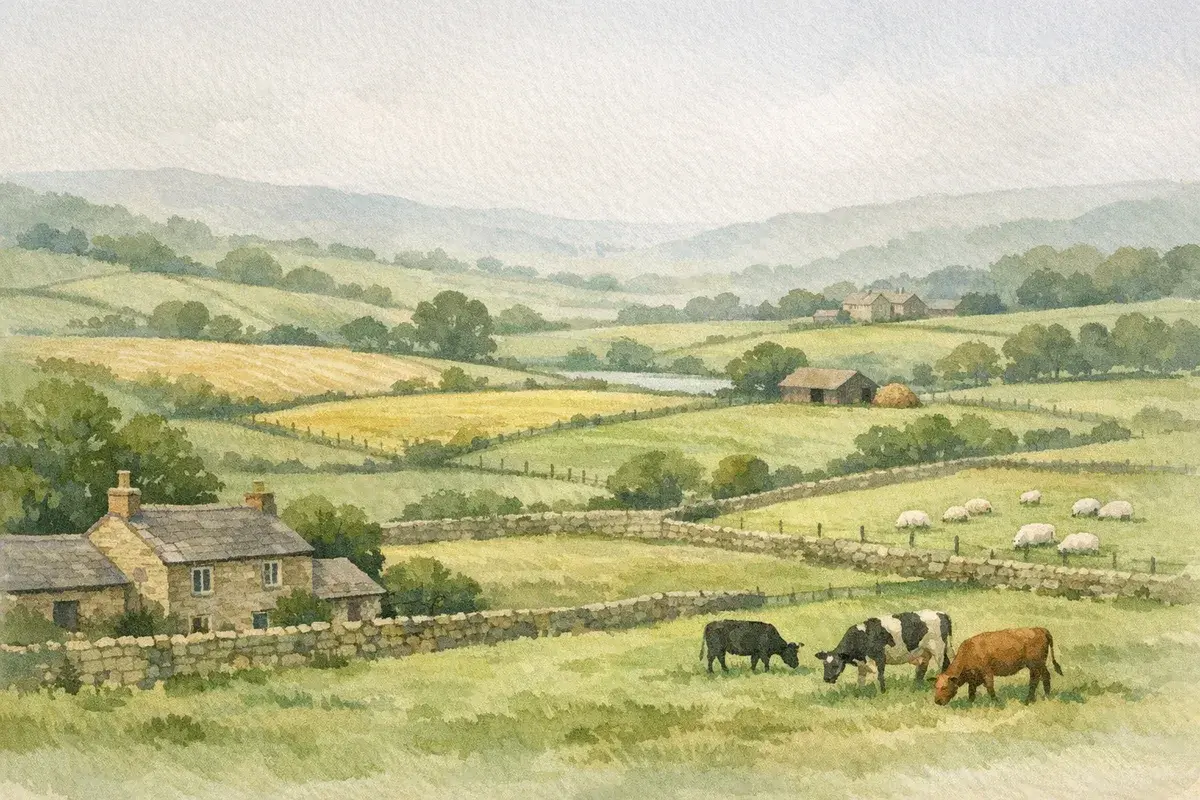
If you've ever looked at two "similar" blocks of farmland, both, say, 80 acres, both in the same broad part of the country, and wondered why one sells for a startling premium, you're not missing something obvious. You're bumping into the real truth of UK farmland values: "regional price" is only the headline.
Agricultural land prices by region are shaped by a tangle of practical farm economics (output, access, labour), legal realities (tenure, rights, restrictions), and human behaviour (who turns up to bid, and why). In 2026, those factors feel sharper than ever: environmental schemes are reshaping income expectations, "natural capital" is now part of mainstream conversations, and lifestyle demand is still influencing the market in pockets.
This guide gives you a grounded way to interpret agricultural land prices by region, so you can set expectations, compare like with like, and make decisions you won't regret in three years' time.
How UK Agricultural Land Pricing Works
Regional averages are useful for orientation, but the land market doesn't price in neat boundaries. It prices in utility (what the land can do), risk (what could go wrong), and competition (who else wants it).
If you keep those three things in mind, you'll read "£X per acre in Y region" with the right amount of scepticism, and you'll ask better questions when you view land.
The Main Drivers: Land Use, Farm Type, And Local Demand
Start with what the land is for.
- Arable land tends to command higher values where yields, rotations and logistics stack up. But arable isn't a magic word, poor access, awkward shapes, or distance from a workable base can flatten price fast.
- Permanent pasture and grassland values often track livestock viability (and local competition), but also lifestyle demand. In certain areas, pony paddock economics can distort what "agricultural" should mean.
- Mixed blocks (arable + grass + woodland) are priced on the best opportunities and the headaches. A balanced block can attract a wider buyer pool, which can lift value.
Then factor in the local market temperature. In some districts, a single motivated neighbour can reset the "going rate" for years.
Quality Signals Buyers Pay For: Soil, Water, Access, And Parcel Size
In practice, buyers pay a premium for fewer unpleasant surprises.
- Soil type and versatility: Freer-draining, workable soils with good structure and consistent performance usually attract stronger competition. Heavier land can still be valuable, but buyers will discount for timeliness risk.
- Water: Any secure water story, mains availability, lawful abstraction where relevant, trough supply, functional drainage, reduces risk. Conversely, unresolved drainage issues can become a silent "tax" on your future margins.
- Access: A clean, wide entrance off an adopted highway matters more than many first-time buyers expect. One tight corner, weight restriction, or contentious access strip can change who's willing to bid.
- Parcel size and shape: Big, workable fields tend to trade better than a patchwork of small enclosures, unless the buyer pool is lifestyle-led, where smaller parcels may actually widen demand.
A quick tip when you're comparing: don't just ask "how many acres?" Ask "how many workable acres, at what cost to operate?"
Tenure And Title Issues That Move The Needle
Two pieces of land can look identical on a plan and be worlds apart in price because of legal position.
- Vacant possession vs sitting tenants: Land with vacant possession usually attracts broader interest and higher bids, because the buyer has choice. Tenanted land can still sell well, but the price will reflect rent level, term, rights, and exit routes.
- Sporting, mineral and timber rights: What's included (or reserved) can matter for value, insurance and management.
- Rights of way, easements and third-party access: A public footpath isn't automatically a deal-breaker, but it does change privacy, biosecurity and practical operations.
- Restrictive covenants and overage: These can materially affect what you can do later, and what you can sell for.
If you're trying to orient yourself before viewings, it can help to understand typical national baselines first, then narrow down. Our wider explainer on the UK market is a useful companion when you're sanity-checking what you're seeing in different counties: the bigger picture of UK land values and what's driving them.
UK Agricultural Land Prices By Region: What The Data Typically Shows
You'll see plenty of charts and "average price per acre" headlines. Treat them as a weather forecast rather than a thermometer reading: directionally helpful, not precise for your specific field.
In the UK, patterns tend to show higher values where land is productive, accessible, and contested by multiple buyer types, while larger-scale, more marginal, or more remote land often trades at lower averages (but with plenty of exceptions).
England: Core Patterns And Regional Hotspots
England commonly shows the widest spread between regions and even between neighbouring districts.
Typical themes you'll see:
- East of England and parts of the Midlands: strong arable performance, farm infrastructure, and established buyer competition often support firmer values for quality blocks.
- South East and commuter-influenced areas: lifestyle demand can raise the floor under smaller parcels, even where the agricultural return alone wouldn't justify it.
- South West: high demand for grassland and mixed farms in many pockets: smaller lot sizes and lifestyle crossover can lift prices, while truly commercial scale can be harder to assemble.
- Northern England: more variation. Good arable land can be keenly priced: upland fringe and less accessible grassland tends to be more price-sensitive.
If your search is England-focused, it's worth reading a county-by-county mindset into your due diligence rather than relying on broad "North/South" assumptions. This practical overview helps you map the buying process onto the realities of different English regions: how to approach buying and managing agricultural land in England.
Scotland: Scale, Upland Versus Arable, And Investor Interest
Scottish agricultural land prices by region often reflect three big differentiators:
- Scale: larger blocks are more common, which can change buyer pools and financing appetite.
- Upland vs arable: the gap between high-performing arable areas and upland grazing can be significant.
- Non-farming demand: in some locations, woodland creation, carbon projects, sporting potential and amenity value can influence pricing, sometimes more visibly than in England.
Also, Scotland has its own buying rules and systems, and those practicalities affect transaction timelines and risk management. If you're looking north of the border, you'll want a Scotland-specific view rather than UK-general advice: what to watch when buying agricultural land in Scotland.
Wales: Grassland Pricing, Lifestyle Demand, And Constraints
Wales is often characterised (in broad strokes) by:
- A heavier grassland weighting and more livestock-oriented systems, with pricing that reflects local farm economics.
- Lifestyle and amenity crossover in accessible areas, which can push up values for smaller holdings with good access, views, or buildings potential.
- Constraints and designations (which may include national park areas or other environmental sensitivities) that can limit "hope value" thinking.
The big mistake in Wales is assuming "cheaper on average" means "better value." Sometimes it does. Sometimes you're buying more operational constraint and fewer exit options.
Northern Ireland: Smaller Parcels, Strong Local Demand, And Supply Limits
Northern Ireland often behaves like its own micro-market.
Common features include:
- Smaller average parcel sizes and intense local competition.
- Strong neighbour and family-farm buyer pools, where land rarely comes forward and the market can move quickly when it does.
- Limited supply in many districts, which can keep values resilient even when farm margins are under pressure.
If you're buying in Northern Ireland, your best "data" is often local intelligence: who's likely to bid, what similar blocks genuinely achieved, and what the land's practical fit is for nearby businesses.
Regional Breakdown: Factors That Explain The Gaps
When people ask why agricultural land prices by region vary so much, they often expect one answer (rainfall, soil, proximity to London…). In reality, it's several overlapping markets.
A useful way to think about it: every acre has an agricultural value, an amenity value, and sometimes an option-like value (uplift potential). Regions differ because the weighting of those components differs.
Arable Versus Pasture Mix And Cropping Potential
The arable/pasture balance matters, but not in a simplistic way.
- In arable-dominant regions, buyers often benchmark land on rotation potential, workability, and logistics.
- In livestock regions, the conversation shifts to stocking capacity, housing, handling facilities, and the reliability of grass growth.
And within arable areas, quality segmentation is real. Top-end land doesn't just "cost a bit more", it can operate as a different market entirely, with different buyers and different resilience. If you're trying to understand why high-grade acres can pull away from local averages, this deeper dive is helpful: what tends to sit behind Grade 1 agricultural land pricing.
Subsidies, Schemes, And Income Alternatives (ELM, Forestry, Natural Capital)
In 2026, you can't talk about price gaps without talking about alternative income.
- Environmental Land Management (ELM) in England (and equivalent schemes elsewhere in the UK) can influence what buyers think a block can earn, and how defensible a purchase price feels.
- Woodland creation has become a serious land-use competitor in some districts, particularly where agricultural returns are marginal and planting stacks up.
- Natural capital projects (biodiversity uplift, habitat creation, peatland restoration in suitable areas) can be a value driver, but also a complexity driver. The best projects are evidence-led and tied to long-term management obligations.
The caution: "scheme potential" is not the same thing as "bankable income." Buyers paying premiums for headline rates without stress-testing eligibility, prescriptions and long-term constraints can get caught out.
Planning, Uplift Potential, And Development Hope Value
Hope value is where regional narratives can become expensive.
A few grounded points:
- Planning is local: even within the same county, different local authorities apply policy differently.
- Uplift isn't binary: it's not just "can I build houses?" It may be diversification buildings, change of use, farm shop potential, equestrian use, or renewable energy, each with its own constraints.
- Designations matter: green belt, national landscape areas, heritage constraints, and access limitations can suppress uplift expectations.
If you want a quick reality check, compare what the market pays for clean agricultural value versus what it pays when development value creeps in. This explainer helps you keep the two concepts separate when you're looking at "strategic" land: how agricultural values differ from residential land economics.
Local Buyer Pools: Farmers, Neighbours, Institutions, And Lifestyle Purchasers
Who shows up to buy land varies sharply by region.
- Neighbouring farmers often pay strongest when the block is genuinely strategic, closes a gap, improves access, or unlocks efficiencies.
- Institutions and funds tend to favour scale, clean title, and a clear income story (often including environmental options).
- Lifestyle purchasers typically care about access, setting, and "manageability." In some regions, they raise the price of small parcels and awkward blocks that commercial buyers aren't chasing.
In other words: regional pricing isn't only about the land. It's about the people competing for it, and what they want it to do.
What You Can And Cannot Compare In Price Per Acre
Price-per-acre (or price-per-hectare) is useful, until it isn't.
You can use it to sense-check whether something is broadly cheap, fair, or frothy for a region. You can't use it to value a specific holding without adjusting for quality, tenure and conditions.
Why Quoted Averages Mislead: Lot Size, Location, And Sale Method
Three reasons averages routinely mislead:
- Lot size changes the buyer pool. A 15-acre parcel and a 300-acre block are not competing for the same money.
- Micro-location trumps region. Being 10 minutes from a strong farming base, a market town, or a major road can matter more than being "in the right county."
- Sale method changes behaviour. Auctions can generate momentum (and occasionally over-exuberance). Private treaty can favour patience and negotiation. "Best and final offers" can turn into a competition of nerves.
If you want a consistent yardstick, it helps to anchor your comparisons to a clear unit. A lot of buyers start by looking at typical agricultural land price per hectare ranges, then adjust based on what they see on the ground.
Adjusting For Quality: A Practical Like-For-Like Checklist
When you're comparing two opportunities in different regions, or even two villages apart, run a quick like-for-like check:
- Soil and land capability (workability, drainage, consistency)
- Effective area (what's actually usable vs lost to tracks, banks, steep ground)
- Access and internal roadways (width, turning, surfaces, gateways)
- Field layout (big workable fields vs fragmented paddocks)
- Water (reliable supply, infrastructure condition)
- Buildings and yard (are they functional, compliant, and in the right place?)
- Constraints (rights of way, neighbours, environmental constraints)
- Connectivity to your base (time costs are real costs)
You don't need to turn this into a spreadsheet on day one. But you do need to be honest with yourself: if the "cheaper" land is cheaper because it's awkward, you'll pay for that awkwardness every season.
Sale Conditions That Skew Prices: Vacant Possession, Tenancies, And Overage
Sale conditions can shift value dramatically, and it's not always obvious from a listing headline.
- Vacant possession generally supports a higher guide because the buyer has flexibility (farm it, let it, enter schemes, or restructure).
- Tenancies require a more investment-like mindset: you're buying income and legal position, not immediate operational control.
- Overage/clawback can depress price if it captures a meaningful share of future uplift or restricts what you can do.
If you're doing regional comparisons, this is where many buyers go wrong: they compare a vacant block in one county to a tenanted block in another and conclude "Region A is expensive." It might be. Or you might be comparing different assets entirely.
How To Use Regional Prices In Real Decisions
Knowing agricultural land prices by region is only helpful if it changes what you do next: how you set your guide, how you structure an offer, how you manage risk, and how you plan your exit.
For Sellers: Setting A Credible Guide Price And Building Competitive Tension
If you're selling, your real job is to make the right buyers take you seriously.
A credible guide price usually comes from:
- Tight comparables (same locality, similar soil/use, similar lot size)
- Clear sale story (vacant possession? tidy title? what's included?)
- Presentation (mapped boundaries, access clarity, wayleave info, basic soil/field info)
Pricing too high can be worse than pricing slightly keen, because land buyers are patient, and a "stale" listing attracts discounting. Pricing sensibly can create competitive tension, particularly where the buyer pool includes neighbours.
For Buyers: Budgeting Beyond The Headline Price (Tax, Fees, And Works)
If you're buying, the land price is the start of the cheque-writing, not the end.
Build a budget that includes:
- Professional fees (solicitor, surveyor/valuer, agent advice if you use one)
- Tax planning and compliance costs (case-specific)
- Immediate works (fencing, drainage, water systems, track repairs)
- Finance costs (arrangement fees, valuations, interest, timing)
One practical discipline: decide your "walk-away number" before best-and-final offers. Regional heat can make people forget they're buying a long-term asset.
For Investors: Income, Risk, Liquidity, And Exit Strategy By Area
If you're investing (rather than buying for operational farming), region matters because it affects risk and liquidity.
- Some regions offer stronger depth of buyer demand, which can make resale easier.
- Others offer larger scale, which can suit long-term strategies, but may narrow your exit market.
- In certain areas, amenity demand may provide a price floor for smaller holdings.
But don't invest on vibes. Your underwriting should be based on realistic income (rent or farming margin), realistic costs, and realistic constraints. If you want a structured way to pressure-test a purchase, use a checklist approach like the one in our guide to agricultural land investment and due diligence.
And because everyone asks: yes, expectations about future growth influence what people are willing to pay today. Just make sure your assumptions are grounded. It's worth comparing your local evidence against a broader view of the agricultural land price forecast, then adjusting for the specific region, asset type and buyer pool you're dealing with.
For Tenants And Expansion-Minded Farmers: Linking Rents To Capital Values
If you're expanding, regional capital values still matter even if you're renting.
- Capital value influences what some landlords expect as a "fair" rent, even when the farm business can't justify it.
- Higher-value regions can mean more pressure on margins, so you need to be sharper on field efficiency, travel time, and infrastructure.
- In lower-value regions, you may find better opportunities for scale, but with different risks (remoteness, weather exposure, limited buyer depth).
The practical move is to tie any rent discussion back to productive capacity and costs, not just what land "is worth" on paper. If a rent only works at peak output every year, it doesn't work.
How To Track Agricultural Land Prices By Region (Without Guesswork)
If you want to make confident decisions, you need your own evidence base, one that reflects your target area, your intended land use, and your budget.
The good news is you don't need to be a full-time analyst. You just need a repeatable system.
Build A Local Evidence Base: Comparable Sales, Listings, And Agent Intelligence
Start with three inputs:
- Completed sales evidence (where you can get it): what actually achieved, not just what was asked.
- Current listings: they tell you sentiment and supply, even if guides are optimistic.
- Local agent intelligence: often the most valuable layer, why a deal happened, who bid, what scared buyers off.
When you track comps, write down the details that explain differences: vacant possession vs tenanted, access, soil, lot size, and any known constraints.
Set Up A Repeatable Monitoring System: Alerts, Mapping, And Shortlists
A simple monitoring workflow that works in the real world:
- Define your patch: draw a realistic travel-time radius from your base (or your intended manager's base).
- Use mapping: note proximity to roads, neighbours, watercourses, towns, and sensitive designations.
- Shortlist with reasons: don't just save listings, note why it's interesting (scale, soil, access, buildings, scheme potential).
- Review monthly: you're looking for patterns, more land coming forward, guides shifting, certain lot sizes moving quicker.
On AgLand, you register the type, acreage, budget and area you're after and hear only when a matching property is advertised, rather than wading through irrelevant stock - useful when you're watching regional movements and need clean signals, not noise.
When To Bring In Specialists: RICS Valuers, CAAV Advisers, And Land Agents
There's a point where "doing your assignments" becomes false economy.
Bring in specialists when:
- You're relying on scheme/natural capital income to justify the price.
- The land has tenure complexity (Farm Business Tenancy terms, historic arrangements, disputed boundaries).
- There's uplift or overage in the heads of terms.
- You need a defensible valuation for lending, partnership changes, tax planning, or dispute avoidance.
A RICS valuer can give you valuation discipline: a CAAV adviser can help you think clearly about tenancies and rural business structure: a good land agent can tell you what's really happening in that postcode, not just what the national average says.
One last practical note: keep your own notes. Six months from now, you won't remember whether "that nice block near the A-road" had mains water, a right of way, and vacant possession, or whether you quietly glossed over those details because the viewing was on a sunny day.
Conclusion
Agricultural land prices by region are a starting point, not an answer. The real value is revealed when you match regional context to the specifics: soil and access, tenure and title, buyer competition, and what the land can reliably earn.
If you're buying, your edge comes from comparing like with like and budgeting for reality, not headlines. If you're selling, your edge comes from credible pricing, clean information, and making it easy for serious buyers to act.
Either way, treat "regional averages" as a compass, then do the field-by-field work that turns a good-looking number into a good decision.
Disclaimer: AgLand.co.uk is a UK agricultural land and rural property matching service, where buyers register what they are looking for and owners advertise directly to the buyers who match, and a rural resource hub. Nothing in this text is intended as legal, financial, tax, or investment advice. You should carry out your own due diligence and seek advice from suitably qualified professionals (for example, solicitors, RICS valuers, land agents, tax advisers, and planning consultants) before making any decisions.