
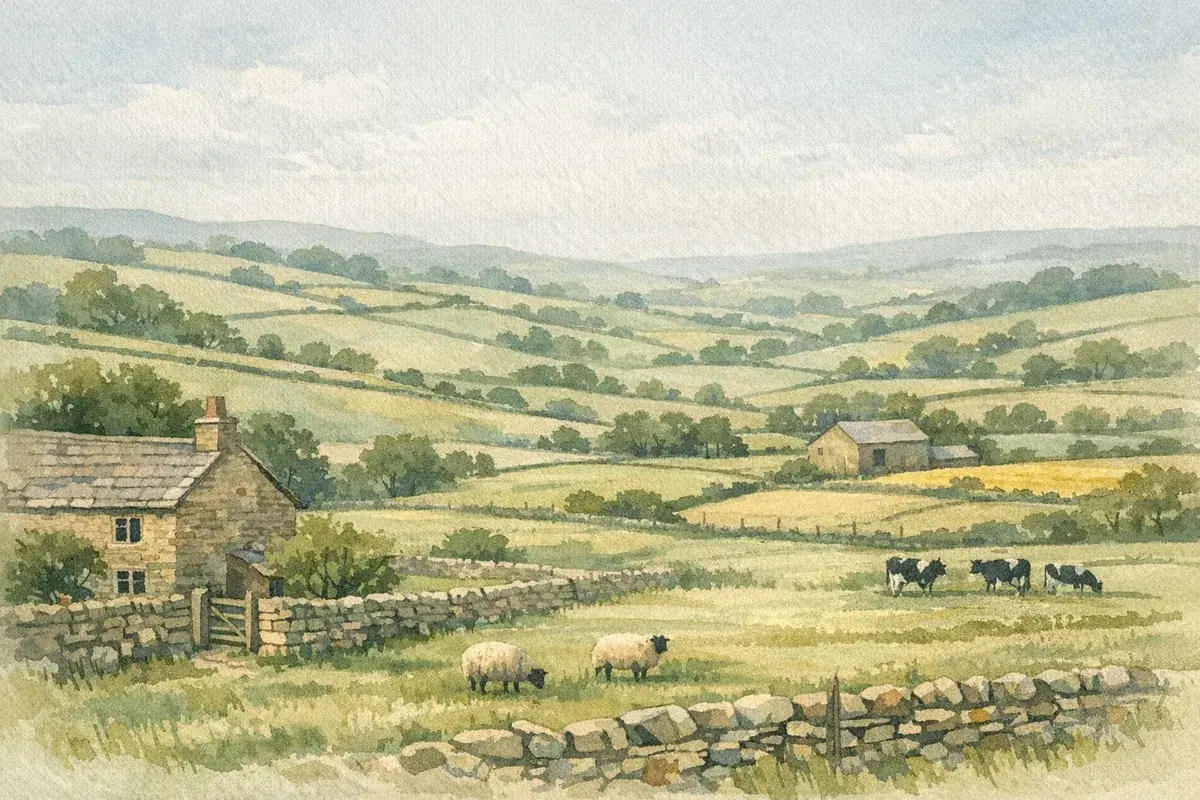
If you've been watching rural listings over the last couple of years, you'll have noticed something odd: two blocks that "feel" similar on a map can be worlds apart on £/hectare when the bids land. That's not hype, it's how UK farmland value really behaves once you factor in soils, access, scheme income, occupation, and the stuff that never makes it into a one‑line brochure.
This guide is about getting you fluent in the numbers behind an agricultural land price per hectare, so you can compare opportunities properly, spot what's driving a premium (or a discount), and make an offer that stands up to scrutiny from your lender, your agent, and your future self.
What “Price Per Hectare” Really Means In Land Deals
You'll see £/hectare used as if it's a single, clean metric. In practice, it's only as accurate as the area measurement and the assumptions behind what's being valued.
Net vs Gross Area: What Actually Gets Valued
In UK sales particulars, the headline area is often the gross area (everything within the red line). But the price you end up justifying, especially when you compare against other deals, may be closer to a net productive area view.
A few common "area gaps" that can materially change the effective £/hectare:
- Tracks, ditches, ponds, and scrub: sometimes valuable, sometimes dead space, sometimes both.
- Steep banks, awkward corners, and shaded edges: still hectares on paper, not always hectares in output.
- Public rights of way: don't reduce area, but can reduce how you farm it (and what it's worth to the next buyer).
- Woodland strips or riparian margins: may bring scheme potential, but they're not arable hectares.
If you're buying to farm, it's sensible to calculate two figures for your own decision-making:
- £/gross hectare (what the market headline suggests)
- £/net productive hectare (what your business model can actually monetise)
Those two numbers can be uncomfortably different, and that's often where "bargains" and "overpays" hide.
Bare Land, Farm With Buildings, And Mixed-Use Blocks
Not all "agricultural land" is being valued on the same basis.
- Bare land (no significant buildings) typically trades on soils, location, access, and comparables.
- Land with buildings can distort £/hectare because you're paying for a working unit, yards, sheds, grain stores, or livestock housing, sometimes with significant replacement value.
- Mixed-use blocks (e.g., land plus a house, holiday lets, or commercial yards) are the classic trap for simplistic £/hectare comparisons. The residential element can dominate total value, making the "land price per hectare" look inflated.
A practical way to sanity-check is to ask: if the buildings weren't there, what would the dirt itself achieve locally? Then treat buildings as a separate valuation exercise rather than forcing everything into one £/hectare headline.
How UK Agricultural Land Prices Are Usually Quoted And Compared
In the UK, land pricing culture is a blend of tradition (per acre), professional valuation norms (per hectare), and sales tactics (guide prices designed to create competition). Knowing which is which helps you avoid comparing apples with turnips.
Per Hectare vs Per Acre: Avoiding Conversion Traps
Even in 2026, plenty of conversations still happen in £/acre, particularly among farmers and agents in some areas. But listings and formal valuations commonly reference hectares.
Key conversions you should keep at hand:
- 1 hectare = 2.471 acres
- 1 acre = 0.405 hectares
The trap isn't the maths, it's rounding and headline psychology. A vendor might talk about "£10,000 an acre" because it sounds familiar, while your bank memo wants £/hectare. If you're building a comparable set, stick to one unit throughout.
If you want a quick cross-check on how £/acre and £/hectare relate in practice, AgLand's explainer on the typical farmland cost per acre is a handy reference point when you're sense-checking agent chatter against wider market ranges.
Guide Prices, Best Offers, And Private Treaty vs Auction Outcomes
UK farmland rarely sells like a supermarket shelf label. The mechanism matters.
- Guide price: often pitched to generate enquiries. It can be realistic, or deliberately inviting.
- Best and final offers: encourages competitive bidding and can push £/hectare above what comparables alone would justify.
- Private treaty: tends to allow more negotiation around conditions (vacant possession, overage wording, timing), not just price.
- Auction: transparent on the day, but can reflect emotion and scarcity, especially for smaller lots.
Two practical implications for your £/hectare comparisons:
- Record the sale method when you log comparables. Auction premiums can be real.
- Note the conditions (tenancies, access rights, clawbacks). A "high" £/hectare might be perfectly rational if the terms are clean and the lot is strategically useful.
What Drives Agricultural Land Price Per Hectare
Land value is rarely about one magic factor. It's an accumulation of practical farming performance, future optionality, and risk, priced differently depending on who's bidding.
Soil, Climate, And Cropping Capability
At the farming end of the spectrum, land is still worth what it can reliably produce.
- Soil type and depth: deeper, well-structured loams with fewer limitations usually command a premium.
- Drainage: systematic drainage and workable windows matter as much as soil map labels.
- Topography and altitude: influences machinery efficiency, grass growth, and cropping reliability.
- Local climate: harvest risk and spring access can make "good on paper" land less valuable in reality.
Where you're looking at top-end arable, it helps to understand how the market treats the very best classifications. If you want to go deeper on that specific niche, AgLand's analysis of premium-grade arable values adds useful context on why the strongest land can behave differently to the wider average.
Access, Shape, Services, And Practical Farmability
Two parcels can share the same soil series and still price miles apart because of day-to-day usability.
Buyers commonly pay up for:
- Good road access (and safe visibility)
- Regular field shapes (less time turning, fewer awkward margins)
- Internal tracks that work in winter, not just in the brochure photos
- Water availability (particularly for livestock and horticulture)
- Proximity to your existing holding (reduces travel time and makes labour/kit work harder)
A slightly "worse" soil that's square, accessible, and next door can outbid "better" soil that's isolated and fiddly. That's not irrational, it's operational reality.
Tenure, Occupation, And Constraints (FBT, Grazing, Rights, Easements)
This is where £/hectare conversations get serious, because occupation and legal rights change what you can actually do with the land.
Common value movers include:
- Farm Business Tenancies (FBTs): length, rent level, break clauses, repair obligations, and whether the tenant is eligible for schemes.
- Grazing licences: can look informal, but you still need clarity on possession and timing.
- Rights and easements: wayleaves, drainage rights, rights of access for neighbours, and utility corridors.
- Sporting rights: sometimes retained, sometimes included: can matter to certain buyers.
From a pricing angle, "vacant possession" usually attracts a premium because it gives you control. But it's only valuable if vacant possession is real and deliverable, not assumed.
Location-Led Value Uplifts And Non-Farming Demand (Residential, Amenity, Carbon)
A growing share of demand isn't purely yield-driven.
- Amenity buyers may prioritise views, privacy, and lifestyle over gross margin.
- Residential proximity can add uplift (even when there's no immediate development angle).
- Natural capital and carbon can underpin bids where the buyer has a long-term environmental or corporate driver.
Here's the catch: non-farming demand can be highly selective. One valley with strong amenity appeal can see "sticky" premiums, while a similar block ten miles away trades like straightforward farm ground.
In other words, location isn't just county-level. It's micro-location: access, neighbours, setting, and what the land could become over time.
Regional Differences Across The UK (And Why They Persist)
You can't sensibly talk about agricultural land price per hectare without acknowledging that the UK market is fragmented. It's not one national price, it's many local markets that occasionally rhyme.
If you want to zoom out before you zoom in, AgLand's overview of how values vary around the country is a useful companion when you're building expectations for your target area.
England: Arable Premiums, Development Pressure, And Natural Capital Buyers
In England, the highest £/hectare results often come from a cocktail of:
- High-output arable areas with proven performance
- Intense competition for scarce supply (especially where neighbour-farm expansion is common)
- Development-adjacent pressure (even when "hope value" is only a small part of the bid)
- Environmental/natural capital strategies where buyers are pricing long-term optionality
But it's not uniform. Even within a strong county, land that's remote, tenanted on unfriendly terms, or operationally awkward can trade at a clear discount.
If your focus is England specifically, rules, due diligence, and what tends to move value, AgLand's practical primer on buying and managing rural land in England is worth having in your back pocket.
Scotland And Wales: Scale, Forestry/Natural Capital, And Local Market Dynamics
Scotland and Wales have their own market physics.
In Scotland, larger scale opportunities can be more common in some regions, and value can be heavily influenced by:
- Forestry potential and long-term land use change
- Sporting and amenity drivers in particular localities
- Crofting and local regulation/market norms (where relevant)
In Wales, upland characteristics, access, and local buyer pools can exert a strong influence on £/hectare. Some blocks trade more like grazing units than cropping assets, and scheme participation can be a bigger part of the value story.
If you're actively looking north of the border, AgLand's guide to buying agricultural land in Scotland covers practical points that can change both your price and your process.
What's consistent across all regions: comparable evidence travels badly. A "great" deal in one region can be an irrelevant data point in another. Keep your comparables tight and local.
Small Parcels vs Whole Farms: The “Lotting” Effect On £/Hectare
If you've ever wondered why a 6-hectare paddock can achieve a scarier £/hectare than a 260-hectare farm, you're seeing the lotting effect in action.
Why Smaller Blocks Often Achieve Higher £/Hectare
Smaller parcels can pull higher £/hectare because they widen the buyer pool.
A 5–20 hectare block might attract:
- Neighbouring farmers looking for a clean add-on
- Lifestyle and equestrian buyers (even if it stays "agricultural" in planning terms)
- Investors who prefer a smaller ticket size
Smaller lots also feel "doable" in finance terms. Many buyers who can't stretch to a whole farm can compete on a smaller block, and competition is what pushes the metric.
There's also a psychological factor: people will fight hard for the land that fixes a problem (access to a yard, squaring off a boundary, securing a water source). The £/hectare can look irrational until you realise it's not being priced as generic farmland, it's being priced as a strategic asset.
How Overages, Ransom Strips, And Strategic Edges Skew Comparables
This is where you need to be a little sceptical with headline comparables.
- Overage/clawback: if the seller retains a right to future uplift (for example, on development or planning gains), the "price" today might be lower than the land's true potential value.
- Ransom strips and access slivers: tiny areas that control access can command huge implied £/hectare figures, but they're not a comparable for normal farmland.
- Strategic edges: land adjoining settlements, roads, or existing buildings can carry hope value even without any immediate planning pathway.
When you collect comparable evidence, tag anything that's "strategic" or "conditional". Otherwise you'll end up benchmarking ordinary farm land against a deal that was really about leverage and optionality.
How Planning, Policy, And Environmental Schemes Influence £/Hectare
Planning and policy don't just change what you can do with land, they change how buyers price risk.
Permitted Development, Prior Approvals, And Planning Risk Pricing
In England (and similarly structured regimes elsewhere in the UK), agricultural permitted development rights can be valuable, but they're not a blank cheque.
Buyers typically price in:
- Whether the holding qualifies (and whether the proposal would be treated as reasonably necessary for agriculture)
- Prior approval / prior notification risk (including highways, design, and environmental considerations)
- Neighbour sensitivity (noise, traffic, visual impact)
- Designation constraints (AONBs, National Parks, SSSIs, where applicable)
If a block's value is being pushed up because "you can put a building up," you'll want to check the details yourself rather than relying on sales patter. A planning consultant's view can save you from paying a premium for something you can't actually bank.
ELM, Stewardship, Biodiversity Net Gain, And Carbon Markets: Reality Checks
Environmental income streams can support value, but they're not magic money, and they don't suit every farm business.
A grounded way to think about it:
- ELM / stewardship-style agreements (in England) can provide steadier income, but you need to understand obligations, length, and management constraints.
- Biodiversity Net Gain (BNG) can be relevant near development pressure, but it's complex: legal structure, monitoring, and long-term land management commitments matter.
- Carbon and natural capital: potential depends on project type, additionality, permanence, and who takes which risks.
In pricing terms, land with clear, credible scheme potential can attract broader demand. But land that's already heavily constrained (designations, wetness, access limits) can go either way: sometimes it's discounted as "difficult," sometimes it's valued by buyers with a conservation-led plan.
If you're trying to align today's price with tomorrow's drivers, it helps to look at the wider picture on where values may head next. AgLand's write-up on the near-term outlook for farmland values is useful for framing that discussion, without pretending anyone has a crystal ball.
How To Estimate A Fair Price Per Hectare For A Specific Parcel
A "fair" £/hectare isn't a national average, it's a reasoned number you can defend. Here's a method that holds up whether you're buying 4 hectares of grass or 140 hectares of combinable land.
Step 1: Build A Like-For-Like Comparable Set
Start with evidence, but be picky.
Aim for comparables that match on:
- Land type (arable, grass, mixed)
- Parcel size (small blocks don't compare neatly to whole farms)
- Tenure (vacant vs tenanted)
- Location and local buyer demand
- Access and services
- Any scheme income or constraints
If you're struggling to triangulate, don't just widen your radius until the numbers fit. Instead, document why each comparable is included and what's different about it.
Also, keep your unit consistent. If you're working in hectares, stay in hectares all the way through.
Step 2: Adjust For Site-Specific Factors And Hidden Costs
This is where you turn "a comparable" into "a comparable that actually applies".
Typical adjustments you should cost (not just note):
- Fencing and gates (especially if boundaries are tired)
- Water supply (new connections can be expensive and slow)
- Tracks and access upgrades (and any third-party consents needed)
- Drainage and soil remediation
- Invasive weeds and management backlog
- Professional fees (surveys, legal, lending, agent fees on disposal)
A good discipline is to produce an "all-in cost per hectare" alongside the purchase £/hectare. The market number gets you through the gate: the all-in number tells you whether it works.
Step 3: Stress-Test With Finance, Tax, And Exit Strategy
Even cash buyers should do this. Why? Because land is illiquid, and you're often buying for the long term.
Stress-test questions worth asking:
- If interest rates move, does your plan still hold?
- If commodity margins tighten, can the land carry itself (with or without scheme income)?
- If you needed to sell in 3–5 years, who is your buyer, and what would they discount for?
- Is your expected uplift based on something you control, or something you're hoping someone else approves?
For bigger decisions, this is where your accountant and land agent earn their keep, particularly around reliefs, business structure, and the difference between a "good asset" and a "good asset for you".
Due Diligence That Protects Value Before You Offer
Paying the right £/hectare is only half the job. The other half is making sure you're not inheriting someone else's problem, because rural problems can be very expensive.
Title, Boundaries, Access Rights, And Restrictive Covenants
Before you get emotionally attached to a block, get clarity on the legal fundamentals:
- Title plan vs what's on the ground: hedges, fences, and ditches don't always match the Land Registry title.
- Access: is it owned, or is it a right of way? If it's a right, what are the terms and who maintains it?
- Restrictive covenants: common on rural land, and can limit buildings, change of use, or even types of activity.
- Wayleaves and easements: pylons, pipes, cables, know what rights exist and whether payments transfer.
One practical tip: walk the boundaries with the plan in hand (or on a tablet) and take photos as you go. It sounds basic, but it's amazing how often "obvious" boundaries turn out to be assumptions.
Soils, Drainage, Flood Risk, And Environmental Designations
The value of agricultural land is tied to its physical reality.
Checks that frequently save buyers money:
- Soil condition and compaction: especially where heavy kit has been used in marginal conditions.
- Field drainage: ask what's been done, when, and whether outfalls are secure.
- Flood risk: not just headline mapping, look for evidence on the ground and talk to neighbours.
- Environmental designations: constraints can be manageable, but you need to understand obligations and consents.
If part of the value story is "this is prime land," make sure you're not just buying a label. Knowing how land grades work, and what they do (and don't) imply, can prevent expensive overconfidence. AgLand's guide to what qualifies as the best agricultural grade is useful context when you're trying to link a classification to real farm performance.
Occupiers, Notices, And What You're Actually Buying Vacant Possession Means
"Vacant possession" is one of the most value-sensitive phrases in UK land buying, and one of the easiest to misunderstand.
You'll want clarity on:
- Who is in occupation today (tenant, licensee, grazing arrangement, informal user)
- What paperwork exists (and what doesn't)
- What notices are required (and whether they've been served correctly)
- Whether any third-party rights could persist after completion
If you're planning to farm it immediately, timing matters. If you're planning to let it out, the nature of the letting matters. In either case, occupation risk is price risk.
Get your solicitor involved early enough to be useful, not two days before exchange.
Conclusion
A realistic agricultural land price per hectare isn't a single number you "look up", it's a number you build. You start with local comparables, then you adjust for what actually makes land workable (or awkward), and you're honest about constraints like occupation, access, and planning risk.
If you take one thing from this: don't let the metric do the thinking for you. £/hectare is a shortcut, not a verdict. The best buyers use it as a starting point, then dig into the details that decide whether land will perform, hold value, and remain saleable when the market mood changes.
Disclaimer: AgLand.co.uk is a UK agricultural land and rural property matching service, where buyers register what they are looking for and owners advertise directly to the buyers who match, and a rural resource hub. Nothing in this text is intended as legal, financial, or investment advice. You should carry out your own due diligence and take advice from appropriately qualified professionals (for example, a solicitor, surveyor, accountant, land agent, or planning consultant) before making decisions or entering into transactions.