
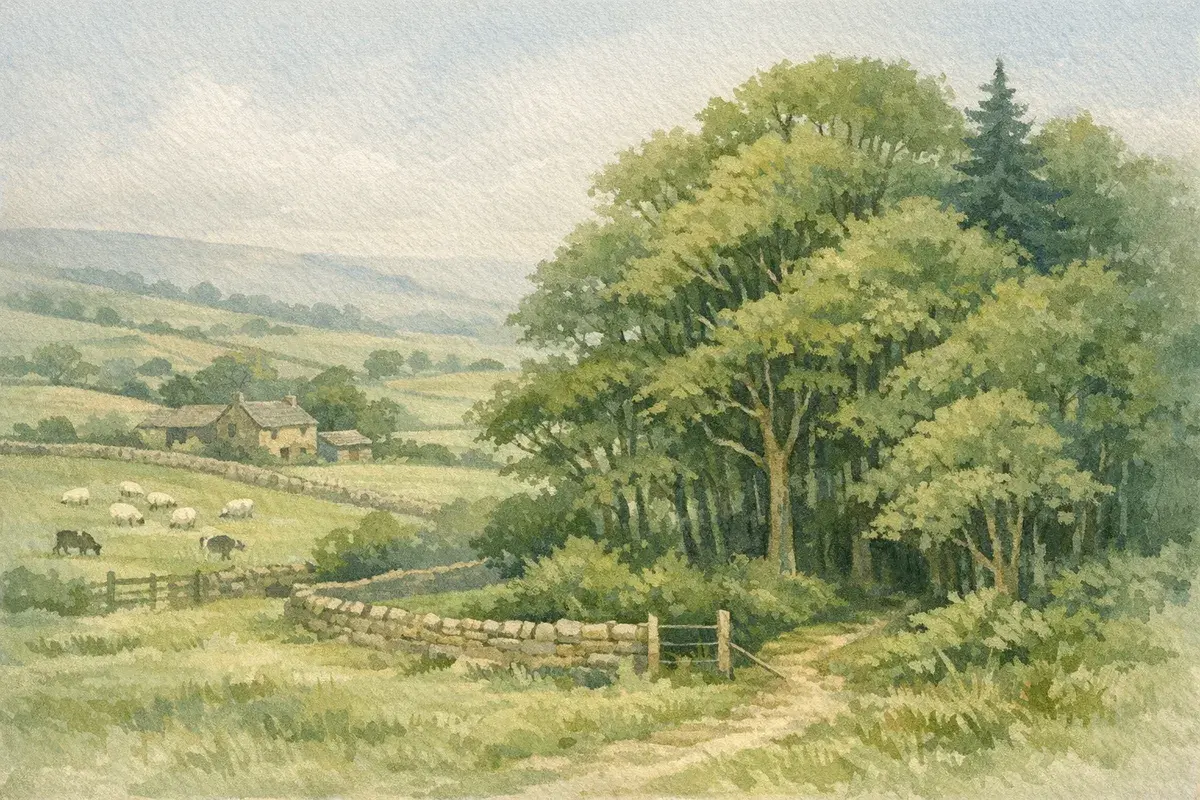
There's a particular kind of excitement that comes with looking at woodland for sale in the UK. It feels tangible: a gate, a track, a canopy line on the horizon, something you can own, manage, improve, and pass on.
But woodland isn't "just land with trees on it". Value is shaped by access, legal rights, designations, timber quality, liabilities, and what you're actually allowed to do once you've bought it. Get the basics wrong and you can end up with a beautiful block that's expensive to manage, hard to reach, or quietly constrained by rules you didn't spot.
This guide is designed to help you search with intent, assess a plot like a pro, and buy with your eyes open, whether you're a farmer adding shelter and diversification, an investor looking for resilient long-term assets, or a buyer who simply wants a place to breathe.
Why People Buy Woodland (And What “Good Value” Really Means)
The word "value" gets thrown around a lot in rural property. In woodland, it's rarely as simple as £ per acre. A block can look cheap on paper but cost you time and money for years if access is weak, boundaries are unclear, or you're boxed in by constraints.
Good value, in practice, is woodland that matches your aim and is straightforward to own: clean title, workable management options, realistic income (if you need it), and no nasty surprises.
Investment, Lifestyle, Conservation, And Farm Business Drivers
Most buyers sit in one (or a mix) of these camps:
- Farm business resilience: shelter belts, flood mitigation, woodland creation as part of whole-farm planning, habitat connectivity, or simply taking awkward corners out of cultivation.
- Lifestyle and privacy: somewhere to walk, learn woodland skills, shoot a few pigeons, or let the family camp (with a big asterisk, planning matters, as we'll cover).
- Conservation and stewardship: restoring broadleaf habitat, improving biodiversity, protecting soils and water, or buffering existing ancient woodland.
- Long-term capital preservation: not a guaranteed "quick win", but woodland can be attractive for buyers thinking in decades, not quarters.
If you're buying as part of a working farm, keep it brutally practical. Can you get a tractor in? Is there a turning head? Will you be able to bring out timber or bring in fencing materials without relying on neighbours' goodwill?
Income Potential: Timber, Grazing, Carbon, And Sporting
Income is possible, but it's rarely plug-and-play.
- Timber: Commercial crops (often conifer) can generate periodic income, but timing is everything. If a crop is 10–15 years away from a meaningful thinning or clearfell, your "income woodland" may actually be a cost centre for a while.
- Grazing and silvopasture: Some woodland comes with rides, glades, or adjacent pasture that can be managed together. But grazing rights and fencing responsibilities need checking.
- Carbon and biodiversity markets: These are evolving fast. They can be relevant to certain blocks (especially for creation projects), but you'll want professional advice and a careful look at contract obligations and who owns the benefit.
- Sporting: From informal rough shooting to structured leases, sporting value depends on location, neighbouring land use, and access. It can also come with neighbour sensitivities and safety obligations.
One practical rule: if the seller's particulars hint at income, ask for the evidence, harvest records, management plans, grant agreements, sporting licences/leases, and any historic felling permissions.
Where To Find Woodland For Sale In The UK
The easiest woodland to buy is the woodland you can properly assess. That means good information, clear particulars, and a sensible viewing process, not a grainy pin on a map and a "best and final offers" email 48 hours later.
On-Market Vs Off-Market: Agents, Estates, And Specialist Portals
In the UK, woodland changes hands through a mix of:
- Specialist rural agents (often with strong local knowledge and relationships)
- Estate disposals (sometimes with historic rights and unusual title features)
- Private/off-market sales (where discretion matters)
- Specialist portals built for rural and agricultural property, where listings are easier to filter properly
If you're serious about woodland for sale in the UK, it's worth building a small network: a land agent, a solicitor who understands rural title quirks, and (if timber matters) a forestry agent.
Looking for land like this? Tell AgLand what you're after - type, acreage, budget and area - and we'll alert you the moment a matching property is advertised. Registering is free, and there's no commission on either side. Tell us what you're looking for.
Search Strategy: Area, Access, Size, Designations, And Budget Filters
Before you fall in love with a block on a map, set your "non-negotiables":
- Drive time: If you won't visit it, you won't manage it.
- Access: Public highway access vs a private track, and whether that track is legally yours to use.
- Size: Small amenity woods can be perfect for lifestyle, but too small to justify professional management costs. Larger blocks may justify a plan and contractor work.
- Designations: SSSI, AONB/National Landscape, Ancient Woodland Inventory, TPOs, these don't always prevent management, but they can change what's realistic.
- Budget (all-in): Not just purchase price, think legal fees, surveys, fencing, gates, tracks, and insurance.
Price research matters here. Even within the same county, values can swing depending on road frontage, timber crop age, and whether the woodland comes with operational "kit" (hardstanding, loading area, decent track). If you want a benchmark before you start offering, see AgLand's guide to the cost per acre for UK woodland, it's a useful reality check when a listing feels oddly cheap (or wildly optimistic).
If your aim is timber-led, you'll also want to focus your search on blocks that are managed and merchantable rather than purely amenity. Start with listings that are clearly positioned as commercial woodland opportunities so you're not trying to turn a conservation-focused broadleaf copse into an income forest.
How Woodland Is Valued And What A Sensible Offer Looks Like
Valuation is part science, part judgement. Two plots can be the same acreage, the same species mix, even the same county, and still trade at very different levels.
Price Drivers: Location, Road Access, Timber Quality, And Amenities
The biggest drivers we see in UK woodland values are:
- Access to a public highway
- Direct gated access typically commands a premium.
- Reliance on a long, soft track (or a neighbour's yard) can knock value and increase risk.
- Timber crop quality and age class
- A well-stocked, well-spaced crop with a clear management history is more valuable than "trees everywhere" with no plan.
- Buyers pay for optionality: the ability to thin, restock, and extract without drama.
- Topography and ground conditions
- Steep or wet ground can be beautiful, but extraction costs rise quickly.
- Amenities and practical infrastructure
- Hardstanding, loading bays, decent internal rides, and a sound track system matter.
- Neighbouring land use
- Adjacent housing, public access hotspots, or intensive livestock units can all affect how you'll use the woodland day to day.
If you're buying for amenity, the premium is often about feel: privacy, mature broadleaf, water features, and ease of access. If your goal is ecological value, you might specifically target blocks that align with protected habitats or older woodland character. In that case, it's worth reading up on ancient woodland purchases so you understand why management options and constraints can differ from a plantation.
Understanding Overage, Uplift, And Development Hope Value
Overage (also called uplift) is common in rural land and can appear in woodland sales too. It's essentially a clause that says if the land's value increases due to a trigger event, often planning permission, then the seller gets a slice.
A few practical points:
- Hope value can distort pricing. A block near a settlement may be priced as if it has development potential even where planning is unlikely.
- Overage can last decades. Terms like 25–40 years aren't unheard of.
- Triggers matter. Is the trigger "planning permission granted", "development commenced", or "sale with planning"? Each has different implications.
- Future buyers may care. Overage can make resale harder, even if you never plan to develop.
If overage appears, treat it as a negotiation topic, not boilerplate. You'll want a solicitor who can explain it in plain English and model what it could mean on an exit.
Due Diligence Checklist Before You Buy
Woodland due diligence is where sensible buyers separate themselves from impulsive ones. It's also where most expensive mistakes are made, because the risks are often boring: a missing right of way, an unregistered boundary, a forgotten easement.
For a deeper walk-through of the early-stage process, AgLand's guide to buying woodland in the UK is a good companion piece, especially on the first 12–24 months after completion, when costs and compliance tend to bite.
Title, Boundaries, Rights Of Way, And Third-Party Rights
Start with the paperwork, then confirm it on the ground.
- Title and tenure: Is it freehold? Any restrictive covenants? Is the title registered and clear?
- Boundaries: Are they fenced, ditched, banked, or simply "to the old oak"? If boundaries are vague, consider a measured survey.
- Rights of way: Public footpaths and bridleways are not dealbreakers, but they change the management and liability picture.
- Private rights and easements: Water pipes, electricity, telecoms, drainage, access rights for neighbours, sporting rights reserved to someone else.
- Mineral and timber rights: These can be reserved or separated. Don't assume you're buying "everything".
A quick but revealing test at viewing: can you walk the boundary line without losing it? If you can't, you need clarity before you exchange.
Constraints: SSSI, AONB, TPOs, Felling Licences, And Restocking Duties
Constraints aren't inherently bad. They just mean you must manage within a framework.
- SSSI (Site of Special Scientific Interest): Likely to require consent for certain operations. Management may be steered toward conservation outcomes.
- AONB / National Landscape: Doesn't stop management, but can influence planning decisions for buildings, tracks, or intensive change.
- TPOs (Tree Preservation Orders): More common in and around settlements, but worth checking.
- Felling licences: In general, felling is regulated in the UK (in practice via the Forestry Commission and devolved bodies). Exceptions exist, but don't rely on assumptions.
- Restocking obligations: If a site has recently been felled or is under a licence condition, restocking duties can carry real cost.
Ask the seller for copies of any felling licences, management plans, grant agreements, and maps. If they don't have them, find out why.
Practical Checks: Access, Water, Biosecurity, And Neighbouring Land Use
This is the "can you actually run it?" layer:
- Vehicle access in winter: A track that looks fine in July can become a liability in February.
- Turning/loading: If timber is part of your plan, where would an HGV or tractor-and-trailer safely load?
- Water and drainage: Streams, ditches, and wet hollows affect species choice and operations.
- Biosecurity: If you're near livestock units or plantings with known disease pressures, think about hygiene protocols for contractors and visitors.
- Neighbours and boundaries: Are you backing onto gardens? A school footpath? A shoot? A campsite? Those contexts matter.
If your intended use is leisure-led, you'll still want to think about ongoing obligations. Buyers sometimes assume "recreational woodland" equals "do what you want". It doesn't. But it can be a great fit if you buy with the right expectations, our round-up of recreational woodland buying considerations is useful for setting those.
Planning And Permitted Uses: What You Can (And Can’t) Do With UK Woodland
Planning is where woodland dreams meet the real world. In the UK, permitted development rights can help in agricultural contexts, but woodland ownership on its own does not automatically give you a free pass to build, surface tracks, or run events.
Buildings, Tracks, Fencing, And Storage: When Consent Is Needed
A few common scenarios:
- Woodland buildings and shelters: A log store or small tool shed might sound minor, but whether it needs planning depends on location, size, permanence, and local policy. If it's in a designated area, scrutiny tends to increase.
- Tracks and surfacing: Creating or significantly improving tracks can trigger planning requirements, particularly if you're engineering groundworks, importing hardcore, or changing drainage.
- Fencing and gates: Boundary fencing is usually straightforward, but it can still become sensitive near highways (visibility splays), public rights of way, or protected habitats.
- Storage and siting timber: Temporary stacking is normal in forestry operations, but semi-permanent storage, containers, or commercial-scale activity can tip into a different category.
If you're buying woodland as part of a wider rural business plan, it helps to think in "evidence". What's the operational need? What's proportionate? Can you show you're managing responsibly rather than creating a quasi-industrial yard in the trees?
Camping, Glamping, Events, And Public Access: Common Pitfalls
This is where we see the most misunderstandings.
- Camping and occasional use: A quiet weekend with family is one thing: advertising pitches, running regular paid stays, or installing facilities can bring planning, licensing, and environmental health into play.
- Glamping units: Pods, bell tents with platforms, showers, compost toilets, these can all trigger consent requirements depending on scale, permanence, access, and local authority approach.
- Events: Weddings, corporate away-days, and organised sports aren't "just a few people". Traffic, noise, waste, and public liability can become serious.
- Public access: If there's a public right of way, you can't obstruct it. And if you invite the public in (even informally), your duty of care and insurance needs change.
The practical approach: decide your intended uses before you buy, then sanity-check them with a planning consultant or rural surveyor. Plenty of uses are possible in the right place, but the costs and permissions need to be part of your budget, not a surprise afterwards.
Managing Woodland After Purchase
A woodland purchase feels like an end point. In reality, it's the start of a management cycle.
Woodland Management Plans, Grants, And Professional Support
A management plan isn't just bureaucracy, it's how you turn a block into something predictable.
A good plan typically covers:
- compartments and species mix
- thinning/felling intentions and timing
- ride and edge management (often where biodiversity gains are quickest)
- invasive species control
- access and infrastructure improvements
- restocking and natural regeneration strategy
Depending on your aims, you may also look at grant support and woodland creation schemes (rules and availability change, and they vary by nation within the UK). This is where working with a forestry agent can pay for itself, because the compliance and record-keeping burden is real, and mistakes can be costly.
If your motivation is partly financial, it's worth thinking about woodland as an asset class with its own quirks: long timelines, intermittent cashflows, and costs that arrive whether you "use" the woodland or not. AgLand's overview of woodland investment in the UK is a helpful framework for stress-testing your expectations.
Insurance, Liability, Tree Safety, And Ongoing Compliance
Woodland ownership comes with responsibilities that don't always get discussed at the viewing.
- Public liability: Particularly important if there are footpaths or you allow access.
- Employers' liability: If you employ contractors directly (and depending on arrangements), you may need appropriate cover.
- Tree safety: If trees overhang roads, paths, or neighbouring property, you'll need inspection routines and records.
- Biosecurity and plant health: Issues like ash dieback have made ongoing monitoring part of responsible ownership.
- Documentation: Keep felling permissions, contractor RAMS (risk assessments/method statements), maps, and photos. If you ever sell, a tidy paper trail helps.
In plain terms: you don't have to run woodland like a corporate forest, but you do need systems, especially where the public might be affected.
Tax, Structuring, And Long-Term Exit Planning
Tax is where "woodland for sale UK" stops being a romantic search term and starts being a serious financial decision. Treatment depends heavily on your circumstances, how the woodland is used, and how it's structured.
If you're making decisions based on reliefs, get advice early. A small clause in a contract or a casual assumption about "it's agricultural" can change the outcome.
Inheritance Tax, Capital Gains Tax, And When Reliefs May Apply
At a high level, you're thinking about:
- Income Tax: income from selling timber from commercially managed woodland is exempt from Income Tax and Corporation Tax.
- Capital Gains Tax (CGT): the growing timber is exempt from CGT. The land itself is not.
- Inheritance Tax (IHT): Business Relief may apply to woodland run as a business, but from 6 April 2026 the 100% rate is limited to the first £2.5 million of combined business and agricultural property. Woodlands Relief can defer IHT on the value of the trees until they are sold.
HMRC's woodland tax guidance sets out the conditions.
There are also potential angles around tax efficiency and long-term planning, but the key is not to DIY this off a forum thread. If you want a structured overview of the usual relief conversations buyers have, AgLand's explainer on tax angles when buying woodland is a good starting point before you speak to your accountant or tax adviser.
Buying Personally Vs Via A Company Or Trust: Practical Trade-Offs
Structure is not just tax, it's control, risk, and succession.
- Personal ownership: Simpler, often cheaper to run, but can complicate succession planning if multiple family members are involved.
- Company ownership: Can be useful for ring-fencing risk or holding as part of a wider business structure, but brings admin and accounting obligations.
- Trusts: Sometimes used for succession and control, but complexity and professional fees are real.
Also consider finance early. Many woodland purchases are cash, but not all. Lenders vary in appetite depending on access, valuation, and whether there's any income. If borrowing is part of your plan, read up on the realities of a UK woodland mortgage so you can assess what's feasible before you commit to a timescale.
Finally, think about your exit before you buy. Who is the next buyer, amenity, commercial, conservation, neighbour, farm expansion? Your management choices (tracks, species, access, rights) will influence saleability later.
Conclusion
Buying woodland in the UK rewards the buyer who's calmly methodical. You're not just choosing a landscape you like, you're buying access, rights, constraints, management obligations, and a long-term relationship with neighbours, regulators, and the land itself.
If you keep your purpose clear (income, lifestyle, conservation, farm resilience), match the plot to that purpose, and do proper due diligence before you exchange, woodland ownership can be deeply satisfying, and, in the right circumstances, financially robust over the long run.
Disclaimer: AgLand.co.uk is a UK agricultural land and rural property matching service, where buyers register what they are looking for and owners advertise directly to the buyers who match, and a rural resource hub. Nothing in this text is intended as legal, financial, or investment advice. You should carry out your own due diligence and seek guidance from suitably qualified professionals (for example, a solicitor, chartered surveyor, forestry agent, accountant/tax adviser, and planning consultant) before making decisions or committing to any transaction.