
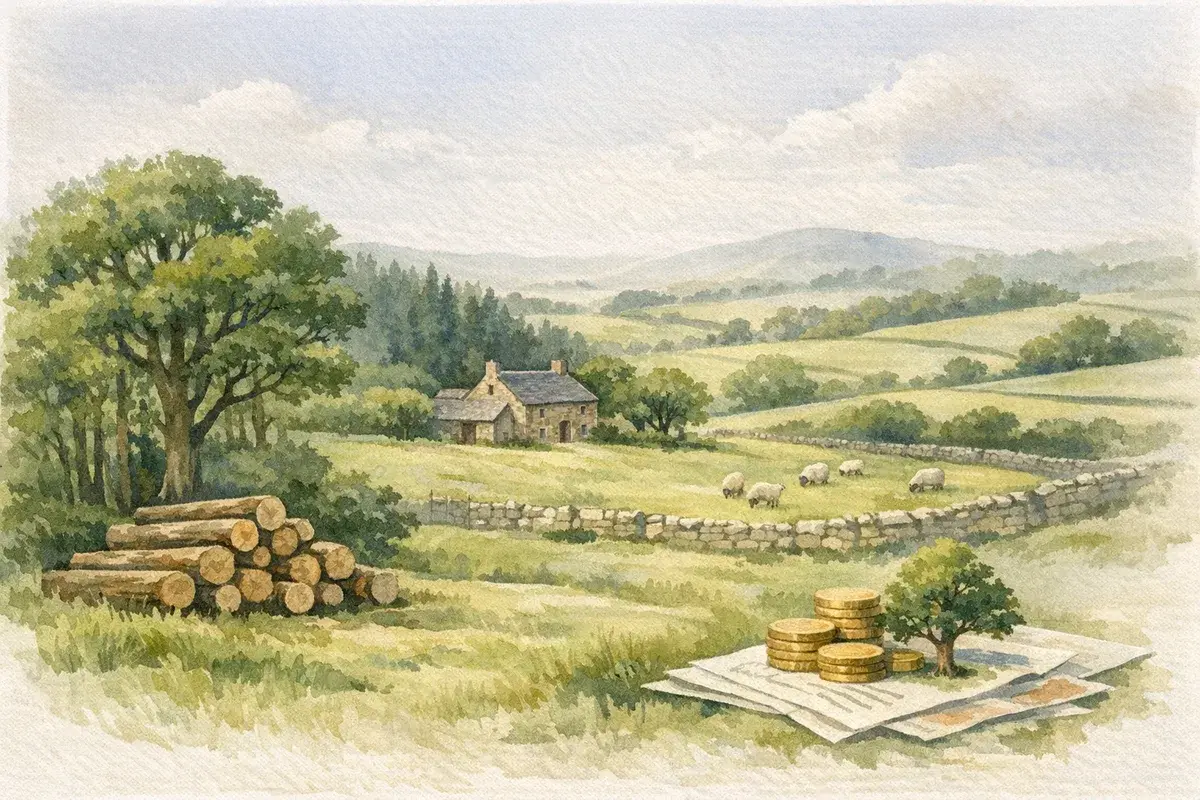
Woodland can be one of the more tax-efficient corners of UK rural property, but it's also one of the easiest places to get carried away by half-truths. "Timber is tax-free." "Woodland is IHT-proof." "It's all a capital gain." Some of that can be true, in the right structure, with the right paperwork, and with the right commercial reality behind it.
If you're looking at buying woodland tax benefits as part of a farm, an estate plan, or an investment strategy, the real win usually comes from understanding how HMRC classifies what you're doing, and then running your ownership and management in a way that matches that classification.
This guide cuts through the reliefs, the practicalities, and the common traps we see buyers fall into, so you can make decisions with your eyes open (and with the right professionals in your corner).
Why Woodland Ownership Can Be Tax-Efficient (And When It Isn’t)
Woodland ownership can be genuinely tax-efficient in the UK, but it isn't a magic shield. The tax outcome depends on what you buy, how you run it, and why you own it. Two people can buy the same block of trees and end up with very different tax positions.
At a high level, the main areas you'll hear discussed are:
- Income Tax treatment of timber receipts and day-to-day woodland income/expenses
- Capital Gains Tax (CGT) on the land element (and what happens when you sell)
- Inheritance Tax (IHT) reliefs, particularly Woodland Relief, and sometimes APR/BPR in mixed situations
- Stamp Duty Land Tax (SDLT) and structuring where woodland is bought alongside other property
But here's the catch: tax efficiency tends to follow commercial substance. If your woodland is essentially a lifestyle purchase with a bit of firewood on the side, you may not get the outcomes you were hoping for.
Trading, Investing, Or Personal Use: Why Intent Matters
HMRC will look at the facts: are you trading, investing, or holding woodland for personal use/amenity?
- Amenity/personal use (quiet enjoyment, occasional hobby forestry): you can still benefit from some long-established forestry tax rules, but you may struggle to justify broader reliefs if there's no credible commercial activity.
- Investment (long-term capital growth, structured harvesting, commercial management): typically where woodland starts to look more "tax-plannable", provided you keep records and can evidence management decisions.
- Trading (buying and selling woodland frequently, or forestry as a business): could bring a different tax profile entirely, potentially pulling profits into income rather than capital, depending on circumstances.
Intent isn't just what you tell yourself, it's what your management plan, accounts, timescales, and actions show.
Woodland As Part Of A Farming Or Rural Estate Structure
For farmers and estate owners, woodland often sits inside a wider asset picture: grazing lets, farm tenancies, diversification units, sporting rights, environmental schemes, and succession planning.
Woodland can be useful where you want:
- A long-term asset with management options (thinning, felling, replanting)
- Environmental upside (biodiversity objectives, shelter belts, flood mitigation)
- Portfolio diversification away from pure agricultural margins
In practice, your woodland tax position may also interact with how the rest of the estate is structured, who owns what (personal vs partnership vs company), who carries the costs, and what evidence exists that the woodland is managed on a commercial footing.
If you're at the research stage, it can help to read a broader overview of the legal and practical checks alongside the tax points, see our guide to the key steps when buying woodland in the UK (link intentionally placed here, not in the intro, so you can use it as a working checklist).
Income Tax: How Woodland Income Is Taxed In Practice
Income Tax is where woodland myths spread fastest, mostly because forestry has some unusual (and favourable) rules, but only when you're clear on what income is what.
There are two practical questions you should keep coming back to:
- What counts as "timber receipts"?
- What costs are truly woodland management costs, and how are you recording them?
Timber Receipts: When They Are Tax-Free And What Qualifies
The UK has long-standing rules that can treat receipts from the sale of timber as outside Income Tax in many cases. In plain English: if you sell timber (for example, under a harvesting contract), the proceeds are often treated as capital rather than income.
But, you need to be careful about what you're actually selling:
- Standing timber (trees growing on the land) is commonly treated differently to
- Processed products (logs cut, milled timber, firewood sold as a product with a trading element)
Once you start processing, packaging, delivering, marketing, and running it like a trading activity, you can drift into taxable trading income. That's not automatically "bad", but it is different, and you don't want to discover the difference after you've built your plans on the wrong assumption.
A sensible approach is to agree early, ideally with your accountant, how you'll structure sales (standing timber sale vs contracted harvesting vs selling processed firewood) and what records you'll keep.
Woodland Expenses, Losses, And What You Can Actually Deduct
The question buyers usually ask is: "If timber is tax-free, can I deduct woodland expenses?"
This is where nuance matters. If receipts aren't taxed as income, you can't always expect a clean set of income deductions in the way you would for a normal trading business. That said, woodland ownership still comes with real costs, management plans, maintenance, professional fees, tracks, fencing, deer control, insurance, and compliance.
In practice, what you can do depends on the nature of your activity and how it's accounted for. The key is consistency:
- Keep separate records for woodland income and expenditure
- Retain invoices and clearly describe what each cost relates to
- Document the commercial rationale for expenditure (e.g., improving access for harvesting: protecting replanting)
And don't underestimate how often small admin choices create big problems later. If you mix woodland costs into "general farm sundries" without detail, you're making it harder to evidence commerciality and harder to support any future tax position.
If grants are part of your plan, it's also worth looking at what support may be available and what it expects from you as an owner, our overview of woodland management grants and how they fit into ownership is a good starting point.
Grants And Subsidies: Tax Treatment And Record-Keeping Basics
Woodland grants can support creation, management, access improvements, and environmental outcomes (availability varies across the UK and over time, and the rules can change).
From a tax perspective, the biggest practical risk isn't usually the headline rate of tax, it's messy evidence:
- Grant agreements often set out what you must do and when
- You may need to show that spending aligns with the scheme's conditions
- Some payments can be treated differently depending on whether they are capital in nature (e.g., establishing woodland) or revenue in nature (e.g., ongoing management)
Your safest play is to assume you'll need to justify the why and the how of each payment and each cost. Keep the grant offer letter, claims, maps, management plan, and completion evidence together in one folder (digital is fine, just organised).
Capital Gains Tax: Disposals, Timber, And The Value In The Land
CGT is where woodland gets interesting, because you're often dealing with two assets living side-by-side:
- the underlying land (which can rise or fall in value), and
- the standing timber (which grows biologically, can be harvested, and may be treated differently for tax).
If you're thinking long-term, especially if you're comparing woodland investment UK options, CGT mechanics can quietly drive your real net outcome.
Standing Timber Versus Underlying Land: Getting The Split Right
A classic issue at sale is: what portion of the sale price relates to timber and what relates to land?
Why it matters:
- The timber element may be treated under forestry rules that differ from the land element.
- The land element is typically where CGT calculations land, including allowable costs and any reliefs.
In the real world, HMRC expects the split to be reasonable and supportable. That usually means:
- a valuation approach you can explain,
- good records of woodland condition, age class, species, access, and yield class,
- and a consistent approach between acquisition, accounts, and disposal.
This is one of those areas where getting a land agent/forestry valuation early is less about "tax cleverness" and more about not painting yourself into a corner.
Planting, Felling, Roads, And Deer Fencing: What Adds To Base Cost
Woodland buyers often spend meaningful money after completion, especially in the first couple of years, because access and protection are what make management feasible.
Examples that may be relevant when thinking about base costs and capital/revenue treatment include:
- Planting/replanting costs
- Forest roads/tracks and upgrades that make harvesting viable
- Deer fencing and tree protection
- Drainage and culvert work where necessary for access
- Professional fees tied to acquisition and long-term improvement
The tax treatment can vary depending on the nature of the spend and your circumstances, so don't take a pub-rule view. But you can help yourself by documenting:
- what you did,
- why you did it,
- and how it relates to future harvesting or long-term woodland value.
That documentation is also useful for buyers down the line, woodland with a clear paper trail tends to be easier to value and easier to transact.
Rollover, Hold-Over, And Timing: When Reliefs Might Apply
Reliefs such as rollover relief or hold-over relief can be relevant in some rural property scenarios, but they're highly fact-specific and depend on asset type, use, ownership, and timing.
The practical takeaway is this: don't buy woodland assuming you'll "sort the relief later." If timing matters (for example, you're selling another asset and looking to reinvest), you want tax advice before exchange, not after.
If you're trying to sense-check whether you're paying a sensible price for the asset you're buying (which directly affects future CGT outcomes), our breakdown on typical woodland pricing per acre helps you benchmark value drivers like access, timber quality, and scale.
Inheritance Tax: Woodland Relief, APR, And BPR Explained
Inheritance Tax is often the headline reason people look at buying woodland tax benefits in the first place. But this is also where the biggest misunderstandings live.
You should treat IHT planning as a "whole-estate" question, not a single-asset trick. Woodland can play a role, but it has to be the right role.
Woodland Relief: What It Covers And What It Doesn't
Woodland Relief is designed to prevent IHT charges forcing the sale of timber at the wrong time. In broad terms, it can allow the value of timber to be deferred for IHT, with the land value still potentially in scope.
Two important practical points:
- Woodland Relief typically relates to timber, not necessarily to the land itself.
- The conditions and interaction with other reliefs can be complex, especially where woodland is part of a mixed estate.
So if you're buying woodland expecting "no IHT", you may be setting yourself up for disappointment. The relief can be valuable, but it's not a blank cheque.
APR And BPR: When Commercial Woodland Or Mixed Estates Qualify
You'll often hear APR (Agricultural Property Relief) and BPR (Business Property Relief) mentioned in the same breath as woodland. In reality:
- APR usually relates to agricultural property as defined for IHT purposes (and woodland doesn't automatically qualify as agricultural property).
- BPR is about relevant business property, in other words, whether there's a business that qualifies, and whether the assets are used in it.
Woodland can sometimes sit within a structure where APR/BPR become relevant, particularly in mixed estates where woodland supports the wider operation, or where there's a genuine commercial forestry business.
But it's very easy to get this wrong by assuming that "commercial" means "I sometimes sell logs". Evidence and substance matter. If there's no credible commercial operation, you may not be where you think you are.
Succession Planning: Ownership, Trusts, And Keeping Evidence Tight
A quiet truth about successful succession planning is that the paperwork tends to be boring, and absolutely decisive.
If woodland is part of your family's long-term plan, you'll want to think about:
- Who owns it (individual, partnership, company, trust)
- Who makes decisions and how that's recorded
- Management evidence (plans, minutes, contracts, accounts)
- Consistency between what you tell HMRC and what you actually do
This is where we often see the best results: families who treat woodland like an asset that needs governance, not just a place that happens to have trees on it.
If your focus is more investment-led but still tied to long-term wealth planning, our explainer on how woodland investment works in a UK context goes deeper into the strategic side (and the trade-offs people don't always talk about).
Stamp Duty Land Tax And Transaction Structuring
SDLT can be straightforward for pure woodland, and surprisingly tricky the moment your purchase includes anything else.
The wrong structure can mean you pay more tax than you expected, or you end up in a compliance tangle that delays completion.
Mixed Purchases: Woodland With Farmland, Houses, Or Commercial Units
If you're buying woodland alongside other property, SDLT depends on what's in the mix:
- A dwelling can bring residential SDLT rates and additional complexities.
- A mixed-use transaction can sometimes be treated differently to a purely residential purchase.
- Farmland, yards, buildings, and cottages can each shift the analysis.
From a practical standpoint, the earlier you identify what the purchase actually contains (and how it's described in heads of terms), the easier it is for your solicitor and tax adviser to structure correctly.
Also watch out for "woodland with a cabin" or "woodland with a partially habitable building." These grey areas are where SDLT mistakes happen.
VAT On Woodland Transactions And Forestry Operations
VAT is not one-size-fits-all in woodland. Issues can arise around:
- whether land is opted to tax,
- what's being supplied (land, rights, timber, services), and
- whether you're carrying out forestry operations as part of a business.
If VAT might apply, you need to know before exchange, not when the invoice lands. In particular, if you're buying woodland via a business entity or you expect to recover VAT, get bespoke advice and make sure contracts and invoices align with the intended treatment.
Five Due Diligence Checks That Protect Your Tax Position
Due diligence isn't just about avoiding a bad purchase: it's also about protecting the tax outcomes you're banking on.
If you want buying woodland tax benefits to stack up, you need a property you can actually manage as intended, and you need evidence that you've checked the things a prudent buyer would check.
Titles, Rights, And Restrictions: Access, Sporting, Minerals, And Wayleaves
Start with the unglamorous basics:
- Legal access (not just "there's a track")
- Rights of way (public or private) and their route
- Sporting rights (do you control them? are they leased?)
- Mineral rights and reservations
- Wayleaves/easements for utilities
These affect value, management options, and sometimes income streams. And if you later claim your woodland is commercially managed but you can't even get machinery in without a neighbour's permission, it's going to look thin.
Designations And Consents: Felling Licences, EIA, SSSIs, And Public Access
Forestry is regulated. Even experienced rural buyers get caught out by "it's my land, I can do what I like." You can't.
Key UK issues to check include:
- whether a felling licence is required (and what exemptions genuinely apply)
- whether an Environmental Impact Assessment (EIA) screening may be needed for certain forestry works
- whether the land is within or near designated areas (for example SSSIs) that constrain operations
- any obligations or expectations around public access
None of this is a reason not to buy, plenty of great woodland sits within constraints. The point is that constraints change your management plan, which changes your costs and, eventually, your tax and cashflow outcomes.
Management Evidence: Plans, Accounts, And The ‘Commerciality' Question
If you take one thing seriously, make it this: evidence.
Commerciality is not a vibe: it's a paper trail:
- a woodland management plan (even a simple one, professionally prepared)
- budgets and forecasts (harvesting cycles are long, show you understand that)
- contractor quotes, invoices, and maps
- records of restocking, pest control, and compliance steps
And yes, this is also where your finance structure matters. If you're borrowing, lenders will expect clarity on the asset and its management. If that's relevant to you, read our guide on financing options for woodland purchases so you can align the tax plan with what a lender will actually accept.
Common Mistakes We See Buyers Make (And How To Avoid Them)
We speak to a lot of buyers and agents across the UK rural market, and the same avoidable mistakes crop up again and again, usually when someone is rushing, or when "tax benefits" become the only lens they're looking through.
Overpaying For "Tax-Free Timber" Without A Real Management Strategy
Standing timber value is real. But paying a premium because you've heard "timber receipts are tax-free" can backfire if:
- access is poor and harvesting costs explode,
- the crop isn't what you assumed (species, age class, yield), or
- constraints make felling/restocking slow or impractical.
A good woodland buy has a management story that makes sense even before you talk about tax.
If you're comparing different types of listing, it helps to be clear what you're actually buying. There's a big difference between commercial woodland with harvesting potential and woodland that's primarily amenity-led.
Assuming Reliefs Apply Automatically To Any Woodland
Reliefs have conditions. Conditions require evidence. Evidence requires effort.
The "automatic relief" mindset is how people end up disappointed at probate, or when they come to sell and discover their valuation split doesn't hold water.
Treat every relief as a hypothesis you need to prove:
- Does it apply to your ownership structure?
- Does it apply to this woodland?
- Can you evidence why it applies?
Ignoring Exit Routes: Saleability, Liquidity, And Valuation Splits
Woodland is not always liquid. Some blocks sell quickly: others sit because:
- access is awkward,
- there's no parking/turning,
- boundaries are unclear,
- rights are fragmented,
- or the buyer pool is narrower than you expected.
Also, the longer you own it, the more likely you'll need to explain your numbers, especially the land/timber split and the history of works.
Even if you're buying to hold for decades, you'll sleep better if you can answer: "If I needed to sell in two years, who would buy this, and why?"
Building A Sensible Woodland Buying Strategy
A good woodland strategy is rarely complicated. It's usually just honest.
You decide what you want the woodland to do, you buy something that can actually do that job, and you set it up so the tax treatment reflects the reality on the ground.
Define Your Objective: Carbon, Timber, Amenity, Or Long-Term Estate Planning
Most woodland buyers fall into one of these camps (sometimes a blend):
- Timber-led: you care about access, crop quality, scale, and harvesting economics.
- Amenity-led: privacy, recreation, shooting, conservation, family use.
- Estate planning-led: long-term wealth/succession thinking: governance and evidence matter as much as the trees.
- Carbon/biodiversity-led: objectives focused on natural capital outcomes (these can still sit alongside timber, but they change constraints and timescales).
Be wary of trying to force one objective into the asset that suits another. A small amenity block can be brilliant for family use: it may be a poor fit for commercial forestry.
If you are amenity-led, you'll likely find your shortlist looks different. You may want to start by browsing smaller recreation-focused woodland listings and then sanity-check whether any "investment" claims match what the property can realistically deliver.
Work With The Right Advisers: Land Agents, Accountants, And Forestry Consultants
Woodland is multidisciplinary. The best outcomes tend to come when your advisers talk to each other.
A strong team often includes:
- a specialist rural land agent (pricing, negotiation, local market, rights)
- a solicitor experienced in rural conveyancing (title, access, covenants)
- an accountant/tax adviser who understands estates and land-based businesses
- a forestry consultant (management plans, felling/restocking, grants, compliance)
If you're planning to lean on tax reliefs, don't treat advice as an afterthought. Build the costs into your budget from day one.
Finding The Right Woodland: Matching Search Filters To Your Tax And Use Case
Your search process should reflect your objective.
For timber-led buyers, filters that matter include:
- scale and compartment structure
- access for harvesters and timber lorries
- nearby timber markets and haulage practicality
- designations and constraints
For amenity/estate buyers, you might prioritise:
- privacy and boundaries
- rights of way (and how busy they are)
- proximity to the rest of your land
- long-term governance and succession fit
On AgLand, you can start broad with woodland across the UK and then register requirements built around what actually changes outcomes: access, use case, and the type of woodland you're buying (not just the postcode).
Conclusion
Woodland can absolutely deliver tax advantages in the UK, but the best results come when the "tax benefits" are the by-product of a sensible purchase and a credible management plan, not the only reason you buy.
If you want to get this right, focus on three things: buy a woodland you can genuinely manage as intended, document decisions and activity like you'd document any serious rural enterprise, and get tax and legal advice early, before you're committed.
Disclaimer: AgLand.co.uk is a UK agricultural land and rural property matching service, where buyers register what they are looking for and owners advertise directly to the buyers who match, and a rural resource hub. Nothing in this text is intended as legal, financial, tax, or investment advice. You should do your own due diligence and seek guidance from appropriately qualified professionals (for example, a solicitor, chartered tax adviser/accountant, and forestry consultant) before making decisions or transactions.