
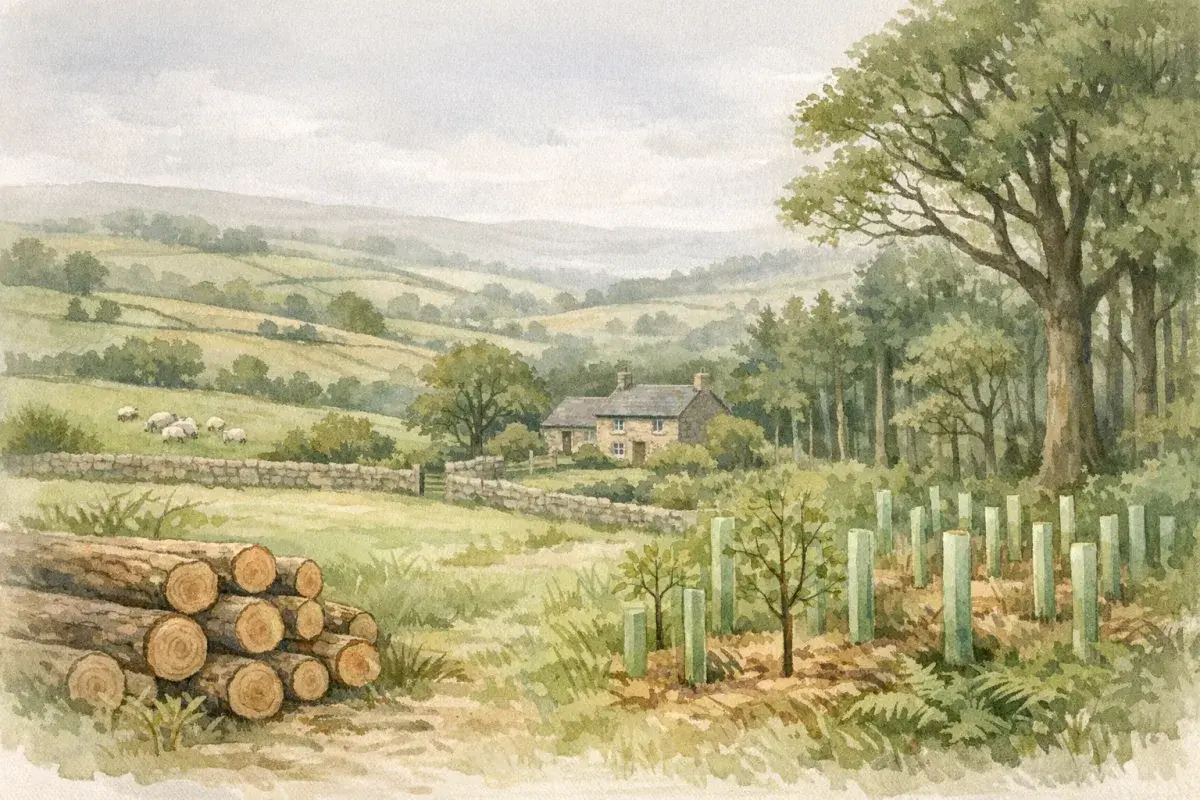
Woodland management grants can look deceptively simple from the outside: "plant a few trees, claim some money, job done." In reality, most schemes are built around outcomes (carbon, biodiversity, water, public benefit, timber resilience) and governed by tight rules on consents, mapping, procurement, and ongoing management.
If you're a farmer, landowner, or rural investor, the right grant can fund meaningful work, deer protection, restocking, ride management, access improvements, habitat creation, and sometimes new planting. The wrong grant (or the right grant applied badly) can cost you months of delay, rejected claims, or, worse, unintended compliance headaches around felling, tracks, protected species, or tenancy rights.
This guide cuts through the confusion, UK-only, with a practical view of what grants typically cover, how the main schemes differ across the four nations, and a workflow that makes approvals and payments far more likely.
What Woodland Management Grants Can Pay For (And What They Usually Won’t)
Most woodland management grants are designed to buy specific environmental or forestry outcomes, not to subsidise general land improvement. That sounds obvious, but it's the reason applications succeed or fail.
The trick is to frame your project in the scheme's language (resilience, habitat condition, water protection, access, biosecurity) and then evidence that the works are reasonable, necessary, and deliverable on your site.
Revenue Vs Capital: Ongoing Management And One-Off Works
Grant funding usually falls into two buckets:
- Capital items (one-off works): fencing, gates, deer shelters/guards, ride reinstatement, water crossing improvements, signage, invasive species control operations, some surfacing, and sometimes creation works (e.g., new planting establishment).
- Revenue items (management payments): annual/ongoing payments linked to maintaining a habitat or woodland in a particular condition, think management prescriptions you agree to follow for a set period.
In practical terms, capital funding is often simpler to understand ("build X metres of fence to spec"), but revenue funding can be where the long-term value sits, because it recognises that woodland isn't ‘finished' after the contractor leaves.
A common planning point: if you're buying woodland and intend to use grants to bring it up to standard, build a realistic 12–24 month timeline that includes surveys, consents, seasonal working windows, and potential back-and-forth with the grant body. (If you're in acquisition mode, our guide on the practical checks when buying woodland is worth reading before you commit.)
Common Eligible Activities: Planting, Protection, Access, And Habitat Improvement
While each nation has its own menu, the same themes come up again and again:
- Establishment and restocking: new woodland creation, restocking after felling, and interventions to improve species mix and resilience.
- Protection measures: deer fencing, individual tree protection, rabbit fencing, vole guards, beating up, and in some cases weed control, where justified and compliant.
- Forest infrastructure (carefully defined): rides, loading bays, gates, some track upgrades, culvert improvements, and signage. Funding is usually tied to necessity (for management, access, or water protection), not convenience.
- Habitat work within woodland: open space creation, glades, scallops, pond restoration, riparian buffer enhancement, deadwood and veteran tree management, and measures that improve structural diversity.
- Biosecurity and invasive species: rhododendron ponticum control is the classic example in many areas: grant bodies often like these projects because the ecological benefit is clear and measurable.
And yes, agroforestry is increasingly part of the conversation, especially where schemes recognise productive land use alongside woodland outcomes.
Typical Exclusions: Non-Woodland Works, Ineligible Species, And Poor Evidence Of Need
Even good projects get turned down for avoidable reasons. The most common exclusions (or de-scoring triggers) include:
- Works that aren't genuinely woodland-related: general farm access tracks, yard surfacing, boundary works with no woodland purpose, or drainage that reads as land improvement rather than habitat protection.
- Planting that doesn't meet scheme objectives: unsuitable species choice, poor provenance, planting on deep peat or sensitive habitats without a strong case, or plans that don't align with resilience guidance.
- Weak evidence: no clear mapping, vague prescriptions ("manage rides"), missing photos, no baseline condition, no explanation of why the intervention is needed now.
- Attempting to "backdate" works: many schemes won't pay for work started before approval (or before a formal start permission), even if the work is excellent.
If you're planning to buy woodland specifically to improve it through grants, treat the grant constraints as part of your due diligence, alongside access, rights, and any designations, because they can materially affect both costs and timeline. (For anyone browsing woodland for sale in the UK, this is one of the most overlooked ‘hidden' factors.)
The Main Grant Schemes To Know Across The UK
Woodland policy is devolved, so you can't assume an "England answer" applies in Scotland, Wales, or Northern Ireland. The broad goals overlap, but the names, application routes, and scoring priorities differ.
What follows is a practical orientation, not an exhaustive list (scheme rules change, and local area priorities matter).
England: Forestry Commission And Defra Woodland Offers
In England, the Forestry Commission is central for woodland creation and felling regulation, and Defra's wider environmental schemes influence how woodland fits into whole-farm plans.
Typical funding routes you'll encounter include:
- Woodland creation support (planning, planting, protection, establishment and sometimes maintenance-style payments).
- Woodland improvement and resilience (bringing neglected woodland back into management, improving biodiversity condition, or strengthening resilience to pests, disease, and climate stress).
- Targeted offers tied to priority outcomes (water quality, nature recovery areas, flood mitigation), which can make certain sites more competitive.
Pragmatic tip: in England, the "make or break" is often your management plan quality and whether any environmental constraints (peat, protected species, watercourse impacts) have been addressed upfront rather than discovered mid-application.
Scotland: Forestry Grant Scheme (FGS) Options
In Scotland, the Forestry Grant Scheme (FGS) is the big one. It supports woodland creation, sustainable forest management, and a range of environmental improvements.
FGS tends to be structured with clear options and specifications, and it's common to combine:
- New planting / woodland creation
- Restocking and replanting
- Forest management planning
- Environmental enhancements (e.g., riparian, biodiversity, restructuring)
- Infrastructure items where justified for management
Scotland can be particularly sensitive on soils (including peatland considerations) and landscape impacts, so early screening for constraints is time well spent.
Wales: Woodland And Agroforestry Support Routes
In Wales, woodland support routes can involve a mix of forestry-focused funding and rural land schemes that recognise trees as part of a wider land management system.
You'll typically be thinking about:
- Woodland creation and establishment (with strong attention to habitat impact and suitability)
- Woodland management and restoration (bringing woodland into favourable condition, tackling invasive species)
- Agroforestry-style integration where schemes support trees that complement grazing or farm resilience
Wales often places a premium on evidence of environmental benefit and alignment with local priorities, so your application narrative (what changes on the ground, and why it matters) is not just paperwork: it's effectively the "sales pitch" for public funding.
Northern Ireland: Forest Expansion And Woodland Management Support
Northern Ireland has its own forestry support structures for creation and management. The emphasis often includes forest expansion, farm woodland, and measures that strengthen long-term woodland condition.
Given the smaller geography and varied land patterns, NI applications can be especially sensitive to:
- Land ownership/control clarity
- Access arrangements and operational practicality
- Environmental screening where sites are near designated areas or waterbodies
Whatever nation you're in, you'll usually get better outcomes by speaking to a local forestry agent early, someone who knows what the grant body is currently prioritising and what typically gets queried.
Eligibility And Compliance: The Checks That Decide Success
If you want one unglamorous truth: most woodland management grant problems aren't about ambition, they're about eligibility and compliance.
Grant bodies need to be confident you can legally do the work, that it won't damage protected features, and that you can prove delivery when audited.
Land Control, Consents, And Mapping Requirements
Expect to evidence:
- Land control: ownership or a lease/licence that gives you authority to carry out the works for the full agreement term.
- Accurate mapping: clear boundaries, compartment outlines, work areas, access routes, and any constraints. Sloppy mapping is a fast route to delays.
- Consents: depending on your plan, you might need felling permissions, environmental permissions, or consents related to highways, water, or heritage.
If you're buying rather than already owning, make sure your purchase contract and title review anticipate future grant-funded works, things like access rights, reserved sporting rights, mineral reservations, or restrictive covenants can all affect what you can actually deliver. This matters for finance too: lenders will want comfort on constraints if you're exploring a woodland mortgage in the UK.
Environmental Constraints: SSSIs, Protected Species, Peat, And Watercourses
This is where "simple woodland work" often becomes a multi-professional job.
Common constraints include:
- SSSIs and other designations: operations may require consent or additional conditions, and grant bodies will expect you to have checked.
- Protected species: bats, dormice, nesting birds, otters, great crested newts (site-dependent) and others can trigger survey needs and seasonal working limits.
- Peat and deep organic soils: planting and ground disturbance can be restricted: you may need to adjust species choice, planting method, or avoid certain areas entirely.
- Watercourses and wetlands: culverts, crossings, extraction points, or any works near a watercourse can require additional permissions and careful method statements.
A practical mindset shift: don't treat constraints as "red tape." Treat them as design parameters. A scheme assessor will be looking for evidence you've understood and designed around them.
Public Access, Heritage, And Rights Of Way Considerations
Public access is a frequent point of confusion. Grants may:
- fund access improvements (gates, signage, path surfacing) where it delivers public benefit, or
- require you not to reduce existing access, especially where definitive rights of way are involved.
Also consider:
- Heritage assets: scheduled monuments, listed structures, historic boundaries, and veteran trees can all influence methods.
- Existing rights: bridleways and footpaths can affect how you site fencing, gates, or timber extraction routes.
If you've ever inherited a woodland with a "mystery track" everyone uses, now's the time to formalise what it is (and isn't) before you promise changes in a grant agreement.
A Practical Application Workflow (From Idea To Payment)
A good application is less about writing skill and more about project management. You're trying to remove uncertainty for the grant body: clear baseline, clear outcomes, clear costs, clear evidence, clear delivery plan.
Building A Credible Woodland Management Plan
A credible plan usually includes:
- A baseline description: compartments, species mix, age structure, access points, current condition issues (e.g., browsing pressure, rhododendron, windthrow risk).
- Objectives: timber production, biodiversity, water protection, public access, education, whatever applies, but prioritised and realistic.
- Prescriptions by area: what you'll do, where, when, and why. "Improve rides" is vague: "re-open 1.2 km of ride to 6 m average width with scalloped edges to improve woodland edge habitat and operational access" is defensible.
- Monitoring and maintenance: how you'll check survival rates, fence integrity, invasive regrowth, and when you'll intervene.
If you're managing an older or more sensitive site, particularly ancient woodland, your plan will need to be conservation-led and restraint-heavy. Buying decisions matter here too: an ancient site can be a wonderful asset, but it comes with practical limits. (If you're weighing options, see what tends to come up with ancient woodland opportunities.)
Quotations, Specifications, And Evidence: Making Costs Defensible
Even where you're not bound by a complex tender process, you should behave as if you are, because audits tend to ask the same questions.
To keep costs defensible:
- Write clear specifications: fence type, height, strainer spacing, gate dimensions, surfacing depth, species and stock size, planting density, protection type.
- Get like-for-like quotes: two quotes that describe different work aren't comparable.
- Keep evidence of need: photos of browsing damage, maps showing access pinch points, notes on health-and-safety issues, and baseline condition statements.
- Separate woodland and non-woodland items: if part of a track benefits the farm generally, don't try to tuck it into a woodland grant claim.
A small but important human detail: allow contingency in time, not in claimed cost. Most schemes want fixed, evidenced costs: if weather delays you, that's usually on your programme rather than the payment rate.
Inspections, Claims, Record-Keeping, And Audit Readiness
Treat your project like it will be inspected, because it might be.
Audit-ready record keeping looks like:
- Before/during/after photos with dates and locations
- Delivery notes and invoices matched to the approved items
- Maps marked-up to show what was actually done
- Contractor method statements where relevant (especially near water, steep ground, or sensitive habitats)
- Maintenance logs (fence checks, tree survival checks, invasive regrowth treatments)
If an inspector arrives and you can produce a tidy folder (digital is fine) that links each claimed item to evidence on the ground, you massively reduce the chance of payments being delayed or reduced.
Combining Woodland Grants With Farming And Rural Property Strategy
Woodland management grants shouldn't sit in isolation. If you own a farm (or are buying rural property), the woodland is part of your whole holding, financially, operationally, and in terms of future options.
Integrating With Stewardship, Grazing, And Whole-Farm Environmental Plans
The most robust projects we see are the ones that link woodland work to the rest of the holding:
- Shelter and livestock resilience: well-placed trees can reduce exposure and improve animal welfare (but you'll need to manage browsing and compaction risk).
- Water management: riparian woodland, targeted buffer planting, and careful track drainage can reduce sediment and slow peak flows.
- Biodiversity connectivity: woodland edges, hedgerows, and small copses can be stitched into a broader habitat network.
If you're an investor, the same principle applies: a grant-backed plan can turn "a neglected block of trees" into a managed asset with clearer outcomes and a stronger management narrative.
Tenancies, Sporting Rights, And Shared Ownership: Avoiding Disputes
This is where rural reality bites. Grants often require you to have control over the land for the full term and to guarantee the works and outcomes.
Watch-outs include:
- Farm Business Tenancies (FBTs) and agricultural tenancies: your tenant's rights and obligations may affect what you can do, and vice versa.
- Sporting rights: if someone else controls shooting, deer management can become a negotiation, yet browsing pressure is one of the biggest practical risks to successful establishment.
- Shared ownership / family arrangements: if multiple parties have a say, document decision-making early.
If you're acquiring woodland as part of a wider portfolio, build these checks into your purchase process: it's the same kind of discipline you'd apply when assessing woodland investment in the UK, returns aren't just about timber price, they're about deliverability and risk.
How Grants Can Affect Valuation, Covenants, And Future Development Options
Grants can increase value by funding infrastructure and improving condition, but they can also introduce constraints:
- Agreement terms: you may be committing to management prescriptions for years. That can be positive (certainty) or restrictive (less flexibility).
- Future use limitations: a site under a grant agreement can be harder to repurpose, and it may complicate future consents.
- Valuation narrative: surveyors and buyers will want to understand what obligations run with the land and what has been paid for.
Don't forget tax is part of the wider strategy too. Depending on your circumstances, woodland can interact with reliefs and broader estate planning, but it's nuanced and fact-specific. If you're exploring this angle, our overview of tax angles people look at when buying woodland is a sensible starting point before you speak to your adviser.
Common Pitfalls We See (And How To Avoid Them)
We speak to a lot of landowners through agents we work with, and the same issues come up, often from perfectly capable people who simply weren't warned about the tripwires.
Choosing The Wrong Scheme Or Missing The Window
Two common problems:
- Wrong scheme fit: you apply to a scheme that pays well for planting, but your real need is woodland improvement: or you pitch access works when the scheme is scoring hardest on water and habitat outcomes.
- Timing and windows: some funding is always open, other offers are seasonal or have fixed rounds. Add ecological survey seasons and forestry operations windows, and a "quick application" can stretch.
Avoidance strategy: do a short "eligibility and scoring" review before you do any big plan writing. If the scheme doesn't match your site's strengths, pivot early.
Under-Specifying Works And Failing On Procurement Rules
Under-specification is the silent killer.
- "Repair track" is not a specification.
- "Deer fence" without height, net type, strainers, gate details, and end assemblies is not a specification.
Even if you use a contractor you trust, the grant body needs to see that public money is being spent on defined outputs at reasonable cost.
Avoidance strategy: write specs as if someone else will deliver them. Then get quotes that mirror those specs line-by-line.
Triggering Enforcement: Felling, Tracks, And Operations Without Consent
This is the one we're most blunt about.
- Felling permissions: felling without permission (or outside exemptions) can lead to enforcement and replanting obligations.
- Tracks and engineering: significant groundworks can trigger planning or other consents depending on scale, location, and designations.
- Operations near sensitive features: works affecting watercourses, protected habitats, or heritage assets can require extra permissions.
Avoidance strategy: build a "consents checklist" into your project plan and don't start physical works until you're sure you're allowed to. Permitted activity isn't a vibe: it's a paper trail.
Working With The Right Professionals
The more valuable the woodland (financially or environmentally), the more it pays to run your grants like a professional project. Not because you can't do it, but because the cost of getting it wrong is disproportionate.
When To Bring In A Woodland Agent, Ecologist, Or Surveyor
You'll typically want help when:
- The site has constraints: SSSI, ancient woodland indicators, peat, watercourse works, or known protected species.
- The works are operationally complex: new infrastructure, significant restructuring, or multiple compartments with phased delivery.
- Ownership/rights are complicated: tenancies, sporting rights, access uncertainty, or shared decision-making.
- You're buying the site: professional due diligence on access, boundaries, covenants, and management obligations can save you from purchasing an unworkable "grant project."
A good woodland agent can also help you translate your intent into the language assessors want: outcomes, prescriptions, measurable deliverables.
What Good Advice Looks Like: Scope, Fees, And Accountability
Good advice is specific and accountable:
- Clear scope: what they're doing (plan, application, surveys, tendering, site supervision, claims) and what they're not.
- Transparent fees: fixed price where possible, or staged fees linked to milestones.
- Evidence-led recommendations: they can show you why a method/spec is chosen, not just assert it.
- Audit-ready habits: they leave you with a tidy record trail, not a messy inbox.
One last pragmatic point: if a professional promises you a grant will be approved, be cautious. What they can promise is a competent application, realistic programme, and reduced risk.
Conclusion
Woodland management grants can be transformative, but only if you treat them as a structured agreement, not a casual rebate. The winning formula is usually straightforward: a credible management plan, clean land control, early constraint checks, tight specifications, and record-keeping that stands up to inspection.
If you're considering buying woodland with grant-funded improvement in mind, bake the grant realities into your search and due diligence from day one. It'll save you time, protect you from compliance surprises, and help you end up with a woodland that's genuinely easier (and cheaper) to manage for the long term.
Disclaimer: AgLand.co.uk is a UK agricultural land and rural property matching service, where buyers register what they are looking for and owners advertise directly to the buyers who match, and a rural resource hub. Nothing in this text is intended as legal, financial, or investment advice. You should carry out your own due diligence and seek guidance from appropriately qualified professionals (for example, a forestry agent, chartered surveyor, ecologist, solicitor, and/or tax adviser) before making decisions or taking action.