
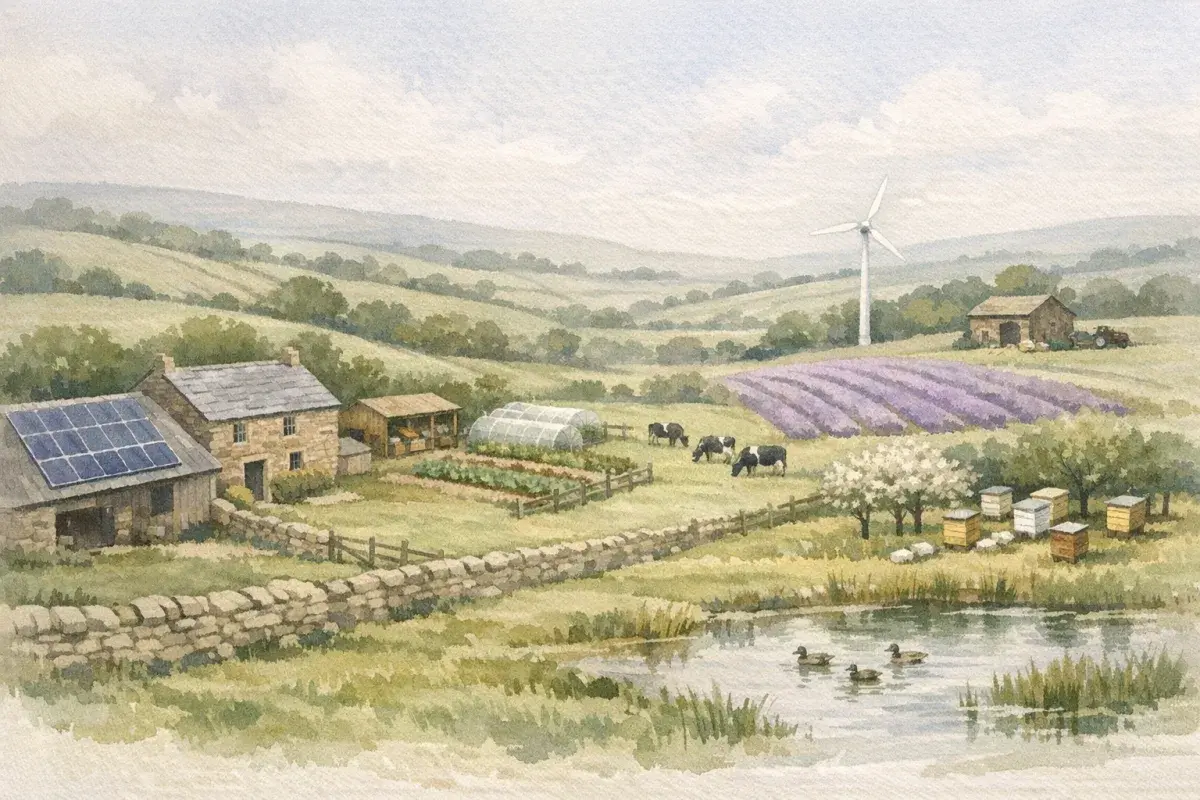
You don't need me to tell you the margins have got tighter. What's changed in the last few years is that diversification has shifted from "nice-to-have" to "risk management": a way to smooth income, keep family members employed, and make better use of buildings and location.
But grants are never "free money". They come with definitions, eligibility tests, procurement rules, planning traps, and timelines that don't always match the farming calendar. This guide cuts through what UK farm diversification grants typically support in 2026, where the main funding routes sit across the four nations, and how to put an application together that stands up to scrutiny, so you don't waste months chasing the wrong pot.
What Counts As Farm Diversification (And Why Funders Care)
Diversification sounds straightforward, "doing something else on the farm", but funders and assessors are usually working to a tighter definition.
In practice, farm diversification means adding a new (or significantly expanded) income stream that's connected to your existing rural asset base, land, buildings, skills, location, supply chains, without undermining agricultural activity or environmental obligations.
Why funders care comes down to three things:
- Additionality: would this happen anyway without grant support? The more your project looks like a standard commercial expansion with easy private finance, the harder it can be to justify public subsidy.
- Public benefit: jobs, rural services, local supply chains, reduced emissions, skills, community access, heritage outcomes, these often score highly.
- Deliverability and compliance: is it "shovel-ready" with permissions, ownership/tenure clarity, and a realistic procurement and delivery plan?
If you're still weighing up options, it's worth sanity-checking ideas against what tends to be fundable, and what stacks up commercially even if grant rounds shift. Our longlist of farm diversification ideas is useful for that early-stage filtering.
Typical Diversification Models Grants Commonly Support
Across the UK, grant-backed diversification often clusters into a few themes:
- Adding value to farm produce: small-scale processing, packing, chilling, storage, butchery units, or on-farm product development.
- Direct-to-consumer retail and short supply chains: farm shops, vending, click-and-collect points, delivery infrastructure.
- Rural tourism and visitor economy: modest accommodation, experiential stays, educational visits, trails, signage, parking and access upgrades.
- Low-carbon and energy projects: energy efficiency, heat recovery, solar and storage (where eligible), low-emission equipment.
- Rural workspaces: conversion of redundant buildings into offices, studios, small industrial units, where demand is evidenced.
- Skills, innovation, and productivity upgrades: tech-enabled improvements that lead to measurable outputs.
Grant assessors generally prefer projects that are clearly defined, evidenced, and proportionate to your holding, not a vague "we might do glamping and a café and a wedding venue if it all works out". If you want inspiration rooted in real-world constraints, our agricultural diversification examples round-up shows what tends to be viable on the ground.
The Difference Between Capital Grants, Revenue Support, And Loans
Not all "grant routes" are grants in the everyday sense. In 2026, you'll commonly see three funding structures:
- Capital grants (most common): part-funding for physical assets, buildings works, equipment, infrastructure. These typically require you to pay upfront and claim back on evidence.
- Revenue support (less common for diversification, but exists): training, feasibility work, advisory support, sometimes early-stage pilots. These can be lighter-touch but smaller.
- Loans and blended finance: government-backed or regional development loans, sometimes alongside smaller grants. These can suit cashflow better than a pure grant, but you'll be assessed like any borrower.
A practical point: capital grants often create a "project management" burden (quotes, procurement, claims, audit trails). If you don't have time or admin capacity, factor in professional support early, or simplify the scope.
The Main UK Grant Routes For Farm Diversification In 2026
There isn't one single "UK farm diversification grant". What you actually have is a patchwork: UK-wide subsidy control rules, but largely nation-specific rural policy plus local growth, sector, innovation, and heritage pots.
In 2026, the smartest approach is to map funding like you'd map cropping: start with the main schemes in your nation, then look for local and sector-specific options that match your project type.
England: DEFRA Schemes And The Rural Payments Landscape
In England, diversification support often shows up through:
- Productivity and capital-focused grant rounds (often time-limited) for equipment, infrastructure and improvements with measurable outcomes.
- Environmental schemes where a diversification project is aligned with land management outcomes (for example, where visitor management, access, habitat works or low-carbon outcomes are central).
- Local growth and innovation funding that intersects with rural enterprise, food, tourism or clean energy.
The key reality: England's landscape changes frequently, new rounds open, guidance is updated, and scoring criteria can pivot. Before you write a single paragraph of an application, pressure-test whether your project can show clear outputs (jobs, productivity, emissions reductions, added value) and whether you can realistically deliver inside the claimed timescales.
Scotland: Scottish Government, SRDP Legacy, And Successor Funding
In Scotland, you'll still hear people refer to SRDP-style approaches, even as successor funding evolves. The practical implications for you are:
- Expect specific scheme rules about location, sector outcomes, and environmental impacts.
- Evidence requirements can be demanding, particularly where public benefit and community outcomes are part of the scoring.
- Island and remote-rural contexts sometimes have dedicated routes or weighting, use that to your advantage, but document it properly.
Wales: Rural Support And Evolving Post-CAP Schemes
In Wales, diversification funding typically aligns with rural economic resilience, supply chains, and community value.
If you're proposing visitor-based diversification, Wales can be especially sensitive to:
- access and transport impacts
- Welsh language and community considerations (depending on area and scheme)
- environmental constraints and designated landscapes
The "what matters" is rarely just the kit list, it's whether the project strengthens the local economy in a way that's credible and sustainable.
Northern Ireland: DAERA Funding And Rural Enterprise Support
In Northern Ireland, DAERA-linked support and rural enterprise funding can be relevant where diversification improves productivity, supports rural jobs, or develops local processing and value-add.
Two recurring make-or-break points:
- your ability to demonstrate market demand beyond optimistic assumptions
- clarity on permissions and compliance, especially where food, visitors, or traffic are involved
Local And Sector-Specific Options: LEPs, Councils, Tourism, Heritage, And Innovation Funds
Beyond the main rural policy schemes, don't ignore the funding that sits "sideways" to farming:
- Local authority and regional growth funds (varies by area) supporting business space, tourism infrastructure, town-centre supply chains, or green upgrades.
- Tourism funds (often targeted) for accessibility, facilities, and quality improvements, especially if you can evidence nights stayed, spend, and season extension.
- Heritage and conservation-linked funding where you're restoring a traditional building with a viable end use.
- Innovation and research routes if your diversification includes demonstrable R&D, trials, or data-driven outcomes.
A tip from what we see across the rural market: the "best" route is often not the one called a diversification grant, it's the one whose scoring criteria you can genuinely meet.
And remember: if your diversification involves a property move, buying a block with the right buildings, or letting a redundant yard, you'll often unlock viability faster by matching the project to the right site rather than forcing the project onto the wrong site. AgLand exists for exactly that kind of matching: you register the site you need and hear the moment something fitting is advertised, which counts for most when the asset mix is the whole point.
Eligibility: The Rules That Most Often Make Or Break An Application
Most failed applications don't fail because the idea is "bad". They fail because the applicant can't prove eligibility, can't evidence demand, or can't show the project is ready.
Below are the rules and friction points that come up again and again across UK farm diversification grants.
Business Structure, Tenure, And Landlord Consents (Owners, Tenants, Common Land)
Eligibility usually turns on who you are in legal terms and what rights you actually have over the site.
Common pitfalls:
- Tenanted holdings: you may need explicit landlord consent for changes of use, new income streams, or structural works. Some schemes ask for evidence that you have a tenancy length sufficient to meet the maintenance period.
- Partnerships and corporate structures: ensure the applicant entity matches bank accounts, VAT status, and ownership/lease documents.
- Common land or shared access: rights and consents can be complicated, assessors won't "assume it'll be fine".
If you're planning a complex diversification (multiple revenue lines, multiple buildings, staged phases), it's worth mapping your structure early in a proper plan. A template-like plan won't cut it: you need something funder-ready. Our guide to a farm diversification business plan is designed to match what assessors actually look for.
Match Funding, Viability, And Evidence Of Demand
Many schemes are part-funded. That means you need:
- match funding clearly identified (cash, finance, sometimes in-kind, depending on scheme rules)
- cashflow that can handle paying suppliers before claiming
- evidence of demand that isn't just "we think tourists will come"
Good evidence looks like:
- competitor/market analysis for your local area (not generic UK stats)
- letters of intent (non-binding is fine, but real)
- booking platform data, footfall estimates, or trade buyer conversations
- pre-app discussions with planners and highways (for visitor schemes)
Viability is often judged by whether the project still makes sense if:
- build costs rise 10–15%
- opening is delayed by a season
- occupancy or footfall is weaker in year 1
Planning Status, Permitted Development, And Environmental Constraints
A huge proportion of diversification grief is planning-related.
Funders typically want one of three positions:
- Full planning consent in place, or
- Evidence that consent is likely (pre-app feedback), or
- A route under permitted development / prior approval (where genuinely applicable)
But here's the catch: even where permitted development rights exist, conditions, prior notification processes, and site constraints matter.
Also factor in constraints early:
- designations (National Parks, AONBs, SSSIs)
- flood risk zones
- protected species and habitats
- heritage assets and curtilage issues
If you're turning buildings into a visitor business, you may find the "grant-ready" version of the project is the one that's more modest and more compliant.
State Aid/Subsidy Control, Procurement, And Double Funding Risks
Since Brexit, the UK operates under Subsidy Control principles rather than EU State Aid rules, but the operational message for you is similar: public funds come with restrictions.
Watch-outs include:
- Double funding: you generally can't be paid twice from public sources for the same cost item.
- Procurement and quotes: many schemes require multiple quotes, an arms-length supplier relationship, and clear justification for supplier choice. If you use a mate's firm (or your own linked company), expect scrutiny.
- Record retention: funders can audit years after completion.
This isn't meant to scare you, it's meant to help you avoid the classic trap of spending time on the story while missing the compliance mechanics that actually decide outcomes.
What Diversification Grants Typically Pay For (And What They Won’t)
If you've ever looked at a grant guidance note and thought, "So… what are they actually paying for?", you're not alone.
Most farm diversification grants in the UK lean towards capital items that are clearly tied to project outputs. The easiest way to stay on track is to separate your costs into: (1) eligible capital, (2) possibly eligible professional fees, (3) ineligible operating costs.
Buildings, Infrastructure, And On-Farm Visitor Facilities
Common eligible themes include:
- building conversion works (subject to scheme rules)
- internal fit-out linked to the new use
- access tracks, parking, drainage, surfacing
- basic visitor facilities (toilets, signage, accessibility upgrades)
Visitor economy projects are popular, but competitive, because funders know they can create local spend. The flip side is that planning, highways, and neighbour impacts get assessed hard.
If you're considering retail, the costs can be chunky but straightforward to evidence, especially if you've already validated local demand and parking/access. Our deep jump into farm shop diversification goes into the practicalities that often sit behind the grant-friendly headline.
Renewables, Energy Efficiency, And Low-Carbon Equipment
Low-carbon elements can strengthen an application, particularly where you can show measurable reductions.
Grants may support:
- insulation, heating controls, efficient lighting
- heat recovery and refrigeration efficiency (for processing and storage)
- on-site energy management equipment
- low-emission equipment where it's clearly linked to productivity or emissions outcomes
Be careful with renewables: eligibility varies widely. Some schemes support specific technologies: others exclude generation but support efficiency. Don't assume.
Processing, Direct-To-Consumer, And Food Business Compliance Costs
Value-add projects often score well because they're tied to UK food supply chains and rural jobs.
Eligible costs might include:
- processing equipment (new, compliant, appropriately specified)
- chill/cold chain equipment
- hygienic fit-out, washable surfaces, drainage
- traceability or labelling systems (where capitalised)
Where people come unstuck is compliance. Food projects may also require:
- HACCP-aligned processes
- environmental health engagement
- trade effluent considerations
Some of these are eligible (as professional fees) in certain schemes: others aren't. Build a budget that works even if the grant only supports the "hard" items.
Common Exclusions: Second-Hand Kit, VAT Assumptions, Working Capital, And Retrospective Spend
The list of typical exclusions is remarkably consistent:
- second-hand equipment (many schemes insist on new)
- VAT (sometimes eligible, often not, depends on your VAT status and scheme rules)
- working capital (stock, wages, day-to-day running costs)
- retrospective spend (anything ordered/paid before approval, or before the eligible start date)
- general maintenance and "like-for-like" replacements
One pragmatic move: split your project into phases so the grant-funded phase is cleanly capital and claimable, while phase two (often marketing, staff, stock) is funded privately.
And if you're eyeing tourism, glamping in particular, make sure your cost plan includes the unglamorous bits (waste, water, access, fire safety, insurance) not just the pods. Our guide to glamping farm diversification is blunt about what tends to be overlooked.
A Practical Application Process That Stands Up To Scrutiny
A strong diversification application reads like you've already started operating the business in your head: you know who it's for, how it works day-to-day, what it costs, and what could derail it.
You don't need fancy language. You need clarity, evidence, and a paper trail.
Define The Project Scope, Budget, And Delivery Timetable
Start with a scope that's funder-proof:
- One project, one clear outcome (even if it's phase one of a bigger plan)
- A defined site plan and description of works
- A delivery timetable that respects:
- planning lead times
- ecology survey seasons
- contractor availability
- your own busy periods (lambing, harvest)
On budget, assume optimism will be punished. Use realistic build rates, include contingencies if the scheme allows, and make it obvious you've thought about inflation and lead times.
Pull Together The Evidence Pack: Quotes, Plans, Permissions, And Baselines
Most schemes want evidence that's boring but essential:
- 2–3 comparable quotes (and a note explaining your choice)
- drawings or layout plans
- planning status (consent, pre-app, prior approval route)
- baseline data (current turnover, current employment, current energy usage, whatever you're claiming against)
Baselines matter because funders score incremental improvement. If you can't show "before", it's harder to prove "after".
Write A Credible Business Case: Outputs, Jobs, Turnover, And Wider Public Benefit
This is where you win or lose points.
A credible business case usually includes:
- a tight description of your customer and catchment
- pricing assumptions you can defend
- conservative year 1 projections (with a ramp-up)
- how you'll market the offer (and the cost)
- staffing plan (including who covers weekends, changeovers, or food safety roles)
- sensitivity analysis: what happens if costs rise or demand is slower?
Also, don't be shy about public benefit, but keep it real:
- local suppliers and subcontractors
- apprenticeships or training
- improved access or facilities
- reduced emissions
If you want to ground your thinking in what's been proven, our farm diversification case studies can help you spot patterns, what worked, what nearly didn't, and what funders tend to like.
Prepare For Assessment, Site Visits, And Grant Offer Conditions
Assume you may face:
- clarification questions (often with short deadlines)
- site visits to verify feasibility
- conditions in the grant offer, such as:
- deliver by X date
- maintain assets for a set period
- meet specific output targets
- publicity/acknowledgement requirements
Treat conditions like a contract, because they effectively are.
A small but important human point: if you're feeling rushed, that's a sign the project plan isn't mature enough for a grant round. Better to miss a deadline and apply well next round than squeeze in something that unravels at audit stage.
Getting Planning, Rights, And Title Matters Right Before You Spend
Even a "successful" grant can become a headache if your underlying property position is messy.
We've seen projects stall because of a forgotten easement, a lender's consent requirement, or an access that looks fine on a map but fails the highways conversation.
Change Of Use, Building Regulations, And High-Risk Planning Triggers
Diversification usually triggers at least one of:
- change of use (agricultural to commercial/tourism)
- material change in traffic, noise, or operating hours
- building regulations compliance for accommodation, food, or public access
High-risk planning triggers include:
- wedding and events uses (intensity, noise, parking, neighbour amenity)
- year-round tourism in sensitive locations
- lighting schemes in dark-sky or wildlife-sensitive areas
- signage and visibility splays onto faster roads
If you're tempted by the high-revenue end of the visitor market, reality-check the planning angle early. There's a reason certain models can be lucrative: they're operationally and permission-heavy. (If you're exploring the numbers, our piece on the most profitable farm diversification is a good starting point for a hard-headed comparison.)
Access, Rights Of Way, Services, And Utilities Capacity
Funders and planners alike will zoom in on "can people actually get there, safely?"
Check:
- legal access: adopted highway vs private track
- visibility splays and junction safety
- capacity for parking and turning (deliveries, emergency vehicles)
- water supply and wastewater (especially for accommodation)
- grid capacity and connection costs (for energy projects or electric-heavy uses)
Also note public rights of way. They're not necessarily a blocker, but they can shape layout, fencing, signage, and insurance.
Tenancies, Overages, Restrictions, And Lender Requirements
Before you spend a penny, make sure you've covered:
- landlord consent (where tenanted)
- mortgagee/lender consent (common in secured lending)
- restrictive covenants (use restrictions, trading restrictions)
- overage/clawback provisions if land has changed hands
This isn't just paperwork. If a grant creates an asset that must be maintained, you need the legal right to control that asset for the full maintenance period.
Thinking of selling? AgLand shows you how many registered buyers already match your land before you pay anything - no board at the gate, no commission, and your details stay private until a buyer asks to connect. Check your matches.
After Approval: Claims, Record-Keeping, And Staying Compliant
Getting the approval letter is a milestone. It's not the finish line.
Post-award compliance is where many projects get stressed, especially if cashflow is tight or contractors slip.
Milestones, Variations, And Managing Cashflow Around Claim Windows
Grant offers typically come with:
- milestone dates
- claim windows
- evidence requirements per claim
To stay in control:
- build a cashflow model that assumes delays
- align contractor payment terms with your claim timetable (where possible)
- keep a running "variation log" from day one
If you need to change scope, suppliers, or specs, don't quietly switch things and hope nobody notices. Most schemes require prior approval for variations, and unapproved changes can make costs ineligible.
Audit Trails: Invoices, Payments, Photos, And Asset Registers
Think like an auditor:
- keep all quotes and procurement notes
- retain invoices and proof of payment (matching bank statements)
- take dated photos before/during/after
- maintain an asset register (serial numbers, location, use)
A neat folder structure can save you days later. We've watched good operators lose time, and sometimes money, because they couldn't evidence a payment chain cleanly.
Publicity, Maintenance Periods, And What Happens If You Change The Project
Many grants require acknowledgement (signage, mentions, or case-study participation). Then there's the maintenance period: you may need to keep assets, keep the use, and keep meeting output targets for a set number of years.
If circumstances change, family illness, market shift, flood damage, you usually have options, but you must engage early with the grant body. The worst move is going silent and hoping it'll wash over.
Handled properly, grant compliance isn't scary. It's admin with consequences. If you treat it with the same discipline you treat assurance schemes or cross-compliance-style record keeping, you'll be fine.
Conclusion
Farm diversification grants can accelerate a solid plan, but they don't rescue a shaky one. In 2026, the applications that tend to land well are the ones that are modestly ambitious: tightly scoped, properly permissioned (or clearly permissionable), and backed by evidence that a real customer will pay a real price.
If you take one practical step after reading this, make it this: write down your "grant-ready" version of the project, scope, costs, permissions, and outputs, in one page. Then stress-test it with your agent, accountant, and a planning adviser before you invest weeks into forms and quotes.
Disclaimer: AgLand.co.uk is a UK agricultural land and rural property matching service, where buyers register what they are looking for and owners advertise directly to the buyers who match, and a rural resource hub. Nothing in this text is intended as legal, financial, tax, or investment advice. You should carry out your own due diligence and seek advice from appropriately qualified professionals (for example, a chartered surveyor, planning consultant, accountant, solicitor, or independent financial adviser) before acting on any information discussed.