
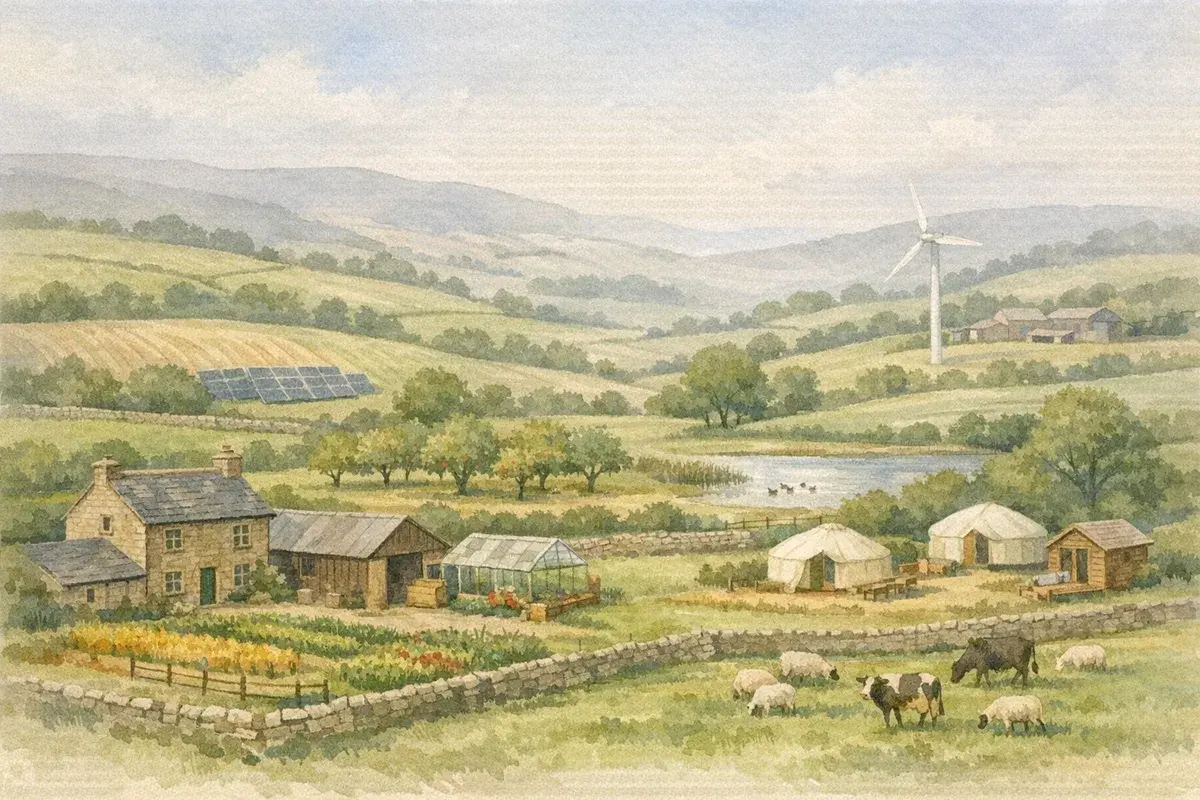
You don't need another "10 ideas to diversify your farm" list. You need proof, what actually worked on real UK holdings, what quietly bled cash, and what the owners would do differently if they were starting again.
Below are five practical farm diversification case studies (drawn from the patterns we see across agents, planners, surveyors and rural lenders we work with), plus a clear decision framework for choosing the right route for your land, buildings and appetite for risk. Some of these options look glamorous from the road. The best ones tend to look boring on paper… until you run the numbers properly.
Let's get into what to copy in 2026, and what to avoid before it becomes an expensive lesson.
Why Farm Diversification Pays Off In The UK (And Where It Commonly Goes Wrong)
Farm diversification in the UK isn't a fad, it's a structural response to three realities: volatile commodity markets, the reshaping of public support, and a planning/land-use environment that rewards the "right" forms of development while punishing the wrong ones.
Done well, diversification does two things at once: it stabilises your cashflow and improves the underlying value and resilience of the holding. Done badly, it can complicate your tax position, annoy neighbours, attract enforcement risk, and lock you into long, inflexible obligations.
The Most Bankable Drivers: Volatility, Subsidy Change, And Land-Use Policy
- Commodity volatility isn't going away. Input costs, weather variability, and global pricing shocks mean relying on one enterprise can feel like running a business with one customer.
- Support is changing shape. In England, the direction of travel has been away from area-based payments and towards paid outcomes (nature, water, carbon, access). Scotland, Wales and Northern Ireland each have different pathways and timetables, but the common theme is: be ready to earn income in more than one way.
- Policy is steering land use. Whether it's rural tourism, renewables, or environmental markets, the planning system and public funding tend to favour proposals that are well-sited, low-impact, and properly evidenced.
If you want a wider menu of routes (and the typical pros/cons), our roundup of realistic diversification examples is a helpful companion, but the case studies below show what it looks like in the messy real world.
The Three Failure Patterns We See Most: Planning, Cashflow, And Over-Optimistic Demand
- Planning assumed, not earned. The application is treated as admin rather than a project in itself. Then highways object, ecology bites, or you discover the curtilage you thought you had… you don't.
- Cashflow doesn't match the build programme. Most failures aren't "bad ideas": they're underfunded timelines. A six-month build becomes twelve. Borrowing costs rack up. You open at the wrong point in the season.
- Demand is guessed, not validated. "Everyone wants glamping" or "we'll do weddings" is not market research. The winners have a specific catchment, a clear price point, and a plan for off-peak.
The thread that runs through successful diversification? The owners treat it like a standalone business with proper diligence, not a side project squeezed between lambing and harvest.
Case Study 1: Converting Traditional Buildings Into Holiday Lets
You've probably seen this done brilliantly, and you've also seen the conversions that look lovely on Instagram and feel oddly empty in November.
This case study follows a fairly typical scenario: traditional stone buildings on a working farm, strong landscape character, and a desire to generate non-farming income without selling land.
Starting Point, Site Constraints, And Neighbour Impacts
- Asset: redundant range of traditional buildings close to the farmhouse, with a sensible yard layout.
- Constraint: the buildings sat within a tight cluster of neighbouring dwellings (old farm cottages sold off years ago). That meant privacy, noise, lighting, and traffic were as important as the aesthetics.
- Early win: the owners walked the neighbour boundaries and sightlines before any drawings were produced. They designed out conflict, screen planting, discreet hot tub locations, and a traffic plan that didn't funnel cars past bedroom windows.
Planning Route, Building Regs, And Utilities Reality Check
The planning journey was less about "can we convert?" and more about "can we do it without triggering a cascade of technical issues?". Key learnings:
- Change of use and heritage character: the application leaned heavily on keeping the building's agricultural form (openings, roof pitch, materials). Planners tend to react better to conversion than quasi-new-build dressed as old.
- Ecology can set your timeline. Bat surveys and nesting constraints aren't rare in rural buildings. If you miss survey windows, you can lose months.
- Utilities are where budgets go to die. Upgrading single-phase supplies, dealing with water pressure, and sorting foul drainage (especially where mains isn't nearby) were major cost drivers.
If holiday accommodation is on your shortlist, it's worth reading our deeper guide to glamping and rural stays as a diversification route, many of the same planning and servicing realities apply even when you're "just putting up pods".
Commercials: Capital Cost, Occupancy Assumptions, And Seasonality
The owners made the project bankable by being conservative:
- Capex discipline: they prioritised durable finishes and low-maintenance landscaping over "wow" features that age quickly.
- Occupancy assumptions: their model didn't rely on full summer occupancy to survive. They planned for realistic shoulder-season trade and priced accordingly.
- Seasonality strategy: they built an off-peak offer (midweek worker stays, walking breaks, and discounts tied to local events) rather than hoping winter would "sort itself out".
What didn't work at first? Paid ads sprayed too widely. What worked later was tighter targeting, repeat-booker incentives, and partnerships with local attractions.
Copy this: treat utilities, access, and neighbour management as core design inputs, not afterthoughts. Avoid this: assuming year-round demand at peak-week prices.
Case Study 2: Farm Shop And Cafe Built Around A Clear Catchment
A farm shop can be a licence to print money, or a very expensive way to learn about staffing, perishables, and car parking.
This case study worked because the owners resisted the temptation to build a "destination" before they'd proved their day-to-day customer base.
Location Strategy: Roadside Visibility Vs Destination Retail
The holding sat on a busy A-road with strong commuter flow and limited competition within a short drive.
- Decision: focus on convenience and habit, not only weekend treats.
- Execution: clear signage, easy in-and-out access, and a layout that let customers park, grab essentials, and leave in ten minutes.
- Range strategy: an "anchor" offer (fresh basics, bread, milk, seasonal veg) supported by higher-margin lines (gifts, deli, local alcohol).
If you're exploring this route, our guide to building a farm shop diversification offer goes into store formats, sizing, and what usually drives repeat footfall.
Food Standards, Licensing, And Car Parking Capacity
The operational side was the make-or-break:
- Food hygiene and process design: the cafe kitchen workflow was designed backwards from compliance, delivery, storage, prep, service, waste. It sounds dull, but it reduced staff errors and simplified training.
- Licensing and alcohol: the owners treated licensing as a programme item, not a last-minute add-on.
- Parking: they underestimated peak parking initially. The fix wasn't just "more spaces", it was better circulation, clearer signage, and a plan for busy weekends so the road didn't back up.
Margins, Staffing, And Supplier Mix That Protected Profit
The farm shop became profitable because they protected margin in three ways:
- Supplier mix: they didn't try to stock everything from local artisan suppliers (which can crush margin and consistency). They blended local heroes with reliable wholesaler lines.
- Staffing realism: they budgeted for a manager-level hire early. It cost more, but it stopped the owners being chained to the till.
- Menu engineering: the cafe wasn't a vanity project. They built a menu around repeatable dishes, controlled portion costs, and ingredients shared across dishes.
What didn't work? Over-expanding the seating area too quickly. The best returns came from throughput and retail baskets, not from doubling covers.
Copy this: design for weekday repeat trade. Avoid this: assuming you can run hospitality "around farming" without dedicated leadership.
Case Study 3: Storage Yards And Light Industrial Lets On Redundant Farmstead Space
This is one of the least glamorous farm diversification case studies, and often one of the most dependable when executed properly.
The scenario: a redundant concrete yard and older general-purpose sheds, good access to a market town, and a desire for predictable monthly income without a big build.
Change Of Use And Planning Risk: What Triggered Objections
The owners' first instinct was "it's already hardstanding: we'll just let it out." In practice, intensification is where planning and neighbour issues show up.
Common triggers for objections:
- HGV movements and hours of operation
- External storage (especially untidy or high stacks)
- Noise and lighting
- Drainage and contamination concerns
The successful version of this case study included a clear site management plan: defined operating hours, designated loading bays, downlighting, and strict limits on what could be stored.
Lease Structures: Break Clauses, Rent Reviews, And Dilapidations
This is where agricultural property owners either protect themselves, or accidentally take on commercial landlord headaches.
Key lease choices that mattered:
- Shorter terms with options to renew (gives you flexibility if the wider estate strategy changes)
- Deposit and guarantees where appropriate
- Clear repair obligations and dilapidations provisions so you're not paying to put right tenant damage
- Rent reviews linked to market evidence (not handshakes)
It's worth having a surveyor who understands rural commercial property set these up properly. A "cheap" lease can be expensive later.
Access, HGV Movements, And Neighbouring Land Safeguards
The operational safeguards were the real profit protectors:
- Access control: gates, CCTV, and clear rules about out-of-hours activity.
- Surface management: potholes and mud transfer can become your liability quickly.
- Biosecurity and boundary discipline: if your core farm business is livestock, you need separation and signage, tenant vans cutting across yards can become a disease risk.
Copy this: pick tenants and permitted uses like you're protecting your main business, because you are. Avoid this: letting "temporary" storage drift into a sprawling, unmanaged industrial site.
Case Study 4: Solar PV With Grazing And Biodiversity Enhancements
Solar is one of the clearest examples of a diversification option that looks simple ("rent some land") but lives or dies on paperwork and grid reality.
This case study reflects a landowner who wanted steady income, minimal management burden, and to keep agricultural use through grazing.
Heads Of Terms: Option Agreements, Rent, And Indexation
The deal structure mattered more than the headline rent.
- Option agreement: the developer paid an option fee for the right to pursue planning and grid. Your land is effectively tied up during this period, so the option terms need to compensate you fairly.
- Rent and indexation: inflation linkage is standard, but the detail matters (what index, how often, any caps/collars).
- Access and easements: you'll likely grant rights for access tracks and cabling. These should be precisely defined.
A lot of owners compare solar rents without comparing the risk allocation. That's how two "similar" offers end up worlds apart.
Grid, Cabling, And Timescales: The Make-Or-Break Constraints
Here's the blunt truth: grid connection can make a good-looking solar deal pointless.
In this case study:
- the initial grid indication looked feasible,
- then timescales stretched,
- and reinforcement costs shifted.
The landowner's protection was insisting that key milestones and long-stop dates were built into the agreement, so the land wasn't tied up indefinitely.
Landowner Protections: Decommissioning, Restoration, And Security
If you copy one thing from this case study, copy this: plan the end at the beginning.
- Decommissioning bond/security: so the site can be restored even if the operator fails.
- Restoration standard: specify what "restored" means (soil condition, drainage, removal of tracks, etc.).
- Operational constraints: stock grazing management, fencing responsibilities, and who controls weeds and vermin.
Solar can be attractive, but it's not "set and forget" unless your documents are tight. If you're weighing it against other income streams, it helps to sense-check what's typically considered the most profitable diversification in different UK contexts, profitability isn't just revenue, it's risk-adjusted return and hassle factor.
Case Study 5: Natural Capital Income From Biodiversity Net Gain And Nutrient Neutrality
Natural capital is no longer just a buzzword. In parts of the UK, it's a genuine new income line, if you understand the rules and you're comfortable with long-term obligations.
This case study covers a landowner exploring Biodiversity Net Gain (BNG) units and opportunities linked to nutrient neutrality constraints.
Baseline Surveys, Additionality, And Stacking Rules In Plain English
The project started with a hard truth: you can't sell what you can't measure.
- Baseline surveys: you'll likely need ecological assessment to establish current habitat condition.
- Additionality: you must demonstrate the uplift is additional, i.e., beyond what would have happened anyway and (in many cases) beyond what's already required or funded.
- Stacking rules: you need to be careful about "double counting" the same uplift for multiple schemes. Some stacking may be possible in certain circumstances, but it's technical and scheme-dependent, get specialist advice before you assume you can sell carbon + BNG + water benefits off the same hectares.
Buyer Demand: Developers, Water Companies, And Local Schemes
Demand tends to come from:
- Developers needing BNG to support planning approvals
- Water companies or catchment initiatives (particularly where nutrients are constrained)
- Local authority or regional schemes with specific priorities
The most successful landowners in this space don't wait passively. They get the right advisers early (ecology, legal, agent) and position their land as a reliable, compliant supply of units.
Long-Term Obligations: Monitoring, Enforcement, And Exit Options
This is the part many people underestimate.
- Time horizon: commitments can be multi-decade.
- Monitoring: you may have to fund and help ongoing monitoring and reporting.
- Enforcement: obligations can bind successors in title: this affects future saleability and lender appetite.
- Exit options: the best deals think about what happens if circumstances change, are there step-in rights, assignment terms, or mechanisms to vary management?
Natural capital can be an excellent fit where farming returns are marginal and the holding can tolerate reduced flexibility. But it's not "free money": it's a long contract with real responsibilities.
Choosing The Right Diversification For Your Holding
By now you've probably recognised a theme: diversification isn't about chasing the fashionable idea, it's about choosing the option that fits your site, your risk tolerance, and your capacity to execute.
If you want to pressure-test ideas systematically, start with a proper farm diversification business plan before you spend serious money on drawings, applications or kit. It forces the uncomfortable questions early, when changing direction is still cheap.
A Practical Fit Test: Location, Buildings, Access, And Labour
Ask yourself (honestly):
- Location: are you selling convenience (farm shop), experience (holiday lets), or yield (solar/natural capital)? Each depends on a different kind of location advantage.
- Buildings: do you have assets worth converting, or are you about to pour capital into new build where payback is slower?
- Access: can you handle visitor traffic or HGVs without disrupting the core farm?
- Labour: who's running this in February when the novelty's worn off? If the answer is "me, in the evenings," be cautious.
A simple rule of thumb: the more "retail" the diversification (food, weddings, hospitality), the more it behaves like a separate business that needs management depth.
Planning And Designations: AONB, SSSI, Flood Risk, And Highways
Planning is not just permission: it's constraints that shape the entire business model.
- AONB / National Landscape: design quality and landscape impact are scrutinised. Expect more iterations.
- SSSI / protected sites: ecological constraints can be significant.
- Flood risk: can limit uses, raise insurance costs, and affect lender comfort.
- Highways: visibility splays, turning radii, and traffic counts can decide whether your "great idea" is viable.
If you're in a constrained area, it's often smarter to pick lower-traffic options (or site visitor uses tightly within existing complexes) than to fight an uphill battle.
Finance And Tax Touchpoints: VAT, Inheritance Tax Reliefs, And Structure
This is where you should slow down and get bespoke advice.
- VAT: some diversified income streams change your VAT position. Registration and partial exemption can catch people out.
- Inheritance Tax (IHT) reliefs: how you use buildings and land can affect Agricultural Property Relief (APR) and Business Property Relief (BPR). There are planning opportunities here, but also real pitfalls.
- Structure: ring-fencing risk via separate entities can help, but it adds admin and cost.
The best operators treat tax and finance as design constraints, like drainage or access, not as a box to tick later.
And yes, funding can make or break timing. If grants are part of your plan, check what's currently available and what usually qualifies under UK schemes via our guide to farm diversification grants. (Grant windows and rules change, so always confirm the latest position.)
Delivering It Properly: A Step-By-Step Route From Idea To Letting Or Launch
Most diversification pain happens in the middle: after the excitement of the idea, before the income arrives. This is the route we see working best when people want fewer surprises.
Due Diligence Checklist: Titles, Rights, Wayleaves, And Services
Before you commit, get clarity on:
- Title and boundaries: exactly what you own, and what's subject to rights.
- Rights of way and access: public footpaths, private easements, and whether your new use increases liability or conflict.
- Wayleaves and utilities: where cables and pipes run, and what rights providers have.
- Services capacity: electricity phase and capacity, water supply/pressure, drainage options.
- Constraints: covenants, tenancies, overage, and any existing agreements that limit change.
This stage feels slow. But it's cheaper than redesigning a scheme after you've told a lender and a planner a different story.
Procurement And Build Strategy: Phasing, Contingencies, And Contracts
A pragmatic build approach typically includes:
- Phasing: start with one or two units (holiday lets) or a smaller retail footprint (farm shop) to prove demand and operations.
- Contingency: rural builds hide surprises, groundworks, drainage, supply upgrades. Plan a realistic contingency rather than hoping you'll "value engineer it out."
- Contracts: clear scopes, realistic programmes, and someone accountable for coordination. If you're not used to managing builds, pay for proper professional support: it's rarely wasted money.
Route To Market: Pricing, Marketing Channels, And Tenant Vetting
How you go live matters as much as what you build.
- Pricing: don't anchor your price on the best competitor you've seen online, anchor it on your offer, your reviews (initially none), and your off-peak strategy.
- Marketing channels: pick the channels that match your customer. A farm shop's success might rely on repeat local trade: a holiday let might rely on high-quality photography and tight targeting.
- Tenant vetting (for yards/industrial lets): check references, understand the end use, and keep tight control over what's permitted.
One final, underrated point: if your diversification depends on buying, selling, or letting rural property, specialist platforms can save time. On AgLand, buyers register what they're after and hear the moment a matching property is advertised, and owners advertise straight to the buyers who already match, for one flat fee and no commission on either side.
Conclusion
The best farm diversification case studies aren't the ones with the flashiest launch, they're the ones still paying you reliably three, five, ten years later.
If you take one mindset into 2026, make it this: choose a route that fits your holding and your capacity, then execute it like a proper business with proper diligence. Be conservative on demand, ruthless on costs, and obsessive about planning, utilities and contracts.
When you're ready to act, whether that's finding the right property asset, assessing a site's potential, or sanity-checking local market appetite, use the right tools and the right professionals. It's almost always cheaper than fixing a mistake once it's built.
Disclaimer: AgLand.co.uk is a UK agricultural land and rural property matching service, where buyers register what they are looking for and owners advertise directly to the buyers who match, and a rural resource hub. Nothing in this text is intended as legal, financial, tax, or investment advice. You should carry out your own due diligence and seek advice from suitably qualified professionals (e.g., a solicitor, accountant, tax adviser, surveyor, planner, and ecologist) before making decisions or committing to any transaction or project.