
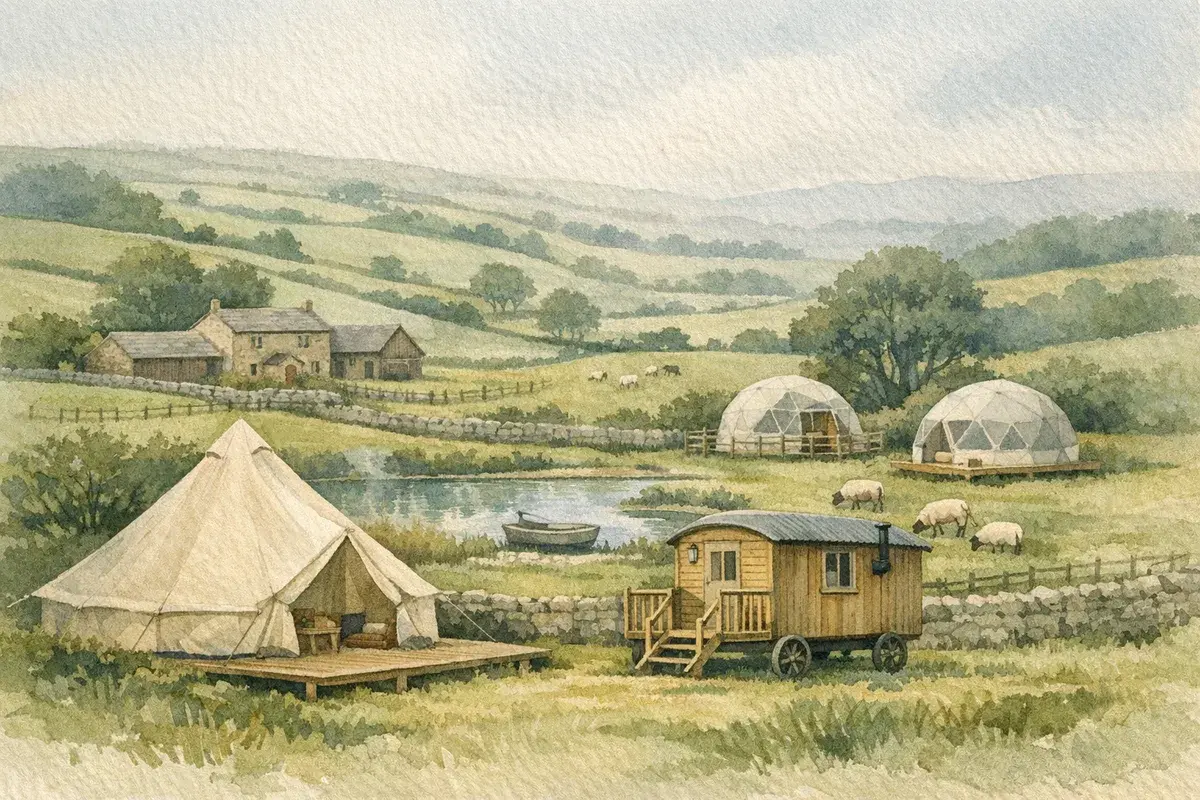
You don't need me to tell you that UK farming margins can feel like they're made of tracing paper some years. Inputs rise, weather throws tantrums, schemes change, and suddenly you're looking at a yard full of underused buildings and a few fields that might be better at earning money from people than from crops.
That's where glamping farm diversification comes in, done properly, it's one of the rare projects that can (a) create a dependable second income stream, (b) use awkward corners of the holding, and (c) stack well with other rural enterprises like a farm shop, events, or experiences.
But glamping isn't "stick up a bell tent and print money". Planning, access, neighbours, utilities, licensing, tax, and the basic reality of running hospitality on top of a farm business… that's where projects either become a tidy earner or an exhausting headache. This guide is written to keep you in the first camp.
Why Glamping Works As A Farm Diversification Strategy
Glamping sits in a sweet spot for a lot of UK farms: it's high-value per acre, can be phased in, and often uses land that's inconvenient for mainstream agriculture (wood edges, steep banks, odd-shaped paddocks, corners near a view).
Unlike many diversification ideas, it also sells an emotion, privacy, nature, comfort, novelty, so you're not only competing on price. You're competing on experience, and that's where well-run farm sites do very well.
If you're weighing options, it's worth scanning broader routes first so you don't commit to glamping just because it's trendy. Our round-up of practical diversification routes UK farms are actually using helps you pressure-test what fits your buildings, your location, and your appetite for customers.
How Glamping Compares With Other Diversification Options
A quick, plain-English comparison:
- Glamping / holiday accommodation: Potentially strong margins, but it's hospitality, guest comms, cleaning, maintenance, complaints, seasonality. Planning and licensing can be straightforward or surprisingly complex depending on site constraints.
- Storage, workshops, small business units: Often steadier, less seasonal, and less customer-facing. But demand is local and you may need significant capex, utilities, and security.
- Events (including weddings): Can be lucrative but can also swallow your calendar and create neighbour/highways pressure. If you're considering that route too, see the specific planning and operational angles in our guide to diversifying into a farm wedding venue.
- Renewables: Great when grid, planning, and land type align. Long lead times: highly technical.
Glamping's advantage is that you can start small, one or two units, learn what guests actually want on your farm, then expand.
What Makes A Site Commercially Viable
A glamping site becomes commercially viable when three things line up:
- A reason to stay
- Views, woodland, water, dark skies, a footpath network, nearby attractions, or simply "peace and quiet within 2 hours of a big population centre".
- A frictionless arrival
- Guests are forgiving about a bumpy track (within reason). They're far less forgiving about not knowing where to go, where to park, or whether their car will survive the last 600 metres.
- A product that matches the local market
- In some areas, guests pay for hot tubs and hotel-level finishes. In others, they pay for simplicity and seclusion. Your job is to find out which you're in before you spend.
A small reality check: if the only way you can make the numbers work is by assuming 90% occupancy at premium rates, the site isn't viable, it's a spreadsheet fantasy. Build a model that still holds up when it's raining sideways in November and the boiler fails on a Saturday.
Choosing The Right Glamping Model For Your Holding
The best glamping model is the one that fits your land, your planning position, and how hands-on you want to be. "Instagrammable" is great. "Maintainable in February" is better.
Pods, Bell Tents, Shepherd's Huts, Cabins, And Treehouses
Here's the practical view (not the brochure view):
- Bell tents / safari tents
- Pros: Lower capex, fast to set up, easy to trial demand.
- Cons: Weather wear, shorter lifespan, more seasonal, storage/off-season labour.
- Best for: Testing a market or running pop-up style pitches.
- Glamping pods
- Pros: Durable, good shoulder-season performance, easier to standardise.
- Cons: Can feel "samey" if the setting isn't special: still needs solid base and services.
- Best for: A scalable, repeatable product.
- Shepherd's huts
- Pros: Strong guest appeal, compact, can command premium nightly rates in the right area.
- Cons: Weight and access matter: quality varies wildly between manufacturers.
- Best for: Couples' stays, higher price point, lower guest volume.
- Cabins / lodges
- Pros: Highest comfort: longer season: suits families.
- Cons: Planning scrutiny can increase: bigger infrastructure and fire safety considerations.
- Best for: A more "holiday park" feel (even if you keep it boutique).
- Treehouses
- Pros: Huge marketing pull.
- Cons: Engineering, access, disability considerations, insurers, and maintenance complexity.
- Best for: One or two premium units where you can justify the build cost.
A useful discipline: choose one "hero" feature (view, hot tub, wild swim, wood burner, total seclusion) and do it exceptionally well. Spreading budget across ten mediocre upgrades rarely pays back.
Seasonality, Pricing Strategy, And Target Guests
UK glamping is rarely a 12-month business unless you build for it. Your choices should match your season:
- If you're mostly March–October: tents and simpler units can work, but design for wet ground and muddy access.
- If you want year-round: insulated units, reliable heating, hard standings, and robust drainage stop winter becoming an endless maintenance loop.
Pricing strategy is less about "what others charge" and more about what your guest is buying:
- Couples: privacy, romance, a proper mattress, and little luxuries.
- Families: safe play space, simple cooking, clear rules, and somewhere to dry coats.
- Groups: communal areas and noise management (plus neighbour relations).
And be honest with yourself: do you want hen dos? Dogs? Kids? Campfires? These decisions affect planning, insurance, wear-and-tear, and reviews.
Before you build, map your target guest and write down what you'll say no to. It's far easier to set boundaries at launch than to claw back control after one chaotic summer.
Planning Permission And Legal Compliance In The UK
Planning is where many glamping projects either get unlocked quickly, or bog down for months because one key constraint was missed early.
If you want the big picture on how councils look at diversification proposals, start with our guide to planning permission for farm diversification. For accommodation-specific nuances (including holiday use conditions), our resource on planning rules for farm holiday lets is also worth a read.
Permitted Development, Change Of Use, And Material Change Tests
In the UK, whether you need planning depends on what you're putting on the land and how it functions in practice.
Key concepts you'll run into:
- Permitted development (PD): A limited set of rights that may apply in some situations, but glamping often strays outside straightforward PD because of siting, engineering works, access, and the intensity of use.
- Change of use / material change of use: Even if a structure is "temporary", the use of the land can still be considered a material change, especially if you're creating a tourism business with regular guest turnover.
- Operational development: Hard standings, tracks, drainage, service trenches, lighting, signage, these can trigger permission needs even when the accommodation itself is marketed as removable.
The practical approach: talk to your planning consultant or agent early, and don't rely on what worked for a friend in another county. Local plans and enforcement appetite vary.
Constraints To Check Early: AONB, SSSI, Flood Risk, Highways, And Neighbours
Do a constraints sweep before you fall in love with a site. Five common tripwires:
- Landscape designations (National Landscapes/AONB, National Parks): Expect higher scrutiny on visual impact, dark skies, and traffic.
- SSSI, priority habitats, protected species: Ecology can set your programme back (or redesign it entirely). Budget for surveys.
- Flood risk and drainage: A glamorous cabin is not glamorous when the approach track turns into a river. Check surface water as well as fluvial risk.
- Highways and access: Visibility splays, passing places, and surfacing can be make-or-break. Councils will care about safety and congestion.
- Neighbours: Noise, lighting, traffic, and "overlooking" are what objections focus on. A smart layout that protects privacy is often the difference between smooth approval and a fight.
Here's the slightly uncomfortable truth: if you're right next to someone's garden, you're not really building a glamping business, you're building a complaints generator.
Licensing, Fire Safety, Accessibility, And Insurance Basics
Glamping sits at the crossroads of hospitality and land management, so compliance is a patchwork.
At a minimum, think about:
- Fire safety: Clear escape routes, safe distances between units, safe storage for gas/solid fuel, extinguishers/blankets where appropriate, and documented risk assessments.
- Electrical and gas safety: Use qualified installers, keep certificates, and have a maintenance regime.
- Environmental health: If you're providing washing, food prep areas, or shared facilities, your local authority may take an interest. Waste and odour management matter.
- Accessibility: You won't always be able to make every unit fully accessible, but you should consider reasonable adjustments and inclusive design where practical.
- Insurance: Public liability is the baseline. You may also need cover for business interruption, employers' liability (if staff are involved), and specialist cover for unusual structures (treehouses, hot tubs, lakes).
Don't treat these as box-ticking. A single incident can undo years of goodwill, and insurers will look closely at whether you ran a competent operation.
Site Design, Infrastructure, And Guest Experience That Sells
If planning is the gate, infrastructure is the foundation. Guests may book for the view, but they review you for the shower pressure, the lighting, and whether they got stuck in mud.
Access, Parking, Drainage, Water, Power, And Connectivity
Start with the boring stuff, it's what saves you later.
- Access and parking: Design so guests can arrive and park without a 12-message WhatsApp exchange. Mark parking discreetly, light it safely (without lighting up the valley), and create turning space so you're not recovering cars with a tractor every weekend.
- Drainage: UK winters will test every assumption you make. Hard standings, French drains, and sensible fall away from units protect your assets.
- Water: Private supplies need careful management and testing regimes where applicable. If you're on mains, check capacity and pressure.
- Power: Battery/solar can work for simpler setups, but many guests now expect device charging, heating, and proper lighting. If you're trenching, do it once and do it right.
- Connectivity: Some guests love "off-grid". Others need a signal for work or kids' entertainment. Decide your offer, and be explicit in listings.
A practical design trick we've seen work: create a ‘service spine' (track + utilities route) that allows you to add units later without ripping up the site.
Toilets, Showers, Waste, And Environmental Health Considerations
Toilets are where guest satisfaction lives or dies.
Options include:
- En-suite in each unit: Higher capex but easier guest experience and fewer shared-facility complaints.
- Shared amenity block: Efficient for multiple units, but it becomes a cleaning and maintenance hotspot.
- Composting toilets: Can be brilliant when managed properly: can also create odour and guest dissatisfaction if you cut corners.
Waste handling needs equal attention:
- Refuse and recycling: Guests produce more packaging than you think. Provide clear instructions and discreet, animal-proof storage.
- Wastewater: Don't assume existing farm drainage is suitable. Package treatment plants and septic systems have design and maintenance requirements: you'll need the right consents and servicing.
If you want good reviews, make it easy for guests to do the right thing. Confusing bins, unclear instructions, or a long walk to facilities are small irritations that show up online.
Layout, Privacy, Noise, Lighting, And Biodiversity Net Gain
You're not just placing units, you're choreographing a stay.
- Privacy: Angle doors and hot tubs away from each other. Use planting and natural screening rather than fences where possible.
- Noise: Think about kids playing, late-night chatter, and morning farm activity. Put "social" units in one zone and "quiet" units elsewhere.
- Lighting: Low-level, warm lighting improves safety without annoying neighbours or ruining dark skies.
- Biodiversity Net Gain (BNG): For some developments in England, BNG requirements can come into play depending on the nature of the proposal. Even when it's not strictly required, ecological enhancements (hedge planting, wildflower margins, pond restoration) can support planning and improve the guest experience.
The best glamping sites don't feel ‘built'. They feel discovered. If your layout looks like a car park with pods, guests will treat it like one, functional, forgettable, and price-sensitive.
Financials: Costs, Funding, And Realistic Returns
Glamping can pay, but only if you budget like a pessimist and market like an optimist.
Before you commit, it's worth grounding yourself in how other farm ventures stack up financially. Our overview of what tends to be most profitable on UK farms when diversifying gives helpful context for expected margin profiles and risk.
Capex And Opex Breakdown For Typical UK Setups
Costs vary hugely by specification and ground conditions, but the big buckets are consistent.
Typical capex lines (often underestimated):
- Groundworks: tracks, hard standings, drainage, bases
- Utilities: water, power, waste, connectivity
- The unit itself: purchase/build, delivery, cranage (sometimes), fit-out
- Bathrooms/hot tubs: not just the kit, also compliance, servicing access, and safe electrics
- Landscaping and screening: planting, fencing, gates
- Professional fees: planning, ecology, highways input, drawings
- Contingency: genuinely keep one (10–20% is not unusual on rural builds)
Typical opex lines:
- Cleaning and laundry (the silent profit killer if not controlled)
- Consumables: logs, firelighters, welcome packs, toiletries
- Maintenance: paths, decking, pumps, heating, hot tub servicing
- Insurance
- Advertising/marketing
- Booking fees if you use third parties
- Utilities and waste servicing
If you're converting existing buildings instead of placing new units, your capex profile changes, but planning and building control complexity can rise.
VAT, Business Rates, And Record-Keeping For Mixed Farm Businesses
Glamping income can push you into decisions you've avoided for years, especially around VAT and business structure.
- VAT: Holiday accommodation can be VAT-able depending on your circumstances and turnover. The right answer depends on your wider farm business, existing registrations, and pricing model.
- Business rates: Some holiday accommodation may be assessed for non-domestic rates (and in certain cases may qualify for reliefs). The details matter.
- Record-keeping: Treat glamping like its own business line. Separate bank tracking (even if not separate accounts), proper invoices, mileage logs, and clear apportionment of shared costs (utilities, labour, machinery use) make life easier at year-end.
Your accountant should be involved before your first booking, not after your first panic.
Grants And Finance Options: What's Possible And What's Not
Funding for tourism and rural enterprise fluctuates across the UK and by local area. Broadly:
- Rural development and local growth funding: Opportunities can exist, but eligibility is specific and evidence-heavy.
- Bank lending: Often possible where you can show planning comfort, demand evidence, and a realistic operating plan.
- Asset finance: Sometimes available for certain unit types, though lenders will scrutinise resale value and security.
What doesn't work well is vague optimism. Lenders (and grant bodies) prefer:
- A phased plan (start small, prove occupancy, expand)
- Evidence of demand (local comps, enquiry data)
- Professional input on planning, access, and constraints
- A stress-tested cashflow that assumes repairs, voids, and management time
If you haven't already, build out a proper plan. Our guide to creating a farm diversification business plan that stands up to scrutiny is designed for exactly this moment.
Tax, Tenure, And Estate Planning Considerations
This is the part many people leave until late, then regret it.
Glamping changes the nature of what your land is used for, how income is classified, and potentially how parts of the estate are viewed for inheritance tax (IHT) purposes. The right structure is highly fact-specific, so use this section as a briefing before you speak to your accountant, land agent, and tax advisor.
Income Tax Vs Capital: Structuring The Trade And Keeping Evidence
In plain terms, glamping income is typically treated as trading/earning income rather than "a capital uplift story". That affects how you report it and what evidence you keep.
Good habits that protect you later:
- Keep clear contracts/terms with guests
- Document what you provide (cleaning, linen, customer service, maintenance)
- Track time spent (by you and staff)
- Separate capital costs from ongoing repairs
If you later sell the holding (or a parcel), clear records make it easier to explain what was trading activity and what was investment/land value.
IHT Reliefs (APR And BPR) And The Diversification Trade-Off
Two reliefs tend to dominate UK farm estate planning conversations:
- Agricultural Property Relief (APR): Generally linked to agricultural value and agricultural use.
- Business Property Relief (BPR): Generally linked to qualifying business interests.
Diversification can be positive, neutral, or problematic depending on scale and structure. A small, clearly ancillary glamping operation may sit differently to a large, standalone tourism business that dominates the holding.
The key risk is drifting, without noticing, from "a farm with a sideline" to "a tourism business with some farming". That shift can change how parts of the estate are viewed.
This is exactly why you should get bespoke advice early. It's not about being scared off: it's about making deliberate choices and keeping evidence.
Leases, Management Agreements, And Partnering With Operators
You don't have to run glamping yourself.
Common structures include:
- You operate everything: Highest control and potentially best margin. Also the most time-intensive.
- Management agreement: You own the asset: an operator runs bookings, cleaning, comms for a fee or revenue share.
- Lease/licence to an operator: More predictable income, less involvement, but you must protect the land, plan for reinstatement, and manage brand/quality risk.
When partnering, pay attention to:
- Who holds planning responsibility and compliance duties
- Repairing obligations (tracks, drainage, utilities)
- Reinstatement at end of term
- Insurance responsibilities
- Break clauses and performance thresholds
A well-structured agreement can stop glamping from "taking over the farm". A sloppy one can do the opposite.
Operations And Marketing: Getting Booked Without Losing The Farm
If you're already working flat out, the operational model matters as much as the planning.
Some of the best glamping businesses we've seen run on a simple principle: standardise what you can, personalise what guests feel.
Day-To-Day Management, Staffing, Cleaning, And Changeovers
The operational reality includes:
- Guest messages at odd hours
- Emergency maintenance (hot tubs, boilers, water pumps)
- Cleaning to a consistent standard
- Linen logistics and storage
- Restocking and checking safety items
To keep your sanity:
- Build checklists (arrival, mid-stay, departure)
- Design units for fast cleaning (hard floors, washable surfaces, sensible storage)
- Keep spares on farm (kettle, hairdryer, bedding, phone chargers)
- Decide your changeover days and stick to them where possible
If you're hiring staff, set expectations early: hospitality is detail work. The "almost clean" standard will cost you reviews.
Direct Bookings, OTAs, And Reputation Management
You'll typically sell nights through a mix of:
- Direct bookings: Better margin, more control, but you need a decent website, clear policies, and consistent marketing.
- Online travel agents (OTAs): Quick access to demand, but fees can bite and you're playing on someone else's rules.
A pragmatic approach for many farms is to use OTAs to build early occupancy, then shift repeat guests to direct, without breaching any terms.
Reputation management isn't fancy. It's basic discipline:
- Under-promise, over-deliver
- Respond to reviews calmly and factually
- Fix recurring issues fast (water pressure, heat, check-in clarity)
- Photograph the site honestly (UK guests hate "wide angle lies")
On-Farm Add-Ons: Activities, Farm Shop Links, And Local Partnerships
Add-ons are where glamping can become a proper farm diversification ecosystem.
High-performing on-farm add-ons include:
- Farm shop hampers and BBQ packs
- Simple guided farm walks (with clear boundaries and safety)
- Seasonal activities (lambing viewings from a safe distance, nature trails)
- Partnerships with local providers (bike hire, yoga, fishing, pubs)
But don't bolt on ten extras at once. Start with one or two that:
- Fit your labour availability
- Don't create disproportionate liability
- Encourage longer stays or midweek bookings
If you want inspiration grounded in real rural projects, our library of farm diversification case studies is a good place to browse what's worked and why.
Exit Strategy, Risk Management, And Next Steps
A grown-up glamping plan includes an exit route. Not because you expect it to fail, but because flexibility is valuable on a working farm.
Common Failure Points And How To De-Risk Early
The failure points we see most often (and how you can reduce the odds):
- Overbuilding too early: Start with a pilot. Prove pricing and occupancy before you scale.
- Ignoring access and winter ground: If you can't operate in wet months without wrecking the track, your season shrinks and your maintenance costs grow.
- Underestimating neighbour impact: Noise, lighting and traffic kill goodwill. Design for privacy and set clear site rules.
- Operational overload: If you're the only person who can do changeovers, maintenance, and guest comms, you don't have a business, you have a second job.
- Planning assumptions: Don't assume "temporary" equals "permission-free". Get proper advice.
An exit strategy can be as simple as choosing movable units, avoiding irreversible groundworks where possible, and maintaining the option to revert land to agriculture.
How To Validate Demand Using Local Comps And Specialist Listing Data
Before you spend serious money, validate demand like you would for any other enterprise.
A practical process:
- Map your catchment
- How many potential guests live within 1–2 hours' drive?
- Check local comparables
- Identify nearby glamping and holiday accommodation options. Look at price points, minimum stays, and what's actually being sold (hot tubs, views, activities, dog-friendliness).
- Study review patterns
- Not just the star rating, what are guests repeatedly praising or complaining about?
- Test your concept cheaply
- A pre-launch landing page, enquiry capture, or even a soft "coming soon" campaign can tell you whether your pitch resonates.
- Use specialist rural property insight
- If you're buying land specifically with glamping in mind, or carving off a parcel, use local comparables and agent feedback to understand what buyers and tenants value. We built AgLand so you can register exactly what you're after - type, acreage, budget and area - and hear the moment an owner advertises something that matches, instead of trying to chase it down yourself.
One more point: if your plan depends on a very particular guest type (luxury couples only, premium winter stays only), validate twice. Niche demand exists, but it's less forgiving if you miss the mark.
Conclusion
Glamping farm diversification can be a genuinely strong move in the UK, especially when you treat it as a hospitality business anchored in good land management, not a side project you squeeze in between silaging and lambing.
If you take one mindset into your next steps, make it this: de-risk first, then expand. Get clarity on planning and constraints early, design the infrastructure to survive winter, build a pricing model that still works when occupancy dips, and set up operations that don't drain your time.
And when you're ready to act, whether that's finding a suitable parcel, assessing a holding's potential, or speaking to the right rural professionals, AgLand is there to help you move with more confidence: tell us what you're looking for, free, and we'll alert you when a matching parcel is advertised.
Disclaimer: AgLand.co.uk is a UK agricultural land and rural property matching service, where buyers register what they are looking for and owners advertise directly to the buyers who match, and a rural resource hub. Nothing in this text is intended as legal, financial, or investment advice. You should carry out your own due diligence and seek guidance from appropriately qualified professionals (for example, a planning consultant, surveyor, solicitor, accountant, tax advisor, and insurer) before making decisions or committing to expenditure.