
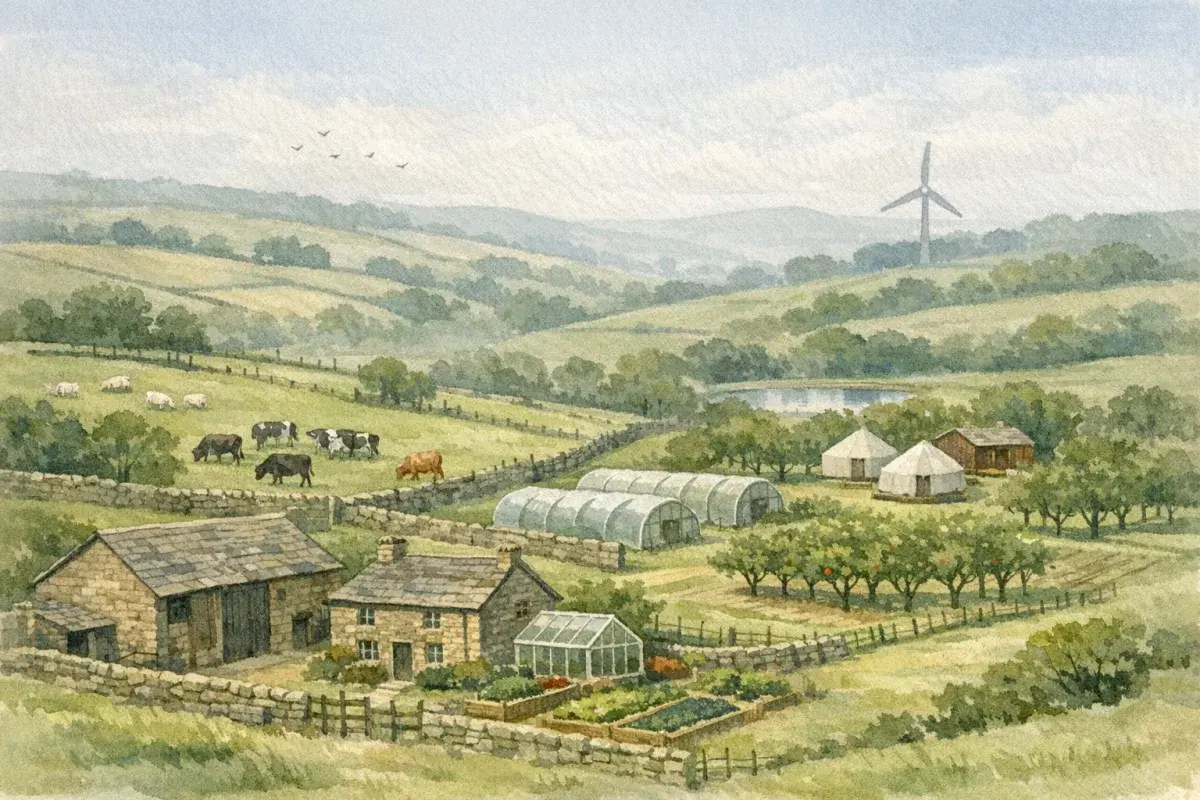
Farm diversification tends to start with a straightforward question, "Can I make this pay without undermining the farm?", and very quickly turns into a planning question.
Because in the UK, diversification usually means intensifying use: more visitors, more vehicles, longer operating hours, different noise and lighting patterns, maybe even a new building or a change of use. Planning permission isn't there to stop you: it's there to control impact. The problem is that rural proposals often fail for avoidable reasons: the wrong planning route, weak evidence, or a scheme that doesn't respect constraints like access, landscape sensitivity, flood risk or neighbours.
This guide cuts through the moving parts so you can choose the right route, assemble a "planning-ready" case, and keep control of risk, cost and timescales, whether you're adding storage, tourism, workspaces, equestrian, or renewables.
What Counts As Farm Diversification (And Why Planning Often Follows)
Farm diversification is any activity that broadens your income beyond (or alongside) core agriculture, typically by using land, buildings, or the farm's location in a new way. In practice, LPAs (Local Planning Authorities) don't judge "diversification" as a buzzword: they judge development: change of use, operational development (building/engineering works), and material changes in how a site functions.
A useful rule of thumb: if your idea changes what happens on the land (use), what stands on the land (buildings/infrastructure), or how often/when it happens (intensity), planning tends to follow.
Common Diversification Routes: Tourism, Storage, Commercial Lets, Equestrian, Renewables
Most UK diversification schemes sit in a handful of buckets:
- Tourism & short stays: holiday lets, glamping, camping, farm experiences.
- Storage & yards: container storage, caravans/boats, small business yards.
- Commercial lets / workspaces: workshops, makerspaces, rural offices.
- Equestrian: stables, ménages, livery, shows/training.
- Renewables & utilities: solar, battery storage, anaerobic digestion (AD), private wire/grid connections.
Each has a different planning "risk signature". A tiny rural workspace in an existing building might be simple. A wedding/events venue can be a planning marathon because it amplifies traffic, noise, lighting, and late hours.
If you're still sense-checking options, it's worth mapping ideas to planning reality early. We've seen strong projects start with a simple shortlist and then get refined once you understand what the LPA will actually care about. The options in our farm diversification ideas breakdown are a good starting point for that initial filter.
Planning Versus Other Consents: Licensing, Building Regs, Highways, Environment
Planning is only one gate. Many diversification projects stumble because people treat planning approval as "job done". In reality you may also need:
- Building Regulations (e.g., conversions, new build, structural changes, fire safety, accessibility).
- Highways approvals (new access, altered visibility splays, crossing a verge, passing places, parking layout).
- Environmental permits/consents (certain waste activities, water discharge, fuel storage, AD, protected species).
- Licensing (alcohol sales, late-night refreshment, events, certain holiday let requirements depending on use).
- Private rights (easements, ransom strips, covenants) and public rights of way considerations.
And then there's tax and business structuring (VAT, business rates, reliefs), not planning matters, but they can change the whole viability picture.
The practical takeaway: treat diversification as a compliance bundle. Planning is often the headline, but your timeline and cost are usually set by surveys, highways, drainage, ecology, and building control as much as by the planning decision itself.
Start With The Planning Baseline: What You Can Do Without Full Permission
Before you pay for drawings and reports, establish your baseline: what you can do under permitted development rights (PDR), what needs prior approval, and what will require a full planning application.
This isn't about "gaming" the system. It's about choosing the correct route, because the wrong route wastes months.
Permitted Development Rights For Farms: Part 6 Basics And Key Limits
For many farms, the starting point is Part 6 of the GPDO (General Permitted Development Order), which grants PDR for certain agricultural buildings and operations, subject to size thresholds, siting rules, and (often) prior approval.
A few realities we see repeatedly:
- PDR is tied to agricultural units and agricultural purposes. If the end use is tourism, general storage, or commercial lets, you're often outside pure agricultural PDR.
- PDR is threshold-driven (floorspace, height, location, proximity to roads/settlements) and conditions-driven (materials, siting, removal in some cases).
- PDR can be restricted by Article 4 Directions, protected landscapes, and specific local policy constraints.
If you need a clearer grounding on when agricultural development falls within PDR, the guide to planning rules for farm buildings goes deeper into the typical limits and pitfalls.
Prior Approval Triggers: Siting, Design, Traffic, Contamination, Flood Risk
Even where PDR applies, prior approval (sometimes called prior notification/approval) can be the make-or-break step.
Expect scrutiny on:
- Siting and design: is the building tucked into existing groups, or isolated and prominent?
- Highways impact: will HGVs, deliveries, staff vehicles or visitor traffic materially change?
- Contamination: especially on former yards, fuel storage areas, or sites with historic uses.
- Flood risk and drainage: surface water management is a frequent sticking point, even outside mapped flood zones.
A common trap: assuming "prior approval" is a rubber stamp. It isn't. It's a focused review that can still derail a scheme if you haven't done the assignments.
When A Lawful Development Certificate Helps (And When It Doesn't)
A Lawful Development Certificate (LDC) can be invaluable in two scenarios:
- To confirm lawfulness of something you believe is permitted development (proposed) or already exists (existing).
- To de-risk a transaction or funding by providing a formal decision notice you can point to.
But an LDC has limits:
- It doesn't grant planning permission for development that isn't lawful in the first place.
- It won't rescue a scheme where the real issue is material change of use or impacts that need assessing under a full application.
If you're unsure what you can do "as of right", it's worth reading the more detailed explainer on what you can build on agricultural land without full planning, it's often the quickest way to avoid expensive false starts.
Picking The Right Planning Route For Your Diversification Project
Choosing the right route is a strategy decision as much as a technical one. The "best" route is usually the one that:
- fits the proposal honestly (no strained arguments),
- matches your timescale and risk appetite,
- and leaves you room to operate without being strangled by conditions.
Prior Notification, Full Application, Or Change Of Use: How To Decide
As a working framework, ask three questions:
- Are you building something new or making engineering changes?
- New buildings, access works, hardstanding and services can trigger either PDR/prior approval or full permission.
- Are you changing the use of a building or land?
- Tourism, B8 storage, flexible commercial, equestrian and events commonly involve change of use.
- Will the intensity change?
- Ten car movements a day is a different proposal to two hundred on Saturdays.
When you're moving from agricultural to something else (especially residential or visitor accommodation), the route matters a lot. If a conversion is on the table, the nuance around Class Q versus full planning is important, and the detail in our guide on agricultural-to-residential routes and pitfalls can help you decide whether you're looking at a realistic pathway or an expensive dead end.
Pre-Application Advice, Planning Performance Agreements, And Early Red Flags
Pre-app can feel like a tax on momentum, but for rural diversification, it often saves money.
Use pre-app to test:
- Principle of development (is it policy-aligned?)
- highways appetite (access upgrades, visibility, passing places, junction capacity)
- landscape/ecology constraints (designations, habitats, lighting sensitivities)
- conditions you'll likely wear (hours, occupancy, use restrictions)
If the scheme is complex (events, major renewables, mixed-use yard), a Planning Performance Agreement (PPA) can be worthwhile. It formalises engagement and can stop your proposal sitting in a queue with no dialogue.
Early red flags to take seriously:
- "We'd struggle with principle in this location."
- "Highways are unlikely to support intensification on that lane."
- "You're in the setting of a heritage asset / within a highly sensitive landscape."
None of these necessarily mean "stop". They mean "design around it", or change the plan before you sink cost.
Section 106, Conditions, And Overage: What May Get Attached To Consent
For diversification projects, the control is often in the fine print.
- Planning conditions can restrict:
- hours of operation,
- number of occupiers/units,
- types of events,
- external lighting,
- noise limits,
- landscaping delivery and maintenance,
- travel plans and signage.
- Section 106 obligations are more typical where there's a clear need to secure mitigation (highways works, habitat management, sometimes affordable housing in residential-led schemes). They're less common for small diversification, but not unheard of.
- Overage isn't a planning mechanism, but it often sits alongside diversification when land is sold with uplift triggers if planning is granted or value increases. If you're buying or selling, make sure your solicitor and agent treat overage as a live commercial issue, not boilerplate.
The practical point: negotiate conditions. A condition that looks harmless ("no external storage") can make a storage-led scheme unworkable.
Site Constraints That Commonly Make Or Break Rural Applications
Most refusals aren't because the idea is "bad". They happen because the proposal collides with one or two hard constraints the application didn't address properly.
Green Belt, AONB, National Parks, SSSI, Heritage Assets, And Setting
Constraints don't automatically block diversification, but they raise the evidence bar.
- Green Belt (England): the emphasis is on openness and preventing urban sprawl. Reuse of existing buildings is often easier than new build, but "easier" doesn't mean easy.
- AONB / National Parks: landscape character and visual impact dominate. Materials, massing, lighting and traffic matter more than you'd expect.
- SSSI and protected habitats: even small changes (lighting, access tracks, drainage) can have ecological implications.
- Listed buildings and conservation areas: significance, setting, and detailing are critical: "farm vernacular" isn't a free pass.
A practical tactic: treat designated and sensitive areas as a design brief, not an obstacle. Keep development close to existing built form, reduce skyline impact, and commit to measurable mitigation.
Access And Highways: Visibility Splays, HGV Movements, Parking, Rights Of Way
Highways is the quiet kingmaker in rural planning.
Planning officers and highways teams will typically focus on:
- Visibility splays at the access (and whether land control makes delivery realistic).
- Junction geometry and whether larger vehicles can turn in/out safely.
- Passing places and whether the lane can cope with opposing flows.
- Parking and turning: cars shouldn't reverse onto the highway: service vehicles need space.
- Public rights of way: reroutes are possible but sensitive: conflicts with visitors, horses and machinery can become a real operational headache.
If your diversification depends on a busy visitor turnover (cafés, events, glamping, holiday lets), you're effectively in transport planning territory, even if the site "feels" remote.
Neighbour Impacts: Noise, Odour, Lighting, Hours Of Use, And Amenity Buffers
In the countryside, neighbours are often closer than they look on a plan.
Diversification triggers predictable concerns:
- Noise: plant and machinery, music, late-night departures, delivery beepers, animal noise in equestrian.
- Odour: food uses, waste storage, or intensified traffic around existing livestock operations.
- Lighting: bollards, festoons, security lights and illuminated signs can be more contentious than the building itself.
- Hours and frequency: an occasional open day is different from weekly events.
You'll usually do better by proposing controls yourself (downward lighting, hours, management plan, clear parking layout) rather than waiting for the LPA to impose them.
Turning A Concept Into A ‘Planning-Ready’ Case
A planning-ready diversification proposal reads like a calm, competent operations plan, not a wish list.
When LPAs refuse rural schemes, it's often because the application doesn't answer basic questions: Who will use it? How often? How will it be managed? What's the impact on landscape, traffic, neighbours, and ecology?
The Core Evidence Pack: Need, Use Case, Operational Details, And Management Plan
Your evidence pack will vary by project, but the strongest applications usually include:
- A clear description of the use: what exactly is happening, by whom, and when.
- A management plan:
- booking/arrival controls,
- refuse and recycling,
- noise policies,
- lighting strategy,
- supervision/staffing,
- complaints procedure.
- Highways note: trip generation, parking numbers, visibility.
- Drainage approach: surface water strategy and foul drainage.
- Phasing: what happens first, and what triggers later phases.
One insider tip: quantify the "small" things. "Occasional events" reads like risk. "Up to 12 events per year, max 120 guests, 10:00–22:30" reads like control.
Design In The Countryside: Materials, Landscape Mitigation, And Biodiversity Net Gain
Good rural design isn't about making everything look like a barn. It's about siting, scale, and restraint.
- Keep new built form near existing clusters.
- Use materials that weather well (and don't glare).
- Design lighting as if you expect it to be scrutinised, because it will be.
- Think about seasonal views: a hedge that screens in summer can be transparent in winter.
On Biodiversity Net Gain (BNG) in England: many development types now require measurable biodiversity uplift, with a minimum 10% requirement for applicable schemes. Whether your project triggers BNG, and how it's calculated, depends on the development type and exemptions, so treat it as a technical item to confirm early with your ecologist and planning consultant.
Viability And Alternatives: Demonstrating Why The Proposal Is Reasonably Necessary
LPAs don't typically approve proposals just because they're profitable. But they do respond to:
- reuse of existing buildings (resource efficiency),
- support for rural jobs and services,
- keeping farms viable (a strong narrative when backed by facts),
- proposals that avoid scattered development and protect landscape character.
Where policy asks for "need" or justification, avoid vague statements like "the farm needs extra income". Explain:
- what pressures you're responding to (input costs, tenancy constraints, labour, markets),
- why this specific location and form is the least harmful option,
- and what you'll do to keep impacts under control.
In other words: you're not begging for permission. You're demonstrating you've designed a responsible rural business.
Diversification Project Types: What Planning Officers Usually Look For
Planning officers are pattern-spotters. They've seen the same project types evolve, sometimes badly, so they'll probe for "creep": the slow expansion from something modest into something that changes the area.
Below are the typical pressure points, and how to head them off.
Barn Conversions And New Rural Workspaces: Flexibility Versus Creep
Conversions and workspaces often perform well in planning terms because they reuse existing structures and can support local employment. But the details matter.
Officers will look for:
- Is the building capable of conversion without major rebuild? Heavy reconstruction can undermine "reuse" arguments.
- What's the use class / nature of occupation? Low-intensity office/workshop differs from general industrial.
- External changes: doors, windows, parking areas, lighting, signage.
- Onward pressure: will this create demand for more units, more hardstanding, more access works?
If your route involves converting a barn (for workspace, visitor use, or potentially residential), it's worth understanding where Class Q can apply and where it can't. Our barn conversion planning guide digs into the deal-breakers that commonly sink applications (access, flood risk, heritage, and whether the building is genuinely eligible).
Glamping, Farm Shops, Cafés, And Events: Seasonality, Traffic, And Controls
Tourism-led diversification can be brilliant, and also the quickest way to trigger neighbour objections and highways pushback.
Glamping and camping
Key questions you'll be assessed on:
- location and visibility in the wider landscape,
- access suitability and passing places,
- lighting, noise, and guest behaviour management,
- foul drainage and surface water,
- biodiversity impacts (especially on semi-natural grassland).
If glamping is your route, build your plan around controls from day one. The practical lessons in our glamping diversification guide are rooted in what LPAs and neighbours actually react to, not just what looks good on a brochure.
Farm shops and cafés
These often succeed where they:
- serve a clear local function (not just a destination that pulls heavy traffic down unsuitable lanes),
- have safe access and enough parking,
- manage deliveries, refuse, and odour,
- keep signage and lighting countryside-appropriate.
Events (weddings, festivals, corporate days)
Events are rarely "just a marquee". The LPA will focus on:
- frequency and cap on guest numbers,
- hours and noise controls,
- traffic management and stewarding,
- lighting strategy,
- toilets, waste, and emergency access.
Holiday lets
Holiday accommodation is very achievable in the right place, but it's heavily scrutinised for occupancy, traffic, design, and amenity. If this is your plan, don't wing it, the specifics in our guide to planning for farm holiday lets can save you from the classic mistakes (like underestimating access, overpromising "low impact", or forgetting management realities).
Renewables And Infrastructure: Solar, Batteries, Anaerobic Digestion, And Grid Issues
Renewables can be a strong diversification pillar, but planning risk increases with scale and infrastructure.
Solar (ground-mounted)
Expect scrutiny on:
- landscape and cumulative impact,
- glint and glare (in certain contexts),
- ecology and habitat management,
- construction traffic,
- decommissioning and restoration.
Battery storage
Often assessed on:
- fire safety strategy and access for emergency services,
- visual screening,
- noise (inverters/cooling),
- proximity to sensitive receptors.
Anaerobic digestion (AD)
AD is usually planning-and-permits heavy. Officers will look closely at:
- feedstock sourcing and HGV movements,
- odour management,
- digestate storage and spreading routes,
- surface water and contamination risks,
- visual impact of tanks and flare stacks.
Grid
Here's a very real-world constraint: you can get a planning consent and still be stuck if the grid connection is delayed or prohibitively expensive. Treat grid feasibility as an early stage due diligence item, not a post-consent footnote.
The Application Process Step By Step (So You Stay In Control)
A calm planning process is usually the result of two things: (1) getting the right team, and (2) sequencing tasks so you don't commission reports you don't need.
Surveys And Drawings: What You'll Likely Need From Agents And Consultants
Your exact list depends on the development type and sensitivity of the site, but commonly includes:
- Location plan, site plan, existing/proposed drawings (and sometimes 3D visuals for landscape sensitivity)
- Design and Access Statement (where required)
- Planning Statement tying the proposal to local and national policy
- Transport statement/assessment and a visibility plan
- Flood Risk Assessment (where relevant) and drainage strategy
- Ecology: preliminary ecological appraisal, protected species surveys as needed
- Heritage statement if there are listed buildings or setting impacts
- Noise assessment for plant, events, or sensitive neighbours
- Lighting assessment where dark skies/amenity is a concern
The sequence matters. For example, ecology and highways can dictate the layout, so lock those down before you over-invest in architectural polish.
How Validation, Consultation, And Determination Actually Play Out
Once submitted, the LPA will:
- Validate the application (checking plans, forms, fee, certificates, and required reports).
- Consult statutory bodies (highways, environment, ecology, parish council where relevant) and notify neighbours.
- Assess against policy and material considerations.
- Determine under delegated powers or at planning committee.
In a straightforward case, you're aiming for a clean validation and a steady run through consultation. In reality, "stop-the-clock" requests for more information are common, particularly where highways or drainage hasn't been nailed down.
A practical tip: keep a single, organised thread of communication and document revisions carefully. LPAs are juggling huge caseloads: your job is to make your proposal easy to understand and hard to misinterpret.
Refusals, Appeals, And Variations: Your Options If The LPA Says No
A refusal isn't the end, but it is a signal.
Your options usually include:
- Resubmission with a revised scheme (often the fastest route if issues are fixable).
- Appeal to the Planning Inspectorate (cost and time can be significant: success depends on the refusal reasons and policy context).
- Non-material/minor material amendments if permission exists but needs tweaks.
- Variation/removal of conditions (Section 73 in England) where a condition is overly restrictive.
Treat appeals strategically. If the issue is truly local (e.g., substandard access with no land control to fix it), an appeal may simply rubber-stamp the refusal. If the LPA has misapplied policy or ignored robust evidence, an appeal can be justified.
Whichever side you're on. Buyers tell AgLand what they're looking for and hear the moment something fits. Owners advertise straight to the buyers who already match, for one flat fee and no commission. Register as a buyer or check your matches.
Conclusion
Planning permission for farm diversification is rarely about whether your idea is "allowed" in the abstract. It's about whether you can prove, in a grounded, site-specific way, that the proposal fits the countryside, functions safely, and won't create unmanaged impacts.
If you do three things well, you tilt the odds heavily in your favour: pick the correct planning route, take constraints seriously (especially highways and landscape), and submit an application that reads like a controlled operation rather than a concept.
And if you're still at the stage of shaping the right project, or looking for a holding that actually suits your plan, you can register free with AgLand.co.uk, set out the sort of holding your plan needs, and hear the moment something matching is advertised - with no commission on either side.
Disclaimer: AgLand.co.uk is a UK agricultural land and rural property matching service, where buyers register what they are looking for and owners advertise directly to the buyers who match, and a rural resource hub. Nothing in this text is intended as legal, financial, tax, or investment advice. Planning and regulatory requirements vary by site, proposal, and nation/authority within the UK and can change over time. You should carry out your own due diligence and seek advice from suitably qualified professionals (for example, a planning consultant, rural surveyor, solicitor, highways engineer, ecologist, and tax adviser) before acting on any information here.