
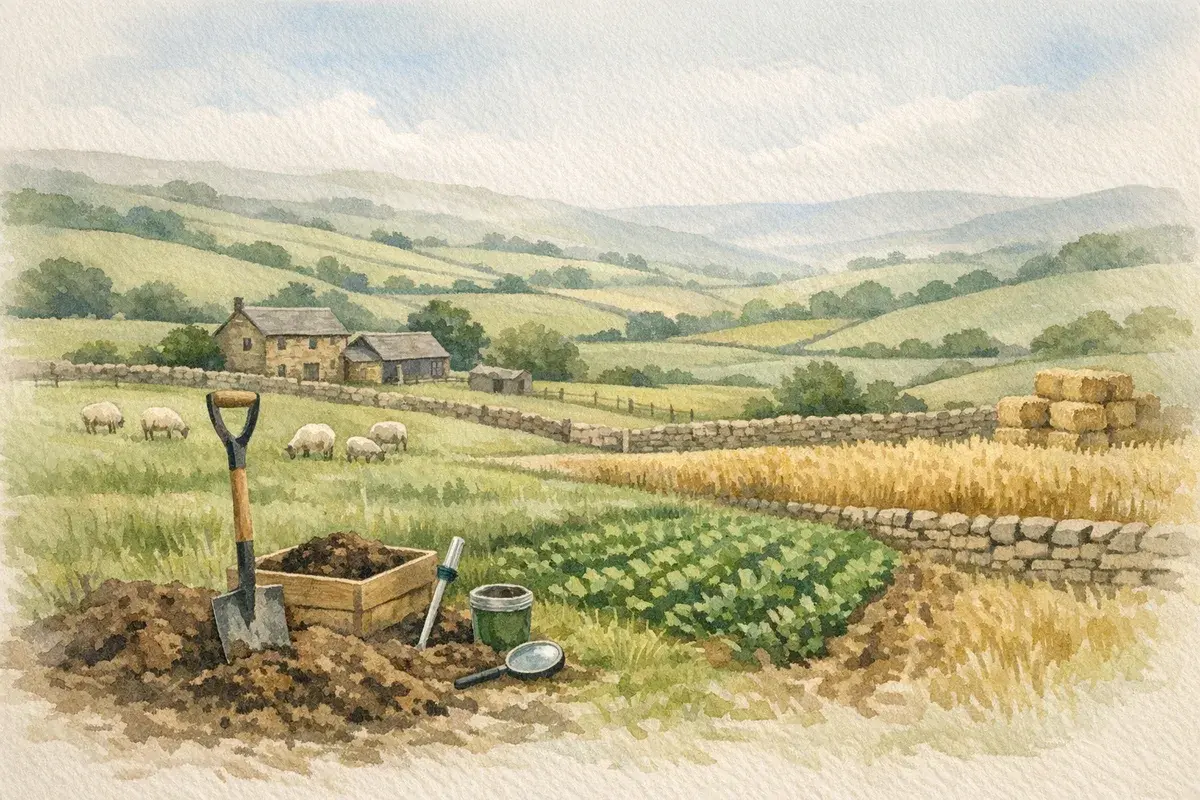
You can fake a lot in a land advert. Freshly topped hedges. A tidy gateway. Even a smart-looking reseed.
You can't fake soil for long.
Whether you're buying a block of arable, negotiating a Farm Business Tenancy, or weighing up a long-term rural investment, soil quality on agricultural land is the thing that quietly decides what's possible, and what's going to cost you. It shapes yield stability, grazing days, machinery timeliness, compliance risk, and (increasingly) your options under environmental schemes.
This guide is written for UK land decisions: practical, field-based, and deal-aware. We'll pin down what "good soil" actually means, how to assess it properly before you commit, what the common constraints look like in reality, and how to improve soil without tripping over water rules, tenancy terms, or unintended consequences.
What “Soil Quality” Means In A UK Farming And Land-Buying Context
Soil quality is one of those phrases everyone uses, but people often mean different things depending on whether they're growing wheat, finishing cattle, or trying to make a land purchase stack up.
In a UK context, it's best to think of soil quality as how well the soil performs the jobs you need it to do, reliably, within UK weather patterns and UK regulation. That includes producing crops or grass, draining (but not dumping sediment into a brook), supporting machinery without smearing, and storing carbon and nutrients in a way that doesn't create pollution.
Soil Health Vs Soil Fertility Vs Soil Condition
These terms get swapped around, but separating them helps you ask better questions during viewings and negotiations.
- Soil fertility is the nutrient side: pH, phosphorus (P), potassium (K), magnesium (Mg), and trace elements, plus how available those nutrients are. A soil can test "high P" yet still grow a disappointing crop if structure is poor or pH is wrong.
- Soil condition is the physical state on the day: compaction, capping, drainage performance, or damage from trafficking. Condition can change quickly (one wet autumn can undo years of care).
- Soil health is the wider, longer-term functioning: biology, organic matter, aggregation, resilience, nutrient cycling, essentially whether the soil system is improving or running down.
When you're assessing soil quality agricultural land for a deal, you need all three. Fertility can be corrected, but fixing structure and drainage, especially with limited outfalls, can be slow and expensive.
The Practical Outcomes That Matter: Yield, Workability, Resilience, And Compliance
From a decision-making angle, soil quality matters because it determines:
- Yield and output stability: not just a good year, but performance across wet springs, dry Junes, and late harvests.
- Workability and timeliness: whether you can drill, spread, graze, or cut silage when you need to, rather than when the soil finally allows it.
- Resilience: soils with good structure and organic matter cope better with drought, intense rainfall, and traffic.
- Compliance and inspection risk: runoff, poaching, soil erosion, and nutrient losses are increasingly visible and enforceable.
And it links to value in a very UK way: land that stays workable through a typical British season has a habit of being the land that attracts better tenants, offers more rotation choices, and holds demand when markets wobble.
If you're also trying to tie soil back to formal grading, it helps to understand the UK's Agricultural Land Classification system and what it can, and can't, tell you. AgLand's explainer on how ALC grades are used in practice is worth reading before you treat a map as gospel.
The Building Blocks Of Soil Quality
Soil quality isn't one metric. It's a bundle of physical, chemical, and biological characteristics interacting with your climate, your cropping, your kit, and your management.
If you're trying to compare fields (or whole farms), it helps to break things down into the components below, and to be honest about what's "inherited" (texture) versus what's "created" (structure).
Texture, Structure, And Compaction
- Texture is the proportions of sand, silt, and clay. You can't change it without moving soil, so it largely sets the ceiling for what's possible.
- Structure is how those particles are arranged into aggregates and pores. Structure can be improved or ruined.
- Compaction is the most common, most expensive-to-ignore limiter in UK farming, often layered (surface capping plus deeper pans from historic ploughing or heavy traffic).
Practical tell: texture tells you what the soil is, structure tells you what you've done to it.
Organic Matter, Biology, And Nutrient Cycling
Soil organic matter (SOM) is the quiet enabler:
- better aggregation and workability
- improved water holding (critical on lighter land in dry spells)
- more stable nutrient cycling and less "boom/bust" growth
- more biological activity (earthworms are still the best free indicator you'll ever get)
You don't need to chase a single "perfect" SOM percentage. You do need to know whether SOM is rising, stable, or falling, and whether biology is being supported (roots, residues, living cover) or starved (bare fallows, repeated intensive cultivations, compaction).
pH, Nutrient Status, And Salinity Risk
For most UK mineral soils, pH is the master switch for nutrient availability. If pH is drifting down, you'll see knock-on problems that look like "low fertility" but are actually lock-up.
Core points for deal-making:
- pH correction (lime) can be straightforward, if access is good and spreading is feasible.
- High soil indices aren't automatically good news. Very high P can create regulatory and scheme complications, and it may reflect historic stocking pressure or manure imports.
- Salinity risk is localised in the UK, but can matter on some coastal marshes and reclaimed ground. It's less common than structure/drainage issues, but when it exists it tends to be persistent.
Drainage, Wetness, And Erosion Vulnerability
UK soil performance is often a drainage story.
- Drainage includes natural permeability, topography, and artificial systems.
- Wetness isn't just "it's a heavy soil". It may be blocked outfalls, collapsed laterals, compacted headlands, or springs.
- Erosion vulnerability depends on slope, soil type (silts are notorious), ground cover, and gateway/runoff pathways.
A field that looks fine in July can be a mess in November. If you can, view land in a wet period, or at least ask for photos and cropping history that prove how it behaves when it's properly tested by a British winter.
For broader capability, especially where altitude, exposure, and climate shorten the season, this deeper look at agricultural land capability helps put "soil quality" into the wider production context.
How To Evaluate Soil Quality Before Buying, Letting, Or Investing In Land
If you're serious about soil quality, don't rely on a single impression or a single report. Use a layered approach: desk research, a proper walkover, then targeted testing.
Start With Desk Research: Soilscapes, ALC, Flood Risk, And Historic Land Use
Start broad, then get specific.
- Soilscapes (from Cranfield/NSRI) gives a useful first steer on dominant soil types and typical limitations.
- Agricultural Land Classification (ALC) data, published by Defra, can indicate likely versatility, but mapping is not always field-accurate and may be based on older surveys.
- Flood risk mapping matters for cropping reliability, grass utilisation, insurance, and long-term resilience.
- Historic land use: former orchards, railway sidings, landfill, industrial uses, or intensive livestock yards can leave legacies (compaction, nutrients, contaminants).
If you're using ALC mapping as part of your filter, it's worth understanding the limitations of an ALC map view and when you'll need a site-specific assessment rather than a screen-based assumption.
Walk The Land: What Good And Bad Soils Look Like In The Field
A proper walkover is where you pick up the stuff a lab won't tell you.
Look for:
- Surface condition: capping, crusting, slumping, and how quickly water infiltrates after rainfall.
- Headlands and gateways: these are compaction "truth zones". If they're battered, assume the rest of the field needs scrutiny too.
- Crop clues: patchiness, tramline ponding, shallow rooting, poor tillering, or weedy corners can all signal underlying issues.
- Smell and colour: grey mottling and a sour smell can indicate prolonged waterlogging: healthy topsoil often has a richer colour and a more "earthy" smell.
- Field drainage evidence: outfalls, ditches, silt build-up, and whether drains are discharging after rain.
If the holding includes land that's clearly struggling, it's not automatically a deal-breaker. But you should treat it as a different asset class with a different plan. AgLand's guide to poor quality agricultural land is a useful sense-check on what "poor" often means in practice, and what it can still be good for.
Sample And Test Properly: P, K, Mg, pH, SOM, And Compaction Checks
Testing is where you move from "feel" to evidence.
At a minimum, you want:
- pH and key macronutrients (P, K, Mg) with soil indices
- Soil organic matter (ask the lab what method is used: keep it consistent over time)
- Compaction assessment: spade tests, a penetrometer (used sensibly, moisture affects readings), and digging inspection pits in representative areas
Practical sampling tips:
- Sample by management zones (soil type, historic mucking, traffic patterns), not just "one sample per field".
- Avoid gateways, manure heaps, and headlands unless you're deliberately testing those as risk areas.
- If you're comparing farms, insist on recent results and ask whether they reflect current boundaries and rotations.
Interpret Results In Context: Rotations, Livestock, Irrigation, And Machinery System
A soil report isn't a scorecard: it's a diagnostic.
Ask yourself:
- Does this soil suit your intended rotation? (A soil that struggles with late-harvested roots may be perfectly fine for spring cropping and grass leys.)
- Are you bringing livestock? Stocking changes compaction risk, nutrient cycling, and compliance exposure.
- Is irrigation relevant? On some lighter soils, water access is what unlocks consistent output, but abstraction and infrastructure can be the limiting factors.
- What's your machinery system? Wider kit, higher axle loads, and tight drilling windows can punish soils that are already marginal.
If you're trying to join the dots between soil, grade, and what that means for planning/strategy, you may also want a clear method for identifying the land's official grade. This step-by-step on how to check a field's land grade helps you avoid common mistakes (like relying on a neighbouring farm's classification or a low-resolution map layer).
What Soil Quality Means For Value, Rents, And Deal Risk
Soil quality doesn't just affect your agronomy: it affects the deal you're about to sign.
Put bluntly: soils that are consistently workable, respond predictably to inputs, and carry traffic without damage tend to command stronger values and rents, because they protect income.
Cropping Options And Gross Margin Headroom
Better soils don't guarantee profit, but they give you more ways to make profit.
- Wider rotation choice (winter crops, spring options, roots, veg in some areas)
- Better utilisation of fertiliser and manures (less lost to waterlogging/runoff)
- More reliable establishment and harvest windows
In England, land commonly described as "best" often aligns with BMV (Grades 1, 2 and 3a), but the reality is field-by-field. If you're assessing genuinely top-end land, this deep dive on Grade 1 agricultural land in the UK is useful for understanding what tends to make it perform, and what can still go wrong (like compaction and drainage neglect).
Hidden Costs: Remedial Works, Drainage, Lime, And Access Infrastructure
This is where people get caught out: the land looks fine, but the first two seasons are a repair job.
Common hidden costs include:
- Drainage repairs: tracing and fixing laterals, renewing outfalls, or re-cutting ditches (and doing it without damaging protected features)
- Lime programmes: not just product cost, haulage, spreading access, and timing
- Subsoiling/loosening: only effective if you address the cause of compaction and do it in the right conditions
- Track and gateway upgrades: small spend compared to crop losses from constant rutting and delayed operations
If you're buying, these costs should feed directly into your offer price and your first-3-years cashflow. If you're taking a tenancy, they should feed into the heads of terms.
Tenancy And Heads Of Terms: Who Pays For Improvements And Who Benefits
Soil improvements create a classic tenant/landlord tension: you might pay for work now, but the benefit may outlast your term.
Before you commit, get clarity on:
- Responsibility for drainage (maintenance vs capital renewal)
- Lime and fertility: whether you're expected to maintain indices, and what happens at waygo
- Reseeding and sward improvement on grass
- Record-keeping: what evidence you'll need to support compensation or to demonstrate you haven't depleted the holding
This is where good professional advice and properly drafted terms matter. A "handshake understanding" feels friendly, right up until you're at the end of the term with a dispute about dilapidations, nutrient status, or whether that new track counts as an improvement.
And remember: soil quality has reputational weight. Agents and neighbours often know which farms "carry" in a wet year and which ones always end up with ruts and delayed drilling. In rural markets, that local knowledge travels.
Common UK Soil Constraints (And The Real-World Fixes)
Most UK soils don't fail because they're inherently "bad". They fail because something is out of balance: traffic, drainage, pH, organic matter, or surface cover.
Here are the constraints we most often see when land is being assessed for sale, letting, or a change of system, plus the fixes that actually work on farms (not just on paper).
Compaction And Poor Structure From Traffic
What it looks like
- Standing water in tramlines
- Shallow rooting and drought stress even when rainfall has been decent
- Smearing and cloddy seedbeds that never quite reconsolidate
Real-world fixes
- Reduce axle loads where possible, and avoid "one more pass" in borderline conditions
- Move to controlled traffic principles if your system and field shapes allow
- Targeted loosening only when soil moisture is right, and only if you're also preventing re-compaction
- Build structure biologically: deeper rooting species in leys/cover crops, leaving residues, maintaining living roots
Low pH And Nutrient Lock-Up
What it looks like
- Poor clover performance in grass
- Sluggish crops even though fertiliser applications
- Moss and sorrel in some grassland situations (not definitive, but often a clue)
Real-world fixes
- Base liming on current soil tests, field zones, and realistic spreading access
- Consider maintenance liming little-and-often where big applications are impractical
- Don't ignore magnesium balance, dolomitic lime can be appropriate on Mg-deficient soils, but it's not a universal answer
Poor Drainage, Waterlogging, And Outfall Limitations
What it looks like
- Grey mottles in the profile, smelly anaerobic layers
- Spring "coldness" and delayed growth
- Compaction getting worse every winter because the soil never properly dries
Real-world fixes
- Start with outfalls and ditches: if water can't leave, nothing else matters
- Map and test existing systems (many farms have drains that are simply unknown or unmapped)
- Address the compaction that's preventing infiltration, drainage and structure are linked
- Be realistic about constraints: high water tables, protected watercourses, and downstream capacity can limit what's feasible
Erosion, Capping, And Runoff To Watercourses
What it looks like
- Rills on slopes after heavy rainfall
- Sediment at the bottom of fields, silted ditches, muddy yard outflows
- Seedlings struggling through a sealed surface
Real-world fixes
- Keep soil covered: overwinter cover crops, earlier drilling where appropriate, or leaving more residue
- Break runoff pathways with buffer strips, in-field grass strips, or tramline management
- Improve aggregate stability with organic matter and reduced destructive cultivation
Contamination And Diffuse Pollution Risks
This is less common than structure/drainage problems, but it matters hugely in due diligence.
Potential sources:
- historic industrial use, infilled ground, or legacy dumping
- agrochemical stores, fuel tanks, sheep dip areas
- high nutrient hotspots from old yards, feed areas, or heavy mucking
Fixes and mitigations depend on what you're dealing with. Sometimes it's a straightforward management change: sometimes it's a red flag requiring specialist environmental advice and potentially significant remediation.
If part of the holding is marginal in ALC terms (steep, wet, shallow, peaty, or otherwise constrained), it can still be productive, but usually in a different role. For realistic options, see what tends to work in practice on Grade 5 land uses, because forcing the wrong enterprise onto the wrong soil is one of the fastest routes to disappointment (and damaged structure).
Improving Soil Quality Without Creating New Problems
Soil improvement is full of "it depends", but there are some reliable principles.
- Protect structure first (because once it's damaged, everything else is harder).
- Keep living roots in the ground more of the year.
- Add organic matter strategically, not blindly.
- Measure progress so you're not farming by nostalgia.
Rotations, Cover Crops, And Staying Green Longer
Rotations are your biggest lever because they control rooting depth, residue returns, cultivations, and the timing of traffic.
Practical approaches that often work well in the UK:
- Use spring cropping (where it fits the business) to create repair windows after wet autumns
- Include temporary leys to rebuild structure and biology, especially after roots or heavy trafficking
- Choose cover crops for a purpose: rooting (radish), biomass (oats), N-fixation (legumes), or soil armour (mixes)
The catch: cover crops aren't magic if you establish them badly, graze them when soils are vulnerable, or create a termination headache that pushes you into poor drilling conditions.
Organic Amendments: FYM, Slurry, Compost, And Digestate, Benefits And Controls
Organic inputs can transform soil condition, but only if you manage them like a nutrient plan, not a waste disposal route.
- FYM improves structure and biology, but nutrient supply is variable and timing matters.
- Slurry is valuable but can increase compaction risk (tanker traffic) and ammonia loss if poorly applied.
- Compost can boost stable organic matter: quality and contamination risk vary.
- Digestate offers readily available nutrients but can push indices up quickly and needs careful handling.
Build these into a plan that considers:
- soil indices and risk of nutrient build-up
- access and traffic in wet months
- proximity to watercourses and slopes
- storage capacity and application windows
Cultivation Strategy: Minimum Till, Strip Till, Ploughing, And When Each Fits
There isn't a single "best" cultivation system for all UK soils.
- Minimum till can preserve structure and reduce erosion risk, but can struggle on some heavy soils if drainage is poor or residue management is weak.
- Strip till can be a strong compromise where you want disturbance only where the crop needs it.
- Ploughing still has a place: resetting weedy fields, dealing with surface compaction, incorporating organic matter, or where specific crops demand it.
The common failure mode is switching system without changing the basics, traffic management, drainage, rotation diversity, and patience.
Managing Grassland Soils: Sward Health, Poaching, And Reseeds
Grassland hides soil problems until it doesn't.
If you're running livestock, focus on:
- Grazing discipline: back-fencing, avoiding poaching conditions, and accepting that sometimes you need to house earlier
- Sward diversity: deep-rooting species can improve structure and drought tolerance
- Reseeds: don't reseed into compaction and expect a miracle: fix physical issues first
A "good grass field" in a dry July can still be a compaction pan with poor infiltration. Dig.
Measuring Progress: KPIs, Re-Testing Cycles, And Record-Keeping
If you don't measure it, you'll end up arguing with yourself in five years.
Useful soil-quality KPIs:
- SOM trend (consistent method, consistent sampling zones)
- pH and indices (P, K, Mg)
- earthworm counts (simple spade test at the same time each year)
- infiltration checks (even basic field observations after heavy rain)
- compaction depth and severity (repeatable pit locations)
Re-test fertility typically every 3–5 years (or more often if you're making big changes), and keep a clean record of amendments, yields, grazing days, and trafficking decisions. It's not just good farming, it can be vital evidence during tenancy changeovers, scheme inspections, or future sale due diligence.
Rules, Standards, And Schemes That Now Shape Soil Management
In the UK, soil management is no longer just "best practice". It's increasingly shaped by enforceable rules and scheme requirements.
The important mindset shift: you're not only managing soils for production, you're managing them to avoid pollution, document decisions, and meet scheme standards.
Farming Rules For Water, Nutrient Planning, And Slurry Storage Realities
England's Farming Rules for Water, enforced by the Environment Agency (with equivalent regulatory expectations elsewhere in the UK), put real emphasis on preventing agricultural pollution. That includes how you handle nutrients and how you prevent runoff and erosion.
In practical terms, this affects:
- when and where you apply manures and fertiliser
- how you manage high-risk fields (slopes, compacted ground, waterlogged soils)
- what you can realistically do with slurry if storage is tight and weather turns
This is where soil quality and compliance overlap: compacted, bare, or eroding soils are not just a yield problem, they're a risk.
Cross-Compliance Successors, SFI/ELM, And What Inspectors Typically Look For
Since the Basic Payment Scheme has been phased down in England, scheme participation (like SFI within ELM) is more central to many farm plans.
Although scheme rules change and differ across the UK, inspectors typically focus on practical evidence:
- soil protection measures in high-risk periods
- records of nutrient applications and rationale
- visible signs of erosion, runoff, or poor practice around watercourses
- whether what you said you'd do is what you actually did
If you're building a long-term strategy around high-quality land, it helps to understand how land is framed as "versatile" and why it matters for both production and wider land-use pressures. AgLand's guide to best and most versatile agricultural land puts that into plain English.
Protected Areas And Constraints: SSSIs, NVZs, SAMs, And Peatland Considerations
Constraints aren't always obvious on a viewing day.
Depending on location, you may need to account for:
- SSSIs (Site of Special Scientific Interest): operations may be restricted and consent from Natural England may be required.
- NVZs (Nitrate Vulnerable Zones): additional nutrient management and closed periods can apply where designated.
- Scheduled Ancient Monuments (SAMs): cultivation depth and ground disturbance can be constrained.
- Peatland: high organic soils can be productive in the right use, but they're sensitive, can subside when drained, and may sit within tightening environmental expectations.
Before you commit to buying or taking on a tenancy, make sure these constraints are identified early. They can change not only what you want to do, but what you're allowed to do, and they can influence the cost and feasibility of soil improvement works.
Working With The Right Professionals Before You Commit
Good soil decisions are rarely made in isolation. The trick is knowing when you can handle the assessment yourself, and when you're about to step into a situation where independent expertise will save you money (or save you from a bad commitment).
When To Bring In A Land Agent, Agronomist, Or Independent Soil Consultant
Consider bringing in professional support when:
- the land is expensive (or the margins are tight), so small errors matter
- you're seeing conflicting signals (good indices but poor crops: good-looking land with persistent wet spots)
- you're planning a system change (e.g., moving to heavier kit, adding livestock, switching cultivation approach)
- drainage and water management look uncertain
- tenancy terms need to reflect improvement plans fairly
A good land agent helps you frame soil quality in the deal: what it means for price, rent, and negotiation. An agronomist brings crop performance and nutrient planning insight. An independent soil consultant can provide a more neutral diagnosis, particularly on compaction, drainage, and remediation priorities.
Surveys And Reports That Add Clarity: Drainage, Environmental, And Cropping Capability
Reports that often add real clarity include:
- Drainage surveys: mapping, outfall checks, and repair recommendations
- Targeted soil pits and profile assessments: showing structure, rooting depth, pans, and wetness indicators
- Environmental and constraints checks: protected areas, historic land use red flags, and diffuse pollution risk
- Cropping capability assessments: especially where you're relying on the land to carry a certain rotation
If you're buying or renting at scale, it's also worth standardising what you ask for, so you're comparing like with like across opportunities.
Whichever side you're on. Buyers tell AgLand what they're looking for and hear the moment something fits. Owners advertise straight to the buyers who already match, for one flat fee and no commission. Register as a buyer or check your matches.
Conclusion
Soil quality isn't a "nice to have" when you're dealing with UK agricultural land. It's the asset.
If you take one practical approach forward, make it this: treat soil like a due diligence topic, not just an agronomy topic. Do the desk research, walk the land properly, dig holes, test strategically, and price the risks honestly, especially drainage, compaction, and access.
Then, once you're in control of the ground, improve it with a plan that fits your system and your constraints. The best soil strategies in the UK aren't flashy. They're consistent, measured, and realistic about weather.
Disclaimer: AgLand.co.uk is a UK agricultural land and rural property matching service, where buyers register what they are looking for and owners advertise directly to the buyers who match, and a rural resource hub. Nothing in this text is intended as legal, financial, or investment advice. You should carry out your own due diligence and seek guidance from suitably qualified professionals (for example, land agents, agronomists, surveyors, solicitors, and tax advisers) before making decisions.