
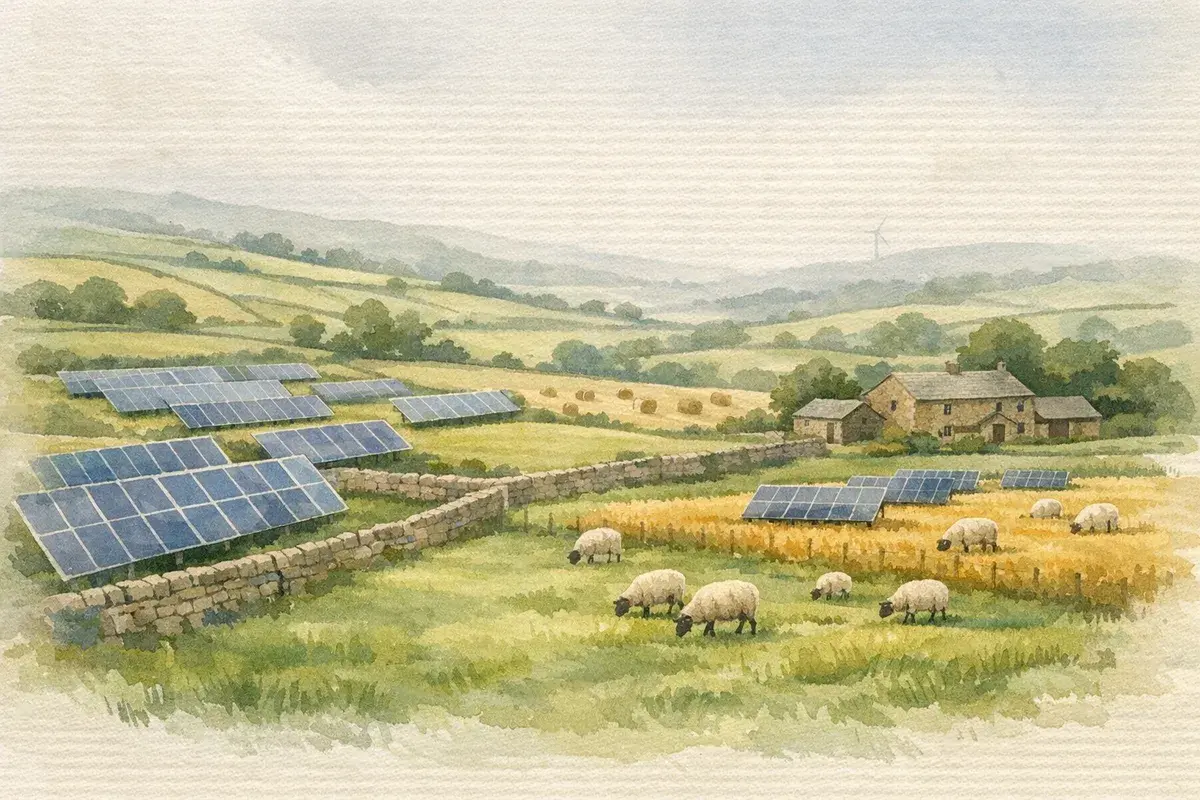
You don't need telling that UK farming margins can feel like they're being squeezed from every angle: input costs, labour, weather volatility, and an energy market that's been anything but predictable. So it's no surprise that agrivoltaics (pairing solar PV with ongoing agricultural use) has moved from "interesting concept" to a serious boardroom and farm-kitchen-table conversation.
But here's the catch: plenty of schemes get marketed as "dual-use" when, in practice, they behave more like a conventional solar farm with a bit of grass underneath. If you're going to consider agrivoltaics in the UK, whether as a landowner, tenant, investor, or buyer, you need a clear view of what it is, where it genuinely works, what planning officers and lenders actually look for, and how to structure a deal that won't come back to bite you.
This guide cuts through the sales talk and focuses on what you'll face in reality: land suitability, planning and compliance, grid strategy, design choices that protect farming output, and the legal/tax questions you'll want answered early.
What Agrivoltaics Means In A UK Farming Context
Agrivoltaics (sometimes written "agri-PV") is the deliberate co-location of solar photovoltaic generation and agricultural production on the same land area, designed so farming remains credible and operational, not token.
In a UK context, the phrase matters because agricultural land is heavily scrutinised in planning terms under the National Planning Policy Framework, and because long-term land decisions are tangled up with tenancy, subsidies/replacement schemes, inheritance planning, and lender requirements. If you're exploring agrivoltaics UK opportunities, your core question shouldn't be "Can I get panels in a field?" It should be:
- Can you maintain meaningful agricultural output and access?
- Can you evidence that to planning and, later, to valuers/lenders?
- Can the scheme survive day-to-day farming realities, machinery, livestock behaviour, drainage, and soil health, over 30–40 years?
How Agrivoltaics Differs From Standard Solar Farms
A standard ground-mounted solar farm is primarily an energy project with land management as a secondary concern. Yes, many include sheep grazing or conservation planting, but the agricultural activity is often limited by:
- low panel clearance heights that restrict machinery
- close row spacing that limits workable area
- security fencing layouts that fragment fields
- construction methods that can compact soil and disrupt drainage
True agrivoltaics flips that logic. The agricultural system is designed in alongside the PV, often requiring higher structures, wider spacing, different array orientations, and a farm plan that stands up to scrutiny.
A practical way to think about it: if you removed the PV tomorrow, would your farming system still make sense? And if you removed the farming element, would the planning argument weaken significantly? In genuine agrivoltaics, the answer to both is usually "yes".
Common UK System Types: Elevated, Spaced-Row, Vertical, And Polytunnel-Style PV
You'll see a few agrivoltaics "families" discussed in the UK market. Each has trade-offs.
- Elevated arrays (high-clearance structures): Panels mounted higher to allow machinery, people, or livestock to pass underneath. These can work well where you need access for mowing, spraying, harvesting, or regular stock checks, but they're typically more expensive and visually prominent.
- Spaced-row arrays (wider inter-row corridors): A more common UK compromise: rows are spaced to preserve cropping lanes or grazing patterns. You're often balancing energy yield per acre against agricultural practicality.
- Vertical bifacial PV (fences of panels): Panels arranged vertically (often east–west), potentially reducing shading footprints and allowing conventional machinery access between "panel lines". These designs can be interesting where you want to keep the land mostly open, but they bring their own challenges around wind loading, security, and animal interaction.
- Polytunnel-style PV / PV-integrated horticulture: Think protected cropping with PV integrated into tunnel structures or glazing-like systems. In the UK, you'll most often see this discussed for higher-value horticulture where power demand (cold storage, packing) aligns with generation.
None of these is automatically "best". What matters is whether the layout and management plan genuinely protects your enterprise.
Why Interest Is Rising: Farm Resilience, Energy Costs, And Policy Direction
Interest in agrivoltaics UK projects is rising for three very down-to-earth reasons:
- Resilience and diversified income: A second revenue stream can stabilise the business through poor seasons.
- Energy as a farm input: For some enterprises, electricity has become a major cost (or constraint). Generating on-site can be transformational, especially where grid capacity is limited.
- Policy direction and local pressure: While planning remains site-specific and sometimes contentious, the broader direction of travel is toward decarbonisation and domestic energy security. The schemes that fare best are the ones that can show they're not undermining food production and landscape character.
If you're a landowner or buyer thinking ahead, agrivoltaics is increasingly part of the "highest and best use" conversation, provided it's done properly.
Where Agrivoltaics Works Best In The UK (And Where It Usually Doesn’t)
Not every field is a candidate. In fact, one of the quickest ways to waste money is to push a scheme onto land that looks fine on a map but fails once you consider access, soil, designations, and grid reality.
Land And Farm Factors: Soil, Slope, Access, Drainage, And Machinery Clearances
Start with what your farm will tolerate for the next few decades.
- Soil type and condition: Heavier clays can be workable, but construction traffic and trenching can cause lasting compaction if not managed. Free-draining soils are often easier, but you still need a plan for rutting, erosion, and maintaining organic matter.
- Slope and aspect: Mild slopes can work. Steeper, complex topography usually increases cost (groundworks, pile design, access tracks) and can amplify landscape impact, making planning harder.
- Access and highway interface: Can HGVs reach the site during construction without unacceptable impacts? During operation, can you access for maintenance without compromising field operations?
- Drainage and water pathways: Arrays can change how water moves, drip lines, concentrated run-off, and altered evaporation patterns. If you already have wet corners or legacy drainage issues, you need to confront that upfront.
- Machinery clearances: If your farming system relies on modern kit, measure it. Sprayers, vegetable rigs, telehandlers, and trailers don't negotiate with low steelwork.
A simple rule: if you can't describe exactly how you'll farm the land post-build, week by week, season by season, you're not ready.
Enterprise Fit: Arable, Horticulture, Livestock, And Mixed Farms
Different enterprises tolerate shading and restricted movement differently.
- Livestock (especially sheep): Often the most straightforward fit under lower-clearance arrays, but "straightforward" isn't "automatic". You'll need a grazing plan, water provision, fencing strategy, and realistic expectations about poaching risk and parasite management.
- Arable: Possible under elevated or carefully spaced systems, but the bar is higher. You'll need workable tramlines, turning space, and a credible plan for compaction control and safe operations around electrical infrastructure.
- Horticulture: Can be compelling where PV supports energy-hungry operations (irrigation, refrigeration, packing), but horticulture also demands frequent access and higher standards of soil management.
- Mixed farms: Often best placed because you can flex land use, grazing at some times, fodder crops or herbal leys at others, depending on what the layout allows.
Constraints To Flag Early: Designations, Grid Proximity, And Neighbour Impacts
Three constraints tend to make or break UK agrivoltaics sites early:
- Planning designations: National Landscapes (formerly AONBs), National Parks, Sites of Special Scientific Interest (SSSIs), listed settings, and scheduled monuments can all raise the burden of proof dramatically.
- Grid proximity and capacity: Being near overhead lines isn't the same as having capacity. Some areas have long queues and expensive reinforcement requirements. A site that's perfect agronomically can be a dead end electrically.
- Neighbour and community impacts: Glint and glare, views, traffic during construction, and cumulative impact (other schemes nearby) matter. You don't have to win a popularity contest, but you do need a defensible position.
If you're looking at land specifically with energy potential in mind, use specialist rural search tools and get constraints mapped early. On AgLand.co.uk, you register the sort of site you're after - type, acreage, budget and area - and you're alerted the moment an owner or agent advertises something that matches, so you can shortlist intelligently before you pay for reports.
Planning, Consents, And Compliance: What You’ll Face In Practice
In the UK, agrivoltaics lives or dies on planning and consenting. The "right" design isn't just engineering, it's evidence.
The Planning Route: Local Policy, National Guidance, And Evidence You'll Need
Most agrivoltaics schemes will require full planning permission. Permitted development rights that apply to certain agricultural buildings don't usually give you a free pass for large-scale PV arrays.
In practice, you should expect to demonstrate:
- Why this site: Alternatives, constraints, and a clear rationale.
- How agricultural use is maintained: A farm management plan that reads like it was written by someone who's actually operated a drill or managed a grazing rotation.
- Landscape and visual impact mitigation: Layout, screening, setbacks, and design choices.
- Construction method and soil protection: Traffic management, timing, compaction controls, and reinstatement.
Local plan policies vary widely. Some authorities are supportive if food production is protected: others are more cautious, particularly where landscape sensitivity is high. Either way, the schemes that progress tend to be the ones that do the assignments early, pre-app discussions, photomontages, and a coherent agricultural case.
Environmental And Heritage Considerations: Ecology, Landscape, And Archaeology
Environmental compliance isn't box-ticking. It's often the reason schemes get delayed.
- Ecology: You may need habitat surveys (and the timing matters, miss the survey window and you can lose months). Biodiversity net gain requirements may apply depending on the development and local approach. Even where not mandatory, credible biodiversity enhancement can strengthen the application.
- Landscape: Landscape and Visual Impact Assessments (LVIAs) are common on larger schemes. The key is not just "can it be screened?" but "does it change the character of the place?"
- Heritage and archaeology: Desk-based assessments are typical: field evaluation may be required if there's potential for archaeological remains. This can affect layout and groundworks methodology.
If your site has known sensitivities, you're better off designing around them than hoping they won't be noticed.
Tenure And Legal Checks: Freehold, FBT, Easements, And Mortgage Consent
Before you get seduced by yield projections, check the basics.
- Freehold vs tenancy: If the land is under a Farm Business Tenancy (FBT) or other arrangement, you'll need to confirm what's permitted and who controls development rights. Consent may be required from the landlord or tenant depending on structure.
- Easements and wayleaves: Existing rights for utilities, private rights of way, and access arrangements can constrain layout.
- Mortgage lender consent: If the land is charged, the lender will typically need to consent to leases, options, and grid easements. Lenders may also have conditions around decommissioning security.
A good rural solicitor will push you to line these up early. It's cheaper to find a deal-breaker in week two than month eight.
Designing A Bankable Agrivoltaics Scheme
A bankable scheme is one that works technically, stacks up commercially, and still functions as a farm. The "farm" part is where many proposals quietly fall over.
Defining The Agricultural Case: Maintaining Output And Operational Practicality
If you want agrivoltaics to be more than branding, you need an agricultural case that's specific and measurable.
Consider documenting:
- baseline yields or stocking rates (what happens now)
- the proposed system (what will happen under/around arrays)
- how you'll manage rotation, access, and inputs
- monitoring commitments (photographic records, production data)
Planning officers and consultees respond better to evidence than assurances. And if you ever sell the farm or refinance, that documentation becomes part of your story.
Layout Decisions That Matter: Height, Row Spacing, Tracking, And Access Lanes
Small design choices make big differences over 30–40 years.
- Height/clearance: Higher isn't always better, but insufficient clearance can make the agricultural element meaningless.
- Row spacing: Wider spacing supports cropping and reduces bottlenecks for livestock movement and machinery, but it reduces panel density. The right answer depends on your farm economics, not just PV output.
- Tracking systems: Trackers can increase generation but add moving parts, complexity, and sometimes a larger visual footprint. They also change shading patterns, which can be good or bad depending on crops.
- Access lanes and turning heads: You need realistic turning circles and maintenance routes that don't cut across your farm workflow. If a contractor has to drive across your best ground every time there's an inverter alarm, you'll feel it.
Don't let the CAD drawing become "the farm". Make the farm the starting point.
Water, Soil, And Animal Management Under Arrays
Under-array management is where agrivoltaics becomes real.
- Water: Shading can reduce evapotranspiration, which sounds helpful, until you concentrate run-off and create wet strips. Design drainage and ground cover with intention.
- Soils: Insist on a soil management plan for construction and operation, protect topsoil, control trafficking, and plan reinstatement. If you're on heavier land, timing of works can be the difference between a tidy build and a decade of compaction.
- Animals: Sheep can work well, but you'll need to think about:
- panel height vs rubbing behaviour
- fencing that keeps stock in and deters dogs/people out
- water supply and trough placement
- biosecurity and safe access for checks
If you're aiming for cattle or more intensive systems, the engineering and risk profile changes again. Make sure your insurer is part of the conversation, not an afterthought.
Grid Connection And Power Strategy: Export, Self-Use, Storage, And Curtailment
You can have the perfect agrivoltaics design and still end up stuck because the grid doesn't play ball. In many parts of the UK, grid capacity and timelines are the real bottleneck.
DNO Process And Timelines: From Budget Quote To Connection Offer
Your local Distribution Network Operator (DNO) controls the process for most connections.
Typically, you'll go through:
- Initial feasibility / budget estimate: A first look at whether capacity exists and what reinforcements might be needed.
- Formal application: More detailed technical submissions.
- Connection offer: Including costs, programme, and technical conditions.
Timelines can be lengthy, and offers can come with eye-watering reinforcement costs. You should also expect that constraints and queue management approaches evolve, so what was possible a year ago may not be possible today (and vice versa).
If you're evaluating land for agrivoltaics UK potential, don't accept hand-waving about "a substation nearby". Get a grid strategy early and treat it as a core risk.
On-Farm Use Cases: Irrigation, Cold Stores, Grain Drying, And EV Charging
Self-use can be the difference between a marginal project and a strong one, especially where export is constrained.
Common UK farm use cases include:
- Irrigation pumps (particularly where summer demand aligns with solar generation)
- Cold stores and packhouses for horticulture
- Dairy operations (milking, refrigeration, hot water)
- Grain drying and handling (note: seasonal alignment matters)
- Workshop power and machinery charging
- EV charging for farm fleets, staff, or diversified rural businesses
The trick is matching generation profiles with demand. A good advisor will model your half-hourly consumption, not just annual totals.
Battery Storage And Private Wire Options: When They Stack Up
Storage and private wire arrangements can unlock value, but they add complexity.
- Battery storage: Can help you shift energy to higher-value periods, reduce peak import, and manage curtailment risk. But it's capital intensive and increasingly scrutinised in planning and fire safety terms.
- Private wire: Supplying power directly to a nearby user (another farm enterprise, rural business park, or processing facility) can improve economics if export terms are poor. It also brings legal agreements, metering, and sometimes additional consents.
Be cautious with assumptions. Storage revenues and constraints change as markets and regulations evolve. Treat projections as scenarios, not promises.
Economics And Deal Structures: Rents, Revenue Shares, And Risk Allocation
Agrivoltaics isn't just an engineering project: it's a long-term property and risk allocation exercise. The "best" deal is the one that fits your objectives and your tolerance for operational hassle.
Typical Commercial Models In The UK And Who Takes Which Risk
In the UK market, you'll commonly encounter:
- Option and lease to a developer/operator: You grant an option (developer secures planning/grid), then a long lease if it proceeds. You typically receive option fees and rent. Developer takes much of the planning and build risk, but you're tying up land.
- Rent plus revenue share: A base rent with an uplift linked to generation or income. This can align incentives, but it also introduces reporting, audit rights, and arguments over curtailment and downtime.
- Landowner-led project (you develop): Higher potential returns, but you take on development risk, capital requirements, and operational responsibilities. This route can suit sophisticated operators with the right professional team.
Whatever the model, make sure risk is explicitly assigned. "We'll sort it out later" has a habit of becoming expensive.
Heads Of Terms To Scrutinise: Indexation, Access, Dilapidations, And Decommissioning
Heads of Terms (HoTs) are where bad deals quietly begin.
Key clauses to scrutinise include:
- Rent review and indexation: What index? Any caps/collars? How often?
- Access rights: Routes, timings, reinstatement obligations, and whether access interferes with farming.
- Damage and compensation: Crops, drainage, tracks, gates, and biosecurity breaches.
- Insurance and liability: Who insures what, and at what levels?
- Dilapidations and reinstatement: What condition must the land be returned in?
- Decommissioning security: Is there a bond or escrow? Who holds it? How is it triggered?
If you're the landowner, decommissioning is not theoretical, it's your land at the end of the term. If you're a buyer, it's a future liability you're inheriting.
Valuation, Finance, And Lender Requirements For Rural Property
Expect lenders and valuers to ask awkward but sensible questions:
- Does the lease restrict saleability or refinancing?
- How is income evidenced and how secure is it?
- Are there break clauses or step-in rights?
- What happens if the operator fails?
Some lenders treat long leases and energy infrastructure as a complication: others are comfortable if documents are robust. Either way, you'll want RICS-aligned valuation advice and lender engagement early, especially if the farm is already leveraged.
If you're buying land with an existing or proposed scheme, build these checks into your offer strategy and timescales. A "cheap" parcel can become very expensive once you factor in constraints and obligations.
Tax And Rural Reliefs: Getting Specialist Advice Early
Tax is where well-meaning diversification can create unpleasant surprises. With agrivoltaics UK projects, you're mixing land, long leases, and potentially significant non-farming income, so you need specialist advice that understands rural reliefs.
Income Tax Vs Capital Treatment, VAT Position, And Accounting Practicalities
How income is taxed depends on structure and facts.
- Lease rents are typically treated as income.
- Option fees and other payments can have different treatments depending on the agreement and circumstances.
- VAT: The VAT position can be complex, particularly where you have a mix of exempt and taxable activities and where you're investing in infrastructure.
You'll want your accountant to look at cashflow timing as well as tax timing. And if you're registered for VAT, consider partial exemption implications.
Inheritance Tax: APR, BPR, And The Risk Of Losing Reliefs
Inheritance Tax (IHT) planning is often a key driver for landowners.
- Agricultural Property Relief (APR) and Business Property Relief (BPR) can be highly valuable, but they're sensitive to how land is used and how businesses are structured.
- Long leases, changes in the character of occupation, or a drift away from agriculture can put reliefs at risk.
This is not an area for generic advice. You need a tailored view that considers occupation, management, and the precise terms of the agreements.
Capital Gains Tax And Land Restructuring: Rollover, Hold-Over, And Overage Considerations
If you're restructuring land, selling parcels, or granting rights, CGT considerations may arise.
Depending on circumstances, advisers may discuss:
- Rollover relief (where you reinvest in qualifying business assets)
- Hold-over relief (in certain gifting scenarios)
- Overage/clawback clauses where development value could be triggered later
The practical point: tax shouldn't be the tail that wags the dog, but it absolutely should inform how you structure the deal and what you agree in writing.
How To Assess A Site Step By Step Before You Commit
If you take one thing from this guide, make it this: the best agrivoltaics projects are methodical. You're trying to align farming, planning, grid, and finance, so you need a step-by-step process that surfaces deal-breakers early.
Desktop Due Diligence: Title, Constraints Mapping, And Grid Reality Checks
Before you spend heavily, tighten your desktop checks:
- Title review: Boundaries, rights of way, restrictive covenants, third-party rights, access.
- Tenure position: If tenanted, clarify who can grant options/leases and on what terms.
- Constraints mapping: Landscape designations, heritage constraints, public rights of way, ecology sensitivities.
- Grid check: Early DNO engagement and a realistic view of capacity, cost, and timeline.
If you're sourcing land, it pays to be specific about what you want rather than trawling the market. AgLand.co.uk is built for agricultural land and rural property: you register the acreage, access, and location profile that typically underpins viable schemes, then hear when something matching is advertised and validate it with proper due diligence.
On-Site Feasibility: Agronomy Input, Trial Plots, And Farm Trafficability
Desktop work doesn't tell you how the place feels under your boots.
On-site, you should assess:
- Trafficability: Where will construction traffic go, and what's the plan in wet periods?
- Drainage reality: Existing outfalls, wet spots, and how water moves through the field.
- Shading and microclimate: Shelter belts, hedges, and frost pockets that could affect both PV and cropping.
- Agronomy trials (where appropriate): If you're serious about cropping under arrays, trial plots or staged rollout can reduce risk.
Bring your farm manager or agronomist into the conversation early. If they're sceptical, listen, then see if design changes can solve the issue.
Choosing The Right Team: Agent, Solicitor, Planner, Surveyor, And Technical Advisor
Agrivoltaics sits at the intersection of multiple specialist disciplines. A typical "right team" includes:
- Agricultural agent/land agent with renewables and rural deal experience
- Rural solicitor (options, leases, easements, lender consents)
- Planning consultant with local authority experience and appeal awareness
- Surveyor (RICS-aligned valuation, compensation, reinstatement)
- Technical advisor/engineer (layout optimisation, yield modelling, grid interface)
- Tax adviser/accountant who understands APR/BPR and rural businesses
If you're looking for introductions, we regularly speak with specialist agents and rural professionals across the UK. The goal isn't to "sell you solar", it's to make sure you don't sign something today that blocks your options tomorrow.
One last practical tip: insist that key commitments (agricultural management, access routes, reinstatement standards, decommissioning security) are written into documents, not left as goodwill.
Conclusion
Agrivoltaics in the UK can be a genuinely powerful tool: a way to produce power and keep land working, rather than choosing one or the other. But it rewards precision.
If you're considering a scheme, anchor everything to three questions:
- Can you farm it properly for the full term? Not just "graze some sheep", but a credible, well-managed agricultural system.
- Can you consent it? Planning success usually comes from evidence, local awareness, and thoughtful design, not optimism.
- Can you connect and monetise the power sensibly? Grid capacity, curtailment, and use strategy will define the real economics.
Treat agrivoltaics as a land and business decision first, and a technology decision second. When you do that, supported by the right professional advice, you're far more likely to end up with a scheme that's resilient, financeable, and workable day to day.
Disclaimer
AgLand.co.uk is a UK agricultural land and rural property matching service, where buyers register what they are looking for and owners advertise directly to the buyers who match, and a rural resource hub. Nothing in this text is intended as legal, financial, tax, or investment advice. You should carry out your own due diligence and seek guidance from appropriately qualified professionals (for example, a rural solicitor, chartered surveyor, planning consultant, and tax adviser) before buying, selling, leasing, or developing land, or entering into any renewables-related agreement.