
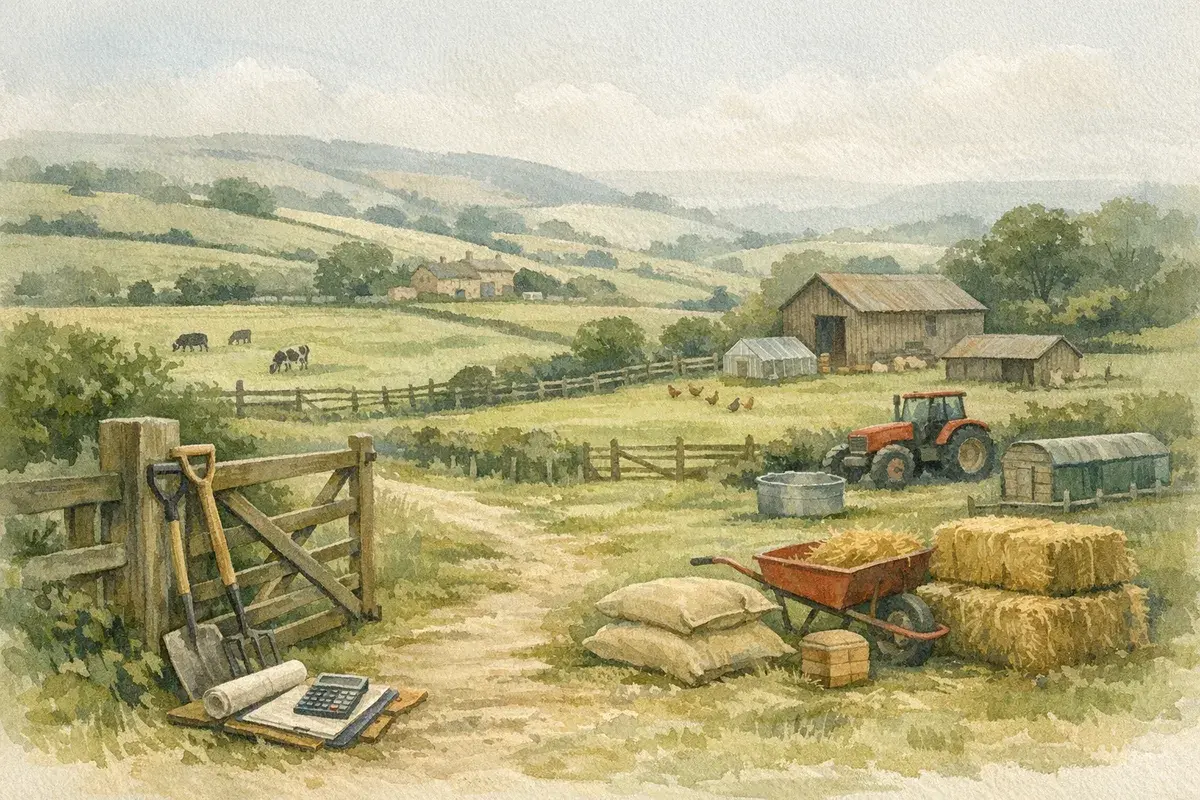
If you are wondering how to start a farm uk, the short answer is this: choose the right business model, secure suitable land, work out the numbers, and keep compliance tight from day one. That sounds simple, but the details matter, and small mistakes on land, stock, buildings, or cashflow can be expensive.
The good news is that farming can start in several ways, from livestock on rented grassland to horticulture, small-scale dairy, diversification, or a mixed enterprise with part-time other income. The best route depends on your budget, your skills, the local letting market, and whether you're buying, renting, or joining an existing family farm.
Before you sign anything, you need a realistic plan. What will you grow or rear, where will you sell it, what capital will it need, and how will the farm survive a bad season? Those are the right questions, and they matter just as much in Norfolk as they do in Devon, Dumfries and Galloway, or Northumberland.
Choose The Right Farm Business Model
The first decision is not where to buy land. It is what kind of farm you want to run. A viable start-up in the UK usually begins with one clear enterprise, then grows carefully once the basics are profitable and repeatable.
For many new entrants, the most realistic options are livestock grazing, small-scale arable, market gardening, or a mixed enterprise that combines production with diversification. In higher-rent areas such as parts of Surrey, Kent, and Oxfordshire, intensive horticulture or direct-to-consumer sales can make more sense than traditional broad-acre cropping. In upland counties like Cumbria, Lancashire, or Powys, sheep and beef systems often fit the terrain better.
We'd argue that scale is often overestimated by first-time buyers. A well-run 40-acre holding with a strong local market can outperform a poorly financed 200-acre purchase, especially if the latter leaves you short of working capital.
Match Enterprise To Local Ground And Market
Soil type, rainfall, access, and nearby buyers all shape what is realistic. Light sandy soils in Lincolnshire or parts of Cambridgeshire may suit potatoes, vegetables, or combinable crops, while heavier land in Somerset or Staffordshire may be better for grass-based livestock.
If you're selling through farm shops, box schemes, livestock markets, processors, or wholesale channels, location affects margin. A farm near Bristol or Edinburgh may support higher-value direct sales. A remote site in the Scottish Borders may rely more on efficient production and lower overheads.
- Low-capital start: Grazing livestock on rented pasture with existing fencing and water.
- Medium-capital start: Market garden, poultry unit, or small mixed farm with basic equipment.
- Higher-capital start: Dairy, arable, or irrigated horticulture with buildings and machinery.
- Lower-risk route: Contract farming or share farming before buying land outright.
Decide Whether To Buy, Rent, Or Enter Jointly
Buying land gives control, but it ties up capital. Renting is often more practical for new farmers, especially if you're testing a business model or building experience. Joint ventures, partnerships, and share farming can be a useful bridge, particularly where family land is available but succession is uncertain.
In counties such as Cheshire, Gloucestershire, and Herefordshire, good land is often tightly held and competitively priced. That can push new entrants towards tenancy, contract work, or a phased expansion plan rather than a full purchase on day one.
Understand Land, Tenancy, And Planning Rules
Once you know what you want to farm, the next step is securing the right land in the right legal structure. This is where many hopeful entrants get stuck, because the best field in the county is no good if the tenancy terms are weak, access is poor, or planning rules block the buildings you need.
A lot depends on whether land is coming on a short-term grazing licence, a farm business tenancy, a family arrangement, or an outright purchase. Each route has different rights, responsibilities, and risks. A grazing licence is usually simpler and shorter-term, while a farm business tenancy can provide more stability if you need to invest in the holding.
Planning matters too. A new livestock shed, slurry store, polytunnel, or packhouse may need permission, and county councils often interpret rural applications differently. In areas of high landscape sensitivity, such as parts of the Cotswolds, Snowdonia, or the South Downs, expect more scrutiny and longer timelines.
Check Boundaries, Access, And Water Rights
Do not rely on a quick viewing and a hand-drawn sketch. Check title plans, field accesses, rights of way, drainage, boundary responsibility, and whether there are easements for services. If stock water is limited, boreholes, mains connections, or consented abstraction can change the economics entirely.
For starting farmers, awkward access can be a hidden cost. A field locked behind third-party land may be cheap to rent, but it can be difficult to move feed, slurry, machinery, or livestock efficiently.
Assess Buildings And Infrastructure Properly
Useful buildings are worth their weight in gold, especially in wet counties where covered storage matters. A basic cattle shed, former dairy parlour, grain store, or packhouse can save years of capital spend, but only if the structure is sound and the layout fits your enterprise.
Look carefully at electricity supply, yard condition, hardstanding, fencing, handling facilities, silage clamps, and biosecurity. If you're starting in Cornwall or Devon, shelter and drainage can be just as important as acreage. In eastern counties, large fields and open exposure may make windbreaks or irrigation more valuable.
| Cost Area | Typical Range As Of August/2025 | What It Often Covers | Notes |
|---|---|---|---|
| Rented grassland | Varies by county | Grazing rights and basic access | Terms matter as much as headline rent |
| Basic livestock setup | Lower five figures to mid five figures | Fencing, handling, water, trailer | Heavily dependent on existing infrastructure |
| Small horticulture start | Mid five figures to low six figures | Polytunnels, irrigation, packshed, tools | Labour intensity is often underestimated |
| Purchased farmland | Highly location dependent | Land acquisition and legal fees | East and south-east generally command stronger values |
As of August/2025, farmland values and farm rents remain very location-sensitive, with improved land in the south and east typically stronger than marginal land in wetter western and northern counties. That makes local advice essential, because the same business can be viable in one county and shaky in another if the cost base changes too much.
Build A Realistic Farm Business Plan And Budget
You need a business plan, but not a glossy one. It should show how money comes in, where it goes out, and what happens if yields disappoint, markets soften, or feed costs rise. Farming is productive, yes, but it is also lumpy, seasonal, and exposed to weather and policy changes.
Start with your enterprise gross margin, which means sales minus direct variable costs such as seed, feed, fertiliser, vet bills, bedding, and packaging. Then work back to the overheads: rent, finance, power, insurance, labour, machinery, repairs, compliance, and your own drawings. If the numbers only work in a perfect year, they do not really work.
For a new starter, cashflow matters more than profit on paper. You can be profitable over twelve months and still run out of cash in month six if sales lag ahead of harvest or livestock sales are delayed.
Cost The Start-Up Properly
Budget for the obvious items, then add a contingency. Too many people forget accountancy, insurance, waste disposal, fuel, grading, animal health, training, and vehicle repairs. A sensible contingency is not a luxury; it is survival.
Also, remember that different enterprises burn cash at different times. Horticulture may need more labour up front, while livestock may require more working capital for feed and store stock. Arable farming often needs machinery investment, or dependable contractor rates.
Use A Simple Cashflow Model
A monthly cashflow sheet is more useful than a year-end forecast. It shows when rent, feed, wages, and loan repayments fall due against sales or subsidy income, which is vital when the season turns against you.
Ask yourself a practical question: if income is delayed by two months, can the business still pay bills? If the answer is no, the plan needs revising before you commit.
Typical starter costs vary widely, but the pattern is consistent. County, enterprise type, and whether land is inherited or rented will determine whether your start-up needs tens of thousands or several hundred thousand pounds. As of August/2025, finance is still available for well-structured proposals, but lenders will look hard at security, experience, and repayment capacity.
Find Funding, Grants, And Support For New Farmers
Funding is often the make-or-break issue. Many first-time farmers combine personal savings, family support, hire purchase, loans, grants, and off-farm income. That mix is common, and there's no shame in it. Farming has always been capital hungry.
Grant availability changes, so you should treat support as a bonus rather than the core of the plan. Environmental schemes, productivity grants, infrastructure funding, and innovation support may be available depending on location and enterprise type, but they are rarely fast money. Applications take time, paperwork, and patience.
If you are in Scotland, Wales, or Northern Ireland, support structures and scheme names may differ from England. That matters because a common mistake is assuming one county policy picture applies across the whole UK. It doesn't.
Consider Partnerships And Shared Risk
One of the more practical routes into farming is to start with someone else's land, kit, or stock. Share farming and partnership models can reduce entry barriers while giving you production experience and a route to future independence.
This can suit counties with expensive land markets, such as Hertfordshire, Berkshire, or parts of the Home Counties, where outright acquisition is difficult for newcomers. It can also work on family farms where succession is being phased over time.
Get The Right Professional Support
You do not need every adviser on day one, but you do need the right ones at the right time. A solicitor, farm business consultant, land agent, surveyor, and accountant can save money if they are briefed properly and used selectively.
That is especially true when dealing with tenancy terms, planning applications, environmental constraints, valuation issues, or business structure. A cheap mistake at the start can cost more than several years of advice fees.
Set Up Operations, Compliance, And First-Year Priorities
Once land and finance are in place, the job becomes operational. The first year is about proving the system, not maximising profit. Build gradually, keep records, and avoid overcomplicating the setup before you know the business works.
For animal enterprises, that means herd or flock health plans, movement records, identification, handling facilities, and suitable isolation space. For crops or horticulture, it means seed choice, rotation planning, spray records where relevant, irrigation, storage, and labour scheduling. For all farms, it means insurance, health and safety, and a clear paper trail.
If you want to farm properly from the start, treat compliance as part of production. It is not separate. A tidy system makes inspections easier, reduces stress, and usually improves management as well.
Prioritise Biosecurity And Animal Health
Good biosecurity is simply good housekeeping with a purpose. Keep visitors controlled, disinfect where needed, quarantine new stock, and reduce the chances of disease entering the holding. In livestock counties like Somerset, Shropshire, and Aberdeenshire, that discipline can protect both performance and reputation.
Animal health issues can wipe out margins quickly, so work with a vet on prevention, not just treatment. The same principle applies to crop pests and weeds. Prevention usually costs less than cure.
Build Sales Channels Early
Before the first crop is lifted or the first lambs are sold, know where buyers are coming from. A new farm can have excellent production and still struggle if sales channels are weak, inconsistent, or too narrow.
Think about livestock markets, processors, farm shops, wholesalers, local restaurants, box schemes, and on-farm sales. In counties with strong tourism, such as Dorset, Cornwall, and the Lake District fringe, direct selling can be powerful. In more production-focused areas, scale and consistency may matter more.
Conclusion: Start Small, Plan Hard, Stay Flexible
If you are asking how to start a farm uk, the answer is to begin with a viable enterprise, sensible land access, and a proper financial plan. The strongest starts usually come from matching the business to the ground, the county, and the market rather than chasing acreage for its own sake.
Be practical about costs, honest about risks, and disciplined about compliance. Farming rewards patience and good judgement, and the businesses that last are usually the ones that started carefully rather than spectacularly.
Disclaimer: AgLand.co.uk is a UK agricultural land and rural property matching service, where buyers register what they are looking for and owners advertise directly to the buyers who match, and a rural resource hub. Nothing in this text is intended as legal, financial, or investment advice. You should carry out your own due diligence and seek guidance from appropriately qualified professionals (for example, solicitors, land agents, surveyors, and financial advisors) for your specific circumstances.