
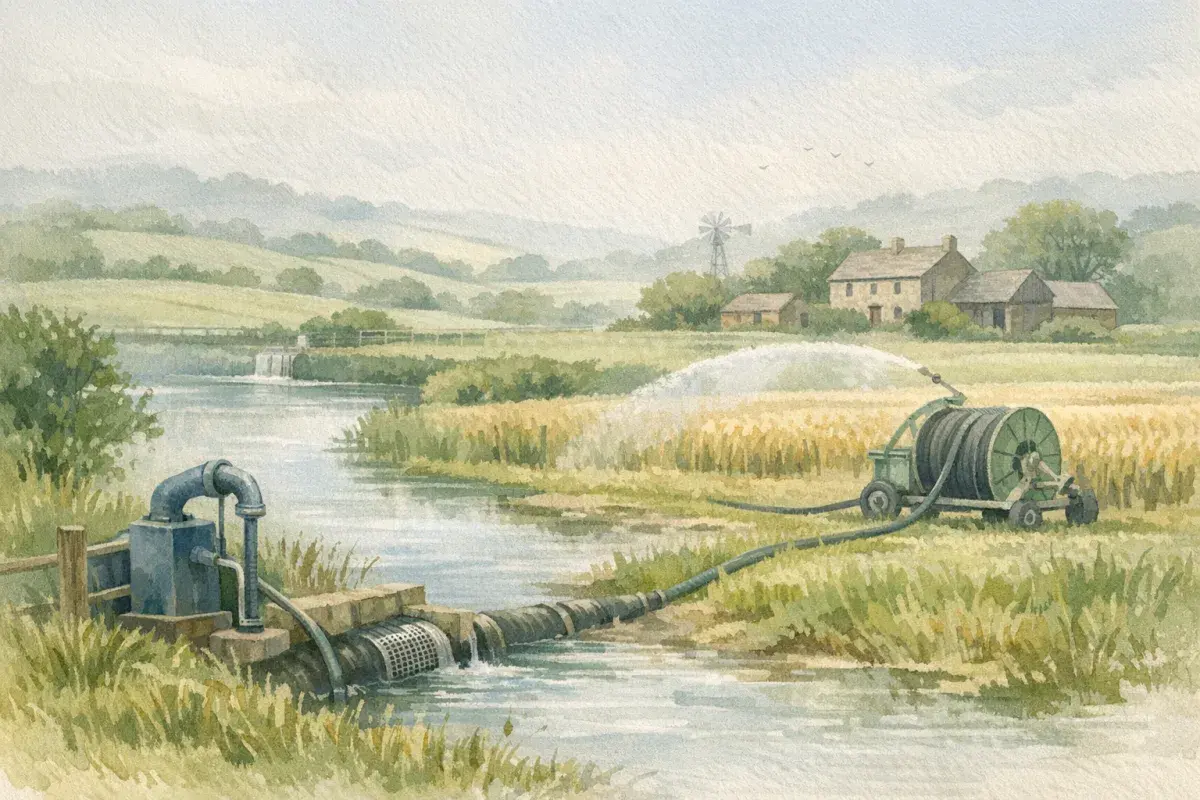
Water abstraction for crop farming is about taking water from rivers, streams, boreholes, reservoirs, or canals to irrigate crops lawfully and efficiently. Get it wrong and you can face delays, higher costs, or enforcement action; get it right and you protect yield, quality, and soil resilience.
The big question is simple: how do you secure enough water without overpaying or overcomplicating the farm business? The answer depends on crop type, soil, location, borehole or surface-water access, and whether you need a seasonal irrigation licence, a full abstraction licence, or no licence at all because of an exemption.
For arable and horticultural businesses, water has become a strategic input rather than a back-up. We'd argue it is now as important as seed choice on many farms, especially in eastern counties where spring droughts can bite hard and irrigation windows are short.
How Water Abstraction Works On UK Farms
In practical terms, abstraction means removing water from a natural or man-made source for on-farm use. For crop farming, that usually means irrigation, frost protection, wash water for produce handling, or occasionally stock and spray tank filling, though the rules can differ by use.
In England and Wales, many abstractions are regulated by the Environment Agency or Natural Resources Wales. The key test is often volume, source, and timing, because summer river flows can be tightly protected when crops need water most.
Surface Water, Groundwater, And Stored Water
Surface water includes rivers, streams, ditches, drains, lakes, and reservoirs. Groundwater is taken from boreholes or wells, and stored water usually means a farm reservoir that was filled earlier under a lawful abstraction right.
Each source has its own risk profile. Rivers can be vulnerable to low-flow restrictions, while boreholes depend on aquifer recharge and local geology, which is why a sandy fenland farm in Cambridgeshire faces different constraints from a heavy-land holding in Shropshire.
- Surface water: often easier to access near irrigable land, but more exposed to drought restrictions.
- Groundwater: useful for reliability, but drilling and pump costs can be significant.
- Stored water: gives flexibility and drought resilience, especially for high-value crops.
Why Volume And Timing Matter
Licensing often turns on how much water you take over a day or year, and when you take it. Summer abstraction proposals can face the toughest scrutiny because environmental pressure is highest exactly when irrigators want to pump.
That matters for crops such as potatoes, salad crops, soft fruit, onions, maize seed, and vegetables, where even a short dry spell can reduce marketable yield. In Kent, Lincolnshire, Norfolk, Suffolk, and East Anglia more broadly, that pressure is familiar and growing.
Licences, Exemptions, And Planning Permission
Most farms do not need to guess their way through abstraction rules, but plenty do. The right route starts with whether your proposed use is exempt, licensable, or tied to existing rights, and whether any storage or engineering work needs planning consent.
For crop farming, a licence is commonly needed where abstraction exceeds exempt thresholds or involves certain controlled sources. You may also need permission for reservoirs, pipelines, intakes, heads, pumps, and electricity connections, which can become a project in their own right.
Common Licence Types For Irrigators
Annual or seasonal abstraction licences can be suitable for farms with intermittent irrigation needs, while licence variations may be needed if you change volume, source, or point of abstraction. In some cases a transfer or variation process is required if rights come with land purchase or tenancy changes.
If you are buying a farm, do not assume the water is included in the right you think you are buying. A farm in Herefordshire, for example, might have land suited to horticulture but no lawful irrigation right beyond limited historic use (not ideal when planning soft fruit expansion).
- Seasonal licence: often used where demand is concentrated in the irrigation season.
- Full licence: may suit businesses needing a more established water right.
- Exempt abstraction: available only in limited circumstances and should be checked carefully.
Planning Permission And Reservoirs
Reservoirs are often the most practical long-term answer, but they can trigger planning, drainage, landscape, and ecology considerations. They may also require design input on embankments, clay lining, safety, and overflow control, which is why reservoir schemes tend to move more slowly than farmers expect.
In parts of Somerset, Lancashire, Cheshire, and the West Midlands, planning committees may look hard at visual impact, flood risk, and habitat implications. That does not mean approval is impossible. It just means strong evidence and good siting matter.
Costs, Market Value, And Business Returns
Water abstraction for crop farming has a direct cost and a wider business value. The direct cost includes application fees, surveys, meter installation, maintenance, power, and sometimes rent or compensation on tenanted land, while the wider value shows up in crop quality, yield stability, and better marketing options.
As of June/2026, the market is still rewarding farms with secure irrigation access, particularly where high-value cropping is the main enterprise. In practical terms, land with reliable water can command a premium because it reduces production risk and supports more intensive rotations.
| Cost Or Value Item | Typical Range As of June/2026 | What It Means On Farm |
|---|---|---|
| Abstraction application and administration | Hundreds to low thousands of pounds | Depends on complexity, source, and any supporting studies |
| Borehole drilling and basic fit-out | Five-figure to low six-figure sums | Depth, geology, pump size, and treatment needs drive cost |
| Farm reservoir construction | Higher six-figure to seven-figure sums | Useful where long-term irrigation demand is large or concentrated |
| Land value uplift for reliable irrigation | Highly localised | Can be significant on horticultural land, especially in eastern counties |
WeD argue the most important number is not the upfront spend. It is the marginal return per extra megalitre (one million litres) saved by reducing crop stress at the right growth stage.
For example, a 2026 carrot or potato business in Lincolnshire may justify a larger reservoir if it protects grading quality during key bulking periods. Conversely, a broad-acre cereals unit in North Yorkshire might need only modest supplementary irrigation, or none at all, if soils and rainfall patterns are forgiving.
How Buyers And Agents Assess Water During Farm Sales
From a market perspective, water access can influence buyer interest as much as acreage or farmhouse quality. Agricultural estate agents increasingly check abstraction entitlement, meter records, historic use, and any expiry dates because buyers want certainty, not surprises after completion.
If you are selling, complete records matter. If you are buying, ask how many hectares are irrigable, what the historic abstraction volume has been, whether the source is reliable in a drought year, and whether any equipment is owned or leased.
Managing Risk, Drought, And Regional Variation
Water pressure is not evenly spread across the UK. Eastern and south-eastern counties such as Norfolk, Suffolk, Lincolnshire, Cambridgeshire, Essex, Kent, and parts of East Yorkshire tend to feel the squeeze earlier, while upland or western areas may have more immediate rainfall but smaller windows for practical application.
That regional variation affects everything from crop choice to infrastructure design. A strawberry grower in Kent will likely think about water differently from a seed grower in Perthshire or a vegetable business in Cheshire, even if the paperwork looks similar.
Practical Drought Planning For Crop Farms
Drought planning starts before the dry spell. Good businesses map crop water demand by growth stage, soil type, and field block, then decide which crops get priority if supply is constrained.
That is especially important for specialist farms where quality penalties are severe. A missed irrigation on onions can affect bulb size and storage life; on potatoes it can affect skin finish and marketability; on salad crops it can mean unusable produce altogether.
- Prioritise crops: protect the highest-value or most vulnerable blocks first.
- Meter accurately: if you do not measure, you cannot manage.
- Maintain kit: pumps, filters, pipes, and nozzles need regular checks.
- Plan storage: reservoirs and tanks reduce reliance on live abstraction in peak demand.
Environmental Limits And Sustainability Pressures
Environmental scrutiny is tightening, and that is unlikely to reverse. Catchment sensitivity, low-flow restrictions, and the need to protect aquatic habitats all mean farmers must think beyond their own fields.
In practical terms, efficient irrigation methods such as drip, trickle, or well-managed rain guns can reduce waste. Soil moisture monitoring, deficit scheduling, and night watering can also cut losses, though the best system depends on crop and field layout rather than fashion.
There is also a reputational angle. Buyers, lenders, and tenants are paying more attention to resilience, water stewardship, and compliance, because a farm that can prove lawful and efficient use of water is simply a better long-term proposition.
What To Check Before Buying Or Expanding Irrigation
If you are considering a farm purchase, a tenancy change, or an irrigation investment, water due diligence should sit near the top of the list. Too many deals stumble because the buyer assumed there was enough water, only to discover the licence is limited, the borehole underperforms, or the reservoir capacity is smaller than advertised.
Start with the legal position, then move to the physical system, then the economics. That sequence sounds basic, but it saves a great deal of pain later.
Key Due Diligence Questions
Ask what can be abstracted, from where, how much, and when. Then check whether the current use matches the authorised use, whether the meter records line up, and whether there are any outstanding enforcement issues or renewal dates.
It also helps to test the system in a dry year if possible, or at least review historic performance. A borehole that looks fine in winter may struggle when demand peaks in July, and a river intake may be perfectly capable in April but disappoint in August.
When a business plans expansion, it should also consider labour and power. More water usually means more pumping, more maintenance, and more management, especially on diversified farms in counties such as Worcestershire, Bedfordshire, and Norfolk where cropping intensity can shift quickly.
Conclusion
Water abstraction for crop farming is no longer a side issue. It shapes cropping choices, land values, resilience, and day-to-day farm management, especially in drier regions and for high-value crops.
The farms that do best are usually the ones that know their lawful rights, measure use properly, invest in storage where it makes sense, and treat water as a strategic asset rather than a summer emergency. That approach pays off in yields, quality, and peace of mind.
Disclaimer: AgLand.co.uk is a UK agricultural land and rural property matching service, where buyers register what they are looking for and owners advertise directly to the buyers who match, and a rural resource hub. Nothing in this text is intended as legal, financial, or investment advice. You should carry out your own due diligence and seek guidance from appropriately qualified professionals (for example, solicitors, land agents, surveyors, and financial advisors) for your specific circumstances.