
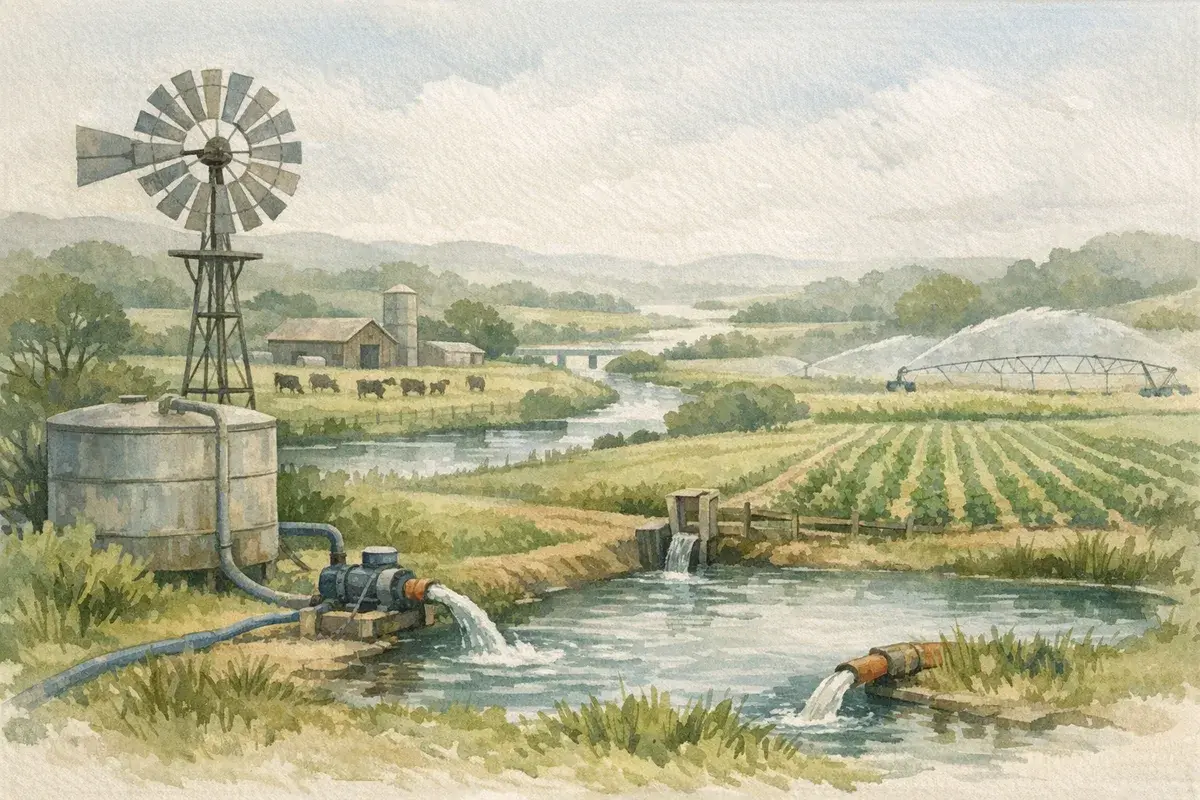
Agricultural water supply UK decisions affect livestock health, crop reliability, and land value. This guide explains the main supply options, the approvals you may need, and where the real costs can land.
If you are buying, renting, or improving farmland, water is rarely a side issue for long. A well-bored borehole, a licensed abstraction point, or a mains connection can make the difference between a workable holding and a constant headache, especially in drier eastern counties and on fragmented blocks in the South West. New entrants feel this hardest, because a well-run 40 acres with reliable water beats a badly financed 200 acres that leaves no working capital - a point we return to in our walkthrough of setting up a farm from scratch.
The short answer? Start with demand, then work back to source. How many cattle or sheep are you watering, how much irrigation do you need in a dry July, and how far is the nearest reliable connection? Those questions matter more than the headline price, because a cheap fix that runs dry, fails consent checks, or cannot scale is usually the most expensive option in the end.
Agricultural Water Supply Options For UK Farms
Most farms rely on a mix of sources rather than one perfect answer. In practice, mains water, boreholes, springs, surface water abstraction, and rainwater storage each have a place, depending on livestock numbers, soil type, topography, and local regulation.
Mains Water For Livestock And Buildings
Mains is the simplest option for many holdings near villages, market towns, or edge-of-settlement sites. It is reliable and familiar, but the bill can sting if you are filling troughs for a large dairy unit or washing down yards all year.
It also tends to suit smaller livestock farms, diversification sites, and rural property buyers who want predictable service more than autonomy. On the other hand, long rural runs can be costly to install, especially in parts of Lincolnshire, Norfolk, Herefordshire, and Cornwall where distance to the public network can be significant.
Boreholes And Private Groundwater Supplies
A borehole can be a strong long-term answer where geology is favourable. It taps groundwater through a drilled shaft, often with a pump, treatment, and storage tank, which makes it attractive for larger livestock enterprises and some irrigation users in counties such as Suffolk, Cambridgeshire, and Kent.
We'd argue the big advantage is control. Once the system is in place and tested properly, you are less exposed to mains tariffs, pressure drops, and long waiting times for utility works, though you do take on maintenance and water-quality risk yourself.
Springs, Streams, And On-Farm Harvesting
Spring supplies can work well on upland and mixed farms, especially where gravity feed reduces pumping costs. Streams and ponds may also support stock or irrigation infrastructure, but they usually bring more scrutiny, tighter seasonal limits, and higher vulnerability in dry weather.
Rainwater harvesting is often underused. Roof water from sheds, parlours, and grain stores can be captured in tanks or lagoons, then used for yard washing, dust suppression, or non-potable applications, which helps reduce pressure on other sources.
- Best for low-risk reliability: mains water, especially for smaller units.
- Best for long-term independence: a well-sited borehole with proper testing.
- Best for low-energy supply: gravity-fed spring systems where available.
- Best for resilience: rainwater storage backed by another source.
Permissions, Abstraction, And Water Quality Rules
Water supply is not only a technical issue. It is also a regulatory one, and this is where many landowners hit delays. Depending on source and volume, you may need planning consent, an environmental permit, an abstraction licence, or building regulations input for tanks, pipework, and pumping equipment.
When An Abstraction Licence Is Likely To Be Needed
If you take water from a river, stream, canal, reservoir, or groundwater source above exempt thresholds, an abstraction licence may be required. The threshold and exemptions depend on the use, the source, and the total daily and annual volumes, so assumptions can be dangerous.
This matters most for irrigation and larger livestock operations. For example, a vegetable grower in Cambridgeshire or a soft fruit unit in Kent may need licensed access where a smaller livestock keeper would not, or may only need a different permission route. Summer applications face the toughest scrutiny, because river flows are most protected exactly when irrigators want to pump, and how volume, source and timing decide the route is worth understanding before you design the system.
Water Testing And Treatment Requirements
Any private supply needs proper testing before you rely on it. Bacteriological quality, iron, manganese, hardness, nitrates, and turbidity can affect livestock performance, pipe scaling, and equipment lifespan, so test results should shape the design, not just sit in a file.
For dairy and food production premises, treatment may include filtration, chlorination, UV, or storage management. If water is used for washing equipment or on premises that handle food, the standards can be stricter again, and a cheap untreated source can become a false economy.
Planning, Environmental, And Farmer Practicalities
New tanks, lagoons, pump houses, and service trenches can trigger planning or environmental checks, particularly in protected landscapes or flood-sensitive areas. Places such as the Somerset Levels, parts of Devon, and low-lying Lincolnshire can require more careful siting because waterlogging and flood risk complicate works.
Remember that a permission is only useful if it is workable in field conditions. Access for maintenance, frost protection, energy supply, and animal safety all matter, because a system that is approved but awkward to run will still cost you money.
Costs, Bills, And The True Economics Of Supply
The economics of agricultural water supply UK projects vary wildly with geology, distance, demand, and engineering complexity. The headline installation figure is only one part of the picture, because operating costs, maintenance, testing, and downtime often decide whether a system pays its way.
As of June/2026, farm water costs are being driven by energy prices, labour, and the cost of materials such as tanks, pumps, and pipework. Buyers should therefore treat any rough quote as a starting point only, not a fixed benchmark.
| Supply Type | Typical Upfront Cost As Of June/2026 | Typical Running Cost | Best Fit |
|---|---|---|---|
| Mains connection | Variable, often low thousands to well into five figures for long rural runs | Metered bill plus standing charges | Smaller farms, yard supplies, edge-of-settlement sites |
| Borehole system | Mid four figures to low six figures depending on depth and kit | Electricity, servicing, testing, treatment | Livestock units, resilient private supply, some irrigation |
| Storage tanks and rainwater harvesting | Low four figures to mid five figures | Low to moderate maintenance and pump costs | Yards, washdown, resilience, supplementary supply |
For estate agents, the key point is that water access can materially change land value and occupier interest. A block with a proven private supply, good storage, and sensible distribution may sell more easily than a comparable parcel that looks similar on paper but lacks dependable water.
For farmers and rural buyers, the real question is return on resilience. If a borehole saves repeated tanker deliveries, reduces stock stress, or protects an irrigated crop in a dry year, the payback may be shorter than the initial figures suggest.
- Electricity: pumps and treatment plants can quietly become a major running cost.
- Servicing: filters, UV lamps, and pump seals all need planned maintenance.
- Testing: private supplies should be checked regularly, not just at installation.
- Back-up supply: a fallback tank or temporary connection can prevent costly disruption.
Regional Differences Across England, Scotland, And Wales
Location shapes water strategy more than many buyers realise. In wetter western counties such as Pembrokeshire, Cumbria, and parts of Devon, the issue may be storage, quality, and flood resilience, while in East Anglia the focus is more often on scarcity, abstraction controls, and irrigation scheduling.
Drier Eastern Counties And Irrigated Horticulture
In Norfolk, Suffolk, Lincolnshire, and Cambridgeshire, water demand for potatoes, sugar beet, salad crops, bulbs, and fruit can be intense. Holdings in these areas often rely on carefully planned abstraction, reservoir storage, or a blend of boreholes and licensed supplies, because summer demand can coincide with the tightest restrictions. Winter storage is what breaks that clash, since a licence can carry hands-off flow conditions that stop pumping in the driest weeks, and the four supply routes open to an arable irrigator trade capital cost against exactly that kind of seasonal risk.
That has a direct effect on farmed land values and rental interest. A block with existing irrigation infrastructure, proven licences, and secure storage is usually more attractive than bare land that still needs a full water strategy.
Upland And Remote Holdings
In parts of Northumberland, Cumbria, Yorkshire, and the Scottish Borders, gravity-fed springs and hilltop storage can still be highly practical. The challenge is not just getting water up to the steading, but protecting pipes and troughs from freezing, stock damage, and seasonal variation.
Remote holdings also need to think about repair access. If a pump fails in January and the nearest engineer is two hours away, redundancy stops being a luxury and becomes a basic management tool.
Wales And The West Country
Wales and the South West often combine plentiful rainfall with difficult terrain. That sounds ideal, but steep ground, dispersed field parcels, and flood-prone valleys can make distribution expensive, especially where livestock units are split across several blocks.
In Gloucestershire, Somerset, Devon, and Wiltshire, buyers should check whether troughs, mains, or private systems actually serve the whole unit evenly. A farm can look well watered on a plan and still struggle in practice if pipes are undersized or pressure varies too much between fields.
What Buyers, Sellers, And Agents Should Check Before A Deal
Water is one of those site matters that can be easy to miss during a quick viewing. A holding may look productive, but if supply is uncertain, in poor condition, or legally weak, the cost and risk can fall on the next owner.
That is particularly relevant on farms split by road, river, or tenure boundaries, where rights to lay pipes or draw water may not be obvious. A sensible diligence pack should cover source, permissions, maintenance history, bills, flow rates, storage capacity, and any known quality issues.
Practical Due Diligence Checks
Ask where the water comes from, who owns the asset, and what happens in a drought or outage. Then confirm whether the system is shared, metered, licensed, or dependent on a neighbour, because informal arrangements can unravel fast once ownership changes.
If a borehole or private supply is involved, ask for installation records, service reports, test results, and any treatment specifications. If the farm has irrigation infrastructure, check the condition of headers, pumps, hoses, and reservoirs, and whether they are sufficient for today's cropping plan, not yesterday's.
- Source ownership: know whether the asset is included in the sale.
- Access rights: confirm wayleaves, easements, and pipe routes.
- Licences and consents: check the permissions match actual use.
- Maintenance history: look for failures, repairs, and service intervals.
- Capacity: test whether the system meets peak demand, not just average use.
For selling agents, having clear water information ready can reduce friction and strengthen buyer confidence. It also helps avoid renegotiation after survey, which is often where apparently small issues become large price deductions.
Conclusion
The best agricultural water supply UK solution is the one that matches demand, regulation, and local conditions, not the one that sounds cheapest on day one. Mains, boreholes, springs, abstraction, and storage all have a role, but each carries different cost, risk, and practical implications for farms, estates, and rural buyers.
If you remember one thing, make it this: check supply quality, legality, and resilience before you rely on it. Water can support value, productivity, and saleability, but only when the system is properly designed, tested, and documented.
Disclaimer: AgLand.co.uk is a UK agricultural land and rural property matching service, where buyers register what they are looking for and owners advertise directly to the buyers who match, and a rural resource hub. Nothing in this text is intended as legal, financial, or investment advice. You should carry out your own due diligence and seek guidance from appropriately qualified professionals (for example, solicitors, land agents, surveyors, and financial advisors) for your specific circumstances.