
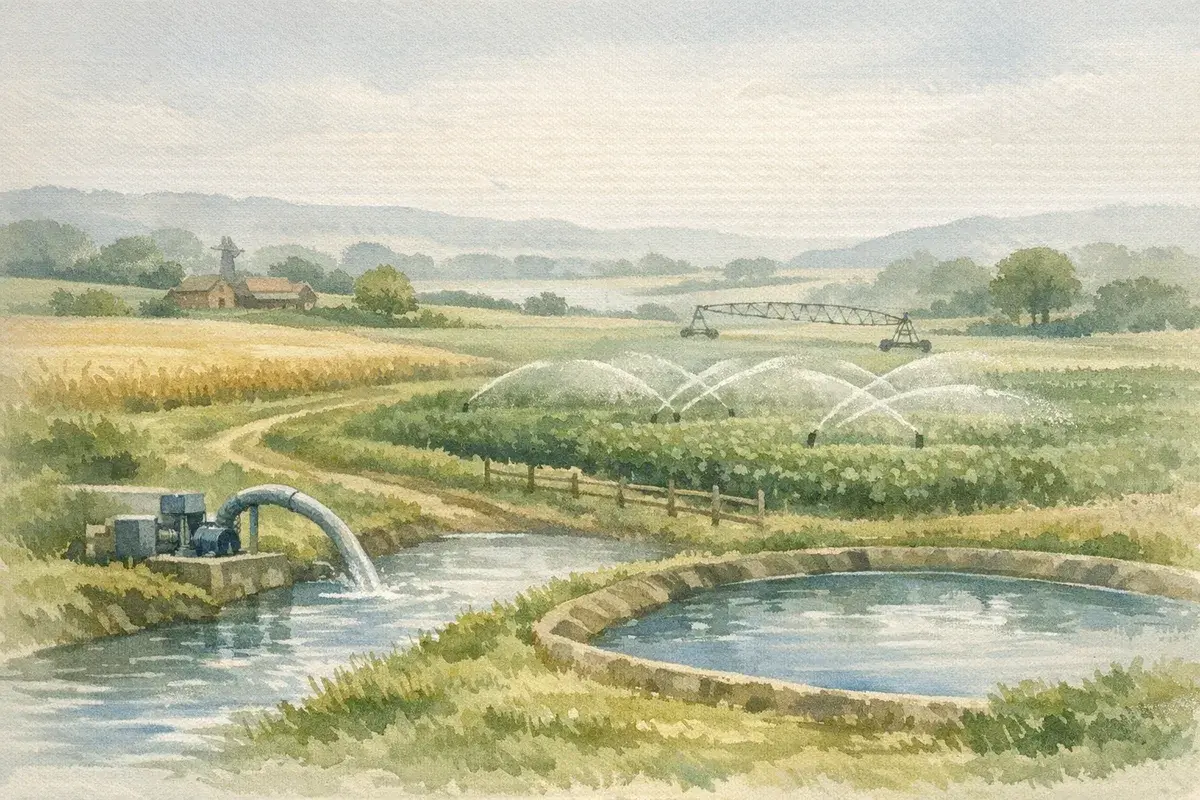
Arable growers are asking harder questions about irrigation water supply arable farms because weather is more erratic, summer droughts bite earlier, and yield gaps widen fast when water runs short. This guide sets out the main supply options, planning issues, costs, and regional factors that matter to farms and land buyers.
For many holdings, irrigation is no longer a nice-to-have. It can be the difference between a saleable crop and a disappointing one, especially on lighter land, root crops, vegetables, and high-value cereals where timing is everything.
The key question is not simply whether water is available. It is whether the supply is legal, reliable, affordable, and sized for the crop mix you want to grow. We'd argue that is where many farms get caught out, because a borehole, reservoir, river abstraction licence, or mains connection can each look workable on paper but perform very differently in practice.
In England and Wales, abstraction rules, local catchment pressure, and grid electricity costs all shape the economics. In Norfolk, Suffolk, Lincolnshire, Kent, and parts of the Fens, irrigation is often central to business planning, while in upland counties or western grassland areas it may be more occasional, but still critical for potatoes, maize, vegetables, and seed crops.
Irrigation Water Supply Options For Arable Farms
The right supply depends on crop type, acreage, soil structure, and how often dry spells hit. On heavier clays, some farms can get by with strategic, high-value applications, while sandy loams in East Anglia may need a much larger and more dependable system.
There are four common supply routes. Each comes with trade-offs, and none is perfect in every county or catchment.
River Or Surface Water Abstraction
Taking water from a river, ditch, lake, or reservoir can be cost-effective where the source is close and the licence is secure. But abstraction rights are tightly managed, and hands-off flow conditions may stop pumping exactly when crops need water most.
This is especially relevant in catchments across East Anglia, the East Midlands, and parts of the South East, where summer pressure is higher. A farmer may have historic rights or a modern licence, but the real value lies in when abstraction is allowed and how much can be taken during peak demand.
Boreholes And Groundwater
A borehole can offer independence and a cleaner water source, but it is not risk-free. Yield, drawdown, water quality, and geology all matter. In some parts of Lincolnshire, Norfolk, and Cambridgeshire, groundwater is a mainstay for irrigation, yet drilling success can vary sharply field by field.
Hard water, iron, sand, or silt can affect pumps and filtration. You also need to think about long-term groundwater availability and whether the local aquifer is already under pressure, which can matter in dry years and for land values too.
Reservoirs And On-Farm Storage
Reservoirs give farms flexibility by storing winter water for summer use. That can be a major advantage where abstraction windows are limited, because you can capture water when it is available and apply it later when the crop actually needs it.
The downside is capital cost, planning complexity, and land take. Even so, we'd argue reservoir-led systems are increasingly attractive on larger arable units in Norfolk, Suffolk, and Kent where water security supports higher-value rotations and more consistent output.
Mains Water And Hybrid Systems
Mains water is rarely the first choice for broad-acre irrigation because volume costs can be punitive. Still, it can work for nurseries, small vegetable blocks, young orchards, or hybrid systems that top up a larger on-farm store.
Hybrid set-ups deserve more attention than they get. A borehole plus reservoir, or river licence plus storage, can spread risk and keep the farm going when one source is constrained.
- Abstraction licence: legal permission to take water from a source.
- Drawdown: how far water levels fall when a borehole is pumped.
- Headroom: spare system capacity above current demand.
- Catchment pressure: the level of demand and environmental strain in a local water area.
- Winter storage: water held in a reservoir for summer irrigation.
Costs, Yield Benefits, And What The Market Is Paying For
Cost is where irrigation decisions become commercial rather than theoretical. A system only stacks up if the extra yield, crop quality, and crop security repay the capital, maintenance, and energy bill over time.
As of June 2026, broad industry benchmarks suggest the following indicative ranges for UK arable farms. Actual figures vary by region, ground conditions, engineering access, and scheme size.
| Item | Typical Range As Of June 2026 | What Drives It |
|---|---|---|
| Borehole installation | £25,000 to £90,000 | Depth, geology, pump size, water quality treatment |
| On-farm reservoir | £150,000 to £600,000+ | Capacity, earthworks, lining, planning, fencing |
| Travelling Irrigator Or Reel | £20,000 to £60,000 | Output, hose length, control systems, used versus new |
| Annual pumping and energy | £5,000 to £40,000+ | Water volume, lift, electricity price, diesel backup |
The yield payback can be compelling on potatoes, brassicas, salads, seed crops, and some cereals. A dry spring can cut establishment, and a scorching June can reduce grain fill or tuber sizing, which is why irrigation often protects both output and quality premiums.
In parts of Suffolk or Cambridgeshire, a well-managed irrigation system may help retain contract-grade quality rather than feed grade returns. On higher-value land, that difference can be larger than many newcomers expect, and it explains why irrigable acreage often carries a premium in sales and lets.
There is also a land market effect. Farms with secure water supply, reservoir potential, or proven borehole yield can be more attractive to buyers, especially where local competitors are all chasing the same dryland risk profile. In practical terms, water security is now part of farm resilience, not a side issue.
Planning, Licensing, And Environmental Constraints
Before drilling, abstracting, or building storage, it is essential to understand the legal framework. The wrong assumption can be expensive, and in some cases the project never reaches the field stage.
In England and Wales, abstraction licencing, environmental permitting, planning consent, and ecological constraints may all apply. If the source is a river or groundwater body, the local catchment status and existing licence pressure will affect what is possible.
When You Need Permission
A new borehole may need environmental checks, and abstraction above certain thresholds will require a licence. Reservoirs, pumping stations, pipes, and associated works may also need planning permission, particularly where there is visual impact, traffic, or landscape sensitivity.
In county terms, this often matters most where irrigation infrastructure meets sensitive ground. For example, parts of Norfolk and Suffolk can involve water resource scrutiny, while Kent and Herefordshire may bring additional landscape or horticultural considerations. Do not assume a single rule fits every farm.
Water Strategy And Catchment Pressure
Catchment-level thinking is becoming more important. If several farms in the same area rely on the same aquifer or river reach, summer demand can outstrip supply and push up competition for secure water.
That is one reason winter storage is gaining favour. It can reduce reliance on peak-season abstraction, which is often the least dependable time to be short of water.
Key due diligence checks usually include these points.
- Licence status: confirm volume, season, and abstraction limits.
- Water source security: test whether the source holds up in dry years.
- Planning risk: assess whether storage or drilling is likely to be approved.
- Ecology constraints: check protected habitats, watercourses, and nearby designations.
- Energy access: review grid capacity or backup fuel needs.
- Maintenance liability: understand ongoing pump, filter, and asset costs.
Regional Differences Across England And Wales
Location changes the answer more than many people expect. A system that works in one county may be poor value in another because water availability, crop mix, and infrastructure all vary.
In Norfolk and Suffolk, irrigation is often central to root crops, vegetables, and high-value cereal production, with reservoir planning and groundwater access frequently under review. In Lincolnshire, large-scale arable and vegetable systems often justify significant capital investment, especially where land is already set up for production intensity.
In Kent, specialist cropping and orchards make dependable water supply very valuable, while in Cambridgeshire and the Fens, relatively flat topography can help distribution but also masks catchment and licensing constraints. In Cheshire, Shropshire, and parts of the West Midlands, irrigation is usually more targeted, often tied to potatoes, maize, or protected cropping rather than whole-farm broad-acre programmes.
Wales can also be highly patchy. Some lowland areas can support worthwhile abstraction or storage, but environmental scrutiny and topography can make design and cost less straightforward, especially on lesser-known holdings between river systems.
For buyers, this means a bare land parcel is not just about acres and soil type. The value of the holding may change materially if there is an existing licence, viable reservoir site, good borehole evidence, or pipe infrastructure already in place.
Building A Practical Irrigation Strategy For Arable Land
The best systems start with crop need, not equipment. A sensible plan asks how much water each crop really requires, when demand peaks, and what level of risk the business can live with.
Most farms should begin with a water audit. That means mapping fields, soil types, current crop rotation, yield history, source options, storage opportunities, and energy costs. Once that is clear, the farm can compare direct abstraction, storage-led supply, or a hybrid model.
For many arable units, the smartest route is phased investment. A farm might start with a borehole and a smaller tank, then add reservoir capacity later if the crop mix shifts towards more water-sensitive production. That staged approach can be kinder to cash flow and easier to justify to lenders or partners.
It also helps to think beyond one season. Climate volatility is making old assumptions less useful, and farms with secure irrigation water supply arable farms can often maintain better consistency in yield and marketing. That matters for rent reviews, valuations, succession planning, and investor confidence too.
Appraisal should include crop gross margin, potential yield uplift, local water pressure, energy access, and future expansion. If the farm is in East Anglia or the South East, the question may be how to secure water. If it is in a drier inland county with lower-value cropping, the question may be whether irrigation ever pays back at all.
Conclusion
For arable businesses, irrigation water supply arable farms is now a core strategic issue, not an optional extra. The best outcome is a supply that is legal, reliable, affordable, and matched to the crop rotation and regional water reality.
Whether the answer is a borehole, reservoir, abstraction licence, mains connection, or hybrid system, the details matter. A good water strategy can protect yield, support crop quality, and strengthen the long-term value of the holding.
Disclaimer: AgLand.co.uk is a UK agricultural land and rural property matching service, where buyers register what they are looking for and owners advertise directly to the buyers who match, and a rural resource hub. Nothing in this text is intended as legal, financial, or investment advice. You should carry out your own due diligence and seek guidance from appropriately qualified professionals (for example, solicitors, land agents, surveyors, and financial advisors) for your specific circumstances.