
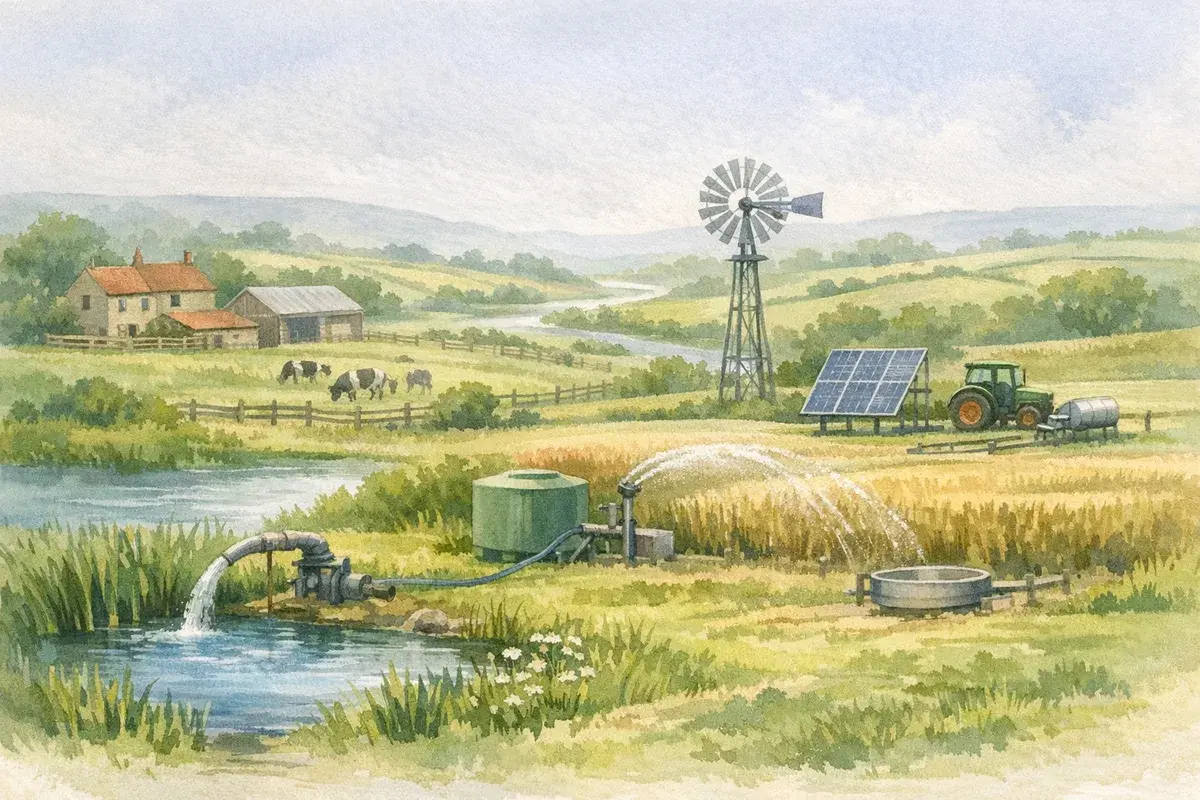
An effective agricultural water supply keeps livestock healthy, irrigated crops productive, and day-to-day farm operations running properly. This guide explains the main supply options, what they cost, the permissions you may need, and the regional factors that shape decisions in the UK.
If you´re buying land, expanding a holding, or upgrading an existing system, water is usually one of the first things worth checking. We´d argue it´s often more important than the farmhouse in pure business terms, because a field without reliable water can quickly become a weak asset.
That matters whether you´re running beef and sheep in Cumbria, dairy in Somerset, arable in Lincolnshire, or a mixed holding in North Yorkshire. The right supply can mean lower stress, better welfare, and fewer expensive headaches when dry weather bites (and it usually does at the worst possible time).
What Agricultural Water Supply Means On A Working Farm
An agricultural water supply is any reliable system that provides water for stock, crops, washdown, spraying, parlour use, and sometimes accommodation on-farm. In practice, it usually means a mix of mains water, boreholes, springs, reservoirs, rainwater harvesting, or tanker support, depending on location and scale.
The key point is consistency. A farm may have water today, but if pressure drops in summer, pipes fail in frost, or a spring runs shallow in a dry spell, the system isn´t really fit for purpose. That´s why buyers and agents increasingly treat water as a core asset, not a side issue.
Common Agricultural Water Sources
Different holdings use different supply mixes. There´s no one-size-fits-all answer, and anyone telling you otherwise is probably selling something.
- Mains water: reliable in many areas, but can be costly for high-volume use and may need upgrades to pipe capacity.
- Boreholes: useful where mains are limited, though drilling, treatment, and pumping costs can be significant.
- Springs and wells: often low running cost, but output can vary with rainfall and geology.
- On-farm reservoirs: good for irrigation resilience, especially in arable and horticultural regions.
- Rainwater harvesting: helpful for yards, livestock, and washdown, though rarely enough on its own.
For livestock farms, chilled or treated drinking water usually matters less than volume and cleanliness. For irrigated land, storage and abstraction rights become the bigger issues, particularly in eastern counties where summer demand can rise sharply.
How To Assess Supply Reliability Before You Buy Or Invest
If you´re buying farmland or a rural property, the first question is simple: does the water supply actually meet the farm´s needs in a dry year, not just a wet one? A glossy brochure can´t answer that, and neither can a single viewing after rainfall.
Start with evidence. Ask for borehole logs, pump maintenance records, meter readings, any abstraction licence details, and maps of pipe routes, storage tanks, troughs, and isolation valves. If the seller says the supply is fine, ask what happens when the herd is fully stocked, silage is being made, and January frost has hit the pipework.
Physical Checks That Matter
Some checks are basic but crucial. They can save a buyer from expensive surprises later.
- Flow rate: can the system meet peak demand at busy times?
- Pressure: important for sprays, parlours, and long pipe runs.
- Storage: tanks and reservoirs should cover outages and seasonal peaks.
- Water quality: test for bacteria, nitrates, iron, manganese, and pH where relevant.
In livestock units, trough placement and pipe diameter can matter almost as much as the source itself. A borehole in Devon or Dorset may be perfectly sound, but if the distribution system is undersized, stock still won´t drink properly.
Regional Differences Across The UK
Regional geology and rainfall patterns shape supply choices. In East Anglia and Lincolnshire, irrigation demand is high and water scarcity can be a real commercial constraint. In parts of Wales, the South West, and Cumbria, water is often more available, but runoff, biosecurity, and pipe resilience still need attention.
Across Scotland, upland holdings may rely on springs and lochs, while lowland farms often mix local supply with tank storage. In Kent and the Vale of Evesham, horticultural farms may prioritise reservoir-backed systems because crop timing is unforgiving when water isn´t there on demand.
Costs, Permissions, and Ongoing Running Expenses
Water systems vary hugely in cost, but the main expense drivers are source type, depth, treatment, storage, and electricity for pumping. As of June 2026, a simple mains-fed livestock boost system can cost far less than a deep borehole with filtration, telemetry, and backup power.
Planning, environmental, and abstraction rules also shape the economics. If you´re taking more than a minor amount of water from a river, stream, or groundwater source, you may need an abstraction licence, and if you´re building a reservoir or substantial infrastructure, planning questions may arise too.
| Supply Option | Typical Upfront Cost As Of June 2026 | Typical Use | Key Risk |
|---|---|---|---|
| Mains connection and pipe upgrade | £5,000 to £25,000 | Livestock, yards, mixed use | Pressure or capacity limits |
| Borehole system with pump and treatment | £15,000 to £60,000+ | Remote farms, stock water, some irrigation | Yield uncertainty and treatment needs |
| On-farm reservoir or storage lagoon | £20,000 to £150,000+ | Irrigation and resilience | Planning and land take |
| Rainwater harvesting and tank storage | £2,000 to £20,000 | Yards, washdown, supplementary supply | Seasonal shortfall |
Running costs usually come down to power, maintenance, filters, testing, and parts replacement. For a dairy unit in Cheshire or Wiltshire, that can mean routine pump checks and water hygiene sampling. For an irrigated arable business in Cambridgeshire, electricity and abstraction compliance may weigh more heavily.
We´d also keep an eye on resilience costs. Backup generators, duplicate pumps, frost protection, and insulated pipe runs feel like extras until a hard freeze or summer fault knocks stock water offline. Then they look cheap.
Market Signals Buyers And Agents Should Watch
Water capability increasingly affects land value, flexibility, and saleability. In practical terms, a field parcel with a proven supply and storage may attract more interest than a similar block without it, especially where irrigation or high stock density is involved.
Agricultural buyers are also more alert to climate risk. In areas such as Norfolk, Suffolk, Essex, and parts of Lincolnshire, the conversation increasingly centres on drought resilience, storage capacity, and how much of the farm can remain productive in a dry summer. That doesn´t necessarily mean every holding needs a reservoir, but it does mean water evidence matters more than ever.
What Adds Value
Not every water asset adds value in the same way. The market tends to reward systems that are documented, compliant, and easy to maintain.
- Proven yield: a borehole with records is worth more than an untested one.
- Storage capacity: useful where summer demand peaks.
- Flexible zoning: separate stock, yard, and irrigation circuits reduce disruption.
- Quality assurance: clean records support livestock health and buyer confidence.
Agents working in Herefordshire, Shropshire, and the West Midlands often see this on mixed farms with livestock and cropping. A farm that can shift water between uses, or store enough for a spell of dry weather, generally presents better than one reliant on a single aging feed line.
There´s a practical reason too. Buyers rarely want avoidable capital projects immediately after completion. If they know a water system is sound, they can focus on production, not emergency trenching.
Practical Ways To Improve Agricultural Water Resilience
Upgrading an agricultural water supply doesn´t always mean major capital works. Sometimes the best fixes are unglamorous and surprisingly affordable, which is good because farms already have enough glamorous spending priorities (not many, admittedly).
The first step is auditing demand. Work out how much water livestock, washdown, parlours, sprays, and staff facilities use at peak, then compare that figure with source output and storage. Many farms find the problem isn´t the source, but the pipework, valves, or lack of buffering.
Low-Cost Improvements That Help Quickly
These are usually sensible first moves, especially where budgets are tight.
- Fit level sensors: helps spot failures before troughs run dry.
- Replace undersized pipes: often improves pressure more than expected.
- Add backup storage: buys time during outages.
- Insulate exposed runs: reduces frost damage on yards and gateways.
- Test water regularly: protects stock health and equipment.
For dairy farms, dual supply lines and automatic cut-offs can be worth their weight in milk cheque. For outdoor pigs, poultry, or specialist horticulture, even modest disruptions can hit welfare or crop quality quickly, so redundancy matters.
Where possible, separate clean and dirty water systems. Keeping roof runoff, yard washdown, and drinking water distinct can cut contamination risk and make maintenance simpler. It´s not fancy, but it works.
Conclusion
A strong agricultural water supply is about more than pipes and pumps. It affects stock health, crop performance, compliance, operating costs, and the long-term value of a holding, which is why buyers and agents keep coming back to it when assessing a farm.
The best systems are reliable, documented, and scaled to real demand, not hoped-for demand. If you understand source, storage, permissions, and resilience, you´re in a far better position to buy well, improve wisely, or sell with confidence.
Disclaimer: AgLand.co.uk is a UK agricultural land and rural property matching service, where buyers register what they are looking for and owners advertise directly to the buyers who match, and a rural resource hub. Nothing in this text is intended as legal, financial, or investment advice. You should carry out your own due diligence and seek guidance from appropriately qualified professionals (for example, solicitors, land agents, surveyors, and financial advisors) for your specific circumstances.