
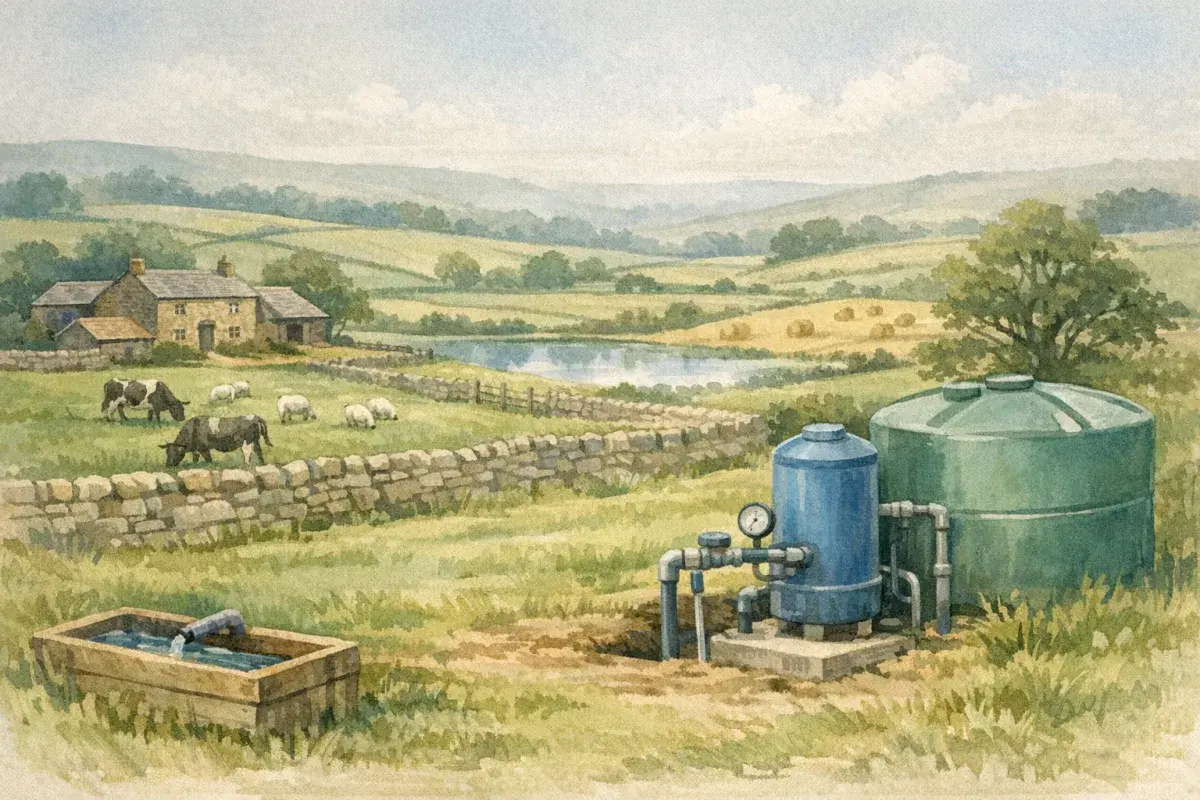
A borehole can feel like the ultimate bit of "future-proofing" for agricultural land: you control your own supply, you're less exposed to hosepipe bans, and you can often run a yard or stock system without sweating every cubic metre coming through a mains meter.
But on UK farmland, a borehole isn't just "drill a hole and pump water". The economics depend on yield and quality. The legal side depends on abstraction rules and where you are in the UK. And the practical success depends on siting, construction standards, and how you maintain (and prove) performance over time.
This guide cuts through the confusion. You'll learn when a borehole is worth it, how to de-risk the water source before you spend big, what permissions and compliance typically apply in England, Wales, Scotland and Northern Ireland, and how boreholes change the picture when you buy, sell, or let agricultural land.
Is A Borehole Right For Your Farm Or Rural Holding?
A borehole on agricultural land can be a genuine game-changer, but only if it fits your holding's water demand profile and your tolerance for upfront risk.
A useful way to think about it is this: you're not buying "a borehole", you're buying a reliable water system. The hole in the ground is just one part of a chain that includes permissions, pumps, storage, treatment, and evidence.
Typical Use Cases: Livestock, Irrigation, Spraying, Washdown, And Diversification
On UK farms, boreholes most commonly stack up when you need consistent, year-round water and the alternatives are either limited, expensive, or operationally awkward.
Common use cases you'll recognise:
- Livestock supply (dairy, beef, sheep, pigs, poultry): A borehole can replace or supplement mains, reduce vulnerability to supply interruptions, and support expansion without costly upgrades.
- Irrigation and horticulture: Even modest abstraction volumes can protect crop value during dry spells. The key is matching peak demand (often summer) to seasonal yield.
- Spraying and filling operations: Reliable water on the yard reduces downtime and helps keep chemical handling controlled (but brings extra siting and pollution-risk considerations).
- Washdown (yards, parlours, machinery): Water costs can be substantial, and washdown is one of the easiest demand lines to model.
- Diversification: Glamping, holiday lets, small-scale food processing, equestrian facilities, caravan sites. These can push you into private water supply territory with more stringent monitoring duties.
If you're still early-stage on "is this land right for my plan?", water availability should sit alongside access, soils, and constraints. It's one of the reasons we push buyers to treat due diligence as a system, not a checklist. For a wider buying framework, use our guide to finding and assessing UK farmland before you commit.
When A Borehole Is The Wrong Tool: Low Yield Risk, Poor Quality, Or High Regulation Burden
Boreholes fail (or disappoint) for three blunt reasons:
- Low or unreliable yield: You might get a decent test result, then discover seasonal drop-off or drawdown impacts when you run the system hard.
- Poor water quality: High iron/manganese, bacterial contamination, or nitrate issues can turn a "cheap" supply into a treatment and maintenance burden.
- Regulatory complexity: Depending on abstraction volumes, location, and end use, permissions and monitoring can become a permanent admin task.
A few red flags we see in practice:
- The borehole is being proposed mainly because "the neighbour has one" (hydrogeology varies hugely even across a field boundary).
- The holding sits in an area of known abstraction pressure or sensitivity.
- You're relying on the borehole to carry a business-critical peak load (e.g., irrigation) without storage or contingency.
- You're intending to supply multiple dwellings or commercial units, private supply rules can bite.
If your motivation is mostly "water security for the long term", do also step back and consider: could storage, rainwater capture, leak reduction, or a hybrid system deliver 80% of the benefit with less risk? Sometimes, yes.
Finding And Proving A Water Source
The single biggest mistake with a borehole on agricultural land is spending money in the wrong order. Before you get emotionally attached to "a borehole by the new yard", you want evidence that (a) water is there, (b) it can be produced at the rate you need, and (c) the quality won't undermine the whole project.
Hydrogeology Basics: Aquifers, Depth, Yield, And Seasonality
You don't need to be a hydrogeologist to ask the right questions, but you do need to understand a few basics:
- Aquifer type matters: Chalk, limestone and sandstone can produce excellent yields, if you intersect productive fractures or layers. Clay-dominated geology often means lower yields and higher uncertainty.
- Depth isn't a proxy for success: Deeper can mean better… or it can mean you're just paying more to chase the same (or worse) yield.
- Yield is not the same as "a good test result": A short test can look promising. The real test is how the borehole performs over sustained pumping, especially in summer.
- Seasonality is real: UK groundwater levels typically dip in late summer/early autumn and recharge in winter. A borehole that "looks fine" in March can struggle in August.
The practical goal: match your peak daily demand and peak hourly demand (e.g., troughs filling, parlour washdown, irrigation sets) to what the ground can actually provide, allowing a margin for dry years.
Desktop Checks: BGS Data, Local Abstraction Pressures, And Neighbouring Boreholes
A sensible desktop stage can save you thousands.
What you're typically trying to establish:
- Likely geology and aquifer productivity (maps, local records).
- Constraints and competing pressures: other abstractors, protected sites, and local sensitivity.
- Neighbouring borehole performance: not as proof, but as a directional clue.
In England and Wales, local abstraction pressures and licensing sensitivity can influence whether getting (or varying) an abstraction licence is straightforward or painful. It's worth reading our dedicated explainer on UK water rights and what to check before you buy land, because "it's on my land" doesn't automatically mean "I can use it how I like".
Site Survey And Test Pumping: What Results You Need Before You Spend Big
A proper site investigation and test pumping programme is where guesswork turns into a decision.
Your adviser/contractor will typically look to produce:
- A drilled borehole log: geology encountered, depths, strata, water strikes.
- Test pumping results:
- pump rate(s)
- drawdown and recovery
- stabilisation behaviour over time
- evidence of sustainable yield
- Indicative water quality sampling (at least baseline parameters).
- Recommendations for final design: casing/screen intervals, grouting, headworks, pump sizing.
If you're buying land and relying on a borehole already in place, ask for evidence that goes beyond "it worked when we turned it on". Where possible, you want historical pumping behaviour, maintenance records, and any yield testing.
And because boreholes and water systems are hard to value (and even harder to fix after the fact), it can be sensible to integrate them into a wider professional inspection. A good starting point is understanding what rural land surveys in the UK typically cover and when you need them.
Legal And Regulatory Requirements In England, Wales, Scotland, And Northern Ireland
Regulation is the part most people underestimate, mainly because it's not one rulebook for the whole UK.
At a high level, you're dealing with three overlapping themes:
- Abstraction (taking water from the ground)
- Environmental protection (pollution prevention, protected sites)
- Supply and public health duties (if you're providing water to others)
The details vary by nation and by use, and they change over time. You should always check current requirements with the relevant regulator and your professional team.
Abstraction Licensing: When You Need A Licence And What Triggers It
Whether you need an abstraction licence depends on how much you take, why you take it, and where you are.
- England: regulated by the Environment Agency.
- Wales: regulated by Natural Resources Wales.
- Scotland: regulated by SEPA under the Environmental Authorisations (Scotland) Regulations 2018, which replaced CAR in November 2025.
- Northern Ireland: regulation sits with NI authorities (including NIEA in environmental contexts), with different processes.
In broad terms, abstraction frameworks typically distinguish between:
- small abstractions that may be exempt or lightly regulated
- abstractions needing registration/authorisation
- larger or more sensitive abstractions needing full licensing and conditions (e.g., hands-off flow/level conditions, metering, reporting)
What commonly triggers tighter control:
- higher daily volume
- irrigation and spray use, especially in water-stressed catchments
- proximity to protected habitats or water-dependent sites
- any sign of impact on neighbouring supplies
If you want the practical "what you can do vs what you must apply for" breakdown, plus typical pitfalls (like discovering the seller's historical abstraction wasn't properly authorised), lean on the detailed guidance in our article on water rights on agricultural land in the UK.
Planning And Environmental Constraints: Protected Sites, Pollution Risk, And Construction Standards
Drilling a borehole isn't always a pure permitted-development-style job. Constraints can include:
- SSSIs, SPAs/SACs, Ramsar sites, and other protected designations
- Groundwater Source Protection Zones (important near public supply abstractions)
- Pollution risk from siting near slurry, silage effluent, fuel, pesticides, septic systems, and dirty yard drainage
Construction standards matter too. A poorly sealed annulus or badly built headworks can create a direct pathway for contaminants, essentially turning your borehole into a pollution shortcut.
If your land has a sensitive setting (or you're planning diversification with visitors), you'll want the drilling contractor and your adviser to design around these risks rather than "see how it goes".
Water Use And Supply Rules: Private Supplies, Tenants, And Public Health Duties
A borehole used solely by you, for agriculture, is one situation. A borehole that supplies tenanted dwellings, holiday lets, staff accommodation, or a yard with multiple occupiers is another.
If you're supplying water to others, you may fall within the scope of private water supply rules, which can bring:
- sampling and risk assessment duties
- notification/registration with the local authority
- record keeping and remedial action expectations
On tenanted land, you also need clarity on:
- who owns the borehole and equipment
- who pays for power, maintenance, and compliance
- what happens if the borehole fails
This is one of those areas where a "small" ambiguity can become a major dispute later, so it's worth sorting in writing early, not at the point someone's got empty troughs.
Borehole Design, Drilling, And Installation Choices
Once you're confident water is there and you understand your permissions path, you get into the nuts and bolts: where it goes, how it's built, and how it runs day-to-day.
Good borehole design is boring in the best way. It's about preventing contamination, avoiding avoidable breakdowns, and making sure you can service the system without tearing your yard apart.
Siting And Setbacks: Slurry Stores, Septic Tanks, Pesticide Stores, And Yard Drainage
Siting is where farm reality meets groundwater hygiene.
As a rule of thumb, you're trying to:
- keep the borehole up-gradient (where possible) from pollution sources
- keep it away from areas prone to flooding or pooling
- avoid locations where traffic, livestock, or machinery will damage headworks
Key risks to separate from the borehole location:
- slurry stores and manure heaps
- silage clamps and effluent channels
- septic tanks and package treatment plants
- fuel tanks and AdBlue/chemical stores
- pesticide and fertiliser handling areas
- dirty yard drainage, including washdown and runoff paths
Your contractor should advise on suitable minimum distances and protection measures for your specific site, because "one-size-fits-all" setbacks aren't realistic across UK farm layouts.
Drilling Methods And Construction: Casing, Screens, Grouting, And Headworks
The stuff you never see is what protects you.
A well-constructed agricultural borehole typically involves:
- Casing to support the borehole and isolate problem strata
- Screens (where needed) to allow water in while controlling sediment
- Gravel pack (in some designs) around the screen
- Grouting/sealing of the annulus to prevent surface water short-circuiting down the borehole
- Headworks that keep the top secure, vermin-proof, and protected from runoff
If you're tempted to cut corners here, don't. The costs you "save" on construction often reappear as:
- recurring bacterial issues
- pump wear and sand ingress
- premature failure
- compliance headaches if you supply third parties
Pumps, Power, And Storage: Submersible Vs Surface, Solar Options, And Buffer Tanks
The pump choice is about reliability, efficiency, and serviceability.
- Submersible pumps are common and efficient for deeper boreholes: they're quiet and protected but can be more involved to pull for servicing.
- Surface pumps can be convenient in certain shallow or accessible setups, but they're not a universal fit and can be noisier and more exposed.
Power and resilience matter:
- If you've got a long run to the nearest supply, grid connection costs can dwarf parts of the drilling cost.
- Solar-assisted pumping can work well for certain low/steady demands (think trough supply into storage), but you still need to design for winter performance and peak demand.
- Buffer tanks are often the unsung hero: they let a modest-yield borehole cover high peak demand, provide firefighting or washdown contingency, and give you time to respond if the pump trips.
If your land's productive potential is the driver, more stock, higher-value cropping, horticulture, tie the water system back to what the holding can actually support. Water doesn't exist in isolation from soils, drainage, and access. Our guide on assessing a farm's real capability in the UK is a useful companion when you're trying to match infrastructure to output.
Costs, Timelines, And Procurement: What To Budget For
The question you actually care about is: "What's this going to cost me in real money, and how long until it works?"
Boreholes range from relatively straightforward to eye-wateringly expensive. The spread is driven by geology, location, and how ‘finished' you need the system to be (simple trough supply vs private supply-grade treatment plus storage and distribution).
Itemised Cost Drivers: Depth, Geology, Access, Testing, And Grid Connection
Budgeting works best when you break the project into parts:
- Desktop assessment and hydrogeology advice
- Drilling and consumables (depth, diameter, casing, screens)
- Test pumping and reporting (including any required monitoring)
- Water quality sampling (baseline and follow-up)
- Pump, controls, and instrumentation (including meter if required)
- Power supply (cable runs, panels, possibly a new connection)
- Storage tanks and distribution pipework
- Treatment equipment (if needed: filtration/UV/chlorination)
- Commissioning and documentation (as-builts, O&M manuals)
Two "surprise" cost areas we see a lot:
- Access and working area: can the rig get in without wrecking gateways, tracks, or drains? Are you drilling in winter when ground conditions are marginal?
- Electrical and civils: trenching, ducts, reinstatement, and grid upgrades can be a bigger cheque than the pump itself.
Tendering And Contractor Due Diligence: Accreditations, Insurances, And Guarantees
A borehole contractor isn't just a driller, you're hiring someone to create a long-lived asset with compliance implications.
When you're comparing quotes, look beyond the headline:
- What exactly is included (depth allowance, casing spec, test pumping duration)?
- What documentation will you receive (borehole log, as-built drawings, pumping data)?
- Do they carry appropriate insurances?
- What warranty/guarantee is offered, and what is explicitly not guaranteed (yield is often the big one)?
Be wary of vague promises. A professional contractor will be clear about uncertainty, especially on yield.
Programme Reality: From Permissions To Commissioning
Timelines tend to get lost in optimism.
A realistic programme often includes:
- time for desktop checks and initial design
- lead time for contractors (busy periods are common)
- any licensing/authorisation steps
- drilling and test pumping
- lab results turnaround
- ordering pumps/tanks/treatment
- civils and electrical works
- commissioning, snagging, and documentation
If you need water for a particular season (e.g., irrigation), work backwards. "We'll sort it by June" can quickly become "we're still waiting on parts in August".
Water Quality, Treatment, And Ongoing Compliance
On agricultural land, water quality is where boreholes stop being a one-off capex project and start being a management responsibility.
Even if your intended use is "just stock water", problems like bacteria, high iron, or sediment can hit animal performance, damage equipment, and create ongoing labour. And if you're supplying people, holiday lets, staff housing, farm shop café, your obligations step up.
Testing Regimes: Bacteria, Nitrates, Iron, Manganese, And Pesticide Residues
You test for two reasons:
- to confirm the water is fit for purpose (and what treatment is needed)
- to prove compliance where private supply duties apply
Parameters that commonly matter for UK boreholes on rural holdings:
- Microbiological: E. coli, coliforms (often linked to surface ingress or poor headworks)
- Nitrates: can be influenced by land use and geology: important for human consumption and broader compliance
- Iron and manganese: common causes of staining, taste issues, biofouling, and filter clogging
- Pesticide residues: risk depends on catchment and practices: relevant in sensitive areas and for human supply
- pH, hardness, conductivity, turbidity: affects corrosion, scaling, and treatment choice
Don't skip baseline sampling after drilling. It's much easier to design the right solution early than to retrofit after you've plumbed half the yard.
Treatment Options: UV, Chlorination, Filtration, And Aeration
Treatment should be designed to the problem, not bolted on because "someone said UV is good".
Typical approaches include:
- Filtration (sediment/particulate) to protect pumps, valves, drinkers, and downstream treatment.
- UV to control microbiological risk, usually requiring good pre-filtration and stable flow.
- Chlorination for disinfection and residual protection in distribution systems (more common where water is supplied to people).
- Aeration and media filtration to reduce iron/manganese and improve taste/odour.
If you're treating for human consumption, you'll want competent design and documentation, this is not a "guess and hope" job.
Monitoring And Record-Keeping: Meters, Maintenance, And Incident Response
Ongoing compliance is mostly about having the right habits.
Good practice includes:
- meter readings and usage records (often required for licensed abstraction, and useful for spotting leaks)
- a maintenance schedule for pumps, filters, UV lamps, and tanks
- periodic water testing appropriate to your use
- a simple incident plan: what you do if results fail, the pump trips, or the water turns turbid
Even if you're not formally required to keep records, they protect you. They also make your borehole a more valuable, less arguable asset when you come to sell or let.
Buying, Selling, Or Letting Agricultural Land With A Borehole
A borehole can add real value to agricultural land, but only when it's documented, compliant, and reliable.
From a transaction perspective, the borehole is a bundle of rights and evidence: the physical installation, the permission to abstract, the proof of yield, and the proof of quality.
Due Diligence Checklist: Licences, Yield Evidence, Water Quality Results, And As-Builts
If you're buying land with a borehole (or selling and want to avoid renegotiation late in the process), aim to assemble:
- abstraction licence/authorisation details (where applicable) and any conditions
- historic abstraction volumes and meter readings (if available)
- borehole log and construction details
- as-built drawings and location plan
- pump make/model/spec and service history
- test pumping report(s): rates, drawdown, recovery
- water quality results and any treatment system records
- details of supply: what's connected, where the stop taps/isolations are, and any shared infrastructure
This is especially important if the borehole is central to the farm's performance, irrigation, high-throughput livestock, or diversified units.
For buyers, the borehole should sit within your broader land due diligence. If you're purchasing in England, our guide to buying and managing agricultural land in England gives a practical structure for pulling the threads together.
Valuation And Deal Risks: Over-Abstracting, Contamination, And Third-Party Reliance
Three deal risks come up again and again:
- Over-abstracting: If historic use exceeded permissions (or if permissions don't match your intended use), you may inherit a problem or a constraint.
- Contamination and water quality liabilities: A borehole that's vulnerable to surface ingress, or sits too close to pollution sources, can create ongoing cost and reputational risk, particularly for diversified uses.
- Third-party reliance: Sometimes a holding uses a neighbour's borehole or shares infrastructure across a boundary. That can work, until it doesn't. You want robust legal agreements and clarity on maintenance responsibilities.
From a valuation angle, a borehole isn't automatically a premium. Valuers and informed buyers will discount heavily if documentation is missing or if the supply looks fragile.
Tenancies And Rights: Who Owns The Equipment, Who Pays, And What Happens At Term End
On let land, you need clarity on rights and responsibilities.
Key points to pin down in writing:
- who owns the borehole, pump, treatment kit, tanks and pipework
- who pays power costs and routine servicing
- what the tenant may (or may not) do: increase abstraction, add connections, change treatment
- what happens at end of term: removal, reinstatement, compensation for improvements
If you're investing in land where water infrastructure is part of the return story, you should factor in both compliance and capex replacement cycles. A "cheap" borehole becomes expensive if the pump is near end-of-life and the paperwork is thin. For the bigger picture, see our guide on buying agricultural land as an investment in the UK.
Conclusion
A borehole on agricultural land can deliver real resilience, especially as dry spells, operational costs, and diversification pressures become more normal across the UK. But the wins come from doing it properly: proving sustainable yield, designing to prevent contamination, understanding abstraction and private supply duties, and keeping the paperwork tight.
If you treat your borehole like an asset (with evidence, maintenance, and compliance built in), it can support higher output, smoother operations, and a more attractive holding when you come to sell or let. If you treat it like a punt, it can become an expensive hole in the ground, plus a liability.
Disclaimer: AgLand.co.uk is a UK agricultural land and rural property matching service, where buyers register what they are looking for and owners advertise directly to the buyers who match, and a rural resource hub. Nothing in this text is intended as legal, financial, or investment advice. You should carry out your own due diligence and take advice from appropriately qualified professionals (for example, hydrogeologists, drilling contractors, solicitors, surveyors, and relevant regulators) before making decisions.