
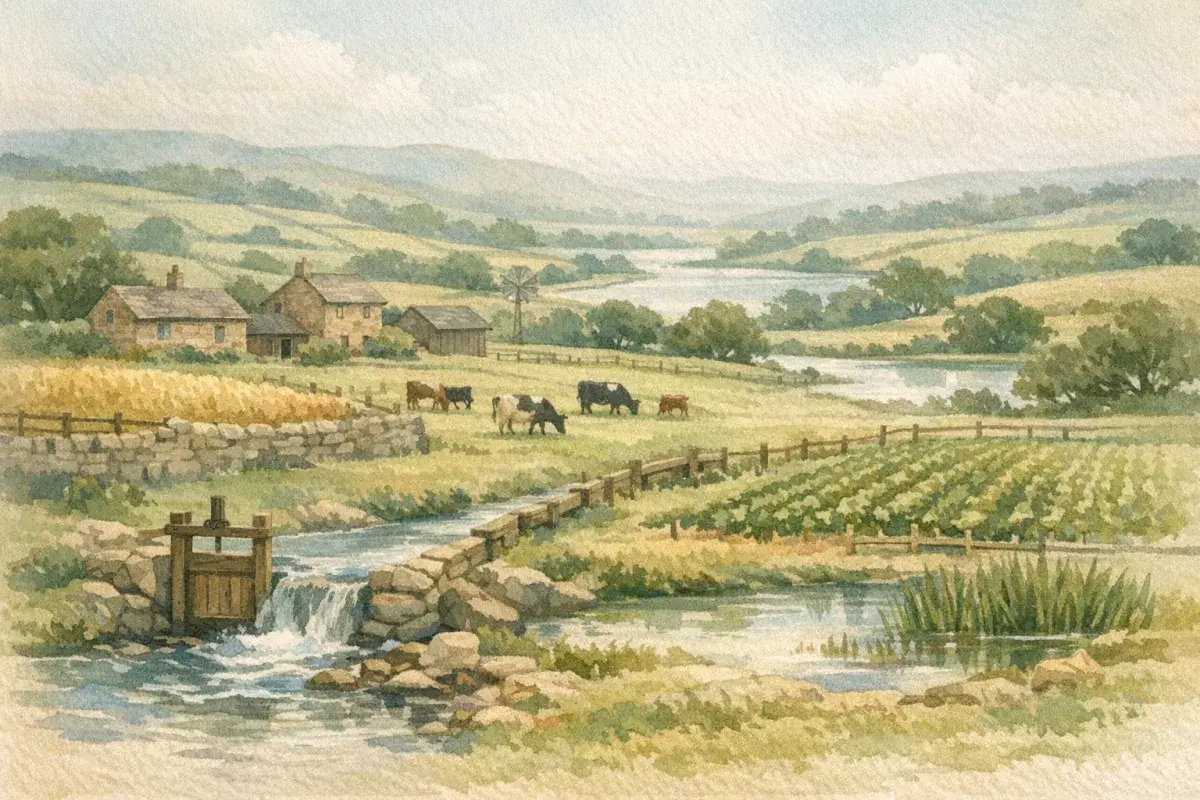
You can look at a farm and see soil, access, buildings and boundaries in a single viewing. Water is different. The most important bits are often invisible: a buried rising main feeding troughs, a borehole licence with tight hands‑off flow conditions, a shared reservoir with a maintenance argument baked in, or a stream that looks "yours" on the plan but comes with duties you didn't price in.
In UK rural property, "water rights" isn't one neat, transferable asset. It's a bundle of legal positions (some automatic, some licensed), practical realities (does it work in August?), and regulatory constraints (can you abstract, store, discharge, or even maintain the bank without permission?). If you're buying, selling, letting or diversifying, getting this wrong can mean anything from a stressed crop to enforcement action, neighbour disputes, or an unexpectedly unmortgageable headache.
This guide cuts through the confusion: what water rights on agricultural land actually mean in the UK, what typically comes with different water sources, the regulators you'll deal with, and a due diligence checklist you can use before you commit.
What “Water Rights” Really Means On UK Farmland
In UK practice, "water rights agricultural land" usually covers four overlapping questions:
- Can you take (abstract) water, and on what terms?
- Can you store or impound it (a pond, reservoir, weir, dam), and is it safe/consented?
- Can you discharge anything back to a watercourse or ground (treated effluent, yard run‑off), and is it permitted?
- What responsibilities do you carry because a watercourse runs through or alongside your land (maintenance, pollution prevention, flood risk)?
Ownership Of Land Vs Ownership Of Water
Owning the field doesn't mean you "own the water" in the way people often assume.
- Water in a river or stream isn't owned like chattels. You may have rights to use it (subject to law and licensing), but you don't own the flow itself.
- Groundwater is heavily regulated. Even if a borehole sits within your boundary, taking water from it can require permissions/licensing, and the regulator can restrict use in dry periods.
- Infrastructure can be separate from the land. Pumps, pipes, trough lines, meters, UV treatment units and storage tanks can be owned by someone else (a neighbour, a water company, an estate), or be subject to easements/wayleaves.
The practical takeaway: treat "water" as a system (source → permission → infrastructure → storage → use → discharge), not a feature.
Riparian Responsibilities And Reasonable Use
If your land borders or includes a natural watercourse, you may be a riparian owner. In plain English, that means you typically have certain rights (for example, to make reasonable domestic/agricultural use) and duties (to maintain the watercourse, avoid pollution, and not unreasonably obstruct flow).
A few points that regularly catch people out:
- "Reasonable use" isn't unlimited use. Taking significant volumes for irrigation or commercial operations usually falls into abstraction licensing territory.
- Maintenance is a duty, not a hobby. Leaving a blocked culvert because it's "not your problem" can quickly become your problem when upstream land floods.
- You can't just "improve" a bank or bed because it's on your land. Works in or near water often need consent.
Abstraction, Impoundment, Discharge, And Flood Risk: The Main Legal Buckets
Most farm water issues fit into these buckets:
- Abstraction: taking water from a source (surface water or groundwater) for use (irrigation, washing down, livestock, processing).
- Impoundment: holding back or altering flow in a watercourse (weirs, dams, some sluices) and, separately, on-farm storage (reservoirs/ponds) which can trigger planning and safety duties.
- Discharge: returning water to a watercourse or ground, anything from treated sewage to yard drainage can be regulated.
- Flood risk & land drainage: culverts, ditches, ordinary watercourses and main rivers have different consenting routes: flood zones can affect development, insurance, and even what a lender is comfortable with.
Common Water Sources On Farms And The Rights Typically Attached
Most rural properties use a blend of sources. And the "best" one depends on your enterprise: a veg unit cares about peak‑season litres per second: a grazing farm cares about resilience in freezing weather: a holiday-let operator cares about potable water quality and liability.
Rivers, Streams, And Ditches (Including Ordinary Watercourses)
A stream on the boundary can feel like a free water supply. In reality:
- Small-scale stock watering may be possible, but you still need to manage banks, prevent poaching, and protect water quality.
- Irrigation abstraction from surface water is often constrained in summer when you need it most. Licences (where available) can have hands‑off flow conditions that effectively switch you off during low flows.
- Ditches and "ordinary watercourses" (not designated "main rivers") still come with maintenance duties and can require consent for works.
If you're looking at cropping land where irrigation matters, it's worth considering not only soil type but also whether the holding sits in a catchment where abstraction is realistic. We often see buyers start with the right land type and then work backwards to water reliability, particularly when assessing arable land listings where yield potential is closely tied to water management.
Groundwater, Boreholes, And Springs
Boreholes can be brilliant, until they aren't.
- Yield is not guaranteed. A borehole that delivers comfortably in February can struggle in late summer if the aquifer is under stress.
- Water quality varies. Iron, manganese, nitrates, hardness, microbiological issues: treatment might be essential for potable uses or sensitive livestock.
- Licensing/permissions can apply. Don't assume "we've always used it" is a defence if paperwork is missing or volumes have crept up.
Springs can also be shared, seasonal, or vulnerable to land management changes upstream. If the spring crosses boundaries, you'll want the legal route for pipes and access to repair points nailed down.
Reservoirs, Ponds, And On-Farm Storage
Storage is the farmer's version of insurance, especially as dry springs and hot spells become more common.
- Ponds may be ornamental, wildlife-focused, or functional. Even small ponds can create downstream flood concerns if bunds/overflow structures fail.
- Reservoirs (particularly raised reservoirs) bring safety and inspection obligations. They can also trigger planning and environmental assessments depending on size, location and design.
- Winter fill strategies can be workable where summer abstraction is restricted, but you need to prove your lawful source and comply with licence conditions.
When you're evaluating a reservoir, don't stop at "it's there". Ask: where does it fill from, what's the consent position, who maintains the spillway, and is the embankment sound?
Mains Supply, Private Networks, And Shared Farm Supplies
Some holdings are on mains water, others on private supplies, and many have a messy hybrid created by decades of piecemeal additions.
- Mains supply is simplest for compliance but can be expensive for high-demand uses.
- Private supplies (single or shared) raise quality testing, maintenance and reliability questions.
- Shared networks are where disputes are born: who pays when the pipe fails under your track? Who upgrades the treatment unit when standards change? Who has the right to increase demand (say, by adding holiday lets or a small dairy processing unit)?
If the property relies on a shared supply, treat the agreement like a core asset, because in drought or a pipe burst, it effectively is.
The Regulatory Framework You’ll Actually Deal With
Water law can feel abstract until you're the person trying to irrigate on a hot Tuesday in July and the regulator says "not today". The UK also isn't one uniform system, England, Wales and Scotland have different regulators and, in places, different regimes.
Environment Agency, Natural Resources Wales, And SEPA: Who Regulates What
In broad terms:
- England: the Environment Agency (EA) is the main regulator for abstraction licensing, discharges, and a lot of water environment compliance.
- Wales: Natural Resources Wales (NRW) performs similar roles.
- Scotland: the Scottish Environment Protection Agency (SEPA) regulates water activities under the Environmental Authorisations (Scotland) Regulations 2018, which replaced the controlled activities regime in November 2025.
Local bodies also matter. For land drainage and works to watercourses, you may deal with Lead Local Flood Authorities and, in some areas, Internal Drainage Boards (IDBs).
Where this becomes practical: the same farm "idea" (say, a winter-fill reservoir with a transfer pipeline) can face a very different consenting path depending on which side of the border you're on.
Abstraction Licensing And Exemptions (And Why "Historically Used" Isn't Enough)
Abstraction licensing is the big one for agriculture, particularly for irrigation and high-volume uses.
Key realities we see on transactions:
- Catchments can be fully committed. In some areas, new abstraction licences are difficult or impossible to secure at meaningful volumes.
- Licence conditions can be the deal-breaker. A licence that looks generous on annual volume can still be operationally useless if hands‑off flows cut abstraction during dry spells.
- Paperwork matters. "We've always taken water from that point" doesn't automatically translate into a lawful right today, especially if the abstraction point moved, volumes increased, or the use changed.
If you're buying land, the legal status of abstraction can be as important as acreage. It should sit alongside your core buying steps, finance, access, tenure, and constraints, set out in guides like our walkthrough on buying farmland properly.
Discharges, Slurry And Silage Effluent, And Diffuse Pollution Rules
Plenty of water problems aren't about taking water, they're about what ends up in it.
Common farm pinch points:
- Yard run-off and dirty water separation: if clean and dirty water systems are mixed (often through "temporary" pipework that became permanent), you can end up with pollution incidents.
- Slurry and silage effluent: high-risk liquids that can cause serious harm if storage fails or drainage is wrong.
- Diffuse pollution: nutrients, sediment and pesticides entering watercourses from fields, gateways and tracks.
Regulators focus heavily on prevention. One small leak into a ditch can become a reportable incident, and in a transaction context it becomes a liability question: what happened, what was remedied, and is there ongoing risk?
Protected Sites And Constraints (SSSI, SAC/SPA, NVZs, Drinking Water Safeguard Zones)
Environmental designations and water protection zones don't just affect "nature" projects: they can materially change what you can do on working farmland.
Constraints you may meet include:
- SSSIs (Sites of Special Scientific Interest) and international designations like SACs/SPAs: can restrict engineering works, drainage changes, abstraction impacts, and certain land management.
- NVZs (Nitrate Vulnerable Zones): can affect nutrient management and storage requirements, with knock-on implications for run-off risk.
- Drinking water safeguard zones / source protection: can increase scrutiny of pesticides, fertiliser handling, and infrastructure.
None of this means "don't buy". It means price, programme and permissions need to reflect reality. And if your plan includes new buildings, tracks, reservoirs or diversification facilities, the water constraints connect directly to planning on agricultural land, often earlier than buyers expect.
Practical Implications For Farming And Rural Businesses
Water rights aren't paperwork for the drawer. They shape day-to-day operating decisions and the resilience of your business in awkward years.
Irrigation, Horticulture, And Peak-Season Reliability
If you grow high-value crops, you already know the uncomfortable truth: the time you most need water is often the time you're most likely to be restricted.
Practical questions to ask yourself (or a vendor/landlord):
- What's your peak daily demand (not just annual volume)?
- Is the abstraction source surface water or groundwater, and how does it behave in a dry summer?
- Are there hands‑off flows or other "stop" conditions, and how often do they bite?
- Is there storage capacity to buffer restrictions?
We've seen otherwise excellent rural units become compromised by a single assumption, "the river's right there", when the licence reality says otherwise.
Livestock Watering, Trough Supply, And Winter Resilience
Livestock enterprises tend to be less about licence volumes and more about reliability.
Typical failure points:
- Long, shallow buried pipes that freeze.
- Old stopcocks and unknown isolations (the "where does that pipe actually go?" problem).
- UV units and filters that aren't maintained, leading to animal health issues.
- Springs that drop off during prolonged dry weather.
If you're taking on a grazing farm or mixed unit, map your supply lines early and plan redundancy, especially if the holding is split by roads or has outlying blocks.
Hydro, Fisheries, Wild Swimming, And Diversification Uses
Diversification is where "water rights agricultural land" becomes multi-layered quickly.
- Hydro schemes can involve impoundment/abstraction-like controls, fish passage, and strict ecological conditions.
- Fisheries depend on water quality and flow: upstream land use can undermine your business even if you do everything right.
- Wild swimming or glamping by a lake introduces public safety, water quality expectations, and reputational risk.
The commercial logic may be sound, but you need to align it with permissions and practical control. A lake you can't legally or safely maintain is a liability dressed as an amenity.
Drainage, Culverts, Maintenance Duties, And Neighbour Disputes
Drainage is the unglamorous twin of water supply.
Culverts and ditches often cause disputes because they sit at the junction of:
- historic informal arrangements ("your grandfather always cleared that")
- unclear boundaries
- different incentives (upstream wants faster drainage: downstream wants slower flows)
If there's a recurring blockage or flooding history, treat it as a transaction issue, not "farm life". It can affect cropping, access, building use, and insurance.
A practical tip: when you walk the farm, walk the water too, ditches, outfalls, low spots, and any culvert inlets/outlets. In wet months you'll see issues you'll never spot in July.
Buying Or Letting Farmland: A Due Diligence Checklist For Water
When you're spending serious money, or signing up to a long tenancy, water due diligence should be as routine as checking access, services and boundaries.
Title, Plans, Easements, Wayleaves, And "Rights To Lay And Maintain Pipes"
Start with the documents. You're looking for:
- Express rights to abstract, to take water, or to drain.
- Easements/servitudes for pipes and cables crossing third-party land.
- Rights of access to maintain an intake, weir, chamber, or pump house.
- Wayleaves (often for utilities) and any restrictions on future works.
Also check whether water infrastructure sits on the title you're buying or on a neighbour's. It's surprisingly common to find that the "farm borehole" is physically on someone else's strip, fine if you've got a robust right, painful if you've only got goodwill.
If you're unsure how this fits into the wider conveyancing process, it helps to place water checks alongside the standard steps in agricultural land registration, because missing or unclear rights can become a registration and lender issue later.
Licence Paperwork: Volumes, Hands-Off Flows, Points Of Abstraction, And Transferability
Where abstraction is involved, ask for:
- The licence (and any variations)
- Abstraction returns/submissions history (where applicable)
- Site plans showing the point of abstraction
- Conditions: annual volume, daily rate, seasonal limits, hands‑off flow, metering requirements
And then sanity-check the essentials:
- Does the licence cover the use you intend (irrigation vs processing vs washdown)?
- Is it tied to land occupation (and what happens on a tenancy change)?
- Does the abstraction point match what exists on the ground?
- Are there any current enforcement conversations or compliance issues?
This is one of those areas where "it'll probably be fine" can be an expensive phrase.
Physical Verification: Locate Intakes, Meters, Pumps, Storage, And Overflows
Paperwork without a site walk can mislead you.
On the ground, you want to locate and confirm:
- Intake position and condition (screening, access, siltation)
- Pump type, capacity, power supply, and maintenance history
- Meters (presence, location, calibration/servicing)
- Pipe routes (where possible), isolation valves and chambers
- Storage capacity, liners/embankments, spillways and overflows
If you're buying a larger unit, it can be worth commissioning a simple "as-built" services plan. It's not glamorous, but it saves months of detective work later.
Risk Flags: Historic Pollution, Enforcement, Flooding, And Insurance Implications
Risk flags don't always kill a deal, but they should change price, terms, and how you manage the holding.
Look for:
- Prior pollution incidents (even if "resolved")
- Evidence of persistent run-off issues: black ditches, poached banks, dead vegetation at outfalls
- Flood history (ask locals as well as reading reports)
- Unconsented structures in watercourses (ad-hoc bunds, makeshift weirs)
- Insurance exclusions or high excesses tied to flood risk
If you're letting land in (or taking a tenancy), be clear who carries the duty to maintain ditches, culverts and storage. Ambiguity tends to surface at exactly the wrong moment, mid-winter, in the rain, when the access track is under water.
Drafting The Deal: Contract Clauses, Tenancy Provisions, And Who Pays For Compliance
Once you've worked out what's there, the next question is simple: how do you stop a water issue becoming your problem by default? The answer is careful drafting and evidence.
Misrepresentation, Warranties, And Evidence Of Lawful Use
Sellers and landlords don't need to give blanket guarantees, but you do want clarity.
Commonly useful protections include:
- Replies to enquiries that are specific about water sources, licences, consents and historic incidents.
- Warranties (or at least confirmations) that the seller is not aware of breaches, enforcement action, or material non-compliance.
- Evidence packs: licence copies, correspondence, maintenance records for pumps/treatment units, reservoir inspection reports where relevant.
If you're disposing of a farm, getting this organised early can make the transaction smoother. It fits naturally with a professional approach to selling farmland, because buyers get nervous when water is "a bit vague".
What To Put In Heads Of Terms For Sales And Farm Business Tenancies
Heads of terms are where you set expectations before solicitors get into the weeds.
For water, consider stating:
- What sources are included (mains, borehole, spring, surface abstraction)
- Who pays for electricity to pumps and treatment units
- Who maintains pipes, trough lines, storage structures and meters
- Who is responsible for compliance (licences/consents and reporting)
- What happens if abstraction is restricted (especially for irrigation-dependent enterprises)
On Farm Business Tenancies, think about future-proofing. If you're the tenant and you plan to intensify irrigation or add a diversification use, you'll want a clear route to apply for permissions and an agreed position on who benefits from (and pays for) capital works.
Shared Supplies And Cost-Sharing Agreements That Don't Fall Apart In Year Two
Shared supplies can work well, until the first major repair.
If water is shared, get agreement in writing on:
- A clear plan of the network and responsibility points
- Metering and how costs are apportioned
- Maintenance schedules and emergency call-out procedures
- Decision-making: who can approve upgrades, and how disputes are resolved
A surprisingly effective approach is to treat it like a mini-utility: define standards, define response times, define cost sharing, and define what happens if one party's demand increases.
And don't forget the boring bit: access rights to repair. A pipe you can't legally access is not a reliable supply, no matter what the pump can do.
Improving Water Security Legally And Sustainably
Water security is increasingly a strategic issue for UK farming, commercially, operationally and reputationally. The good news is you often have options, but they need to be aligned with permissions, catchment reality and environmental constraints.
Storage And Winter Fill: Reservoirs, Planning, And Safety Requirements
Storage tends to be the most robust answer to summer restrictions, but it comes with hurdles:
- Planning: reservoirs can require planning permission and supporting surveys (ecology, landscape, flood risk) depending on location and scale.
- Licensing/consents: you'll need to demonstrate the legality of the fill source and comply with licence conditions.
- Safety: certain reservoirs fall under statutory safety regimes, requiring proper engineering and inspection.
A practical way to think about it: storage is a long-term asset. It's worth designing it properly, not "digging a hole and hoping".
Efficiency Measures That Protect Yield When Abstraction Is Restricted
Sometimes the cheapest litre is the litre you don't need to take.
Measures we see paying back quickly include:
- Irrigation scheduling (soil moisture monitoring, weather-based planning)
- Improving distribution uniformity (nozzles, pressure regulation, leak reduction)
- Switching to systems that reduce evaporation loss where appropriate
- Lining or repairing leaky storage where losses are significant
Efficiency also helps with regulator conversations: being able to show you're using water responsibly is increasingly important in constrained catchments.
Catchment Schemes, Nature-Based Solutions, And Working With Neighbours
Not every solution sits within your boundary.
Depending on area and scheme availability, you may be able to work with neighbours and local initiatives on:
- Natural flood management (slowing flow upstream, leaky dams, wetland creation)
- Buffer strips and sediment control to protect water quality
- Collaborative storage and distribution (with proper agreements)
These approaches can reduce downstream conflict, improve resilience and, in some cases, open up funding routes. Just keep one foot in pragmatism: a scheme is only helpful if it doesn't compromise your core farming operation.
If you're assessing opportunities by region, it helps to understand the policy and land market context where you are, whether that's English farmland considerations or differences you'll encounter with Scottish rural holdings.
When To Bring In Specialists And What They’ll Do
Some water questions are simple. Many aren't, especially when licences, shared infrastructure, protected sites or development plans collide. Knowing when to pay for expertise is part of protecting your downside.
RICS/CAAV Surveyors, Land Agents, And Rural Solicitors
A good rural professional team will help you:
- Identify missing rights on title and negotiate remedies
- Draft practical deal terms for shared supplies and maintenance
- Sense-check whether a holding's water position matches its marketed "potential"
In our experience, the strongest transactions are the ones where the buyer's questions are specific early on. Vague water answers tend to become slow, expensive enquiries later.
Hydrologists, Drainage Engineers, And Reservoir Safety Engineers
Bring technical specialists in when:
- You're relying on a borehole and need a yield/quality assessment
- You're planning storage, transfers, or significant irrigation upgrades
- You have recurring drainage/flooding issues and need a designed fix (not a seasonal patch)
A hydrologist can help you understand catchment risk: a drainage engineer can map flow routes and propose works: a reservoir engineer can ensure safety compliance and long-term integrity.
Environment And Planning Consultants For Permissions And Compliance
Planning and environmental consultants earn their keep when:
- You're operating near designated sites (SSSI/SAC/SPA)
- You need abstraction/discharge consents or variations
- You're developing diversification uses that increase water demand or change discharge profiles
They can also help you present a credible, evidence-led case to regulators, useful when the local catchment is under pressure and permissions are tightly controlled.
Conclusion
If you treat water as a "nice extra", you'll eventually pay for it like a core asset, usually at the worst time, with crops under stress or a deal deadline looming. Treat it properly from day one: understand the source, prove the legal position, verify the infrastructure, and draft agreements that match how farms actually operate.
If you're buying, selling or letting, build water checks into your process early. Ask awkward questions on viewings. Request documents before you fall in love with the place. And don't be shy about bringing in specialist advice when the sums (or the risks) justify it.
Disclaimer: AgLand.co.uk is a UK agricultural land and rural property matching service, where buyers register what they are looking for and owners advertise directly to the buyers who match, and a rural resource hub. Nothing in this text is intended as legal, financial, or investment advice. You should carry out your own due diligence and take advice from appropriately qualified professionals (for example, rural solicitors, RICS/CAAV surveyors, land agents, hydrologists, engineers, and environmental/planning consultants) before making decisions.