
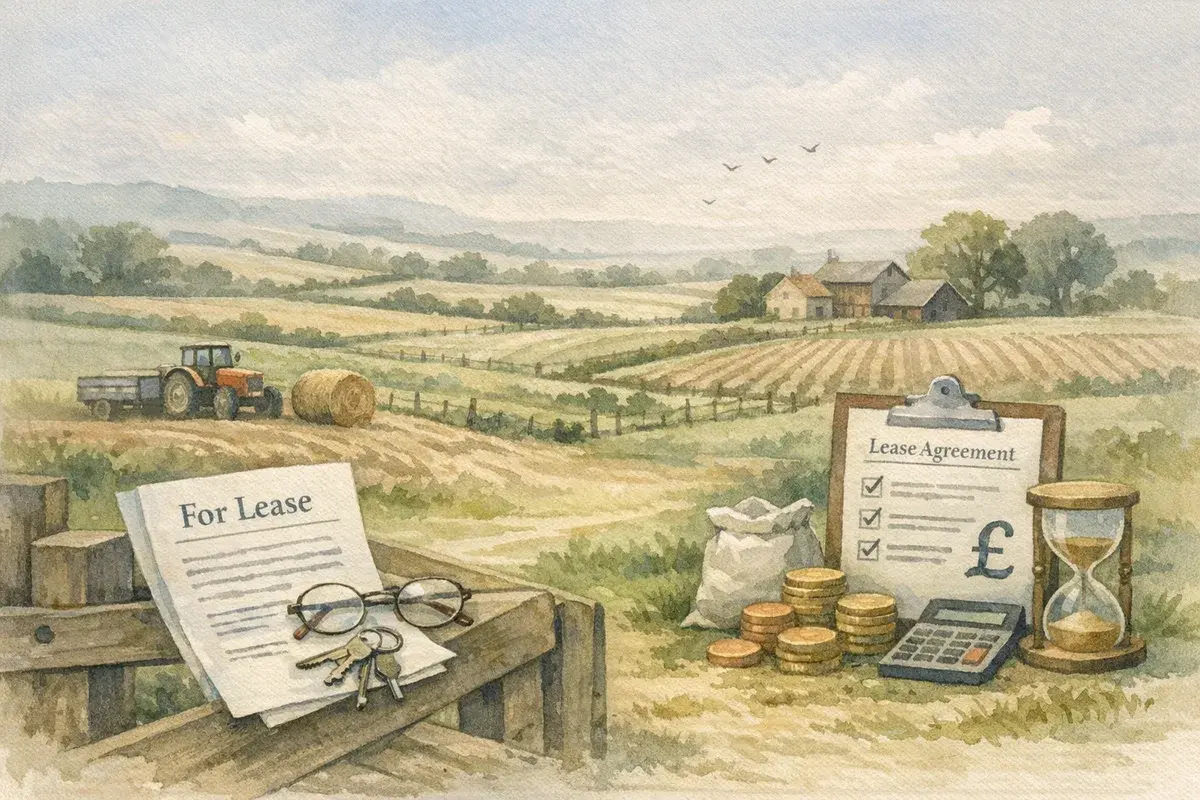
An agricultural land lease can suit tenants needing extra ground and landlords seeking steady income, but the detail matters. In practice, the right lease can support expansion, cashflow, and flexibility, while the wrong one can create expensive disputes.
If you're weighing up an agricultural land lease, the first question is simple: what is the land being used for, for how long, and on what terms? Those three points shape rent, repair duties, notice rights, diversification options, tax treatment, and whether the arrangement is actually secure enough for either side.
We'd argue this is one of the most overlooked areas in rural property. A field let for grazing in Cheshire, a block of arable ground in Lincolnshire, or a mixed holding on the Somerset Levels may all look similar on paper, yet the commercial and legal reality can be very different.
What An Agricultural Land Lease Actually Covers
An agricultural land lease is an agreement giving a tenant the right to occupy land for agricultural use in return for rent. Agricultural use usually means growing crops, keeping livestock, or both, but the exact wording in the agreement is critical because it controls what 'use' really means.
In England and Wales, the legal framework often turns on whether the arrangement is a tenancy, a licence, or something else entirely, a distinction the Central Association of Agricultural Valuers deals with constantly. That distinction matters because a tenancy generally gives stronger occupation rights, while a licence is usually more limited and easier to end. Rural land agents in counties such as Norfolk, Devon, Herefordshire, and North Yorkshire see this issue arise constantly, especially where land is let for grazing, mow-and-graze, or seasonal arable use.
Tenancy Or Licence
The label on the document is not enough on its own. Tribunals and courts look at the reality of occupation, so if someone has exclusive possession for a term at rent, the arrangement may be a tenancy even if the paperwork calls it a licence.
For landlords, that can create unexpected statutory rights. For tenants, it can mean greater stability than they first thought. Either way, clarity at the start saves trouble later (and usually saves legal fees too).
- Exclusive possession: The tenant controls the land to the exclusion of the landlord, subject to agreed rights.
- Term: The fixed period of occupation, which may be seasonal, annual, or longer.
- Rent: The payment for use of the land, commonly agreed per acre or as a whole.
- Permitted use: The activities allowed on the holding, such as grazing, cropping, or hay production.
Common Occupation Models
Short term grazing lets remain common in livestock counties such as Cumbria, Shropshire, and Pembrokeshire, where flexibility matters and grass demand changes quickly. Arable lets are often longer and more structured, particularly where the tenant needs cropping certainty for rotation planning, fertiliser strategy, and contracting.
Some agreements are deliberately narrow, covering only pasture and water access. Others include buildings, machinery yards, or rights over tracks and drainage. The broader the package, the more likely extra obligations appear in the lease.
How Rent Is Set And What Influences Value
Rent on an agricultural land lease is rarely determined by one factor alone. Soil quality, field size, access, drainage, location, sporting rights, water availability, and existing cropping potential all influence price, along with the length and security of the arrangement.
As of March 2025, market evidence suggests substantial variation across the UK, with shorter grazing arrangements generally priced much lower than longer, more secure arable occupations. In practical terms, bare pasture in peripheral locations may attract modest annual rents, while prime irrigated arable ground in eastern counties can command much stronger returns where the tenant gains real operational value.
| Lease Type | Typical Use | Indicative Rent Pattern | As Of |
|---|---|---|---|
| Short Grazing Let | Seasonal livestock grazing | Lower rent, often flexible and area-based | March 2025 |
| Arable Land Lease | Cropping and rotation | Higher rent, influenced by soil and access | March 2025 |
| Mixed Use Lease | Grass, crops, and ancillary land | Variable, depends on buildings and rights included | March 2025 |
That said, headline rent only tells part of the story. A cheaper lease can become expensive if the tenant must fund fencing, ditch clearance, weed control, or track repairs that should have been priced into the agreement from the start. A full repairing and insuring obligation shifts more cost again, which is why our wider explainer on the terms that decide what an agricultural lease really costs treats repairing liabilities, access and stocking limits as the real economics rather than the rent line.
Regional Differences Across The UK
County-level differences still matter. In parts of East Anglia, where scale and crop quality are often stronger, occupiers may accept firmer rents for productive blocks. In the South West, fragmented land, hedgerows, and stock access may keep rents more modest, but the value of secure grazing can still be high for local livestock systems.
Tools like local comparables, farm business consultation, and recent tender outcomes remain vital because no national average tells the full story. We'd say the best deals are usually the ones where both sides understand what the land can realistically produce, not what it might achieve in an optimistic year.
Key Lease Terms Every Farmer And Landlord Should Check
The best agricultural land lease is the one that reflects day-to-day reality. That means the document has to cover practical matters, not just rent and duration, because most disputes start with what 'wasn't mentioned' rather than what was.
Repair responsibilities are a classic flashpoint. If fencing, gates, water troughs, drains, or boundaries fail, who pays? A vague lease can leave both sides arguing over whether the item was part of the holding, shared infrastructure, or tenant maintenance. The same applies to soil condition, weed control, and the after-use of manurial value at the end of the term.
Repairs, Condition, And Access
Landlords should record the state of the land at the outset, ideally with a schedule of condition and photographs. Tenants should check access lanes, culverts, water supply, and the condition of gates and boundaries before signing, because the cost of fixing a problem after occupation usually lands on the person who did not explain it properly.
Access rights matter too. A lease for land behind third-party ground can unravel fast if the tenant cannot get machinery in at harvest time. In counties with narrow lanes and wet winters, such as parts of Somerset, Lancashire, and Devon, access can be as valuable as the acreage itself.
Use, Subletting, And Diversification
Most agricultural leases restrict use to farming, but the modern countryside often throws up side opportunities. Solar kit, farm shops, storage, caravan grazing, or tourism uses may sound attractive, yet they can trigger planning, tax, or insurance problems if the lease is too rigid or too loose.
Subletting and sharing occupation should be dealt with expressly. Without clear drafting, a tenant could accidentally give rise to unintended occupation rights, while a landlord may find it harder to recover the land when the term ends.
- Repair schedule: A written record of the holding's condition at the start.
- Break clause: A right for one or both parties to end the lease early.
- Permitted diversification: Extra uses allowed beyond core farming.
- Restoration obligation: The duty to return land in an agreed condition at expiry.
Legal And Tax Points That Change The Deal
An agricultural land lease is rarely just a property arrangement. It can affect tax, succession planning, environmental schemes, and compensation rights, so both parties need to think beyond the rent cheque.
For landlords, the structure may influence Inheritance Tax, Capital Gains Tax, and the treatment of tenancy income. For tenants, the lease terms may affect business structure, subsidy eligibility where relevant, and access to support schemes or environmental management agreements. The precise tax position depends on the facts, which is why local professional advice is worth its weight.
Agricultural Property Relief And Business Strategy
Some landowners let land because they want income without day-to-day farming risk, but they may also be protecting family succession plans. The interaction with Agricultural Property Relief can be important, particularly where land is owned in the wrong way, occupied on an uncertain basis, or let under terms that do not match the wider estate strategy.
Tenants should also think about how improvements are treated. If they pay for drainage, fencing, or soil improvements, can they claim compensation? Who owns the fixture? What happens if a hedge is laid or a track is upgraded? The lease should answer these points before the work starts, not after the last trailer leaves the field.
Environmental Schemes And Stewardship Rules
With stewardship, nutrient management, and biodiversity requirements becoming more prominent, leases increasingly need to deal with scheme participation. If the landlord is in a scheme, the tenant must know what actions are required. If the tenant wants to enter a scheme, the landlord's consent and the lease wording may control whether that is possible.
That is especially relevant in sensitive landscapes such as the Norfolk Broads, the Yorkshire Dales, and parts of the Cotswolds, where environmental obligations can influence stocking, cutting dates, and boundary management. A lease that ignores this reality is asking for trouble.
What Agents And Landowners Should Watch In The 2025 Market
Demand for an agricultural land lease remains driven by farm profitability, cashflow pressure, and the need for flexible scale. As of March 2025, many occupiers still want short or medium-term agreements because they can expand without buying land outright, while landlords often prefer dependable income over direct management headaches.
Market appetite is strongest where land is well accessed, useful to an existing farm, and free from major uncertainty. Blocks close to farmyards, silos, irrigation infrastructure, or livestock units usually let more easily than isolated parcels, even when the acreage is similar.
| Factor | Why It Matters | Likely Effect On Lease Value | As Of |
|---|---|---|---|
| Soil Quality | Affects yield and grazing capacity | Higher value on better land | March 2025 |
| Access | Controls machinery movement and logistics | Good access supports stronger demand | March 2025 |
| Lease Length | Impacts security and planning | Longer terms usually improve value | March 2025 |
For estate agents, the practical lesson is straightforward. Package the land properly, be explicit about rights, and present useful information early. Acreage alone is never enough. Buyers and tenants want evidence of water, soil type, field boundaries, cropping history, and any constraints that might affect operations or future flexibility.
For landowners in counties such as Cambridgeshire, Leicestershire, and Essex, where demand for productive ground can be strong, a well-structured lease can attract quality operators quickly. In more marginal or fragmented areas, realistic pricing and tidy documentation make the difference between a quick let and months of uncertainty.
Conclusion
An agricultural land lease works best when both sides understand the ground, the numbers, and the legal consequences before signing. The strongest agreements are clear on occupation, rent, repairs, use, and end-of-term obligations, because that is where disputes usually begin.
Whether you are letting grass in Cornwall, taking arable land in Lincolnshire, or structuring a mixed holding in the West Midlands, the message is the same: get the detail right, and the lease has a far better chance of doing what it should. In agriculture, certainty is valuable.
Disclaimer: AgLand.co.uk is a UK agricultural land and rural property matching service, where buyers register what they are looking for and owners advertise directly to the buyers who match, and a rural resource hub. Nothing in this text is intended as legal, financial, or investment advice. You should carry out your own due diligence and seek guidance from appropriately qualified professionals (for example, solicitors, land agents, surveyors, and financial advisors) for your specific circumstances.