
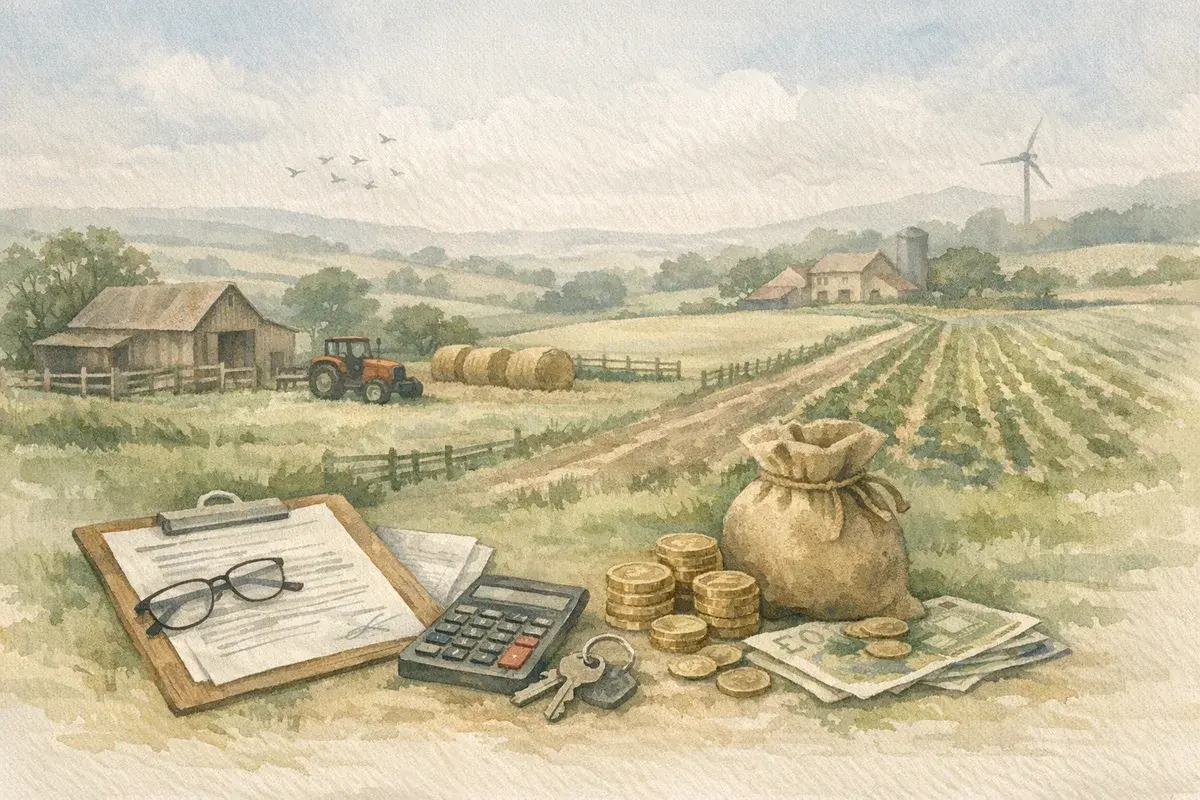
An agricultural lease sets out how farmland, buildings, and sometimes equipment are used by a tenant for farming. This guide explains the main terms, likely costs, and the practical issues that matter most to farmers, landlords, and agents.
If you're wondering whether an agricultural lease suits your business, the short answer is this: it depends on control, flexibility, and risk. A well-written agreement can support expansion or succession planning, while a poor one can lock both sides into avoidable disputes.
We'd argue that the detail matters more than the headline rent. Rent is important, of course, but so are repairing liabilities, access rights, stocking limits, environmental duties, and how long the term actually lasts. Miss those, and you can end up with a cheap-looking deal that's expensive in practice.
What An Agricultural Lease Actually Covers
An agricultural lease is a legal agreement giving a tenant the right to occupy land for agricultural use, usually in return for rent. In plain English, the landlord keeps ownership, but the tenant gets day-to-day farming control within the limits of the lease.
That sounds straightforward, yet the range of arrangements is wide. Some leases cover a few arable fields in Lincolnshire, others include dairy buildings in Somerset, mixed grassland in Cumbria, or a whole let farm in Norfolk with cottages, yards, and drainage systems included.
Typical Subjects Within The Lease
The lease should spell out exactly what is being let. That might include land, farmhouses, livestock buildings, grain stores, irrigation kit, slurry systems, or shared access routes. If it is not written clearly, assumptions tend to cause trouble later.
- Land area: the hectares or acres being let, with boundaries shown on a plan.
- Use: cropping, grazing, mixed farming, or specialist production such as root crops or horticulture.
- Buildings: barns, cattle courts, milking parlours, yards, stores, and hard standings.
- Access: rights of way for machinery, stock, deliveries, and maintenance.
Landlords in counties such as Yorkshire, Devon, and Aberdeenshire often want tight control over how the holding is managed, while tenants commonly want enough freedom to respond to weather, markets, and crop rotations. That balance is the heart of any good lease.
Types Of Agricultural Lease And Tenancy Structure
Not every agreement is a classic long farm letting. Depending on the site and business model, the deal may be a short-term grazing licence, a seasonal arrangement, or a longer tenancy with stronger rights and more obligations. The label matters, but the substance matters more. Where someone has exclusive possession for a term at a rent, a tribunal can find a tenancy however the paperwork is titled, and what an agricultural land lease actually commits both sides to sets out how that test is applied.
In England and Wales, the form of tenancy can affect security of tenure, rent review, succession prospects, and the ability to diversify. In Scotland and Northern Ireland, different statutory regimes and local practice can change the picture again, so it is never wise to assume one county's norm fits another.
Common Farming Occupation Models
A tenancy can sit anywhere on the spectrum from very flexible to highly secure. A grazing licence, for example, may suit a livestock keeper needing summer grass in Gloucestershire, while a longer farm business tenancy may suit an arable operator in Cambridgeshire needing confidence to invest in soil improvement.
- Short term letting: often used for grazing, forage, or temporary occupancy.
- Farm business tenancy: a common commercial structure in England for new lettings.
- Older protected tenancy: less common for new deals, but still important in succession and valuation.
- Seasonal agreement: useful where land is only needed for part of the year.
The right structure depends on what both sides need. A tenant investing in drainage, fencing, or a new dung store will want more certainty than someone simply turning out sheep for a single season.
| Tenancy Type | Typical Use | Key Point | As Of |
|---|---|---|---|
| Grazing licence | Seasonal livestock grazing | Flexible but limited security | June 2026 |
| Farm business tenancy | Commercial farming occupation | Widely used for new English lettings | June 2026 |
| Protected tenancy | Established long term occupation | Greater security, fewer modern variations | June 2026 |
| Seasonal agreement | Forage or temporary land use | Useful for short term needs | June 2026 |
Rent, Repairs, And Other Core Commercial Terms
Rent is usually the first number people ask about, but it is only one part of the economic deal. An agricultural lease can shift a lot of value through repair obligations, insurance responsibilities, fixed equipment maintenance, and whether the tenant is expected to contribute to buildings or drainage works.
As of June 2026, rural rents still vary sharply by county, land quality, and the amount of residential or building content. Best-grade arable in prime eastern counties generally commands more than marginal grassland in upland areas, although local demand and unit size can change that quickly.
What Drives Agricultural Rent
Rent is shaped by productive capacity, not just acreage. Soils, field size, access, road frontage, irrigation, building quality, and whether the holding supports dairying, arable, or livestock all feed into likely value.
- Land quality: Grade 1 and 2 land usually supports stronger returns.
- Location: East Anglia, the Vale of York, and parts of the Midlands often attract higher bids.
- Buildings: Useable sheds and yards can materially increase value.
- Term length: Longer certainty can support a stronger rent, but may require more tenant investment.
For context, a modest ring-fenced arable block in Cambridgeshire may be priced very differently from hill grazing in Cumbria, even if the headline acreage looks similar. Why? Because productive potential, cropping flexibility, and access to markets all influence what the land can realistically earn.
Repairs, Insurance, And Outgoings
The repairing clause is one of the most practical parts of the lease. A full repairing and insuring obligation can leave the tenant carrying more cost than expected, especially where older buildings, corrugated roofs, or tired drainage systems are involved.
Landlords often prefer clear responsibility for structural repairs, while tenants may accept routine maintenance but resist major capital items. That is sensible, because a broken gate can be managed, but a failing roof or collapsed culvert is another matter entirely.
Due Diligence Before Signing An Agricultural Lease
Before anyone signs an agricultural lease, the site should be checked properly. A quick walkover is not enough. You need to know what is physically there, what rights are included, and whether the paperwork matches the reality on the ground.
This is where experienced land agents and solicitors earn their keep. A good check can uncover hidden boundary problems, missing rights to use an access lane, historic drainage obligations, or a building tied to a different part of the estate.
Practical Checks That Matter
Think about how the holding will function day to day. Can machinery enter safely in wet weather? Is there enough water for livestock? Are there restrictions from environment or planning controls that may affect spreading, storage, or diversification?
- Boundaries: confirm fences, hedges, ditches, and ownership lines on the ground.
- Access: check for legal rights over tracks, gateways, and shared roads.
- Water supply: assess troughs, mains connections, boreholes, or private systems.
- Drainage: inspect ditches, grips, pipes, and areas prone to waterlogging.
- Planning and environmental limits: identify any constraints on use, works, or storage.
There is also the practical question of fit. A tenant growing cereals around Lincolnshire will care about machinery access and storage differently from a bidder wanting a dairy unit in Cheshire or a mixed livestock yard in Pembrokeshire. The best agricultural lease is the one that matches the business plan, not just the rent sheet.
Regional Market Differences Across The UK
Market conditions for an agricultural lease vary across the UK, and county-level differences are often stark. Availability, farm type, and the competitiveness of local demand shape both rent and structure, especially where good blocks are scarce.
In eastern counties such as Norfolk, Suffolk, Cambridgeshire, and Lincolnshire, arable demand remains strong because commercial farming systems are often easier to scale. In contrast, livestock ground in parts of the North West, Wales, and the Scottish Borders may be driven more by grazing needs, stocking rates, and support buildings.
| Region | Common Lease Focus | Typical Market Driver | As Of |
|---|---|---|---|
| East Anglia | Arable blocks and storage | Productive soils and cropped area | June 2026 |
| South West | Mixed and livestock units | Grassland, dairying, and diversification | June 2026 |
| Midlands | Commercial farm let units | Balanced access and arable-livestock mix | June 2026 |
| Uplands | Grazing and hill ground | Stocking capacity and seasonal use | June 2026 |
The county detail really matters. A lease in Devon may prioritise pasture management and slurry handling, while one in North Yorkshire may focus on rotations, field drainage, and rings of road access for large kit. Would the same template work for both? Hardly.
For investors and estate agents, the regional angle also affects void risk. Larger, better-equipped holdings in stronger farming districts may let more quickly, while smaller parcels or awkwardly shaped fields can linger unless the terms are sensible and the use is clear.
Common Pitfalls And How To Avoid Them
Most disputes around an agricultural lease come down to poor drafting or mismatched expectations. The parties think they have agreed the main points, then the small print quietly changes the deal.
One common issue is assuming that improvements will be compensated. Another is discovering that the tenant cannot alter cropping, keep certain livestock, or sublet part of the holding without consent. These are not minor details. They can affect business viability.
Issues That Often Cause Trouble
Good leases are specific. Vague ones create room for argument, and rural disputes can be slow and costly to unpick once relationships sour.
- Ambiguous terms: unclear boundaries, use rights, or repair duties.
- Hidden constraints: overlooked stewardship, planning, or access limits.
- Unfair apportionment: one side carrying more maintenance cost than expected.
- Weak exit terms: no clarity on break clauses, surrender, or end-of-term condition.
We'd argue that the best protection is simple: write it down properly, inspect the holding thoroughly, and match the tenancy type to the actual farming business. That may sound obvious, but plenty of expensive mistakes begin with a hand-shake and an optimistic assumption.
Conclusion
An agricultural lease is more than a rent agreement. It defines control, risk, and the commercial future of the holding, so the structure, repairs, and rights all deserve proper attention.
For farmers, the right lease can support growth, flexibility, and sensible capital planning. For landlords and agents, a carefully drafted agreement can protect the asset while keeping it attractive to the right tenant. Either way, the detail is what makes the difference.
Disclaimer: AgLand.co.uk is a UK agricultural land and rural property matching service, where buyers register what they are looking for and owners advertise directly to the buyers who match, and a rural resource hub. Nothing in this text is intended as legal, financial, or investment advice. You should carry out your own due diligence and seek guidance from appropriately qualified professionals (for example, solicitors, land agents, surveyors, and financial advisors) for your specific circumstances.