
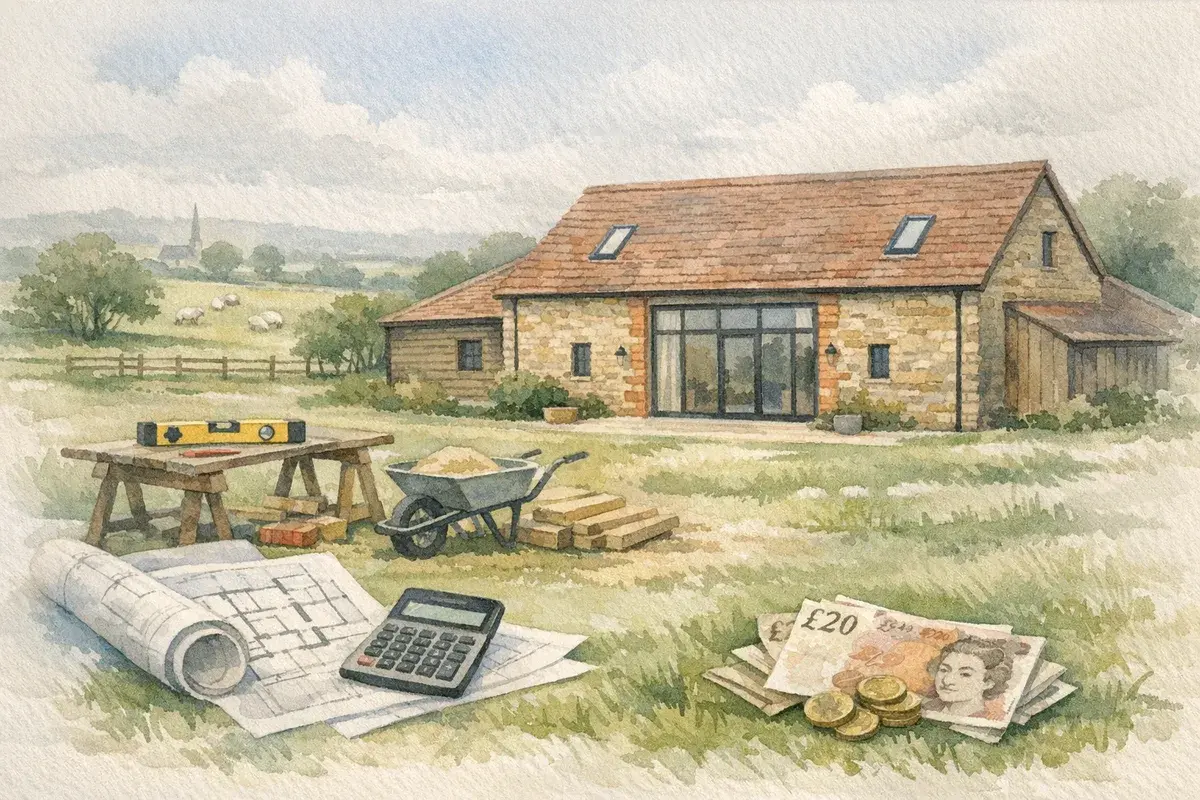
If you're asking how much does a barn conversion cost, the short answer is that it varies wildly. As of June 2026, a typical UK barn conversion can cost from £250,000 to £1.2 million+, depending on size, location, structural condition, and the quality of finish.
That range sounds broad because it is. A modest stone barn in Lincolnshire with planning in place and good access will sit in a very different bracket from a large timber-framed barn in the Cotswolds requiring major structural repairs, services, and full planning consent.
The important point is this: the purchase price is only the starting line. The real budget needs to include acquisition, planning, surveys, construction, utilities, external works, VAT, and contingency. Miss one of those and the numbers can get uncomfortable fast.
Barn Conversion Cost Breakdown
We'd argue the cleanest way to think about a barn conversion is in layers. First, you've got the asset itself. Then come the feasibility costs. Finally, there's the build, which is often where the biggest surprises land.
As of June 2026, many self-build and conversion projects are seeing build costs of roughly £1,800 to £3,500 per square metre for a standard residential specification, with higher-end schemes comfortably exceeding that. In practical terms, a 200 square metre barn could therefore cost somewhere between £360,000 and £700,000 to convert, before land purchase or exceptional works.
Typical Cost Components
The headline figure is only useful if you know what it includes. A decent budget should cover the full chain from due diligence to completion, not just the builders' invoice.
- Purchase price: The barn itself, whether sold with land or as a standalone plot.
- Professional fees: Architect, planning consultant, structural engineer, quantity surveyor, and survey fees.
- Construction: Structural repairs, insulation, roofing, internal layout, fittings, and finishes.
- Services: Electricity, water, drainage, sewage treatment, heating, and broadband.
- External works: Access tracks, parking, landscaping, boundaries, and any agricultural diversification features.
- Contingency: Usually 10% to 15%, though old rural buildings can need more.
One often-overlooked item is VAT. Building work to convert a barn into a home usually qualifies for the reduced 5% VAT rate rather than the zero rate for new builds, and self-builders can often reclaim VAT through the DIY housebuilders scheme, claimed within 6 months of finishing. The details depend on the works, so get advice early.
What Changes The Budget Most
Location matters, but so does the barn's bones. If the structure is sound and the envelope is dry, costs stay more manageable. If the roof, walls, or foundations need serious intervention, the bill rises quickly.
Access can be a quiet budget killer too. A rural site in Somerset with narrow lanes, poor turning space, or long service runs can cost more to build than a straightforward barn in parts of Yorkshire or East Anglia. Likewise, listed buildings or barns in conservation areas can bring tighter design controls and longer professional timelines.
Planning Permission And Feasibility Costs
Before you spend heavily on drawings or builders, you need to know whether the scheme is actually possible. That means checking planning policy, building regulations, highways access, drainage, ecology, and, in some cases, heritage constraints.
For many agricultural agents and landowners, the first real spend is on a feasibility pack. As of June 2026, that might cost £2,000 to £10,000+ depending on the complexity, local authority area, and whether the site needs specialist reports. It's not glamorous money, but it can save far more than it costs.
Regional Planning Differences
County-level planning culture can shape the whole equation. In the Cotswolds, parts of Surrey, and the South Downs, design scrutiny is typically more exacting, and that can push up both adviser fees and timeframes. In contrast, some rural authorities in Lincolnshire, Shropshire, or parts of Northumberland may be more practical where the barn has a strong agricultural legacy and the design is sympathetic.
That said, there are no easy rules. A barn in Devon on a sensitive site may face more hurdles than a similar building in Nottinghamshire, while a well-screened barn in Cheshire with strong access and reuse credentials may proceed smoothly. Local policy is everything.
| Stage | Typical Cost Range as of June 2026 | Notes |
|---|---|---|
| Feasibility review | £1,000 to £3,000 | Initial planning and site checks |
| Planning application support | £2,000 to £8,000 | Architect and planning consultant fees |
| Specialist surveys | £1,500 to £7,500 | Structural, ecology, drainage, heritage |
| Constraints-led schemes | £5,000 to £15,000+ | For listed or complex rural sites |
There's also the question of permitted development rights, which sometimes apply to agricultural buildings, though barn conversions often still require careful legal and technical interpretation. If the building has been altered, abandoned, or used differently over time, the available rights can narrow quickly.
Planning Risk And Delay Costs
Time has a cost. A six-month delay can mean extra finance charges, higher labour rates, and a more expensive material procurement window. In the current market, that matters more than many buyers expect.
We'd suggest building a delay buffer into your budget. If you're financing the project, even a modest increase in interest rates can hurt cashflow. And if the barn sits idle while paperwork drags, the holding cost of the site still ticks on.
Construction Costs By Size And Specification
The size and finish of the barn conversion will drive the largest part of the spend. A compact two-bedroom conversion on an uncomplicated plot is a very different proposition from a large family home with vaulted ceilings, underfloor heating, a boot room, utility space, and high-spec kitchen joinery.
As of June 2026, a practical budgeting guide is to think in terms of cost per square metre rather than just total project value. That gives you a better way to compare barns across counties and build types, especially when one site has more structural work than another.
Size-Based Budget Examples
A 120 square metre barn in a lower-cost rural area might be converted for £220,000 to £360,000 excluding purchase, assuming a sensible layout and limited structural intervention. A 250 square metre barn with premium finishes can easily move into the £450,000 to £875,000 range, again before land or abnormal costs.
Larger barns also tend to need more thinking around heat loss and room arrangement. Open-plan living looks wonderful, but oversized volumes can become expensive to heat unless the building fabric and services are properly designed.
Specification Choices That Move The Needle
Materials make a sharp difference. Reclaimed stone floors, bespoke glazing, oak frames, and handmade kitchens all add character, but they also add pounds. Good insulation, quality windows, and efficient heating are often worth spending on first because they protect comfort and running costs for years.
In agricultural settings, there's a useful distinction between cosmetic spend and structural spend. Fancy taps are nice. A watertight roof, proper damp strategy, and well-detailed junctions are essential. Guess which ones matter when the winter rain arrives?
Typical cost drivers include:
- Roof replacement: Often one of the biggest single items if the structure is tired.
- Glazing: Large openings and bifolds can be expensive in rural bespoke builds.
- Heating system: Air source heat pumps, ground source systems, or biomass options.
- Internal layout: More rooms usually mean more doors, plumbing, and finishes.
- Ground conditions: Poor soils or sloping sites can create extra foundation costs.
Regional Price Differences Across The UK
Where the barn sits can change the final figure as much as the spec. The same building may cost materially more to finish in one county than another, partly because labour, materials, planning pressure, and local demand vary across the country.
As of June 2026, barn conversion projects in the South East, Cotswolds, and parts of the West Country are often the most expensive on a per-square-metre basis, while areas such as parts of the East Midlands, Yorkshire, and the North West can offer better value, particularly where local contractor availability is strong.
Where Costs Tend To Be Higher
Higher-value rural markets usually mean higher competition for skilled trades and tighter design expectations. Gloucestershire, Oxfordshire, Surrey, and Hampshire are good examples, especially where premium residential demand supports strong end values but also pushes up build ambition.
That doesn't mean cheap is always cheerful. In some lower-cost counties, a limited pool of specialist barn contractors can offset the advantage of lower land values. If the project needs heritage masonry, structural steel, or conservation-grade detailing, the right contractor may not be local.
Where Costs Can Be More Balanced
Shropshire, Lincolnshire, North Yorkshire, and parts of Norfolk can offer decent balance between purchase price and end value, provided planning and access are manageable. These areas often make sense for buyers wanting space without paying premium South East land prices.
For landowners, that regional spread matters commercially. A barn conversion can unlock value from underused agricultural stock, but only if the gross development value justifies the conversion costs and the planning position is sound.
Useful regional influences include:
- Labour availability: Specialist trades can be harder to secure in remote counties.
- Planning stringency: Affects design, delay, and solicitor or consultant time.
- Market value on completion: Premium areas support more ambitious schemes.
- Access and logistics: Remote sites often cost more to build and service.
How To Budget Sensibly Before You Buy
The smartest buyers treat the barn like a project, not just a romantic rural purchase. Look beyond the building's charm and ask what it would actually take to make it a legal, comfortable home.
Start with a weighted budget. Put hard numbers against purchase, surveys, planning, build, utilities, and contingency. Then add a separate reserve for unknowns. If the building turns out to have hidden structural issues, you'll be glad you did.
A sensible pre-purchase checklist includes surveying the roof and frame, checking drainage options, confirming access, and understanding whether the barn sits within a protected landscape or heritage setting. For a converted agricultural building, the local authority's stance on design and reuse can be the difference between a viable project and a very expensive daydream.
We'd also suggest testing the end value against local comparable homes. If the finished barn would likely sell for £550,000 but the total project cost is creeping close to £500,000, the margin is thin. If the project is for your own occupation, profitability matters less, but cashflow and resale risk still matter.
Conclusion
So, how much does a barn conversion cost? As of June 2026, the honest answer is that most projects land somewhere between £250,000 and £1.2 million+, with the exact figure shaped by size, condition, planning, region, and specification. The land, the structure, and the services all matter, and the hidden costs often matter most of all.
If you're assessing a barn in the countryside, think in terms of full project viability rather than just the initial purchase. A well-planned conversion can be a superb rural home or a strong investment, but only when the numbers stack up from the outset.
Disclaimer: AgLand.co.uk is a UK agricultural land and rural property matching service, where buyers register what they are looking for and owners advertise directly to the buyers who match, and a rural resource hub. Nothing in this text is intended as legal, financial, or investment advice. You should carry out your own due diligence and seek guidance from appropriately qualified professionals (for example, solicitors, land agents, surveyors, and financial advisors) for your specific circumstances.