
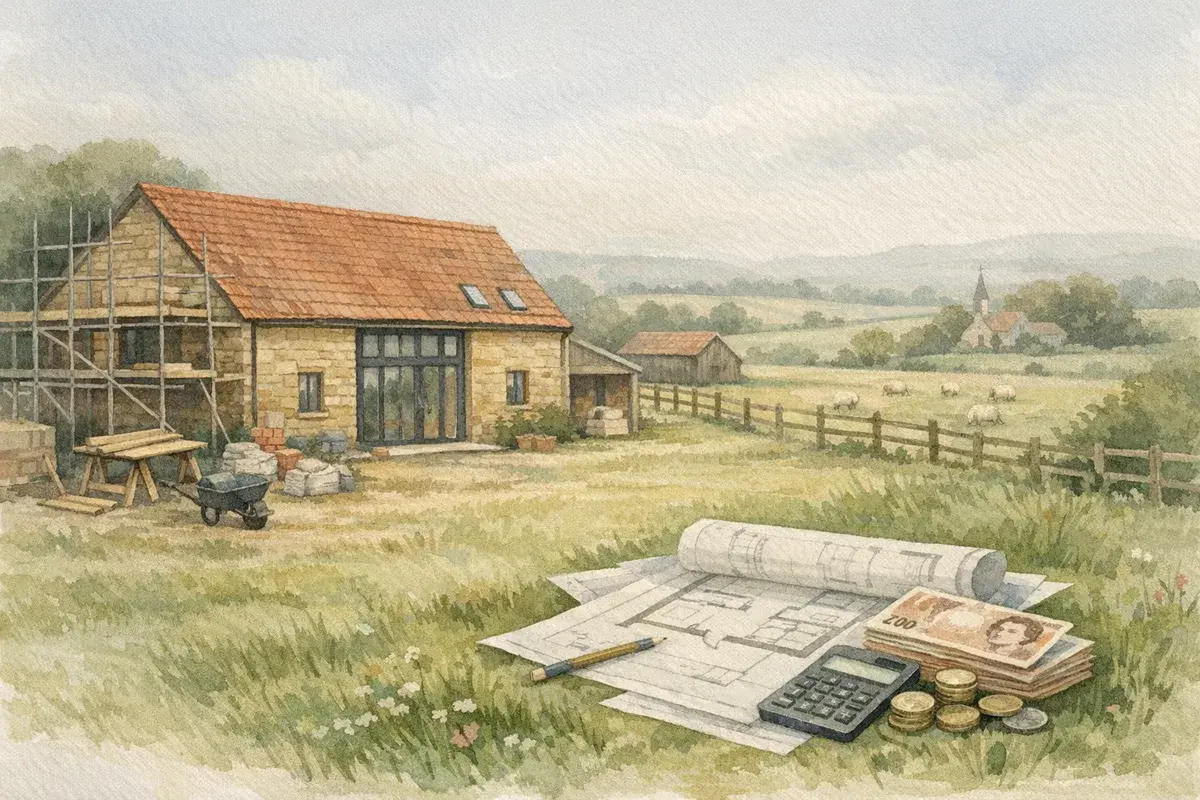
The average cost of barn conversion in the UK usually starts around £175,000 to £350,000+ as of June/2026, but the real figure depends on the barn's condition, size, location, and how much structural work is needed. This guide explains the main cost drivers, regional variations, and the hidden extras that catch buyers out.
If you're looking at a derelict Dutch barn in Lincolnshire, a stone threshing barn in the Cotswolds, or a timber building in Powys, the headline price is only part of the story. Structural repairs, planning compliance, drainage, utilities, and finishing standards can swing the budget by six figures, and that's before you think about landscaping or access.
We'd argue the smartest question isn't just 'what does a barn conversion cost?' It's 'what kind of barn am I buying, and what will it take to make it liveable?' The answer changes fast. A shell conversion in Cheshire may be far cheaper than a heavily altered building in Surrey, but local labour, materials, and planning conditions can flip that equation in a hurry.
What The Average Cost Of Barn Conversion Includes
The average cost of barn conversion usually covers four broad areas: purchase, design and professional fees, construction, and finishing. On many rural projects, the build itself makes up the biggest slice, but the pre-build stage can still be surprisingly expensive, especially if you need architect drawings, structural advice, ecology surveys, or a specialist planning consultant.
As a rough guide as of June/2026, a modest conversion of a structurally sound barn might come in at £175,000 to £250,000 for the works alone. A more ambitious scheme with a poor roof, new openings, underfloor heating, and high-end finishes can quickly move towards £350,000 to £500,000+. In premium counties such as Oxfordshire, Gloucestershire, and parts of Hampshire, buyers often need to budget even more for labour and material logistics. Expressed as a rate, most UK schemes work out at roughly £120 to £250 per square foot, though what a per square foot figure quietly leaves out is usually the professional fees, VAT and external works.
That said, the cheapest barn is rarely the cheapest project. A low asking price can hide substantial costs for steel reinforcement, damp treatment, rebuilds, or a complete roof replacement. In rural property, access matters too. If a mixer lorry or crane can't get close, costs tend to rise. Small footprints offer less protection than owners expect, since a building of roughly 75 to 120 square metres still needs the same surveys, service connections and consents, which is why budgets for small barn conversions rarely start below £150,000. Structural remediation on a poor shell commonly adds 10% to 35% on top of the base build cost, a figure we break down alongside per square foot rates in our closer look at what a barn conversion really costs.
Typical Barn Conversion Cost Components
Before you build a spreadsheet, break the project into cost bands. That helps you compare like with like and spot where the money is really going. The bands people leave out tend to be the soft ones, from ecology and drainage design to a contingency of 10% to 20%, so it is worth building the sheet around the full set of buckets a barn conversion cost calculator should model.
- Survey and design: measured surveys, architects, planning input, and structural engineering.
- Shell works: roof repair, walls, floors, insulation, and new openings.
- Services: electrics, plumbing, heating, water supply, septic tank or treatment plant.
- Internal finish: kitchens, bathrooms, flooring, plaster, joinery, and decoration.
- External works: drainage, access, parking, landscaping, and boundary treatment.
These are not optional extras in many cases. For example, a barn in a flood-risk part of Somerset may need more robust drainage and floor build-ups, while a remote building in Northumberland might require a private water solution and longer service runs. Those issues don't just add cost. They can also affect whether the conversion is viable at all.
Regional Barn Conversion Costs Across The UK
Location makes a big difference to the average cost of barn conversion. Not just because land values vary, but because labour rates, planning expectations, and access conditions vary too. County-level differences matter, especially when barns sit in protected landscapes or areas with strong local design requirements.
As of June/2026, a basic conversion in the Midlands may still sit within the lower end of the national range, while the South East and parts of the South West often sit higher. Rural counties with strong demand, such as Oxfordshire, Kent, and Surrey, can attract premium labour and consultancy costs. By contrast, several northern counties and parts of Wales may offer better build value, though very remote sites can offset that advantage.
| Region | Typical Build Cost Range | Common Pressure Points | Date Reference |
|---|---|---|---|
| Midlands | £175,000 to £300,000 | Standard labour, moderate access issues | As of June/2026 |
| South East | £225,000 to £450,000+ | High labour rates, planning sensitivity | As of June/2026 |
| South West and Wales | £190,000 to £400,000+ | Remote access, drainage, heritage settings | As of June/2026 |
| North and Scotland | £165,000 to £350,000+ | Transport, weather delays, servicing costs | As of June/2026 |
Take Gloucestershire, for instance. A converted barn near the Cotswolds Area of Outstanding Natural Beauty can face tighter design control and more expensive finishes because buyers expect a certain standard. In Lincolnshire, where large agricultural sheds and traditional barns may be more common, the key issue can be the starting structure rather than the postcode. And in Devon or Cornwall, the cost of bringing materials in and getting services connected can make a supposedly cheaper barn look far less attractive.
When County Location Matters Most
County location matters most when the project sits in one of these situations:
- Protected landscapes: Areas such as the Cotswolds, Norfolk Broads, and North York Moors often bring stricter design scrutiny.
- High-value commuter belts: Surrey, Buckinghamshire, and Cheshire can attract higher contractor rates and stronger end values.
- Remote rural sites: Powys, Cumbria, and Highlands locations may face higher logistics and servicing costs.
- Heritage-led areas: Stone barns in counties like Herefordshire and Yorkshire often need specialist repair methods.
The key takeaway? The same barn can cost very different amounts to convert depending on where it stands. That's why local market knowledge is worth more than generic national averages.
What Drives The Final Conversion Budget
The biggest cost variable is the barn itself. A dry, structurally sound agricultural building with a decent roof and solid walls is a very different proposition from a leaning shell with failing timbers and no services nearby. The more the existing structure can be retained, the better your chances of keeping the average cost of barn conversion within the lower end of the range.
Planning status also matters. Some barns can be converted under permitted development rights, while others need full planning permission. In practice, planning often shapes the whole scheme, from the number of windows to the external materials you can use. If the local authority wants minimal change to the exterior, your internal layout may have to work harder, and that can increase design fees or reduce floorplan flexibility.
Structural Condition And Building Fabric
Look carefully at the roof, walls, foundations, and frame. Roof replacements are expensive, especially on larger spans, and steelwork for stabilisation can be a major line item. Stone barns may need repointing and wall repairs, while timber barns often require careful treatment of decayed members and insect damage.
Don't overlook floors. Many agricultural barns were never intended for domestic loading or insulation standards, so new slabs, damp membranes, and insulation layers are common. If the floor levels need to be lowered or reworked, costs can rise quickly.
Services, Access, And Groundworks
Utilities are often underestimated. Electricity supply upgrades, private drainage, water storage, septic tanks, and heating all add up. Underfloor heating, for example, is popular in barn conversions because it suits open-plan layouts, but it requires careful floor construction and design coordination.
Access can be a hidden budget killer. Narrow lanes, weak bridges, overhead cables, or soft ground can all slow delivery and increase plant hire. Even simple things like temporary welfare units and site storage can be more expensive on an exposed farmstead than on a standard housing plot.
Professional Fees, Planning, And Hidden Extras
It's easy to focus on bricks, timber, and tiles, but professional fees can account for a substantial share of the total. As of June/2026, many barn projects involve architect services, structural engineering, planning consultancy, ecology reports, bat surveys, drainage design, and building control fees. Those can easily absorb 10% to 20% of the project budget, sometimes more on complex rural sites.
And then there are the hidden extras. Some are predictable once you know what to look for, but they still catch out plenty of buyers. Think temporary power, muck-away costs, reinstating tracks, replacing fencing, or meeting biodiversity and landscaping conditions attached to planning approval. If the barn lies in a conservation area or near listed buildings, the professional input often becomes more specialised and more expensive.
We'd also flag contingency. On a barn conversion, a contingency fund of 15% to 20% is sensible, because old agricultural buildings are full of surprises. Rotten roof purlins, cracked masonry, buried concrete, or uneven settlement can all appear once work starts.
Common Hidden Costs To Budget For
- Surveys: structural, ecology, drainage, asbestos, and bat assessments.
- Planning conditions: extra drawings, reports, and discharge fees.
- Service connections: electricity, water, drainage, and telecoms.
- Groundworks: excavation, levelling, retaining walls, and drainage runs.
- Finishing upgrades: bespoke glazing, joinery, kitchens, and flooring.
These items aren't nice-to-haves. They're often what separates a working conversion from a stalled one. If you're buying a barn on a rural estate, ask early about wayleaves, access rights, and whether any shared infrastructure needs to be upgraded before work begins.
How To Judge Whether A Barn Is Good Value
Good value is not the same as a cheap asking price. In many cases, the best opportunity is a barn that already has a clear planning route, decent access, and a structure that can be adapted without drastic rebuilding. That's especially true for owner-occupiers who want a home rather than an investment project.
For farmers and landowners, the equation can be more strategic. A barn conversion may unlock residential value from a redundant farm building, but it can also change the character of a holding and create long-term maintenance responsibilities. If you're considering sale, let, or retained occupation, think beyond the build cost and consider the end use carefully.
A practical appraisal should compare likely total spend against the finished value of the property in its county market. A converted barn in Cheshire or West Sussex may command a strong premium if it's well executed, while a similar build in a lower-value area may need tighter cost control to remain viable. The best projects tend to be those where the structure, planning route, and end market all point in the same direction.
So, what should you ask before committing? Start with the condition of the existing building, then local planning constraints, then access and servicing. If those three don't stack up, the average cost of barn conversion becomes almost irrelevant because the project may be fundamentally underpriced from the start.
Conclusion
The average cost of barn conversion in the UK sits in a wide band, but most projects fall somewhere between £175,000 and £350,000+ as of June/2026, with regional and structural differences pushing budgets higher or lower. The smartest buyers focus on the condition of the barn, planning route, access, and hidden infrastructure costs before they fall in love with the idea of conversion. Get those basics right, and the numbers make far more sense.
Disclaimer: AgLand.co.uk is a UK agricultural land and rural property matching service, where buyers register what they are looking for and owners advertise directly to the buyers who match, and a rural resource hub. Nothing in this text is intended as legal, financial, or investment advice. You should carry out your own due diligence and seek guidance from appropriately qualified professionals (for example, solicitors, land agents, surveyors, and financial advisors) for your specific circumstances.