
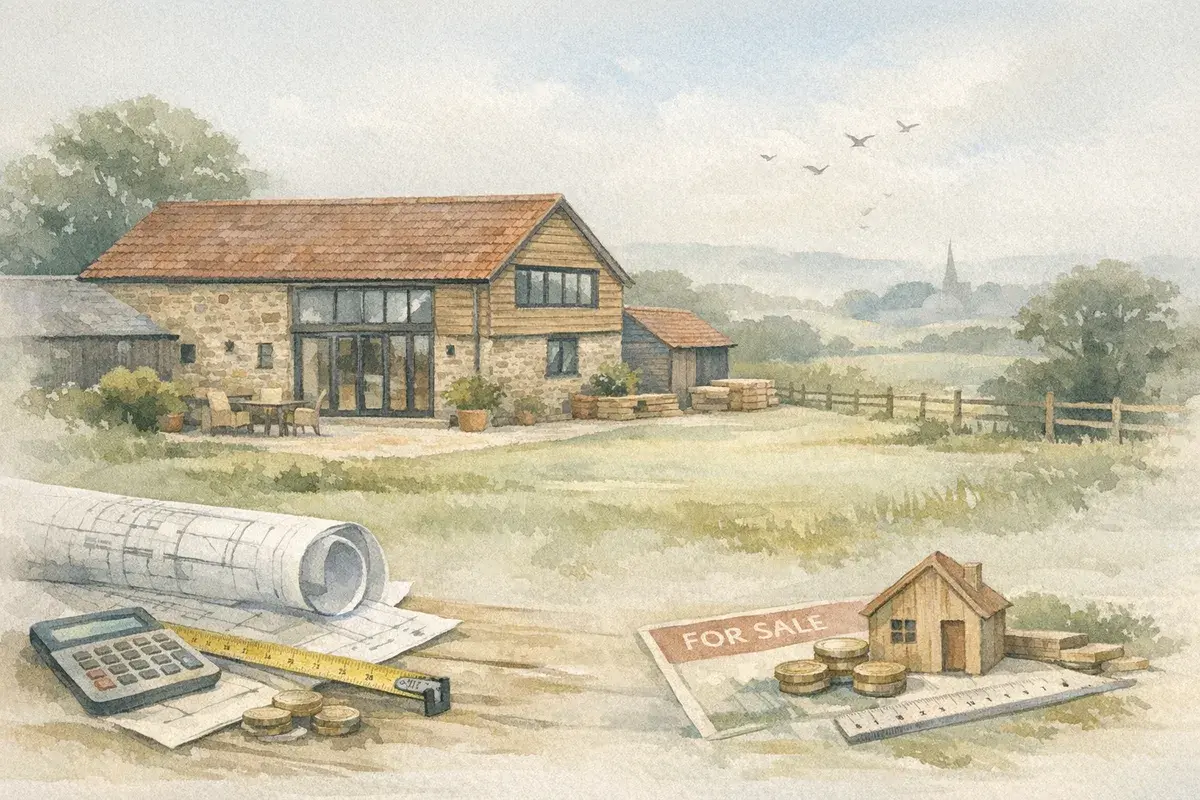
If you're trying to pin down barn conversion cost per square foot, the short answer is that UK projects often fall somewhere between £120 and £250 per sq ft as of June/2026, with higher-spec rural homes often climbing beyond that. The final figure depends heavily on structure condition, planning constraints, services, and the finish you want.
That range sounds wide because it is. A sound stone barn in Somerset with decent access and existing services will not cost the same per square foot as a dilapidated timber-and-corrugated shell in the Scottish Borders that needs major structural repair, new drainage, and a full planning battle.
So what should you budget? We'd argue the right question is: what level of conversion are you buying into, and what risks are hiding behind the walls? In this guide, we break down the main cost drivers, regional differences, realistic budgets, and where barn conversions most often run over budget.
What Barn Conversion Cost Per Square Foot Really Means
When people quote barn conversion cost per square foot, they usually mean the total construction cost divided by the internal floor area. That can be useful for quick comparisons, but it's only helpful if you know what's included. Does it cover professional fees, planning, VAT, and external works such as driveways or landscaping? Often, it doesn't.
For agricultural properties, the headline figure can also be misleading because barns vary hugely in build type. A brick threshing barn in Lincolnshire behaves very differently from a steel-framed dairy unit in Cheshire or a stone byre in South West Scotland. One may need minimal structural intervention. Another may need a near-total rebuild inside the shell.
Typical Cost Bands As of June/2026
As of June/2026, a sensible planning range for many UK barn conversions looks like this:
| Project Type | Typical Cost Per Sq Ft | What It Usually Includes | Notes |
|---|---|---|---|
| Basic Shell Conversion | £120-£160 | Structure repair, insulation, services, standard finishes | Best case only, with limited surprises |
| Mid-Range Rural Home | £160-£220 | Improved joinery, quality kitchen and bathrooms, new heating | Common for family homes in good condition barns |
| High-Spec Conversion | £220-£300+ | Architect-led design, premium finishes, bespoke glazing, heating upgrades | More likely in premium counties and complex schemes |
Those figures are not a substitute for a proper budget, but they do help with early-stage appraisal. If a contractor quotes far below these levels, ask what's missing. If the number is far above them, check whether the scheme includes unusually high structural or planning costs. It also pays to sense-check the rate against whole-project totals, because typical UK barn conversion budgets, and what pushes them from £175,000 towards £500,000, show how quickly roof condition, access and region absorb the difference.
The Main Factors That Push Costs Up Or Down
The biggest cost drivers are rarely the pretty bits. It's the hidden stuff: structure, access, drainage, and services. That's where barn conversions can become expensive in a hurry.
Condition matters first. Thick masonry walls may need repointing, damp treatment, lintel replacement, or new floor build-ups. Steel frames may need corrosion repair. Timber barns can need significant structural strengthening, especially where historic alterations have weakened the original fabric.
Structural Issues And Fabric Repairs
A barn with sound foundations and a stable shell can save thousands. By contrast, subsidence, failed roof trusses, rotten timbers, or cracked masonry can add tens of thousands of pounds before you've even started on interiors. In older agricultural buildings, unexpected remedial works are one of the main reasons budgets drift.
Planning restrictions can also shape the cost per square foot. In parts of the Cotswolds, Kent, Dorset, and North Yorkshire, planners may insist on retaining more original fabric or use sympathetic materials. That can be entirely reasonable, but it usually costs more than a straightforward modern fit-out.
- Access: Difficult site access can add plant, labour, and logistics costs.
- Drainage: New treatment plants or soakaways often increase the budget.
- Services: Running water, electricity, and broadband to a remote site can be costly.
- Roofing: Full reroofing or insulation upgrades often change the budget dramatically.
- Openings: Creating windows, doors, and glazed links can require structural steel and careful detailing.
Heating choice matters too. Underfloor heating paired with a heat pump has become more common, especially where owners want lower running costs, but the installation price can be higher than traditional radiators and a gas boiler. The benefit is long-term comfort and efficiency, which matters in big open-plan barn spaces.
Regional Variations Across The UK
Location has a real impact on barn conversion cost per square foot, and not just because labour rates differ. Planning complexity, design expectations, and local contractor availability all vary by county. Even within the same region, a conversion near a market town can price differently from one deep in the countryside.
As of June/2026, southern counties often attract higher build costs, partly because of stronger demand for skilled trades and higher specification expectations. In rural Somerset, Gloucestershire, Oxfordshire, and Surrey, a buyer is often looking for premium finish levels. In parts of the North East, Cumbria, or rural Wales, build costs may be lower, but access and logistics can still bite.
County-Level Cost Differences
Here's a practical guide, based on current market conditions as of June/2026:
| Region | Indicative Cost Per Sq Ft | Common Influences |
|---|---|---|
| South East And London Fringe | £180-£300+ | Higher labour rates, premium finish expectations, planning sensitivity |
| South West | £160-£260 | Traditional stone barns, conservation-led design, rural access issues |
| Midlands | £140-£220 | Broad mix of barn types, moderate labour costs, variable site conditions |
| North Of England And Wales | £120-£210 | Potentially lower labour costs, but transport and weather can add risk |
Scotland deserves special mention. In Aberdeenshire, Perthshire, and the Scottish Borders, conversions can be excellent value if the barn is structurally sound. But remote sites, harsher winter weather, and longer supply chains can offset some of the savings. The same applies in parts of Cornwall and Northumberland, where isolated locations increase practical costs.
For estate agents and landowners, this regional split matters. A barn with conversion potential in Wiltshire may support a much higher residual land value than a similar structure in a less accessible part of the country. That's why the same physical building can produce very different investment outcomes.
What's Included In The Budget
A proper barn conversion budget should be built line by line. If you only price the building works, you'll get a false sense of security. The most reliable estimates include professional fees, contingency, and external works from day one.
As a rule of thumb, many projects need at least 10% to 15% contingency, and sometimes more for older agricultural buildings. If the shell is uncertain, a 15% to 20% contingency isn't being pessimistic. It's being sensible.
Core Cost Headings
Most barn conversions should account for the following:
- Structural works: Repairs, strengthening, and opening up the shell.
- Envelope works: Roof, insulation, windows, doors, and damp protection.
- Internal fit-out: Floors, partitions, kitchens, bathrooms, joinery, decorating.
- Services: Heating, electrics, plumbing, drainage, and broadband.
- Professional fees: Architect, planning consultant, structural engineer, surveyor.
- External works: Parking, access tracks, septic systems, landscaping, and boundary treatments.
VAT is another area that catches people out. The tax treatment of barn conversions can be complex, especially where the building is being changed from agricultural use to residential use. Don't assume a quote includes everything, and don't assume VAT relief will apply without checking the exact circumstances. Ask the right professionals early.
One practical point: big open spaces are charming, but they soak up money. High ceilings mean more insulation, more wall area, more glazing, and more heating demand. That can make the cost per square foot look worse than in a standard house, yet the character is often exactly why people want a barn conversion in the first place.
How To Estimate Your Own Barn Conversion Budget
The best way to estimate barn conversion cost per square foot is to work backwards from the most likely end use. Is this a family home, a holiday let, a prestige residence, or a live-work rural property? Your answer changes the finish, the room layout, and the spend per square foot.
Start with the gross internal area, then decide what standard you're aiming for. After that, add a contingency for unknowns. A 2,000 sq ft barn at £160 per sq ft suggests a base build of £320,000, but that is rarely the full story once fees and externals are included.
A Simple Budgeting Approach
Use this rough method as a starting point:
- Measure the internal floor area accurately.
- Choose a realistic cost band for your region and finish level.
- Add professional fees of roughly 8% to 15%.
- Allow a contingency of at least 10%.
- Include access, drainage, and utility connections.
Want a quick reality check? If your per square foot estimate leaves no room for contingency, it's too tight. Barns have a habit of revealing problems once the fabric is opened up, particularly where the building has been neglected or altered over time.
It also helps to separate must-haves from nice-to-haves. A compliant conversion with good insulation and a solid heating system comes before statement glazing or bespoke cabinetry. You can always improve finishes later, but structural compromises are much harder to fix once the shell is closed up.
Where Barn Conversion Budgets Most Often Go Over
The overruns are usually predictable, even if they are irritating. Weak structure, poor site access, planning conditions, and underestimated service connections are the usual culprits. In our view, the biggest mistake is assuming a barn shell is already a head start. It isn't always.
Older farm buildings can conceal expensive surprises. Hidden asbestos, unusable old concrete floors, unstable openings, or water ingress can turn a tidy scheme into a more serious project. And when you're already working in a rural location, every delay tends to cost more than expected.
Another common issue is specification creep. The kitchen gets upgraded. The glazing grows. The flooring changes. Suddenly the project has moved well above the original per-square-foot estimate, and that's before you've landscaped the yard or completed drainage work.
For farmers and landowners, timing can matter as much as budget. A barn conversion project that ties up capital during a period of changing commodity prices or tenancy decisions needs careful thought. A strong appraisal is about more than immediate build cost. It's about opportunity cost too, which is especially relevant on working estates.
Conclusion
Barn conversion cost per square foot is a useful starting point, but only if you treat it as a rough guide rather than a fixed rule. As of June/2026, many UK schemes sit between £120 and £250 per sq ft, with regional and structural factors pushing some projects higher.
The key is to budget for the shell, the services, the fees, and the unknowns. If you do that properly, you'll get a much clearer picture of whether the conversion stacks up as a home, an investment, or a long-term asset on the farm.
Disclaimer: AgLand.co.uk is a UK agricultural land and rural property matching service, where buyers register what they are looking for and owners advertise directly to the buyers who match, and a rural resource hub. Nothing in this text is intended as legal, financial, or investment advice. You should carry out your own due diligence and seek guidance from appropriately qualified professionals (for example, solicitors, land agents, surveyors, and financial advisors) for your specific circumstances.