
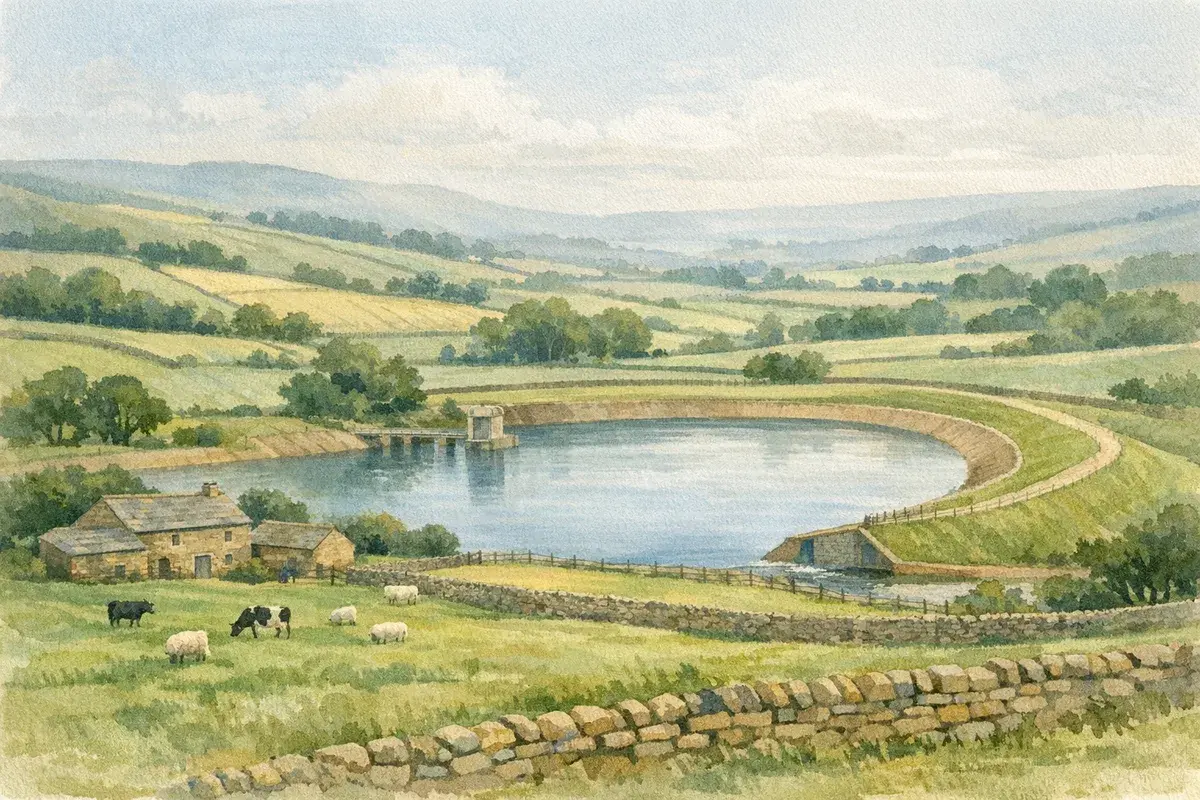
A farm reservoir can be one of those "looks simple on paper, gets complicated fast" projects. Dig a hole, build an embankment, line it, fill it, job done, right?
In UK planning and environmental regulation, a reservoir is rarely just a hole in a field. It's engineering operations, a water management scheme, a potential flood-risk issue, sometimes a protected-species trigger, and, if it's big enough, a safety-regulated asset with inspections for the rest of its life.
If you're considering a reservoir on farmland, the best outcomes come when you treat it like a compliance-led infrastructure project from day one: clear purpose, robust water logic, early constraints mapping, and a planning application that answers the questions officers and regulators will ask anyway. This guide walks you through the UK-specific pathways, the regulatory "stack" beyond planning, and the practical choices that make consent (and construction) smoother.
Start With Feasibility: What You’re Building And Why
Planning success usually starts long before you speak to the local authority. Your first job is to turn "we want a reservoir" into a specific, defensible scheme: purpose, size, catchment, how it fills, how it's used, and what risks it creates (or reduces).
Irrigation, Livestock, Firefighting, And Amenity Uses
Reservoirs on farmland tend to fall into a few common buckets:
- Irrigation resilience (increasingly common for veg, potatoes, soft fruit, and high-value arable). Here, the "need case" is typically about security of supply and timing, having water when you need it, not when a river says you can.
- Livestock water and washdown. Often smaller in scale, but still needs clear evidence of demand and safe operation.
- Firefighting supply. This can be persuasive in remote areas where hydrant coverage is poor, but it's usually a secondary benefit rather than the sole justification.
- Amenity and biodiversity (wildlife, angling, landscape). These can be positives, but if amenity starts to look like the primary purpose, expect more scrutiny on "agricultural justification" and public access implications.
Be honest with yourself: if the reservoir is mainly to support a diversification (say, holiday lets, fishing, or equestrian), you may be in a different planning conversation than a straightforward agricultural water storage asset.
Location, Catchment, And Water Balance Basics
A reservoir that makes sense hydrologically is easier to defend.
You'll want a simple water balance that answers:
- How will it fill? Winter abstraction? On-farm run-off? A spring? A diverted watercourse? Captured roof water from buildings? (Each route has different permitting and consent angles.)
- How much will you take, and when? "We'll fill it in winter" is not a plan unless it's backed by numbers.
- Where does overflow go? Planning officers will look for safe spillways, exceedance routes, and no increase in flood risk off-site.
From a land and transaction standpoint, also check you actually control the rights you'll rely on. Water storage schemes can expose awkward gaps in title, riparian responsibilities, easements for pipes, or historic abstraction rights. If you're buying land with a reservoir in mind, it's worth reading up on how water rights can affect a farmland purchase because it can change value, viability, and the legal work your solicitor must do.
Early Red Flags: Flood Risk, Peat, Protected Sites, And Neighbours
A quick constraints sweep can save you months:
- Floodplains and surface water flow paths: Building in Flood Zones (and sometimes just near them) can trigger Flood Risk Assessment requirements and tougher tests.
- Peat and deep organics: Excavation and embankments on peat bring stability, carbon, and habitat issues. Some sites become "not worth the fight".
- Designations: SSSI, SAC/SPA, Ramsar sites, National Landscapes (formerly AONB), and Local Wildlife Sites can all raise the bar. Even if you're outside the boundary, impacts (hydrology, disturbance, lighting) can matter.
- Neighbours and downstream owners: Reservoirs make people nervous, especially if an embankment sits above a lane, a house, or someone else's land. Early engagement, clear drawings, and a safety story reduce objections.
A quiet but common red flag: access. If you can't get plant and materials to site without ripping up verges, blocking a village lane, or working through a weak bridge, your construction method statement (and local politics) gets complicated fast.
Planning Permission Pathways And When Reservoirs Are “Operational Development”
In UK planning terms, many farm reservoirs are treated as engineering operations and hence "operational development". That doesn't automatically mean refusal, but it does mean you shouldn't assume it's permitted development.
Permitted Development Limits Versus Full Planning
Some agricultural works can proceed under permitted development (PD) rights via the General Permitted Development Order (GPDO), but reservoirs are frequently outside the "simple PD" comfort zone because of their scale, landscape effect, and engineering complexity.
A useful mental model is this:
- If the proposal looks like major earthworks with a new engineered embankment, spillway, liner, and permanent access track, it usually behaves like a full planning application in practice, even where elements might be argued under agricultural PD.
- If it's small, closely tied to day-to-day agricultural use, and not in a sensitive location, there may be a PD route, but you still need to check thresholds, conditions, and prior approval requirements carefully.
If you're trying to understand how councils interpret agricultural PD more generally, what triggers prior approval, what documentation helps, and where applicants get caught, AgLand's guide on how planning permission works for farm buildings is a useful parallel read. Different development type, same reality: PD is a privilege, and the details matter.
Earthworks, Embankments, Linings, Access Tracks, And Compounds
Planning officers rarely assess "a reservoir" as a single thing. They assess the parts:
- Excavation and cut/fill balance (how much material is moved, where it goes)
- Embankment height and footprint (landform change, visual impact, stability)
- Liner choice (clay, geomembrane) and implications for edges, fencing, and safety
- Access track upgrades (visibility splays, passing places, HGV routing)
- Temporary compounds (storage of soils, plant, fuel, welfare)
This is why good sections, levels, and a method statement are so persuasive: they turn fear-of-the-unknown into something the case officer can actually recommend.
Change Of Use, Engineering Operations, And Agricultural Justification
Most reservoir applications hinge on two questions:
- Is it genuinely required for agriculture on the holding?
- Are the impacts proportionate to that need?
If you can't show the link to agricultural operations, cropping plan, livestock numbers, irrigation requirement, drought risk management, then the scheme can drift into "speculative landscaping" or amenity development in the planner's mind.
One more nuance: sometimes reservoir projects get entangled with wider ambitions, new worker housing, conversion of buildings, or a future diversification plan. Those are valid strategies, but they can complicate the narrative if bundled together.
If your long-term plan includes residential elements, keep a clear boundary between the reservoir justification and any housing justification. (And if you're exploring routes to a dwelling on farm land, it's worth understanding the separate tests in building a house on agricultural land and the distinct pathways in agricultural-to-residential planning routes.) Mentioning them here isn't to encourage "planning by stealth", it's to highlight that councils spot mixed motives quickly, so your reservoir case needs to stand on its own feet.
The Regulatory Stack Beyond Planning: Don’t Get Caught Out
Even with planning permission in hand, you can still be dead in the water (sometimes literally) if you haven't lined up the non-planning consents. In practice, it's usually these parallel regimes that drive programme risk.
Environment Agency Permits, Abstraction Impoundment, And Discharge Controls
Depending on how your reservoir fills and how it interacts with watercourses, you may need to address:
- Water abstraction licensing (commonly relevant if you're taking from a river, stream, borehole, or transferring water from elsewhere). Rules and exemptions are detailed and location-specific.
- Impoundment licensing if you're damming or impeding flow in a watercourse.
- Discharge controls if there's a proposal to discharge water back to a watercourse in a way that could affect quality or flow.
In England, the Environment Agency (EA) is typically the lead regulator for abstraction/impoundment and environmental permitting: in Wales, it's Natural Resources Wales (NRW): in Scotland, it's SEPA under a different controlled activities framework. The principle is consistent: regulators will want confidence you're not harming downstream users, ecology, or flood risk, and that you've got lawful authority for the water you plan to store.
A practical tip: don't leave this as a "later" workstream. If your planning statement assumes winter fill volumes that aren't licensable, you've built your application on sand.
Reservoirs Act 1975 Thresholds, Panel Engineers, And Ongoing Inspections
If your scheme is big enough, it may fall under the Reservoirs Act 1975 (as amended). The key concept is capacity, if a reservoir can hold above the statutory threshold (commonly referenced as over 25,000 cubic metres of water above natural ground level), it can become a regulated reservoir.
If you're anywhere near that scale, treat this as non-negotiable:
- You'll likely need involvement from qualified panel engineers for design and construction sign-off.
- There are ongoing inspection and supervision duties once the reservoir is in service.
- The enforcing authority and requirements can differ across the UK nations, so you need nation-specific advice.
Why it matters for planning: case officers and statutory consultees are reassured by applications that clearly state whether the Reservoirs Act applies and, if it does, how you'll comply.
Land Drainage Consents, Ordinary Watercourses, And IDB Areas
Many farm reservoirs interact with ordinary watercourses (ditches, drains, smaller streams). Works like culverting, weirs, headwalls, outfalls, or diversions can require land drainage consent.
If you're in an Internal Drainage Board (IDB) district, the IDB may be the consenting body for ordinary watercourse works and byelaws. Outside IDB areas, the Lead Local Flood Authority or local authority functions may be relevant.
This is where programmes slip: you submit planning, get a permission, start booking contractors… and then discover an outfall detail needs separate consent, with its own review timeline.
Also consider maintenance responsibility. A reservoir isn't just a build: it's a long-term asset on your holding. That raises ownership and record-keeping issues, particularly if land is split, tenanted, or subject to refinancing.
On that point, if you're doing wider "housekeeping" on farm titles (especially where historic boundaries, drains, or rights are messy), voluntary registration can help you reduce future friction. Our piece on voluntary first registration for farmland explains when it's worth doing and what it can (and can't) solve.
Biodiversity, Landscape, And Ecology: Designing For Consent
Reservoirs can be ecology flashpoints, or they can be ecology wins. The difference is usually design detail and timing.
Biodiversity Net Gain Triggers And How To Evidence Them
In England, Biodiversity Net Gain (BNG) obligations can apply to many development types, with specific rules and exemptions. Whether your reservoir triggers BNG, and how it's measured, depends on the planning route, the development definition, and current regulations.
What councils tend to respond well to (even where BNG isn't formally required) is a clear, quantified approach:
- A baseline habitat description (what's there now)
- What you're creating (marginal planting, wet grassland edges, buffer strips)
- How it will be managed for 30 years where relevant
Done properly, a reservoir can support pollinators, amphibians, wetland birds, and beneficial insects, especially if you avoid steep bare edges and design in shallow shelves.
Protected Species Surveys, Timing, And Mitigation
If there's one thing that repeatedly derails programmes, it's ecological survey timing.
Common triggers around reservoirs include:
- Great crested newts (pond networks nearby, suitable terrestrial habitat)
- Bats (if trees are affected or lighting changes)
- Otters and water voles (watercourse connections)
- Breeding birds (hedgerow removal, scrub clearance)
Your ecologist will advise survey windows, but the practical takeaway is simple: if you miss the season, you might lose a year.
Mitigation isn't necessarily a deal-breaker: it's often very doable, buffer zones, timing restrictions, habitat creation, sensitive lighting, and method statements. But you need it designed in before submission, not promised vaguely later.
Landscape And Visual Impact: Screening, Bunds, And Public Rights Of Way
Reservoirs change landform, so landscape matters, even outside designated areas.
Planning officers often focus on:
- Views from public rights of way (footpaths, bridleways)
- Edge treatment (how the liner is concealed, how fencing reads in the landscape)
- Bunds and screening (and whether bunds look like unnatural mounds)
- Hedgerow and tree planting that's locally characteristic (species, spacing, long-term maintenance)
A little realism helps: planting is not instant screening. If your reservoir is highly visible on day one, acknowledge that and show how the scheme will settle over time.
Also, don't forget safety. If public routes are close, you may need clear fencing and signage, and you'll want to demonstrate safe access control, without making the countryside feel "industrialised".
Technical Design And Construction Considerations Planning Officers Look For
Good planning applications read like someone has actually built things on farms before. Practical details, spillways, construction traffic, restoration, are often what flips an officer from "concerned" to "comfortable".
Dam Safety, Spillways, Freeboard, And Extreme Rainfall Allowance
Even where the Reservoirs Act doesn't apply, councils and consultees expect competent water engineering.
Key concepts you'll see in strong submissions:
- Spillway capacity and routing: where does water go in extreme events, and what does it hit?
- Freeboard: the safety margin between normal maximum water level and the top of the embankment.
- Embankment stability: slope angles, compaction, seepage control, and how you'll prevent piping.
- Emergency drawdown / control structures: how you manage levels safely.
Why this is planning-relevant: it ties directly to flood risk and public safety, two areas where objections carry weight.
Clay-Lined Versus Geomembrane Reservoirs: Planning Implications
The liner choice isn't just a contractor decision: it can affect planning considerations.
- Clay-lined reservoirs often need larger footprints (to accommodate thicker liners and side slopes) and more material handling. That can increase HGV movements and earthworks impacts, but can look more natural once established.
- Geomembrane-lined reservoirs can reduce footprint and sometimes speed construction, but they introduce concerns about edge detailing, UV exposure, vandalism risk, and visual appearance if not well finished.
From a consent perspective, planners like to see:
- how the liner will be buried and protected
- what the edge profile looks like (shelves, fencing line, planting)
- how repairs and inspections will happen without repeated disturbance
Construction Traffic, Hours, Noise, Dust, And Site Restoration
If you want fewer objections, make construction predictable.
A robust Construction Environmental Management Plan (CEMP) or method statement typically covers:
- HGV routes and passing arrangements
- Working hours (and what happens at harvest time, school run pinch points, etc.)
- Dust suppression and wheel washing where needed
- Fuel storage, spill response, and concrete washout controls
- Topsoil stripping, storage, and reinstatement so you don't permanently damage your best land
This is also where you protect your own interests. A reservoir can be an asset: a poorly controlled build can turn into compacted headlands, ruined gateways, and a long-running neighbour dispute.
One more practical note: many councils will condition a landscaping scheme and aftercare period. If you submit a realistic restoration and management plan up front, you reduce the risk of open-ended conditions later.
Application Strategy: Reports, Drawings, And A Step-By-Step Route To Approval
A reservoir application isn't won by a single "planning statement". It's won by a tidy, coherent pack where each report answers a specific concern.
Pre-App Meetings And The Right Professional Team
If your scheme is anything beyond a small on-farm pond, a pre-application discussion is usually money well spent. It surfaces showstoppers early, especially flood risk, landscape, and ecology.
A typical team might include:
- Planning consultant (to steer policy and narrative)
- Civil/water engineer (design, spillway, embankment stability)
- Hydrologist/hydrogeologist (water balance, fill regime)
- Ecologist (surveys and mitigation)
- Landscape consultant (LVIA where needed)
- Agricultural agent/surveyor (need case, holding context)
If the reservoir is part of wider farm development (new buildings, yard reconfiguration), align the strategy so you're not submitting contradictory drawings or transport assumptions.
What To Submit: Plans, Sections, Flood Risk, Drainage, Ecology, And Method Statements
Most successful submissions include, as a baseline:
- Location plan and red line boundary
- Existing and proposed levels, cross-sections, and cut/fill calculations
- Engineering description: embankment construction, spillway, control structures
- Flood Risk Assessment (where relevant) and exceedance routing
- Drainage strategy for construction and operation
- Ecology report(s), including protected species surveys and mitigation
- Landscape and visual assessment where impacts justify it
- Construction method statement/CEMP
- Agricultural justification: why you need it, how it supports the holding, and why this location/scale
You're trying to do two things at once: show competence and reduce uncertainty. The more "unknowns" you leave, the more likely you'll be hit with heavy conditions.
Conditions, Section 106 Risks, And How To Keep Control Of Costs
Reservoir consents often come with conditions. Some are reasonable (materials, landscaping, hours). Others can quietly balloon cost or risk.
Ways to keep control:
- Pre-empt key conditions by submitting detail (e.g., planting plans, construction routes) rather than letting the council write vague requirements.
- Be careful with phasing: conditions that prevent first fill until other approvals are in place can be sensible, but you'll want clarity on what evidence is required.
- Watch for "off-site" demands: in some cases, contributions or legal obligations (often via Section 106) might be floated if the council believes there are wider impacts. For most straightforward agricultural reservoirs, S106 is not typical, but if the project is tied to other development or public access changes, it can come into play.
A pragmatic approach is to keep the reservoir application cleanly agricultural where possible, and deal with other ambitions through separate, appropriate routes rather than bundling everything into one high-stakes decision.
Costs, Timelines, And Common Reasons Reservoir Schemes Get Refused
Reservoir projects fail for predictable reasons: weak need cases, late ecology surprises, and underestimating the regulatory stack. The earlier you plan for those, the less painful the process.
Typical Budget Lines: Surveys, Design, Planning, And Compliance
Costs vary wildly by size, ground conditions, liner choice, access, and whether the Reservoirs Act applies. But your budget headings will usually include:
- Topographical survey and ground investigation (including permeability)
- Engineering design (embankments, spillway, control structures)
- Hydrology/water balance work
- Ecology surveys and mitigation (often phased across seasons)
- Landscape assessment and planting design
- Planning consultant and application fees
- EA/NRW/SEPA consenting costs where applicable
- Construction: earthmoving, liner, fencing, tracks, control chambers
- Monitoring and maintenance allowances
If the reservoir is regulated, add the long-term reality: engineer involvement and inspections aren't one-off costs.
Indicative Timeframes From Site Search To First Fill
As a rough, real-world guide (not a promise), many schemes look like this:
- Feasibility and constraints: 1–3 months (longer if you need seasonal ecology)
- Pre-app and design development: 2–4 months
- Planning determination: commonly 8–13+ weeks depending on complexity and validation
- Separate consents (abstraction/impoundment/land drainage): can run in parallel but may add months
- Construction: often 2–6 months depending on scale and weather windows
- First fill: depends entirely on your lawful water source and seasonal strategy (winter fill is a common approach, but it must be licensable and realistic)
The schedule killer is missing a survey window and then trying to "paper over it" with assumptions. Councils don't like assumptions, and neither do regulators.
Avoidable Pitfalls: Cumulative Impacts, Weak Need Case, And Poor Consultation
The refusals and withdrawals we see tend to cluster around a few themes:
- Cumulative impacts: one reservoir might be fine: multiple in a catchment can trigger bigger questions about flows, ecology, and landscape character.
- A thin agricultural case: "future-proofing" is sensible, but you still need numbers, cropping, demand, irrigation requirement, drought history, business plan logic.
- Underplaying neighbours' concerns: if there's perceived flood or safety risk, objections can harden fast.
- Inadequate drawings/levels: if officers can't understand the earthworks, they assume the worst.
- Late regulator engagement: if abstraction or land drainage consent looks unlikely, planning permission doesn't save you.
A final pitfall that catches buyers and tenants: assuming the land you're dealing with is "simple". Reservoir delivery is much easier when ownership boundaries, rights, and responsibilities are crystal clear. If you're restructuring ownership or acquiring land with water infrastructure in mind, it's worth tightening up the paperwork early rather than discovering issues mid-application.
Conclusion
A reservoir on farmland can be a genuine competitive advantage, more resilient cropping, better livestock reliability, and a long-term asset that supports the holding's value. But in the UK, getting there is a compliance exercise as much as an engineering one.
If you do three things well, you'll put yourself ahead of most applicants: (1) build a clear agricultural and water-balance case, (2) map constraints early (flood risk, ecology, designations, neighbours), and (3) treat planning and the wider regulatory consents as parallel workstreams, not a sequential afterthought.
When you're ready to act, it often pays to assemble the right team and sanity-check the scheme before you spend heavily on drawings and surveys. You'll move faster, waste less money, and end up with a reservoir you can operate confidently for years.
Disclaimer: AgLand.co.uk is a UK agricultural land and rural property matching service, where buyers register what they are looking for and owners advertise directly to the buyers who match, and a rural resource hub. Nothing in this text is intended as legal, financial, or investment advice. You should carry out your own due diligence and take advice from suitably qualified professionals (for example, a planning consultant, chartered surveyor, solicitor, engineer, ecologist, and relevant regulator) before acting.